+91 9312966129
 sparc.enquiry01@gmail.com


Union Budget 2026–27: What Students & Job Seekers Must Understand to Stay Career-Ready
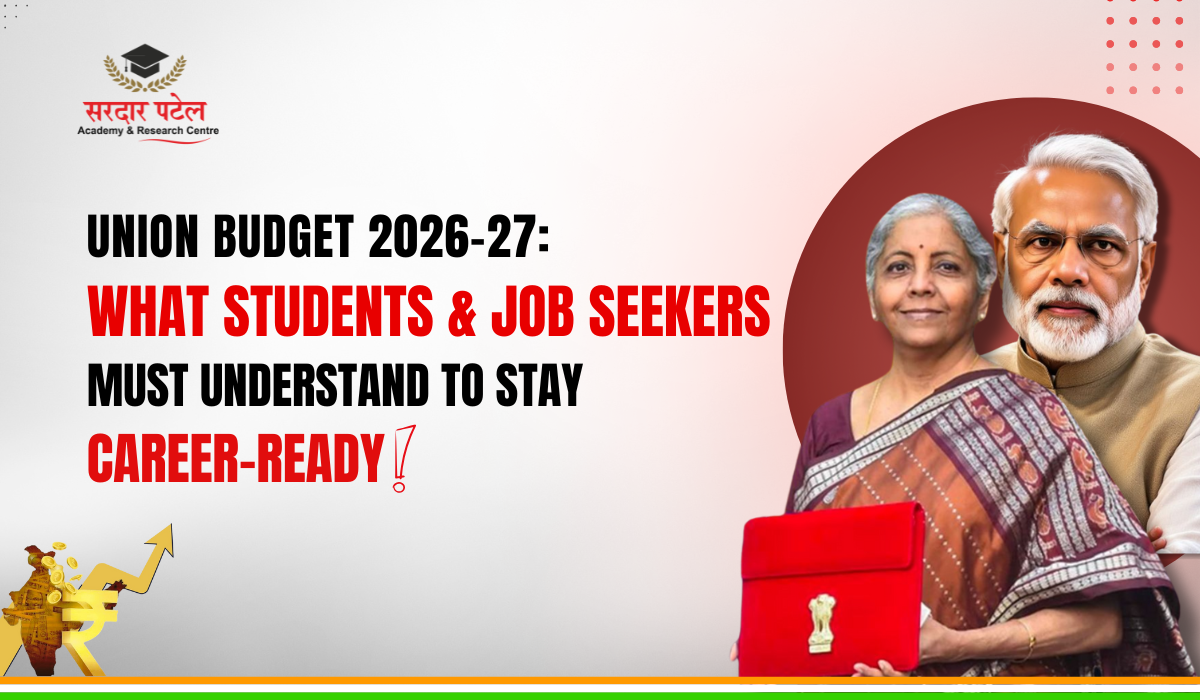
The Union Budget 2026-27 is more than a budget—it is a roadmap that points towards where the Indian economy is headed and, more importantly, what skills, jobs, and industries will develop in the years to come. For students, freshers, and job seekers, it is no longer a choice but a necessity. It affects your career, hiring trends, skills, and future-proof jobs.
The Union Budget 2026-27 is more than a budget—it is a roadmap that points towards where the Indian economy is headed and, more importantly, what skills, jobs, and industries will develop in the years to come. For students, freshers, and job seekers, it is no longer a choice but a necessity. It affects your career, hiring trends, skills, and future-proof jobs.
At Sardar Patel Academy & Research Centre (SPARC), we strongly believe that education must adapt to the changing needs of policies and industries. This blog post will help you learn the Union Budget 2026-27 in a simple, student-friendly tone and help you know about how skill-based learning can help you stay one step ahead in the competitive job market.
Why Union Budget 2026–27 Matters for Students and Job Seekers?
Students often believe that the Union Budget has significance only for the business or taxation community or for economists. The truth is that the Union Budget has implications for:
- Job creation in various industries
- Demand for particular skills
- Development of new sectors
Hiring and firing in the accounting, finance, taxation, analytics, and compliance fields
Transition from degree-based recruitment to skill-based recruitment
The Union Budget 2026-27 explicitly states that the government is concentrating on the healthcare, digital, green energy, manufacturing, MSME, and compliance-driven sectors.
Key Focus Areas of Union Budget 2026–27
Before delving into career impact, it is essential to examine the budget’s key focus areas:
- Affordable healthcare and life-saving drugs
- Boost to manufacturing and exports
- Strong focus on EVs and green energy
- Digital economy and compliance transparency
- Support for MSMEs and startups
- Discouraging luxury and sin goods by imposing higher taxes
Each of these focus areas is directly related to employment and skill requirements.
Career Opportunities Emerging After Union Budget 2026–27
1. Accounting, Taxation & GST – A Growing Backbone
With constant changes in policies, duties, and taxes, the demand for skilled accounting and GST professionals is on the rise. Companies, especially MSMEs, need professionals who can:
- File GST returns correctly
- Handle input tax credit (ITC)
- Comply with new tax laws
- Prepare financial statements
- Career Roles Growing Fast:
- GST Executive
- Accounts Executive
- Tax Consultant
- Compliance Analyst
At Sardar Patel Academy & Research Centre, students are trained on live GST filing, accounting software, and case studies, which are in high demand by employers.
2. Healthcare & Pharma Compliance Careers
The Union Budget 2026-27 cut duties on life-saving drugs and improved healthcare accessibility. This is an added advantage to the healthcare industry, and the demand for the following careers will increase:
- Accounting professionals in hospitals
- Billing and compliance executives
- Pharma accounting specialists
- Healthcare finance analysts
The healthcare industry is recession-proof, and hence a great career option for students with accounting and finance skills.
3. Green Energy, EV & Sustainability Careers
With the high incentives for EV batteries and green energy equipment, India is quickly embracing sustainability. This presents opportunities in:
- EV accounting and cost analysis
- ESG (Environmental, Social, Governance) reporting
- Sustainability compliance
- Green finance roles
These are future-proof jobs that demand a combination of accounting skills, compliance expertise, and analytical skills.
4. MSME & Startup-Focused Roles
The Union Budget is also supporting MSMEs, which are the biggest employment generators in India. Professionals are required in MSMEs for:
- Handling day-to-day accounts
- Handling GST and TDS
- Preparing MIS and financial statements
- Assisting in audits and filings
Practical experience is more valuable than theory in this sector.SPARC trains students for the MSME sectors, where accounting professionals with diverse skills are in demand compared to theoretical degree holders.
Skill-Based Hiring: The Biggest Lesson from Budget 2026–27
One thing that is clear from the Union Budget 2026-27 is that skills are given more importance than degrees.
Today, employers ask job seekers these questions:
- Do you have the ability to file GST returns on your own?
- Do you have the ability to work on accounting software?
- Do you have the ability to understand financial statements?
- Do you have the ability to comply with requirements on your own?
Unfortunately, many students lack experience despite having degrees.
Why Traditional Education Alone Is Not Enough
Most college curricula:
- Focus heavily on theory
- Lack of exposure to real compliance work
- Do not align with current industry tools
As a result, students struggle to convert degrees into jobs.
This is where skill-focused institutes play a crucial role.
How Sardar Patel Academy & Research Centre Helps Students Stay Career-Ready
At Sardar Patel Academy & Research Centre, we have a very simple training philosophy; it's this - “Learn what the industry wants, not what just appears in the book."
What Makes SPARC Unique?
The SPARC is unique in that it offers:
- Practical accounting and GST training,
- Training based on live projects,
- A curriculum that is relevant to industry and includes constant updates for changes in governmental policies.
- A focus on employability rather than on just getting a certificate from SPARC.
- Guidance available for Fresh Graduate Employment (FGE), recent university graduates, and those currently employed.
Courses at the SPARC will provide students with the necessary background to be prepared for the changing landscape resulting from budgets and other policy updates, including the Union Budget for FY 2026–27.
Skills Students Must Build After Union Budget 2026–27
To remain competitive in today's labor market, students must therefore concentrate on developing the following skills:
- Practical knowledge of accounting
- Filing and tax compliance
- Awareness of the structure of taxes and changes to duties
- Financial analysis and reporting basics
- Experience with accounting software
- Industry-specific compliance knowledge
Budget 2026–27 & Long-Term Career Planning
Developing these skills will create an increased opportunity to be hired and the potential for a higher salary.
Instead of following the latest trends, students should consider questions like:
- Which sectors are receiving continuous government support?
- Which skills will be valuable over the next 5 to 10 years?
- How do I get ready for work before I graduate?
Individuals working in the fields of accounting, taxation, compliance, and finance typically experience salary growth, job security, and career diversity; therefore, they are excellent long-term career options.
Final Thoughts: Turn Budget Awareness into Career Advantage
The Union Budget 2026–27 is more than a finance sheet; it’s also a signal for careers. Those who understand which policies will lead to their desired jobs and develop their skill sets based on that knowledge will consistently be ahead of others on their desired career paths.
At Sardar Patel Academy & Research Centre, we help to close the 'education to employment' gap by focusing on providing students with relevant, practical, and industry-aligned skills to succeed in today's job marketplace.
FAQs
It influences job creation, skill demand, and sectoral growth, directly impacting career opportunities.
Accounting, GST, healthcare finance, MSME accounting, and green energy compliance roles.
Employers prefer candidates who can perform real tasks from day one, not just theoretical knowledge.