+91 9312966129
 sparc.enquiry01@gmail.com



AI Data Analyst vs Data Analyst: What’s the Difference?
AI data analyst vs data analyst: compare tasks, tools, skills and career scope, and find which path suits you before choosing a course in India.
Table of Contents
A career comparison from Sardar Patel Academy & Research Centre
Job boards now carry titles like “AI analyst”, “analytics engineer” and “AI-enabled data analyst”, and students are left wondering which role is real. The honest answer is less dramatic than the titles suggest. The AI data analyst vs data analyst question is mostly about how much of the work runs through AI tools and how much through classic methods.
This comparison covers tasks, tools, skills and career direction so you can pick a starting point with confidence. Where reliable figures are unavailable, we say so instead of inventing them.
The Short Answer
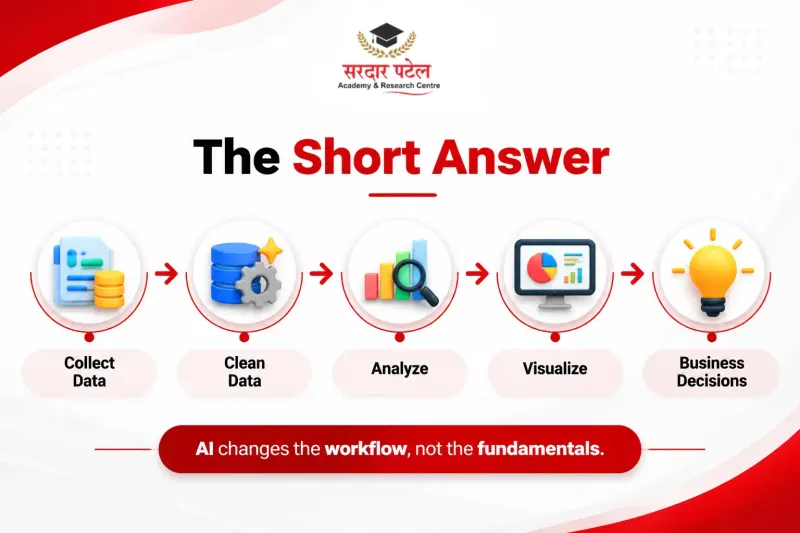
A traditional data analyst collects, cleans and interprets data with SQL, spreadsheets and BI tools, then explains the findings to decision-makers. An AI data analyst does much of the same job, but leans on machine learning, generative AI assistants and automation to speed up preparation, exploration and reporting.
In practice, the AI data analyst vs data analyst divide is one of degree. Most traditional analysts already use AI features, and most AI-focused analysts still depend on core analytics fundamentals.
AI Data Analyst vs Data Analyst at a Glance
Use this table to compare an AI data analyst vs. a data analyst across the areas that matter most.
| Area |
Traditional data analyst |
AI data analyst |
| Main goal |
Explain what happened and why |
Explain it, and also predict or automate what comes next |
| Core tools |
SQL, Excel, Power BI or Tableau |
Same tools, plus Python, AI assistants and ML libraries |
| Typical output |
Dashboards, reports, recommendations |
Dashboards, forecasts, automated insights, model-backed analysis |
| Technical depth |
Strong in querying and visualisation |
Adds scripting, modelling and workflow automation |
| Key risk |
Slow manual work |
Trusting AI output without checking it |
| Best starting point |
Analytics fundamentals |
Analytics fundamentals, then AI and Python |
How Their Daily Work Differs
Data preparation and exploration
This is where the AI data analyst vs data analyst contrast is easiest to see. A traditional analyst may spend hours writing queries, joining tables and hunting for duplicates. An AI-assisted analyst can draft that code, flag odd values and suggest charts in minutes, then spend the saved time checking whether the results make sense.
Speed is not accuracy, though. An AI assistant can produce a confident but wrong query, so a human who understands the data still has to review the result.
Reporting and storytelling
AI features inside BI tools are changing how reports get built. Our guide to Power BI Copilot in 2026: Features, Uses and Limitations explains what these assistants can and cannot do, and Microsoft documents the feature in its Copilot for Power BI overview.
Both roles still own the story. A dashboard nobody understands has no value, whether a person or a model built it. In any AI data analyst vs data analyst comparison, communication remains the skill that separates good analysts from average ones.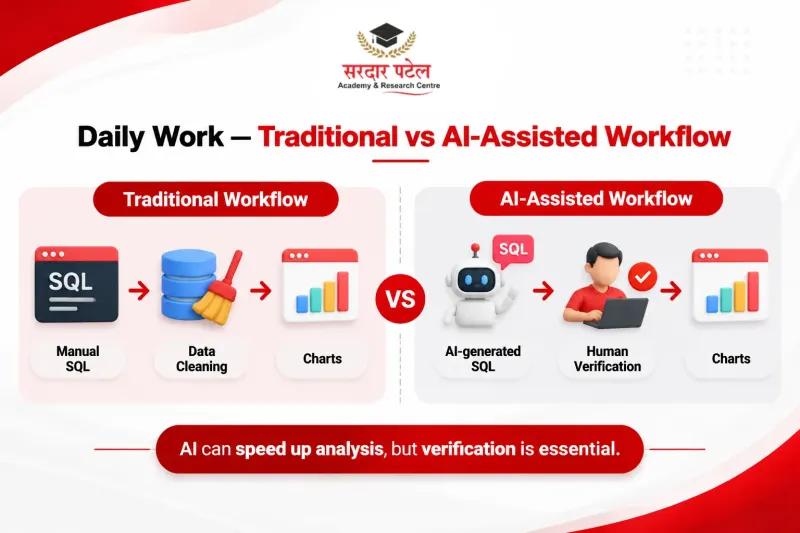
Skills Each Role Needs
Traditional data analyst skills
- SQL for pulling and shaping data
- Excel or Google Sheets for quick analysis
- Statistics for sound conclusions
- Visualisation in Power BI or Tableau
- Business communication for turning numbers into decisions
For a full breakdown, read Skills Required to Become a Data Analyst. If you want an industry-recognised target, Microsoft’s Power BI Data Analyst certification shows what employers may expect from a BI-focused analyst.
AI analyst skills
AI analyst skills build on those foundations rather than replacing them:
- Python, especially data libraries such as pandas
- Machine learning basics, including regression, classification and model evaluation
- Prompting and verification, meaning clear instructions to AI tools and careful checking of what comes back
- Automation, such as scheduled data pipelines and report generation
- Data ethics, including privacy and bias awareness
Notice that AI analyst skills are additions, not substitutes. Whichever side of the AI data analyst vs data analyst line you choose, SQL and statistics stay non-negotiable. To see how these tools are already reshaping the profession, read How ChatGPT is Changing Analytics Careers.
Where do data scientists and analytics engineers fit?
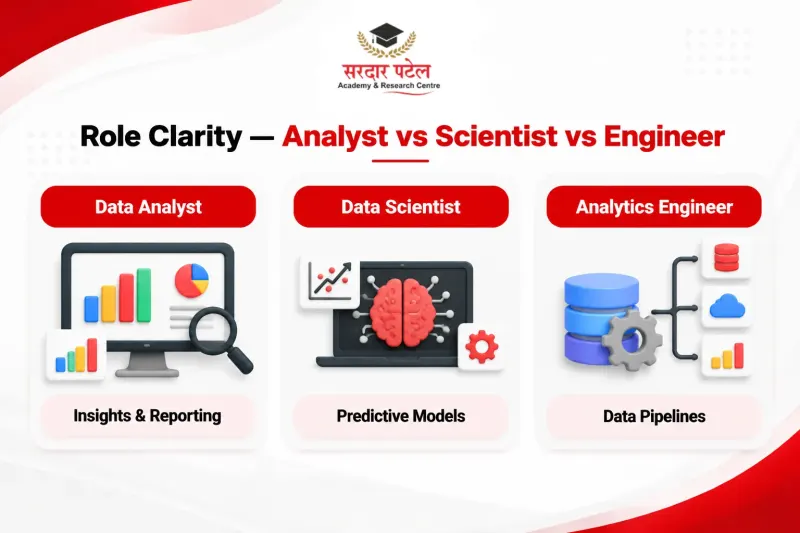
Titles overlap, so here is a rough way to separate them. An AI data analyst stays close to business questions and reporting, using AI tools to work faster. A data scientist usually spends more time building and validating predictive models. An analytics engineer focuses on the data layer: building clean, reliable, well-documented datasets and pipelines that analysts then use. These are general descriptions, not fixed definitions, and employers use the titles differently, so always read the job description rather than the title.
Career Scope and Outlook
Employers keep signalling that analytical talent matters. The World Economic Forum’s Future of Jobs Report has highlighted data and AI skills among those employers expect to grow in importance, and the US Bureau of Labor Statistics publishes outlook data for data scientist roles. Treat both as directional guides, since international job titles do not map neatly onto Indian job listings.
The India picture
For India specifically, the Nasscom–Indeed report India’s AI Talent Inflection Point (May 2026) found that 86% of employers have seen AI affect job roles and responsibilities, and 35% saw significant redefinition or transformation. Data analytics and visualisation appear among the top six skills employers look for in AI-related work, with 32% of employers seeking them. The same report found that 40% of employers prefer demonstrable AI skills or certifications over degrees. You can read the source on the Nasscom community page. For more on how this plays out in hiring, see Future of Data Analytics Jobs in India.
When you weigh AI data analyst vs data analyst careers, expect plenty of overlap. AI analytics careers usually demand more coding and modelling, while traditional roles put more weight on reporting and business communication. Neither is automatically better paid. Pay depends on city, employer, domain and experience, and we will not quote figures we cannot source.
The future of data analyst roles looks less like replacement and more like role expansion. Analysts who can question AI output, understand the business and explain results clearly are the ones likely to stay valuable. For a broader view, see Is Data Analytics a Good Career in 2026? and Future of Data Analytics Jobs in India. If you are curious about why employers want both skill sets together, read Why AI + Analytics Professionals Are in Demand.
What Job Listings Actually Ask For
“AI analyst” is not a standardised title, so we checked what employers actually ask for. We sampled [15–20] live listings with “AI analyst” or “AI data analyst” in the title on Naukri and LinkedIn on [date], and counted how many mention each skill:
| Skill mentioned |
Listings (out of [N]) |
| SQL |
[X] |
| Python |
[X] |
| Machine learning |
[X] |
| Power BI / Tableau |
[X] |
| Generative AI / prompting |
[X] |
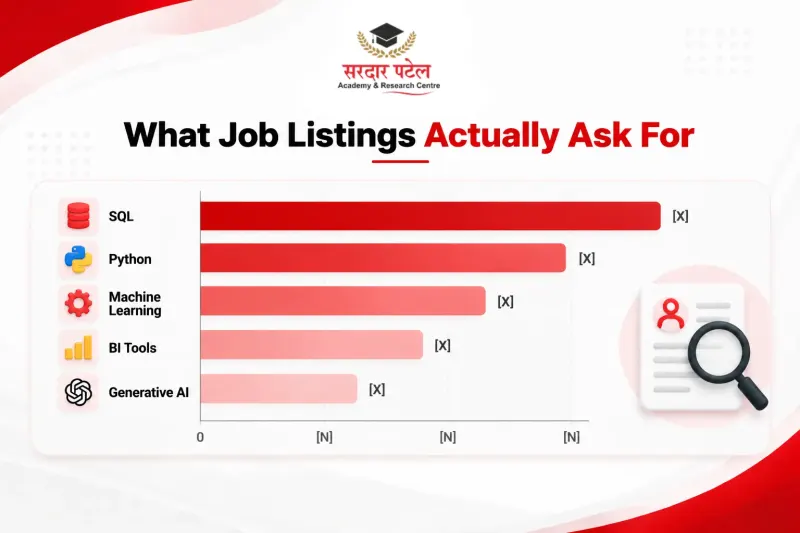
This is a small sample, not a market study, so read it as a snapshot rather than a rule.
Which Path Should You Choose?
Match the path to where you are today. At Sardar Patel Academy & Research Centre (SPARC), this is a single programme: the Data Analytics Course with AI, an 8-month course with 40+ projects covering Excel, SQL, Python, Power BI, Tableau and AI tools. It starts from the fundamentals and builds up to Python and AI, so you do not have to choose between two separate courses.
- Complete beginner: build fundamentals first. The course begins with Excel and SQL, then moves on to visualisation and statistics before you reach Python and AI tools.
- Comfortable with maths or Python: if machine learning interests you, the same course lets you go deeper on Python and AI tools once the analytics base is in place.
- Commerce or accounting background: finance knowledge is a real advantage in analytics. Many learners pair it with a credential such as the Advanced Diploma in Financial Accounting before adding data skills.
- Working analyst: add AI tools gradually, starting with the tasks that eat most of your time.
A practical way to settle the AI data analyst vs data analyst choice is to build one small project, such as a sales dashboard, then repeat it using an AI assistant. Notice which version you enjoyed more and which taught you more.
Talk to us before you decide. Visit the Data Analytics Course with AI page for the full details, call us on +91 93129-66129, or use our contact page. You can also visit the centre at GTB Nagar (Kingsway Camp), near Metro Gate 4.
Common Mistakes to Avoid
- Treating the roles as rivals. The AI data analyst vs. data analyst debate is not a fight. The roles share the same base.
- Skipping fundamentals. AI tools amplify skill. They do not replace it.
- Trusting AI output blindly. Always verify queries, calculations and charts.
- Collecting tool names. A long list of tools impresses less than two solid projects.
- Ignoring domain knowledge. Understanding finance, retail or healthcare makes your analysis far more useful.
Conclusion
The AI data analyst vs data analyst question does not have a winner. One role leans more heavily on AI tools, the other on classic methods, and both are built on the same foundation of data literacy, statistics and clear communication. If you are planning around the future of data analyst roles, aim to learn the fundamentals first, then add AI analyst skills as your confidence grows.
Strong AI analytics careers go to people who can use the tools and still think for themselves. Whichever label you choose in the AI data analyst vs data analyst debate, build real projects and keep your judgement sharp. When you are ready to take the next step, explore the Data Analytics Course with AI or contact us at +91 93129-66129.
FAQs
The main difference is how much AI, automation and modelling sit inside the workflow. Both roles answer business questions with data, but the AI-focused analyst adds prediction and automation.
Not automatically. The better role depends on your interests, background and the problems an employer needs solved. Strong fundamentals matter in both.
Basic Python is usually expected, along with SQL. You do not need to be a software engineer, but you should be comfortable reading and checking code.
Nobody can promise either way. Current evidence points to AI changing tasks more than eliminating the role, because someone still has to frame questions, check results and communicate decisions.
The traditional route is usually easier to begin with because the fundamentals come first. You can add AI skills once you are comfortable with data.
Yes. Most analysts make the move by learning Python, basic machine learning and automation, while keeping the business and reporting skills they already have.