+91 9312966129
 sparc.enquiry01@gmail.com


Voice Search SEO Future in India: What Marketers Need to Prepare For
Explore the future of voice search SEO in India, including AI search, regional-language queries, local SEO, and practical optimisation tips for 2026. SEO-Friendly URL Slug: /blog/voice-search-seo-future-india

Table of Contents
- Why Voice Search SEO Is Different in India
- How Voice Search and AI Search Are Becoming More Connected
- What this means practically:
- How Voice Queries Differ From Typed Searches
- Practical Steps to Prepare for the Voice Search SEO Future
- 1. Write for Questions, Not Just Keywords
- 2. Keep Answers Short and Direct Near the Top
- 3. Use Structured Data and FAQ Formatting
- 4. Don't Ignore Regional Language Content
- 5. Strengthen Local SEO
- 6. Improve Page Speed and Mobile Experience
- Common Mistakes Brands Make With Voice and AI Search
- SEO Future Trends India Should Watch Alongside Voice Search
- Practical Tips for Students and Professionals Building SEO Skills
- Final Thoughts
Ask ten people in Delhi NCR how they searched for something on their phone this morning, and a growing number won't say “I typed it.” They'll say they spoke it — to Google Assistant, to Siri, to a smart speaker in the kitchen, or increasingly, to an AI chatbot that answered them directly without showing a single blue link.That shift is exactly why the future of voice search SEO matters right now, not five years from now.
Voice search is becoming an increasingly important way for users in India to find information, ask questions, compare options, and get quick answers. In this article, we'll unpack what's actually driving the future of voice search SEO in India, how it's colliding with AI-powered search, and what beginners, students, working professionals, and business owners can practically do to stay visible as this shift continues.
Why Voice Search SEO Is Different in India
Voice search isn't new globally, but India's version of it has its own character. For many Indian users, speaking can be a more natural way to search, particularly when they prefer using their first language. Voice search in India can involve Hindi, Tamil, Telugu, Bengali, Marathi, and other regional languages, making multilingual and conversational content increasingly relevant for businesses targeting diverse audiences.
India's diverse digital audience also makes conversational and multilingual search important, particularly for businesses targeting users beyond major metropolitan areas. Voice removes that friction. Someone can simply ask, in their own language, “sabse acha digital marketing course Delhi mein kahan hai?” instead of typing a search string that feels unnatural.
This is the core reason the future of voice search SEO in India looks less like “optimize for smart speakers” and more like “optimize for natural, spoken, often regional-language questions.”
How Voice Search and AI Search Are Becoming More Connected
Here's where things get interesting for 2026: voice search and AI-powered search are becoming increasingly connected through conversational, question-based search experiences. When someone asks a voice assistant a question, and when someone types a question into an AI-powered search result, the underlying expectation is identical — one clear, direct answer, not a list of ten links to sift through.
This is why AI search optimization and voice search seo future are increasingly discussed together. AI-powered search experiences can synthesise information from multiple sources and present users with a more direct, conversational answer, whether that answer is spoken aloud or shown as a short A brief AI-generated overview that appears above the search results.
What this means practically:
- Content written as a direct, well-structured answer can make information easier for search systems and users to understand across voice and AI-powered search experiences.
- Being “quotable” — clear, factual, and well-organised — matters more than being keyword-dense.
- Ranking highly in traditional search results does not necessarily mean that the same page will be selected for an AI-generated summary or voice answer.
How Voice Queries Differ From Typed Searches
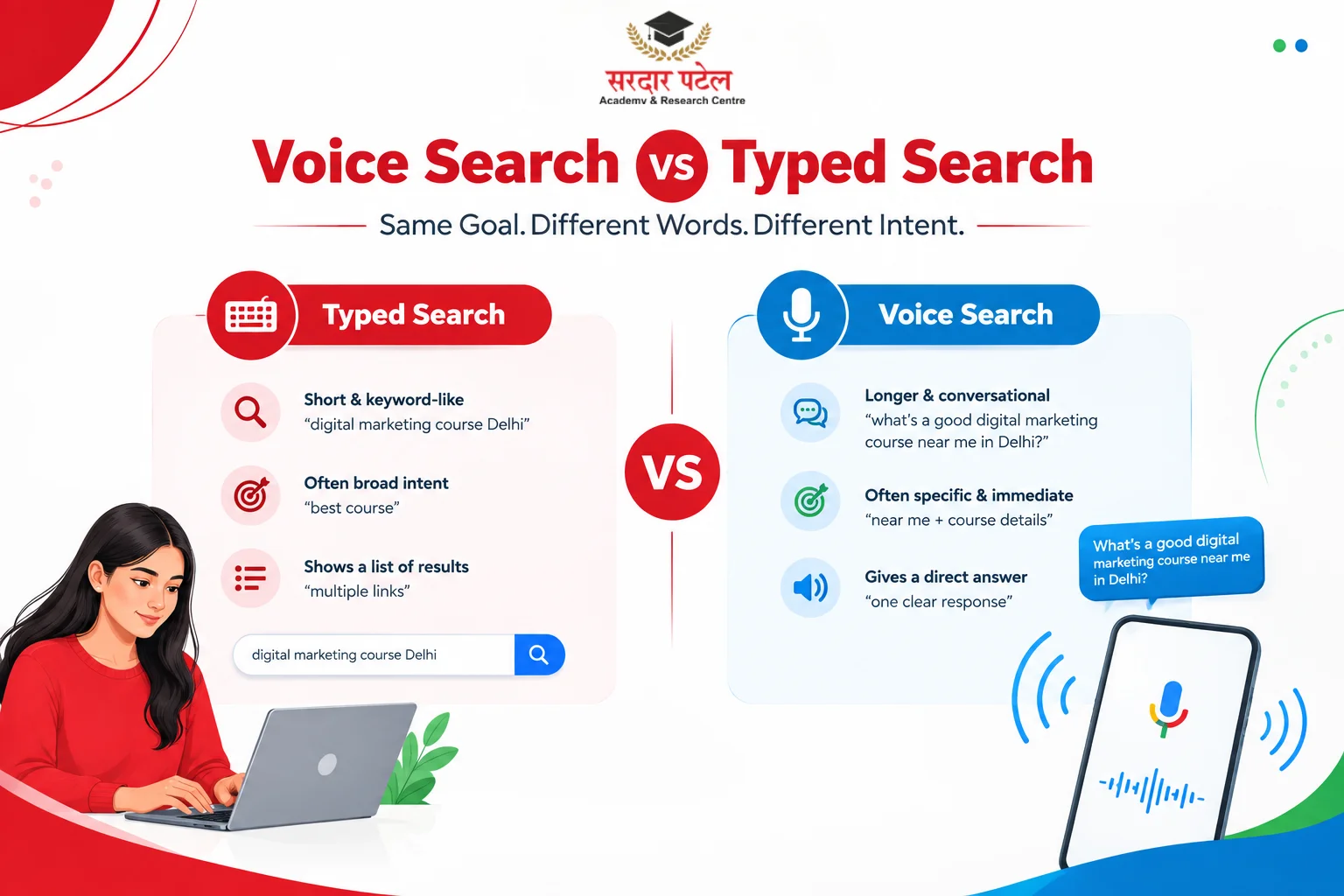
Understanding this difference is the foundation of any voice search seo future strategy.
| Factor |
Typed Search |
Voice Search |
| Query length |
Short, fragmented (“digital marketing course Delhi”) |
List of results |
| Tone |
Keyword-style |
Natural, question-based |
| Intent |
Often broad |
Often specific and immediate |
| Language |
Frequently English, even for non-native speakers |
May include regional languages or mixed Hindi-English |
| Ideal answer format |
List of results |
One direct, spoken-friendly answer |
Once you see the pattern, the strategy becomes clearer: content needs to sound like something a person would actually say out loud, not like a string of keywords stitched together.
Practical Steps to Prepare for the Voice Search SEO Future
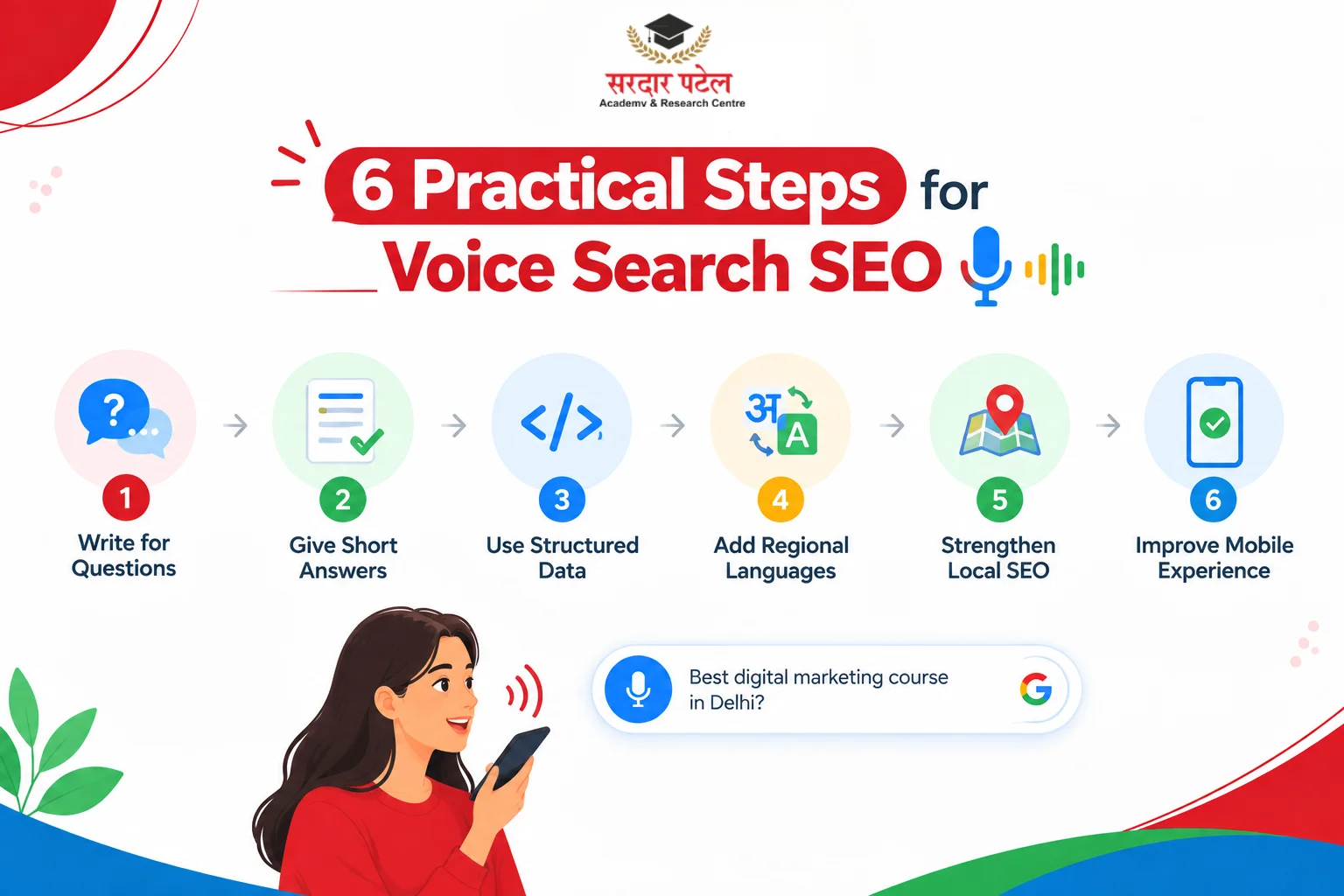
1. Write for Questions, Not Just Keywords
Instead of optimising a page around a short phrase, structure sections around the actual question a person might ask. What Time Should You Post on Instagram in 2026 for Better Reach?
This wording is more suitable for voice search than a general heading like “Instagram Posting Times.”
2. Keep Answers Short and Direct Near the Top
Providing a concise answer near the beginning of a page can make the content easier for users and search systems to understand before the page provides additional detail. then expands with detail afterwards. Bury the answer three paragraphs deep, and it's far less likely to be picked up.
3. Use Structured Data and FAQ Formatting
Using relevant structured data, clear H2/H3 questions, and scannable content blocks can help search engines understand the page and its content more clearly, although they do not guarantee inclusion in voice or AI-generated answers.
4. Don't Ignore Regional Language Content
If your audience includes users who prefer Hindi or other Indian languages, adding relevant regional-language content, key phrases, or FAQs can help you reach a wider audience through conversational search, especially when the target audience is multilingual.
5. Strengthen Local SEO
Many voice queries can have local intent, such as ‘coaching centre near GTB Nagar’ or ‘best cafe near me.— “coaching centre near GTB Nagar,” “best cafe near me.” Keeping your Google Business Profile accurate, using location-specific pages, and mentioning nearby areas naturally (rather than repeating one keyword awkwardly) all help here.
6. Improve Page Speed and Mobile Experience
Most voice queries happen on mobile. A slow-loading page can create a poor mobile experience and make it harder for users to access and engage with useful content, regardless of how well the page is written.
Common Mistakes Brands Make With Voice and AI Search
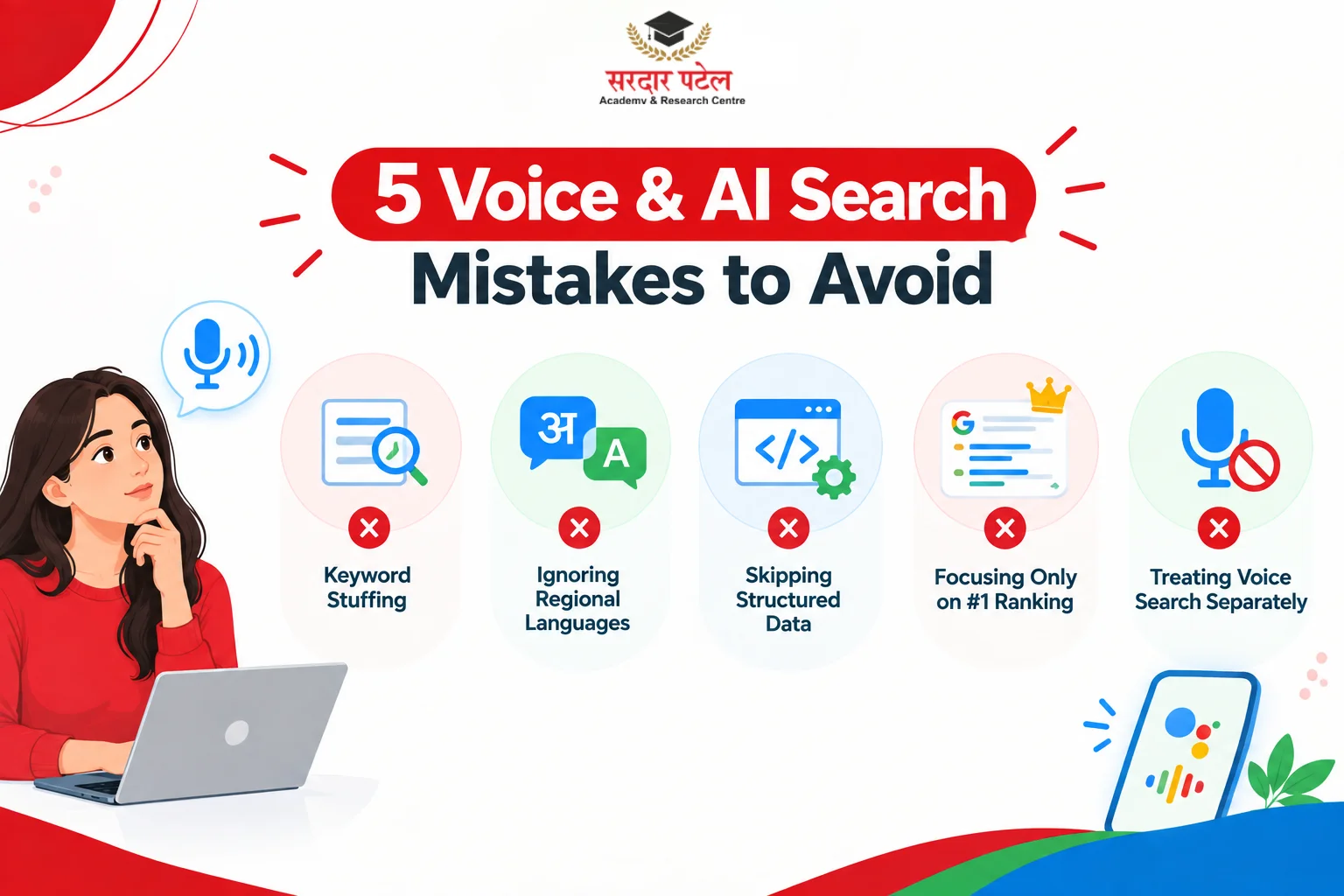
- Treating voice search as a separate strategy instead of an extension of good, clear, well-structured content.
- Stuffing keywords unnaturally, which reads awkwardly to a human and performs poorly for both voice assistants and AI summarisation.Ignoring regional language users, assuming English-only content is enough for a genuinely national audience.
- Skipping structured data, making it harder for search engines to extract a clean, citable answer.
- Focusing only on ranking position one while overlooking whether the content provides clear, useful, and well-structured answers for users.
SEO Future Trends India Should Watch Alongside Voice Search
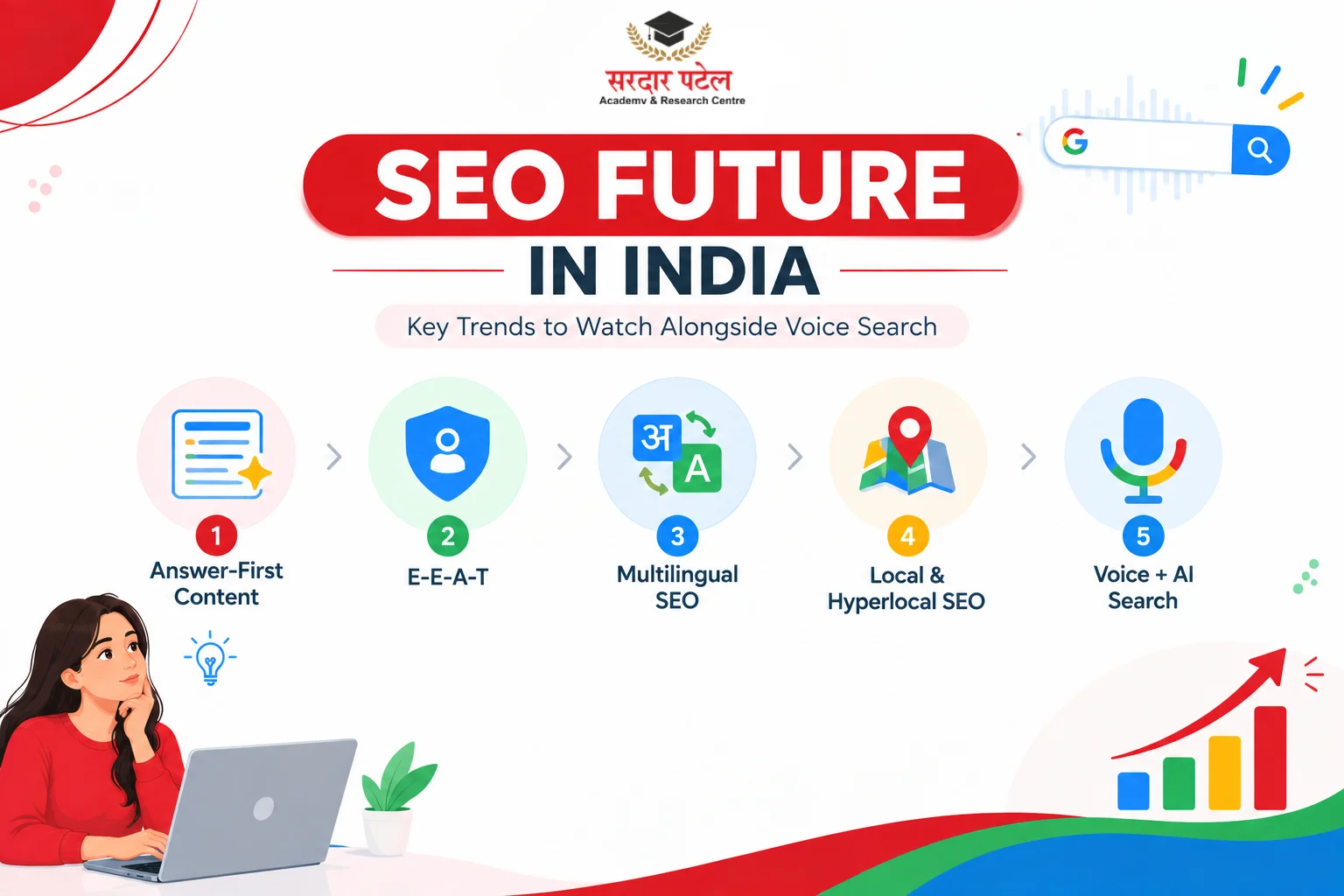
Voice search doesn't exist in isolation — it's one part of a broader shift in India's SEO landscape:
- Answer-first content structure is becoming standard practice, not an optional extra.
- E-E-A-T (experience, expertise, authoritativeness, and trustworthiness) provides a useful framework for creating content that demonstrates credibility and reliability.
- Multilingual content strategy is moving from “nice to have” to a genuine competitive advantage, especially for brands targeting Tier 2 and Tier 3 audiences.
- Local and hyperlocal optimization continues to grow in importance as more everyday queries — from students searching for courses to shoppers comparing prices — happen on the move, by voice.
Practical Tips for Students and Professionals Building SEO Skills
If you're learning digital marketing right now, this is a useful skill to build early as search continues to become more conversational and AI-powered. A few starting points:
- Practice rewriting five keyword-style headings into natural, spoken questions.
- Study how AI-generated search summaries present information from web pages, and analyse what makes content clear, useful, and easy for search systems to understand.
Build a small portfolio project — even a single optimised blog post — showing before-and-after structure for voice and AI readiness. If you want to see how other learners have approached similar portfolio work, the SPARC student portfolio showcase is worth a look for practical inspiration.
If you want a more structured path into this area, a digital marketing course with placement support that covers current search behaviour — not just traditional keyword SEO — will save you a lot of trial and error.
Final Thoughts
The future of voice search SEO isn't a distant prediction— it's already reshaping how people in Delhi NCR and across India find information, compare options, and ask questions using increasingly conversational search experiences. Combined with the rise of AI-generated search summaries, clear, conversational, and genuinely useful content can improve how easily users and search systems understand and discover a page.
The practical next step isn't complicated: start writing content the way people actually ask questions, pay attention to regional language behaviour, and treat structured, answer-first content as the norm rather than the exception.
Prepare for future SEO — if you'd like a more structured, hands-on understanding of where search is heading, explore the digital marketing course at Sardar Patel Academy & Research Centre, or get in touch with the team to ask where to begin.
FAQs
The future of voice search SEO in India is closely connected to regional-language search and AI-powered search experiences. Content that answers questions directly, uses natural language, and supports relevant regional queries can make information easier for users and search systems to understand.
Traditional voice search focuses on spoken queries to assistants like Google Assistant or Siri. AI search optimization is broader — it covers how AI-generated summaries across search engines select and cite content, whether the original query was typed or spoken.
It depends on your audience, but for most Indian businesses, offering at least some regional-language content or FAQs improves reach, especially when your target audience regularly searches in Hindi or another regional language.
Yes. Strong technical SEO, quality backlinks, clear site structure, and E-E-A-T signals remain the foundation. Voice and AI optimisation build on top of solid SEO, not in place of it.
Focus on free, high-impact steps: keep your Google Business Profile updated, write FAQ sections in natural language, and make sure your site loads quickly on mobile.
Not entirely, at least not yet. AI-generated summaries are now part of the search experience for some queries, while traditional organic listings continue to provide users with additional sources and options.
Treating it as a checklist item rather than rethinking content structure. Simply adding a few question-style headings without genuinely restructuring the page rarely moves the needle.