+91 9312966129
 sparc.enquiry01@gmail.com


What is Social Media Marketing?
Learn social media marketing basics step by step — platforms, strategy, tools, careers, and salaries. A complete SMM tutorial for beginners in India.
Table of Contents
- What Is Social Media Marketing? Social Media Marketing Basics Explained
- Why is Social Media Marketing Important?
- How Does Social Media Marketing Work? Social Media Marketing Basics Step by Step
- Define Goals
- Know Your Audience
- Choose Platforms
- Create Content
- Publish Consistently
- Engage Audience
- Track Results
- Top Social Media Platforms You Should Know
- Types of Social Media Marketing
- Organic
- Paid
- Influencer
- Community
- Video Marketing
- UGC
- Comparison Box (Featured Snippet):
- Social Media Marketing Strategy for Beginners: Social Media Marketing Basics in Action
- Essential Social Media Marketing Tools
- Common Mistakes Beginners Should Avoid
- Career Opportunities in Social Media Marketing
- How to Learn Social Media Marketing Basics as a Beginner
- Conclusion
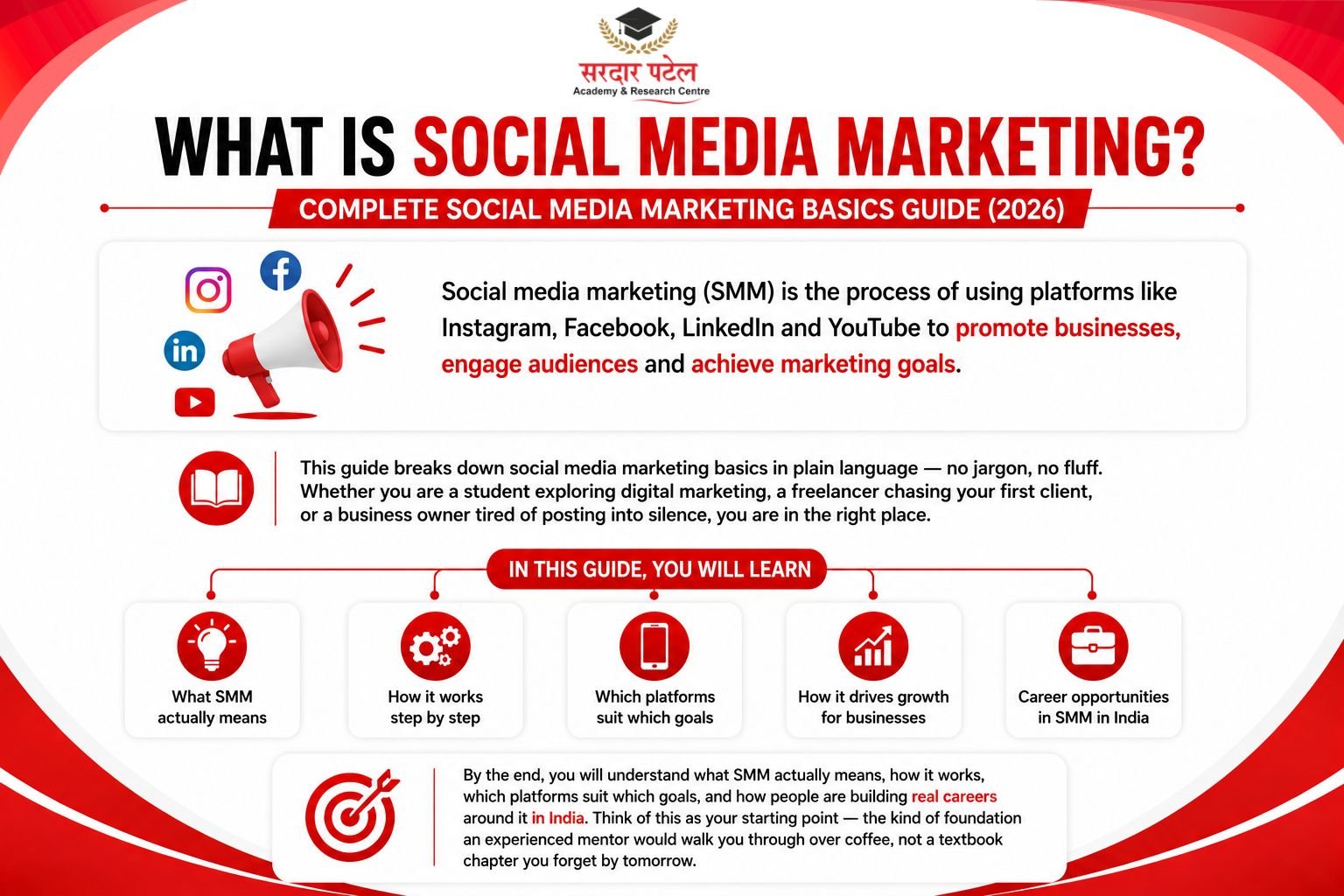
Social media marketing (SMM) is the process of using platforms like Instagram, Facebook, LinkedIn and YouTube to promote businesses, engage audiences and achieve marketing goals.
This guide breaks down social media marketing basics in plain language — no jargon, no fluff. Whether you are a student exploring digital marketing, a freelancer chasing your first client, or a business owner tired of posting into silence, you are in the right place.
By the end, you will understand what SMM actually means, how it works step by step, which platforms suit which goals, and how people are building real careers around it in India. Think of this as your starting point — the kind of foundation an experienced mentor would walk you through over coffee, not a textbook chapter you forget by tomorrow.
Let's get into it.
Want to build practical digital marketing skills instead of just learning the basics?
Explore Sardar Patel Academy & Research Centre –SPARC's Digital Marketing Course to learn Social Media Marketing, SEO, Google Ads, Content Marketing, and other in-demand skills through practical training and live projects.
What Is Social Media Marketing? Social Media Marketing Basics Explained
Social media marketing (SMM) is the practice of using platforms like Instagram, Facebook, and LinkedIn to promote a brand, connect with an audience, and drive measurable business results such as traffic, leads, or sales — not just to publish posts.
Here is the simplest way to understand it: posting is uploading a photo because you feel like it. Marketing is uploading that photo with a goal, a target audience, and a plan to measure what happens next.
A local bakery posted a random cake photo. That same bakery posted a Reel timed for weekend orders, tagged with location, and boosted to reach nearby foodies — that's social media marketing.
Businesses use SMM because their customers already spend hours on these platforms every day. Instead of interrupting people with ads, brands can show up naturally in the content people choose to scroll through. That's why understanding social media marketing basics has become non-negotiable for anyone in digital marketing today, not an optional extra skill. SMM is just one part of a broader digital marketing guide that also includes SEO, PPC, content marketing, and email marketing.
Why is Social Media Marketing Important?
Social media marketing is important because it helps businesses reach customers, build trust, increase website traffic, generate leads and improve sales at a relatively low marketing cost. Social media isn't a side channel anymore — it's often the first place a customer meets a brand. Here's what strong SMM actually delivers:
- Brand awareness: consistent visibility keeps you top of mind
- Customer engagement: comments, DMs, and shares build real relationships
- Website traffic: posts and bios drive visitors straight to your site
- Lead generation: forms, DMs, and landing pages capture interested buyers
- Sales: direct product tags and shoppable posts shorten the buying journey
- Community building: loyal followers become repeat customers and advocates
India now has more than 500 million social media users, making it the second-largest social media market in the world after China. That works out to roughly a third of the country's total population already active on social platforms as of late 2025, with numbers still climbing. (Source: DataReportal, Digital 2026: India)
How Does Social Media Marketing Work? Social Media Marketing Basics Step by Step
Social media marketing works in seven steps: set goals, know your audience, choose platforms, create content, publish consistently, engage your audience, and track results using analytics tools.
Define Goals
Start with why. Are you chasing brand awareness, leads, or direct sales? Your goal shapes every decision after this.
Know Your Audience
Understand their age, interests, problems, and where they actually spend time online. Guessing wastes the budget.
Choose Platforms
Pick platforms where your audience is active, not every platform that exists. Fewer, well-run pages beat five neglected ones.
Create Content
Design posts, Reels, carousels, and captions that inform, entertain, or solve a real problem for your viewer.
Publish Consistently
Irregular posting kills momentum. A realistic, repeatable schedule beats an ambitious one you abandon in two weeks.
Engage Audience
Reply to comments and DMs quickly. Engagement signals tell platforms — and people — that your page is worth trusting.
Track Results
Check reach, engagement rate, and conversions weekly. Data tells you what to repeat and what to drop.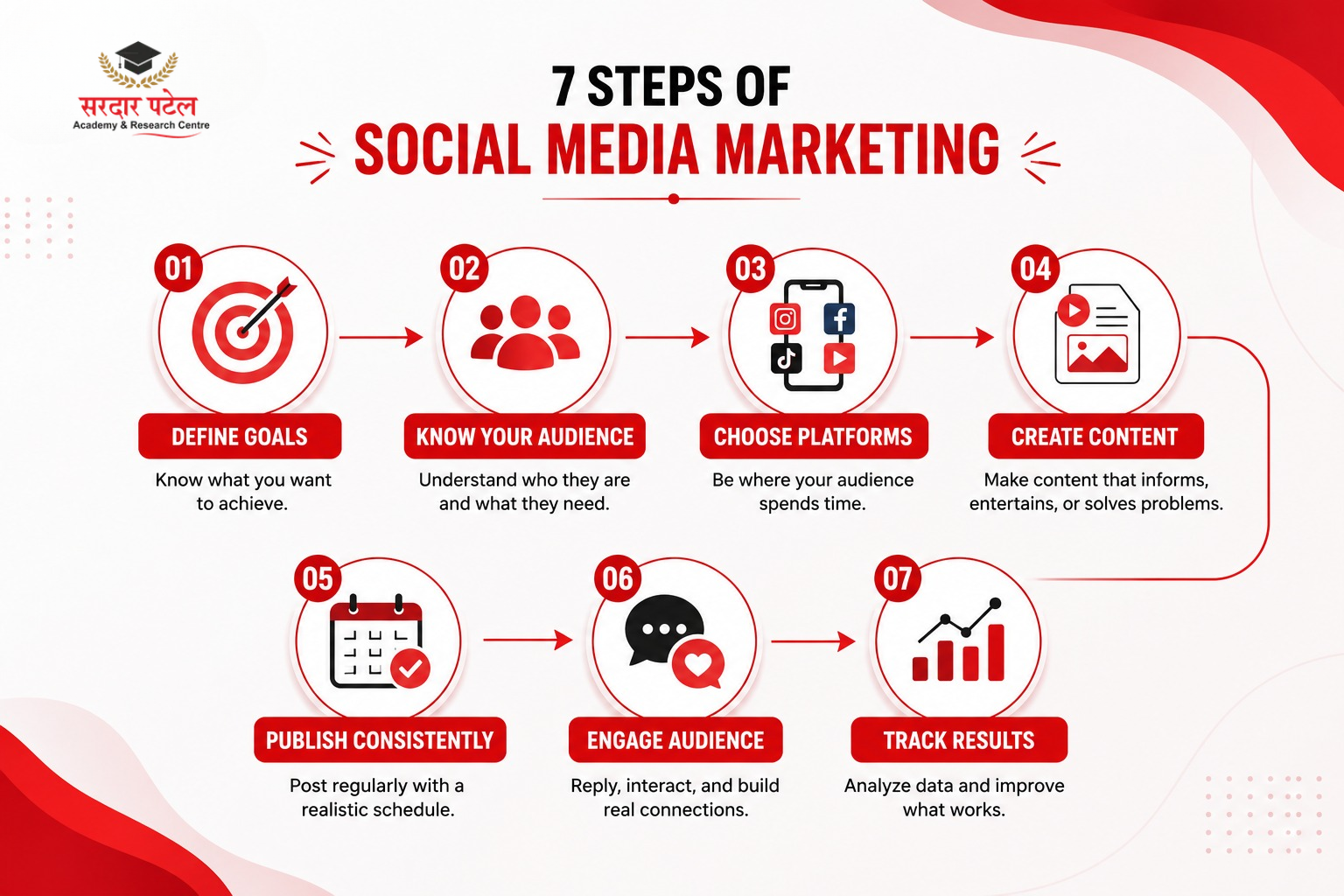
Top Social Media Platforms You Should Know
Each platform serves a different purpose, so choosing correctly is one of the most important social media marketing basics to master early.
Source: Meta Business Suite, LinkedIn Marketing Solutions, platform official data (2026)
For someone just starting, Instagram is usually the best platform for beginners — it has low production barriers, strong Reels marketing reach, and a large, active Indian audience exceeding 550 million users. (Source: NapoleonCat, Social Media Users in India, June 2026)
Types of Social Media Marketing
Understanding these formats is another core part of social media marketing basics, since each one works differently depending on your goal and budget.
Organic
Free, unpaid content — posts, Reels, and Stories that grow reach through relevance and engagement rather than budget.
Paid
Paid social media uses ad budgets — Meta Ads, LinkedIn Ads — to target specific audiences precisely and quickly.
Influencer
Partnering with creators who already hold their audience's trust to promote a product authentically.
Community
Building and nurturing groups, forums, or comment communities around shared interests tied to your brand.
Video Marketing
Reels, Shorts, and long-form YouTube videos that dominate current platform algorithms and attention spans.
UGC
User-generated content — real customers creating content about your brand, which builds trust faster than polished ads.
Comparison Box (Featured Snippet):
Source: Meta Business Suite, LinkedIn Marketing Solutions (2026)
If you're interested in running paid campaigns, check out our Meta Ads tutorial to learn how Facebook and Instagram ads work step by step.
Social Media Marketing Strategy for Beginners: Social Media Marketing Basics in Action
A strategy turns scattered posting into a system. Follow these steps to build one that actually works:
- Goal setting — pick one primary objective for the next 90 days
- Audience research — build a simple profile of your ideal follower
- Content calendar — plan themes and dates at least two weeks ahead
- Content pillars — choose 3–4 recurring topics you'll always return to
- Scheduling — batch-create and schedule posts using a tool, not memory
- Analytics — review what's working every week, not once a month
- Optimisation — double down on formats that perform, cut what doesn't
Applying these social media marketing basics consistently, even for 30 days, will teach you more than months of passive scrolling ever could.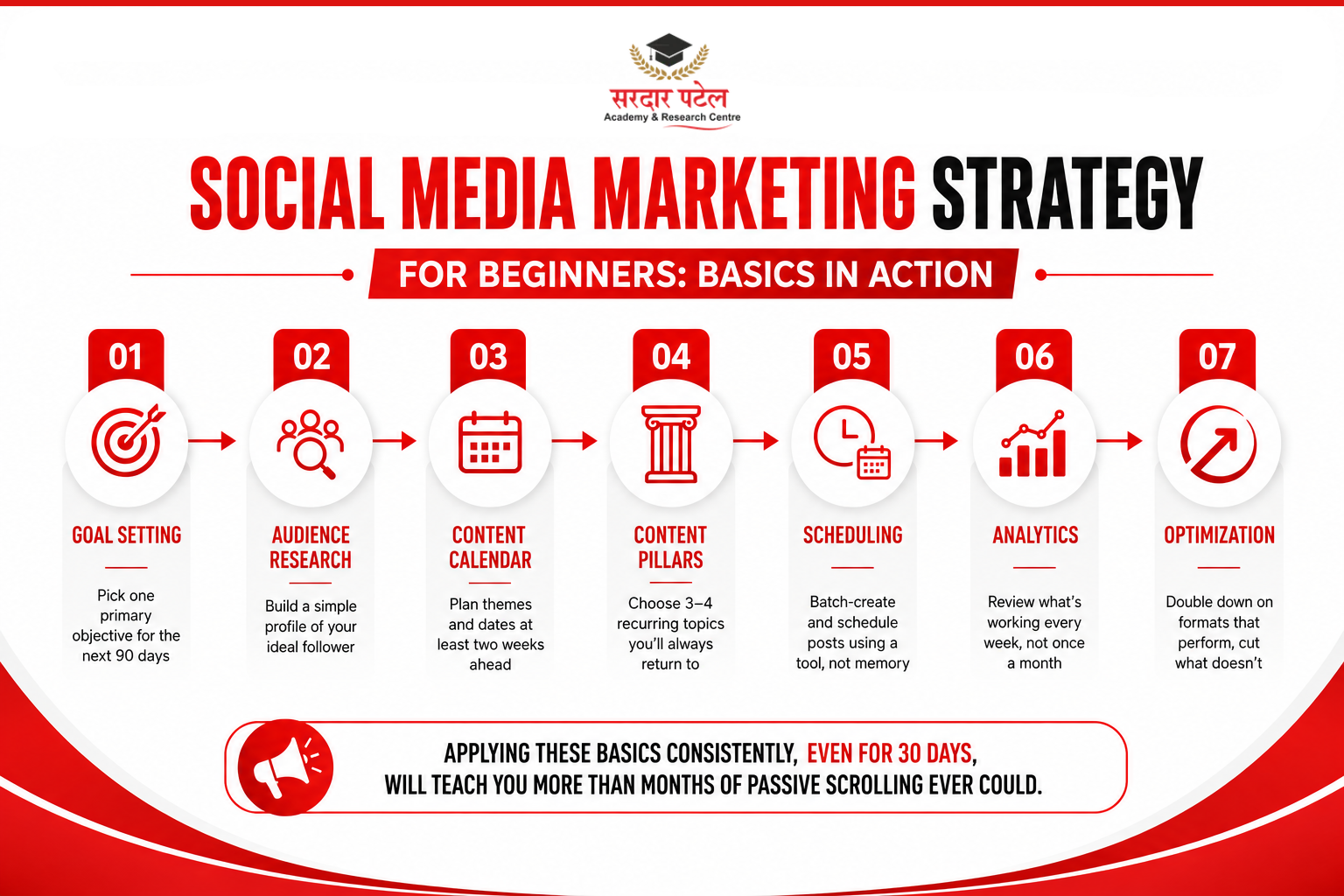
Essential Social Media Marketing Tools
| Tool |
Best Use |
Free/Paid |
Official Website |
| Canva |
Designing posts and Reels covers |
Free + Paid |
canva.com |
| Meta Business Suite |
Managing Facebook & Instagram |
Free |
business.facebook.com |
| Buffer |
Scheduling posts across platforms |
Free + Paid |
buffer.com |
| Hootsuite |
Multi-platform management |
Paid |
hootsuite.com |
| Metricool |
Analytics and reporting |
Free + Paid |
metricool.com |
| Google Analytics |
Tracking website traffic from social |
Free |
analytics.google.com |
| ChatGPT |
Caption and content ideation |
Free + Paid |
chatgpt.com |
| CapCut |
Editing Reels and Shorts |
Free + Paid |
capcut.com |
| Source: Official tool websites of Canva, Meta Business Suite, Buffer, Hootsuite, Metricool, Google Analytics, ChatGPT, and CapCut (2026). |
Explore each tool through its official website to learn about its latest features, pricing, and documentation. Canva Official Website, Meta Business Suite, Buffer, Hootsuite, Metricool, Google Analytics, CapCut
Common Mistakes Beginners Should Avoid
These mistakes trip up almost every beginner still learning social media marketing basics — here's what to watch for, and what to do instead:
| Common Mistake |
Better Approach |
| Posting without a clear goal or audience |
Define one goal and audience before creating content |
| Being active on every platform |
Focus on 2–3 platforms and run them well |
| Ignoring comments and DMs |
Reply within hours to build engagement signals |
| Copying competitors directly |
Build an original voice using your own insights |
| Chasing followers over engagement |
Track engagement rate and conversions instead |
| Skipping analytics |
Review performance data weekly, not occasionally |
| Only posting promotional content |
Mix value, storytelling, and promotion (e.g., 80/20 rule) |
| Source: Sprout Social, HubSpot content marketing benchmarks (2026) |
Career Opportunities in Social Media Marketing
A social media career in India has grown into a genuine, well-paying profession, not just a side hustle.
| Job Role |
Average Salary (per annum) |
Experience |
Hiring Platforms |
| Social Media Executive |
₹1.8–3.3 LPA |
0–2 years |
Naukri, Indeed |
| Social Media Manager |
₹4.5–9 LPA |
2-5 years |
LinkedIn Jobs, Naukri |
| Social Media Strategist |
₹9–15 LPA |
5-8years |
AmbitionBox, LinkedIn Jobs |
| Social Media Director |
₹15–32 LPA |
8+ years |
LinkedIn Jobs, Indeed |
| Source: Naukri, AmbitionBox, LinkedIn Jobs, Indeed (2026 industry data) Salaries vary depending on location, company size, certifications, practical experience, and portfolio quality. |
Freelance social media managers in India also earn well beyond fixed salaries, especially when working with global clients who pay in dollars for the same skill set. Roles like social media manager, content strategist, and paid social media specialist are consistently listed among the fastest-growing digital marketing jobs on Naukri and LinkedIn.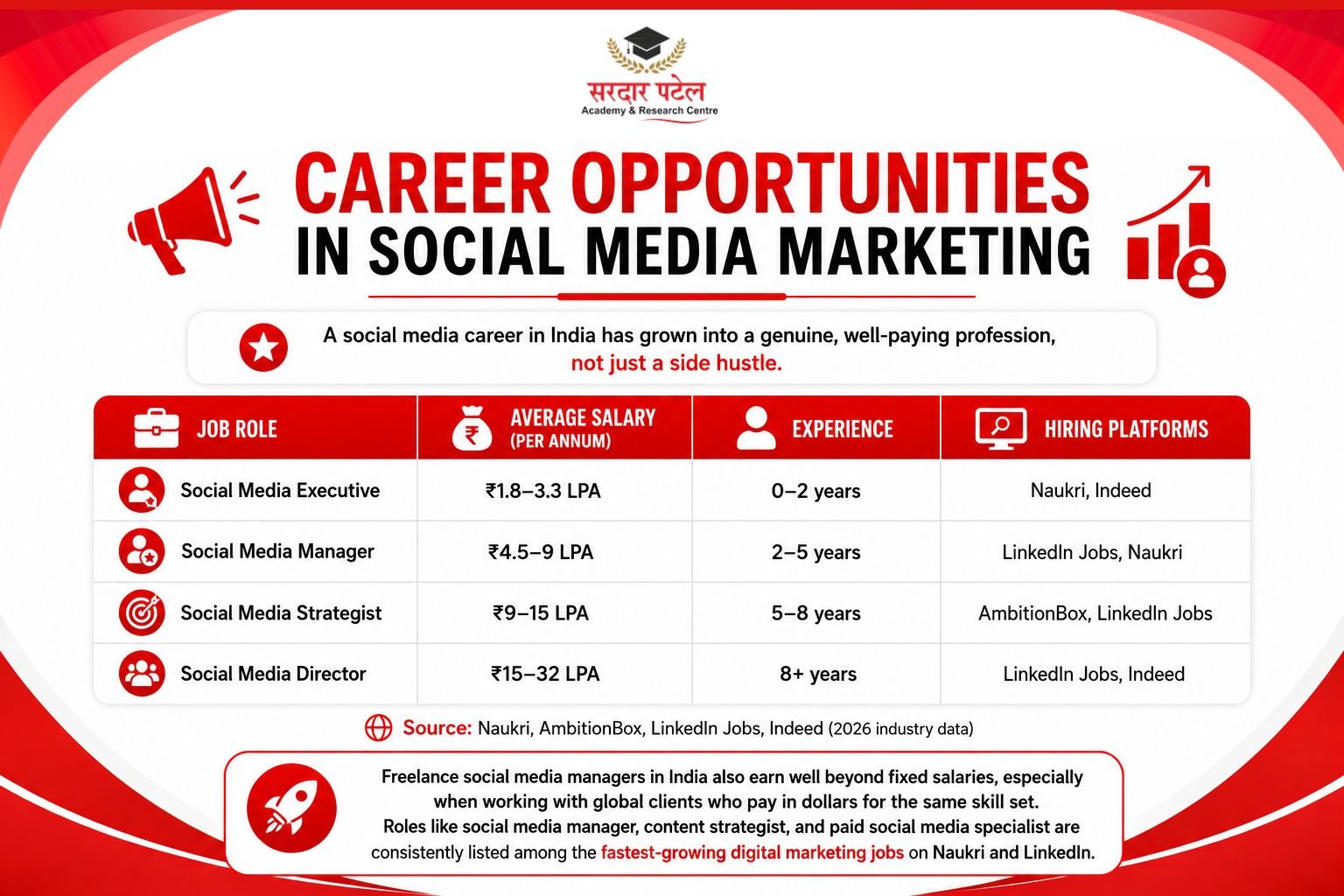
If you're exploring long-term career options beyond social media, check out these digital marketing job roles to understand the skills, responsibilities, and growth opportunities in different specializations.
How to Learn Social Media Marketing Basics as a Beginner
You don't need a fancy degree to start — you need structure and practice. Here's a practical path for social media training for beginners:
- Free resources: Meta Blueprint, Google Skillshop, YouTube tutorials, and HubSpot Academy
- Practice: start a personal or dummy brand page and run it like a real client account
- Projects: offer to manage social media for a local shop or NGO for real-world experience
- Portfolio: document your campaigns, growth numbers, and creatives in one shareable place
- Certifications: Meta Blueprint, Google Analytics, and HubSpot certifications add credibility
If self-study feels scattered, a structured SMM tutorial or classroom-based social media course can shortcut the learning curve considerably, especially one that includes live campaigns instead of only theory.
One of the best ways to gain practical experience is by helping a local business grow online. Learn how social media marketing for small businesses works in real-world scenarios.
Conclusion
Learning social media marketing basics isn't complicated once you break it into steps — set goals, know your audience, choose the right platforms, create content, and track what works. That's the whole game, repeated consistently.
Whether you're a student exploring careers, a freelancer building client skills, or a business owner tired of inconsistent results, these fundamentals apply equally. Start small: pick one platform, apply what you've learned here, and stay consistent for 30 days before judging results.
If you want structured, mentor-led social media training for beginners with real campaigns instead of just theory, that's exactly the kind of hands-on SMM tutorial worth investing in. Mastering social media marketing basics today is one of the most practical, career-proof skills you can build in 2026 — so start now, not someday.
Ready to turn your knowledge into practical skills?
Connect with the experts at Sardar Patel Academy & Research Centre –SPARC for personalized guidance, hands-on training, and real-world learning. Whether you need career advice or want to explore the right digital marketing program, our team is here to help.
Contact Us today and take the next step with confidence.
FAQs
It's using platforms like Instagram and Facebook to promote a brand, engage an audience, and drive measurable results like traffic or sales — not just posting content randomly.
Yes. Demand for skilled social media managers, strategists, and paid social specialists continues rising across Indian startups, agencies, and enterprises.
Instagram is generally best for beginners due to its low production cost, strong Reels reach, and large active audience in India.
With consistent practice, most beginners grasp core social media marketing basics within 4–8 weeks through hands-on projects and a structured course.
No, but certifications like Meta Blueprint or Google Analytics strengthen your resume and build client trust faster.
Organic social media is free and relies on content quality; paid social media uses budget to target specific audiences through Meta Ads or LinkedIn Ads.
Entry-level roles start around ₹1.8–3.3 LPA, while experienced managers earn ₹4.5–9 LPA or more, depending on city and skill set.
Common tools include Canva for design, Buffer or Hootsuite for scheduling, and Metricool or Google Analytics for tracking performance.
Absolutely. Most successful social media managers are self-taught or trained through short, practical courses rather than formal degrees.
It's a planned schedule of what to post, where, and when — helping you stay consistent instead of posting randomly.
Social media marketing is one part of digital marketing; digital marketing also includes SEO, Google Ads, email marketing, and content marketing.
Basic content creation, audience research, scheduling tools, analytics reading, and consistent communication are the core beginner skills.