+91 9312966129
 sparc.enquiry01@gmail.com


Accounting Career Options After 12th Commerce
Explore accounting career options after 12th commerce, including courses, jobs, essential skills, career growth, and professional paths like CA and CMA.
Table of Contents
- Why Accounting Is Still a Solid Choice After 12th Commerce
- Accounting Career Options After 12th Commerce: The Big Picture
- Accounting Courses After 12th Commerce
- Degree-Level Courses
- Professional Qualifications
- Practical / Vocational Courses
- Quick Comparison: Which Course Fits Your Goal?
- Accountant Career After 12th Commerce: What Does the Job Actually Look Like?
- Accounting Jobs After 12th Commerce: Roles You Can Target
- Entry-Level Roles (0-2 years experience)
- Mid-Level Roles (2-5 years experience)
- Roles After Professional Qualification (CA/CMA)
- Essential Accounting Skills Employers Actually Look For
- How Accounting Careers Grow Over Time
- Career Options in Accounting Beyond Traditional Roles
- Common Mistakes Students Make After 12th Commerce
- Final Thoughts
If you've just finished 12th Commerce and you're wondering what to do next, you're not alone. Every year, thousands of commerce students in Delhi NCR sit down and ask the same question: is accounting a good career, or should I look at something else entirely?
Here's the honest answer: accounting remains one of the most stable and widely available career paths for commerce students, mainly because every business, big or small, needs someone who can manage its books. But "accounting" isn't just one path anymore. There are multiple accounting career options after 12th commerce, ranging from short-term practical courses to full professional qualifications like CA and CMA.
In this guide, we'll walk through the courses you can take, the job roles you can expect, the skills that actually matter to employers, and how your career can grow over the next 5-10 years. By the end, you'll have a clear picture of which direction suits you best.
Why Accounting Is Still a Solid Choice After 12th Commerce
Accounting isn't glamorous, but it's dependable. Businesses don't stop needing accountants during slowdowns – if anything, they need them more, because someone has to track cash flow, file taxes, and keep the numbers honest. If you're still unsure about the long-term potential, this guide on accounting as a career in India explains its scope, job opportunities, skills, and career growth in more detail.
For a commerce student, accounting also has a practical advantage: you already have a head start. Concepts like debit-credit, ledgers, and financial statements aren't entirely new to you, which means you can move faster than someone switching in from a non-commerce background.
That said, accounting as a career today looks different from what it did a decade ago. Manual bookkeeping has largely given way to software-based accounting, and employers increasingly expect candidates to know tools like Tally alongside basic accounting theory.
Accounting Career Options After 12th Commerce: The Big Picture
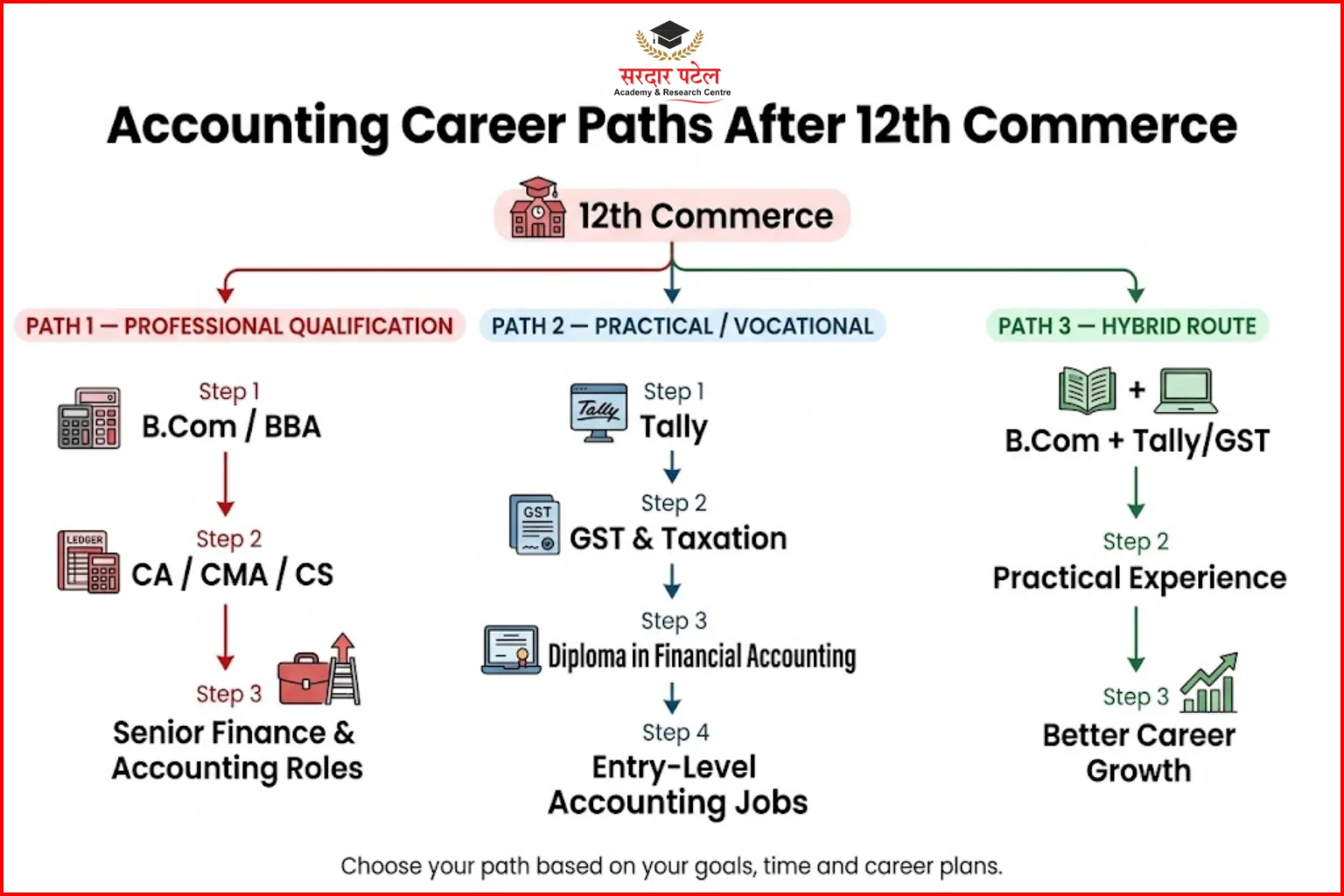
Broadly, students choose between three kinds of paths after 12th:
- Professional qualification route – B.Com/BBA combined with CA, CMA, or CS
- Practical/vocational route – Certificate or diploma courses in Tally, GST, and accounting software
- Hybrid route – A degree alongside short-term practical courses, which is what most working accountants actually end up doing
None of these is inherently better - it depends on your timeline, budget, and whether you want to start earning quickly or build toward a higher-paying specialised role over several years. If you're also considering banking, comparing accounting vs banking after 12th can help you understand which career path better matches your interests and goals.
Accounting Courses After 12th Commerce
Let's break down the actual courses available, since this is usually where students get stuck. Students who want to compare their options in more detail can also explore this guide to the best accounting courses after 12th commerce.
Degree-Level Courses
B.Com (Bachelor of Commerce)
A 3-year degree that covers accounting, taxation, business law, and economics. It's the most common foundation for anyone planning to pursue CA, CMA, or a corporate accounting role later.
B.Com (Honours)
A more specialised, exam-intensive version of B.Com, generally preferred by students aiming for competitive professional exams or further studies like M.Com.
BBA with a Finance/Accounting specialisation
Broader than B.Com, with more focus on management alongside finance. Useful if you're not fully sure yet whether you want pure accounting or a management-track role.
Professional Qualifications
Chartered Accountancy (CA)
Conducted by the Institute of Chartered Accountants of India (ICAI), this is one of the most recognised professional accounting qualifications in India. It's demanding; most students take 4-5 years to clear all levels alongside practical training (articleship). CAs typically move into auditing, taxation, and senior finance roles.
Cost and Management Accountancy (CMA)
Conducted by ICMAI, this focuses more on cost control, budgeting, and management accounting. It's a strong option if you're interested in the manufacturing or production side of finance.
Company Secretary (CS)
Not purely accounting, but many commerce students consider it alongside CA/CMA since it deals with corporate law and compliance.
Practical / Vocational Courses
Tally Course
A Tally course after 12th commerce is one of the fastest ways to become job-ready. Tally remains the most widely used accounting software among small and mid-sized businesses in India, and most entry-level accounting job postings still list it as a requirement.
GST and Taxation Certification
Short courses focused specifically on GST return filing, invoicing, and compliance — practical, in-demand, and often completed in a few weeks to a couple of months. Students can also refer to the official GST portal for information related to GST services and return filing.
Diploma in Financial Accounting
It usually covers Tally, GST, payroll, and MS Excel together, giving a broader practical skill set than a single-software course. If you're deciding between a traditional commerce education and a more skill-focused route, this comparison of commerce vs computer accounting course can help you choose based on your career goals.
Quick Comparison: Which Course Fits Your Goal?
| Course |
Duration |
Best for |
Entry Point |
| B. Com |
3 years |
Building a strong academic base |
After 12th |
| CA |
4-5 years |
High-paying, senior finance/audit roles |
After 12th or graduation |
| CMA |
3-4 years |
Cost accounting, manufacturing sector |
After 12th or graduation |
| Tally Course |
A few weeks to 3 months |
Quick job readiness |
After 12th, alongside degree |
| GST Certification |
A few weeks |
Taxation-focused roles |
After 12th, alongside degree |
| Diploma in Financial Accounting |
3-6 Months |
All-round practical skills |
After 12th, alongside degree |
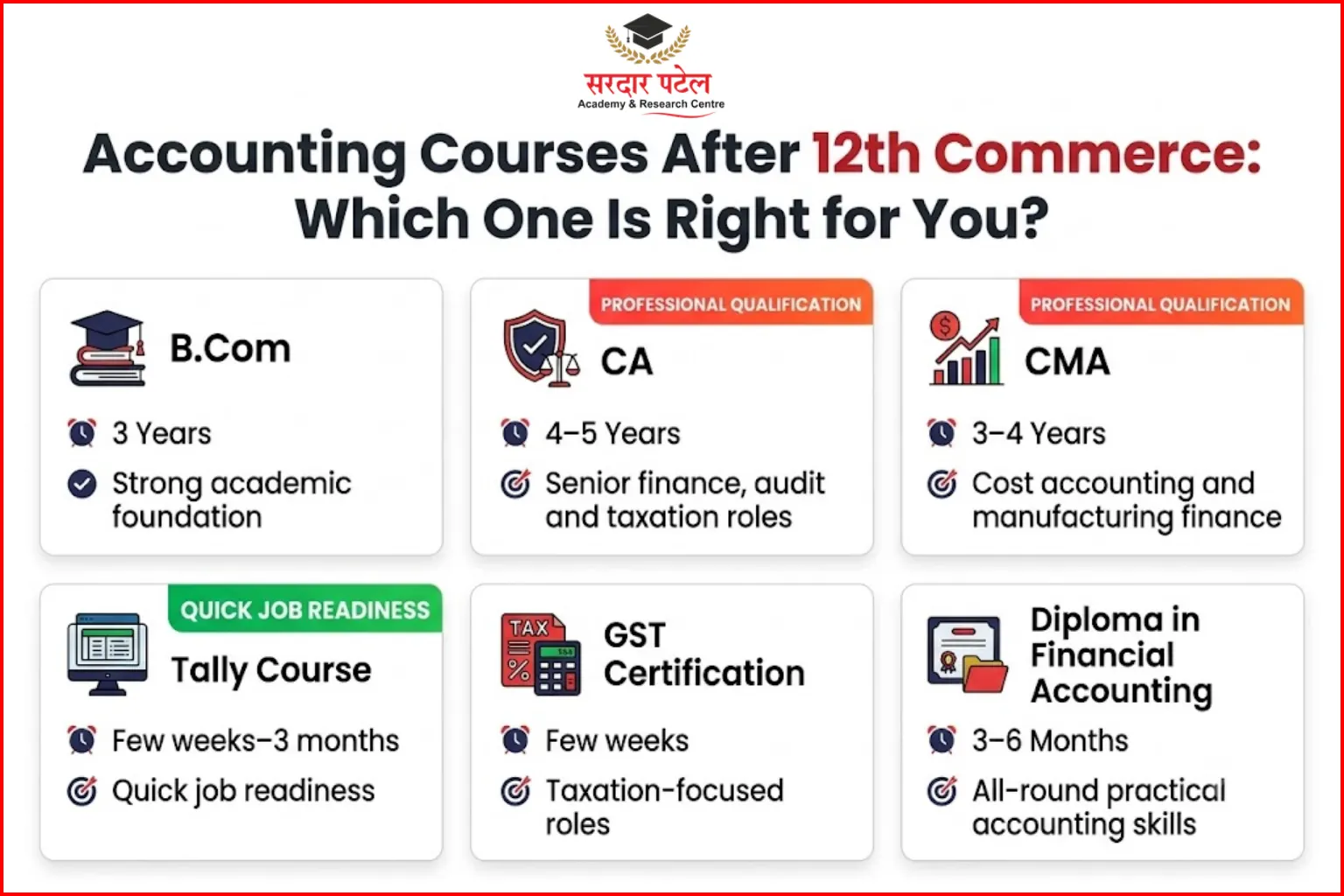
A common and sensible approach: pursue B.Com for the degree, and complete a Tally or GST course alongside it. This way, you graduate with both credentials and practical, job-ready skills — rather than a degree alone, which many employers now consider insufficient on its own.
Accountant Career After 12th Commerce: What Does the Job Actually Look Like?
It helps to know what accountants actually do day-to-day, rather than just chasing a job title. If you're looking for a step-by-step path from 12th Commerce to your first accounting role, check out this guide on how to start a career in accounting after 12th.
At the entry level, an accountant typically:
- Records daily financial transactions in accounting software
- Maintains ledgers and reconciles bank statements
- Assists with GST return filing and invoicing
- Prepares basic financial reports for management
- Supports the senior accountant or finance team during audits
As you gain experience, the role shifts from data entry toward analysis and decision support — reviewing reports, flagging discrepancies, and eventually managing a small accounting team or handling compliance independently.
Accounting Jobs After 12th Commerce: Roles You Can Target
Here's where things get practical. What jobs can you actually apply for, and at what stage?
Entry-Level Roles (0-2 years experience)
- Accounts Assistant – Data entry, invoice processing, basic bookkeeping
- Tally Operator—Software-focused role, common in small and mid-sized firms
- Billing Executive – Invoice generation, GST-compliant billing
- Junior Accountant – Ledger maintenance, bank reconciliation, basic reporting
Mid-Level Roles (2-5 years experience)
- Senior Accountant – Oversees the full accounting cycle, prepares financial statements
- Tax Assistant/Associate – Handles GST, TDS, and income tax filings
- Accounts Payable/Receivable Executive – Manages vendor payments and customer collections
- Payroll Executive - Handles salary processing, statutory deductions, and compliance
Roles After Professional Qualification (CA/CMA)
- Chartered Accountant – Auditing, taxation, financial advisory
- Cost Accountant – Budgeting, cost analysis, manufacturing finance
- Finance Manager – Broader financial planning and strategic decision-making
A practical point worth noting: many students land their first job in a small firm doing bookkeeping and Tally entries and use that experience to move up rather than waiting for a "perfect" first role. That first job is often less about prestige and more about building real, hands-on experience.
Essential Accounting Skills Employers Actually Look For
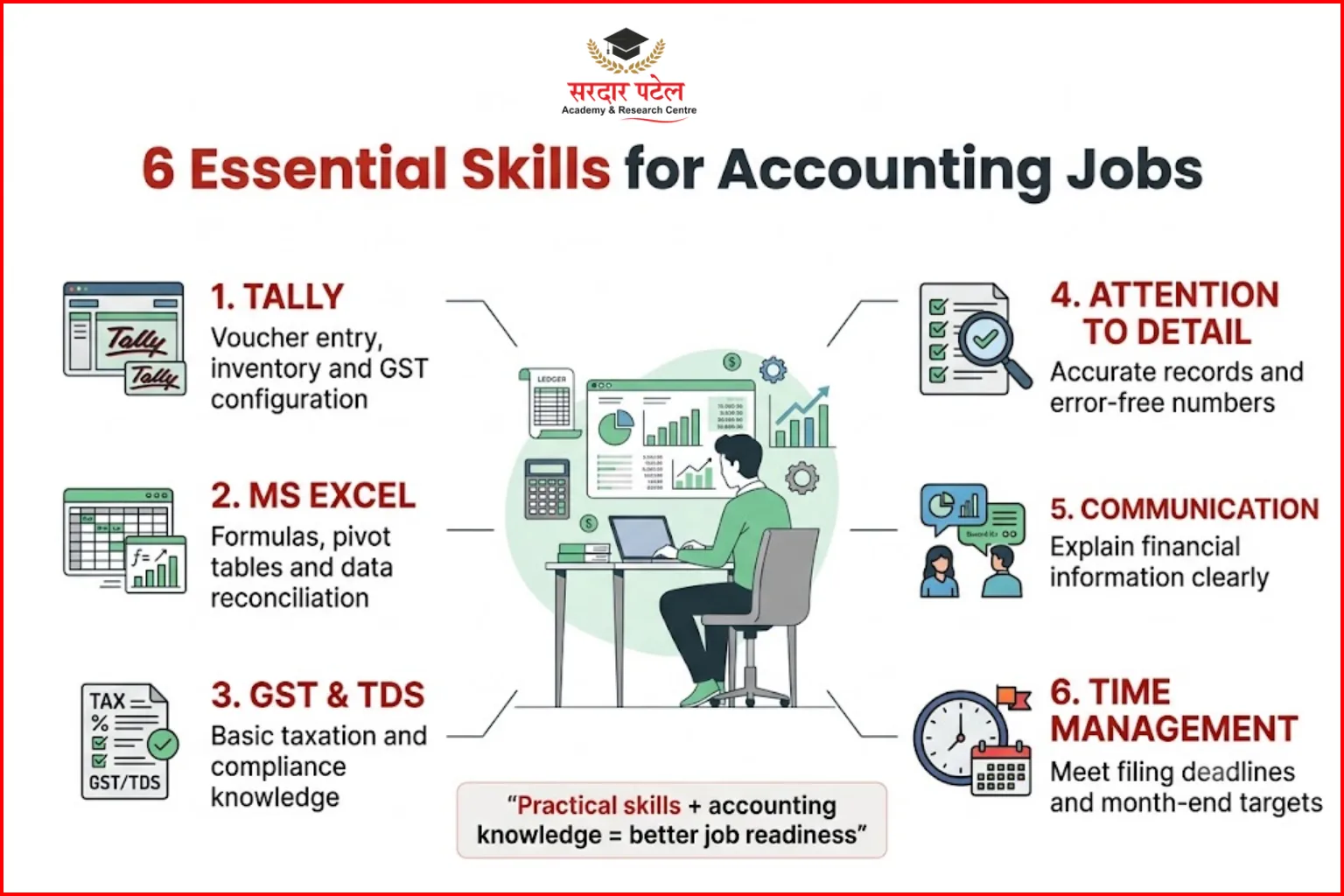
Course certificates matter, but employers hire for skills. Here's what actually gets checked in interviews for entry-level accounting roles:
- Tally proficiency – voucher entry, inventory management, GST configuration
- MS Excel – Formulas, pivot tables, basic data reconciliation
- Basic taxation knowledge – GST, TDS fundamentals. For updated information on income-tax and TDS-related compliance, students can refer to the Income Tax Department's e-filing portal.
- Attention to detail – Numbers don't forgive careless mistakes
- Communication skills – Explaining figures clearly to non-finance colleagues or clients
- Time management – especially around filing deadlines and month-end closing
A common mistake students make is focusing only on theory and neglecting hands-on software practice. An employer would rather hire someone who can confidently operate Tally and handle a GST return than someone who has memorised accounting standards but has never entered a live transaction. This is exactly the gap that practical, software-based training is designed to close.
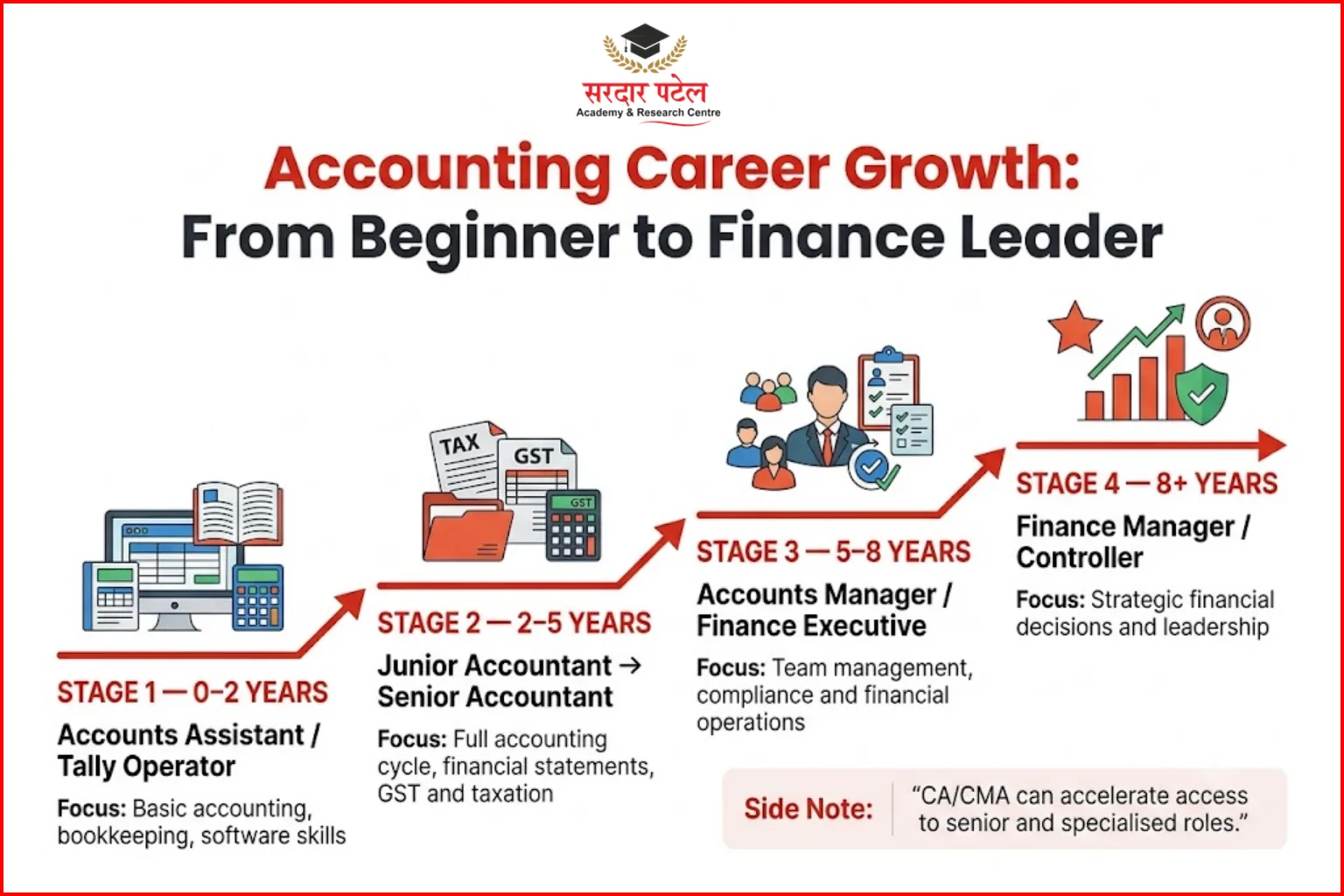
How Accounting Careers Grow Over Time
Career growth in accounting is fairly linear, which is part of its appeal — you generally know what the next step looks like.
- Accounts Assistant/Tally Operator (0-2 years) – Building foundational skills
- Junior to Senior Accountant (2-5 years) – Taking ownership of the full accounting cycle
- Accounts Manager/Finance Executive (5-8 years)—Managing a team, handling compliance strategy
- Finance Manager/Controller (8+ years, often with CA/CMA) -Strategic financial decision-making
Professional qualifications like CA or CMA tend to accelerate this growth curve significantly and open doors to leadership roles that are harder to reach with a degree and practical certification alone. That said, plenty of accountants build solid, stable careers without CA/CMA; it depends on your ambition and how much time you're willing to invest upfront.
Salary figures vary quite a bit by city, company size, and role, so rather than quoting numbers here that may not hold true for your specific situation, it's worth checking current listings on job portals for GTB Nagar and Delhi NCR to get a realistic sense of current market rates.
Career Options in Accounting Beyond Traditional Roles
- GST Practitioner: Independent GST filing and advisory work
- Bookkeeping for small businesses: Freelance or part-time, especially useful while studying
- Accounts outsourcing firms: Many firms in Delhi NCR handle accounting for multiple small clients, offering varied experience
- Finance roles in e-commerce and startups: Growing demand for accountants comfortable with digital invoicing and multiple payment platforms
Common Mistakes Students Make After 12th Commerce
A few patterns show up repeatedly among students choosing their accounting path:
- Waiting too long to learn practical software – theory alone doesn't get you hired
- Choosing CA without understanding the commitment – It's a serious, multi-year path; go in with realistic expectations.
- Ignoring GST and taxation basics — these come up in almost every accounting job interview now.
- Treating the degree as the only qualification needed — most employers now expect some practical, software-based training alongside it.
Final Thoughts
There isn't one correct path when it comes to accounting career options after 12th commerce the right choice depends on how quickly you want to start working, how much time you're willing to invest in professional qualifications, and where your interests lie within finance.
For most students, a practical starting point works best: pursue your degree, but don't wait until graduation to build job-ready skills. Learning Tally, GST, and basic accounting software early gives you a real edge when you start applying for jobs.
If you're based in or around GTB Nagar and want to build these skills hands-on, explore SPARC's practical accounting and Tally courses to develop industry-relevant accounting skills after 12th Commerce — designed specifically to help commerce students bridge the gap between classroom theory and what employers actually expect on day one.
FAQs
There's no single best option; it depends on your goals. If you want to start earning quickly, a Tally or GST certification alongside a B.Com works well. If you're aiming for a high-paying, senior role and are willing to invest several years, a CA or CMA is the stronger long-term path.
Yes, for entry-level roles like Accounts Assistant or Tally Operator, many small and mid-sized firms prioritise practical skills over a degree. However, a degree does open up more roles and higher growth potential over time.
A Tally course after 12th commerce is often enough to land an entry-level role, especially at smaller firms. For long-term growth, pairing it with a degree and basic taxation knowledge strengthens your profile considerably.
Typically 4-5 years, including the foundation/intermediate exams and mandatory articleship training under ICAI's structure. It's a demanding path, so plan your timeline realistically.
Tally proficiency, MS Excel, basic GST/TDS knowledge, and attention to detail are the skills employers check first, often before looking closely at academic scores.
Yes, particularly if you're interested in cost accounting, budgeting, or manufacturing-sector finance. CMA is generally considered somewhat less time-intensive than CA, though both are serious professional commitments.
Yes, Delhi NCR has a large base of small and mid-sized businesses, outsourced accounting firms, and startups that regularly hire entry-level accounting staff, particularly those comfortable with Tally and GST filing.