+91 9312966129
 sparc.enquiry01@gmail.com


Delhi Companies Hiring More Data Analysts
Discover the latest data analyst hiring trends in Delhi NCR — top hiring sectors, in-demand skills, and how to prepare for growing analytics roles.

If you've been scrolling job portals or LinkedIn lately, you've probably noticed something: data analyst roles are popping up everywhere across Delhi NCR. From fintech startups in Gurugram to established BFSI players in Connaught Place, companies just can't seem to hire enough people who can make sense of their numbers.
This isn't a random spike. It's part of a broader shift in how businesses operate, and understanding the current data analyst hiring trends in Delhi can help you make smarter decisions — whether you're a student picking a career path, a working professional thinking about a switch, or a business owner trying to figure out your own hiring strategy.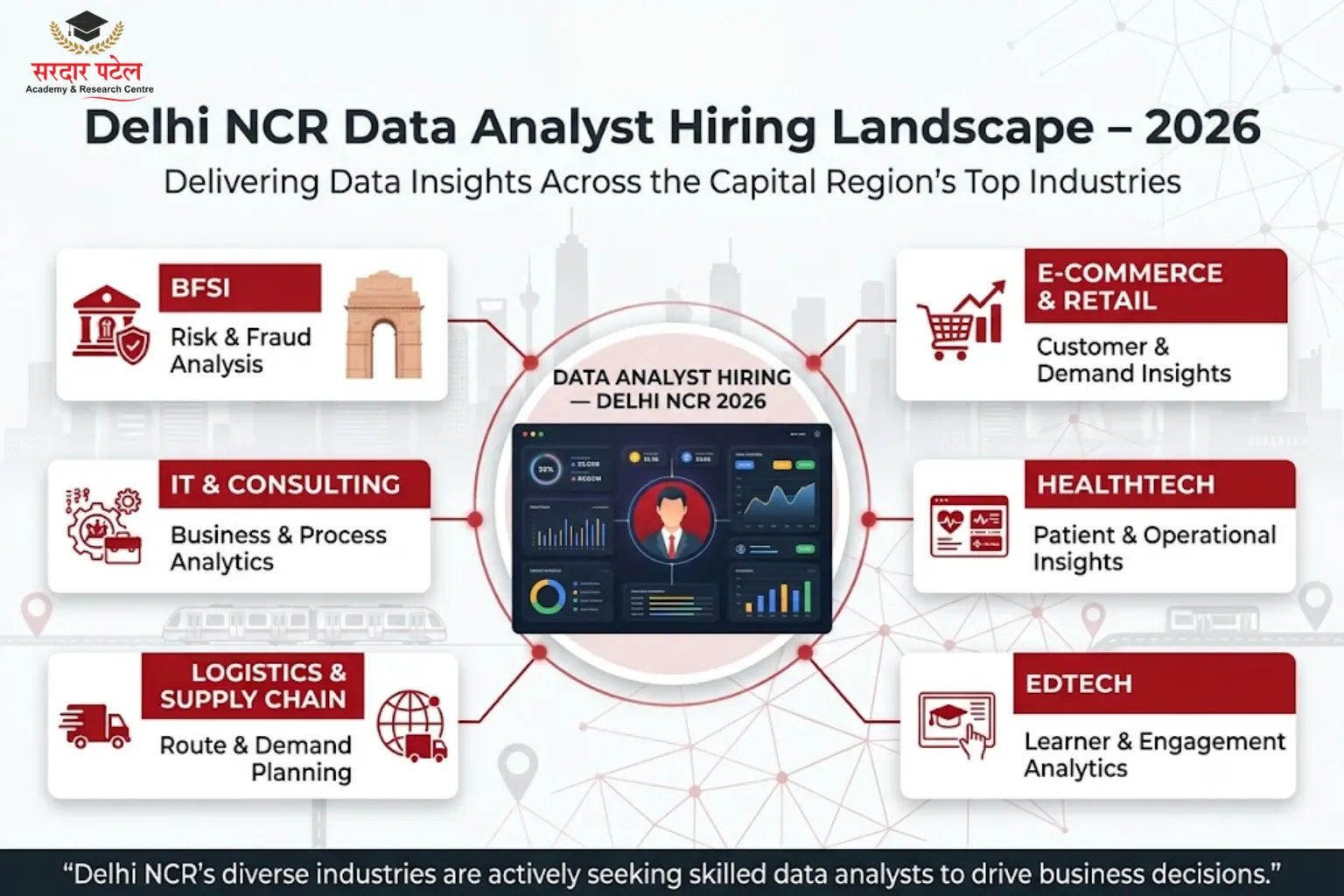
In this report, we'll break down the data analyst hiring trends in Delhi that matter most right now — why this demand exists, which sectors are hiring the most, what skills employers actually want, and how you can position yourself (or your team) to take advantage of it.
Why Delhi Companies Are Hiring More Data Analysts
Every business today generates data — customer clicks, sales transactions, app usage, delivery times, ad performance. The problem most companies face isn't a shortage of data. It's a shortage of people who can turn that data into decisions.
Delhi NCR has grown into one of India's most diverse business hubs, spanning IT services, e-commerce, BFSI, healthtech, and logistics. As these industries digitize further, the data analyst hiring trends in Delhi have grown alongside them, simply because more processes now produce data that needs interpreting.
A few forces are driving this specifically in the Delhi NCR region:
- Digital-first business models — More companies are running operations, sales, and marketing through digital platforms, which means more trackable data.
- Regulatory and compliance pressure — Sectors like BFSI and healthtech face growing requirements around data governance and reporting, which increases the need for skilled analysts.
- Startup density — Gurugram and Noida host a large number of startups that rely heavily on data to validate decisions with limited resources.
- Cost-effective analytics hubs — Many companies are building analytics teams in Delhi NCR rather than metro cities like Mumbai or Bengaluru, partly due to talent availability and operational costs.
These forces sit right at the center of the data analyst hiring trends in Delhi that we're seeing today, and they explain why hiring hasn't slowed down even as broader tech hiring has cooled in some sectors.
None of this means every company is hiring at the same pace, or that demand is unlimited. It varies by sector, company size, and the specific skill set required — which is exactly what shapes the data analyst hiring trends in Delhi on a sector-by-sector basis.
For a broader, data-backed view of India's white-collar hiring momentum (which sets the context for regional trends in Delhi NCR), the Naukri JobSpeak Index is published monthly by Info Edge and tracks hiring activity across industries, cities, and experience bands.
Which Industries in Delhi NCR Are Hiring the Most
The data analyst hiring trends in Delhi aren't uniform across sectors. Some industries are clearly ahead of others in building out analytics teams.
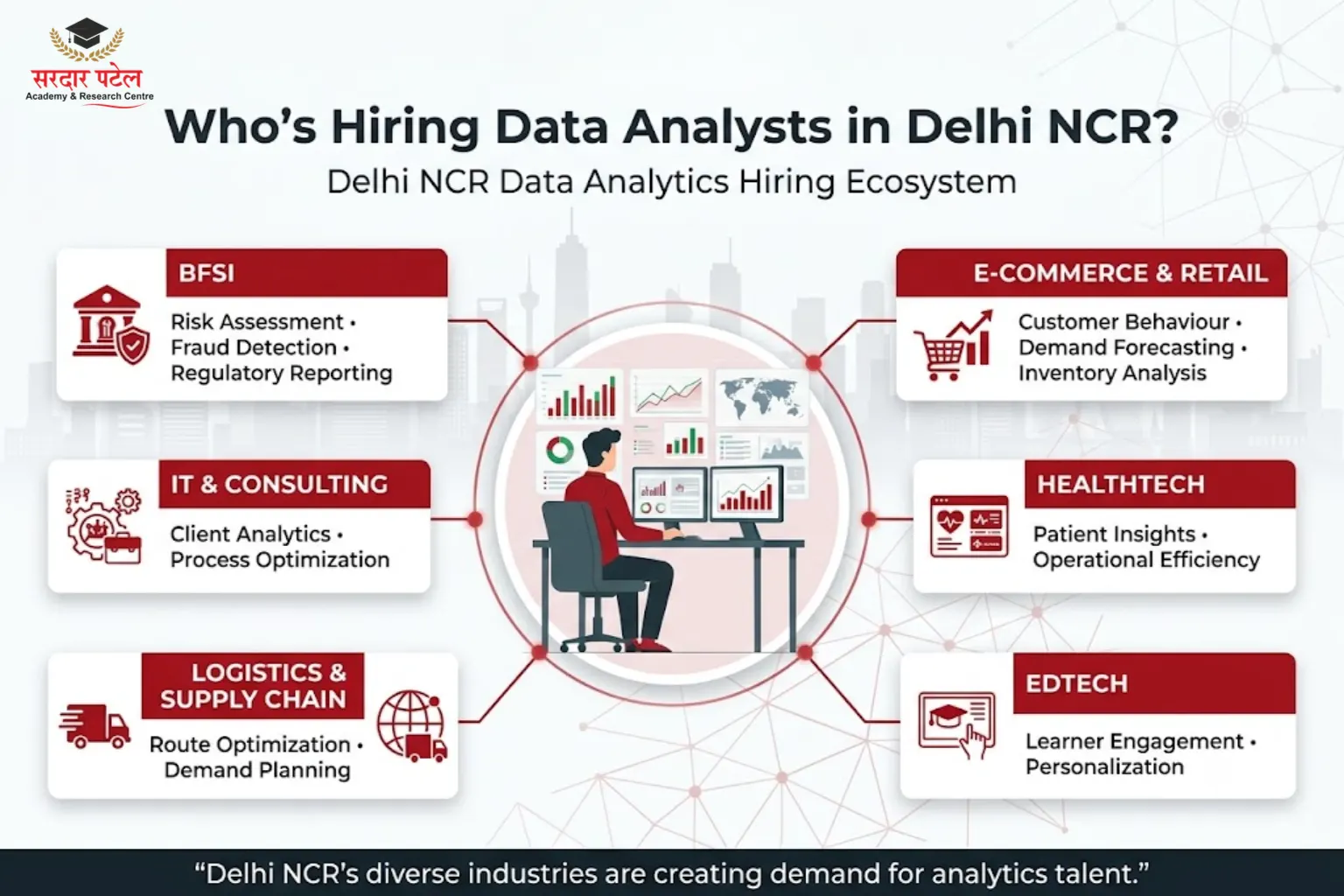
| Industry |
Why They're Hiring Analysts |
| BFSI (Banking, Financial Services, Insurance) |
Risk assessment, fraud detection, regulatory reporting |
| E-commerce & Retail |
Customer behavior analysis, inventory and demand forecasting |
| IT & Consulting |
Client analytics projects, internal process optimization |
| Healthtech |
Patient data insights, operational efficiency |
| Logistics & Supply Chain |
Route optimization, demand planning |
| EdTech |
Learner engagement tracking, personalization |
If you're a student or early professional deciding where to focus, understanding these data analyst hiring trends in Delhi at the sector level is a good starting point. BFSI and e-commerce, for instance, tend to look for analysts who are comfortable with large transactional datasets, while IT consulting roles often expect stronger client-facing communication skills alongside technical ability.
For a more detailed sector-by-sector breakdown, our guide on how Delhi companies hire data analysts walks through specific hiring patterns by industry.
What Skills Are Companies Actually Asking For
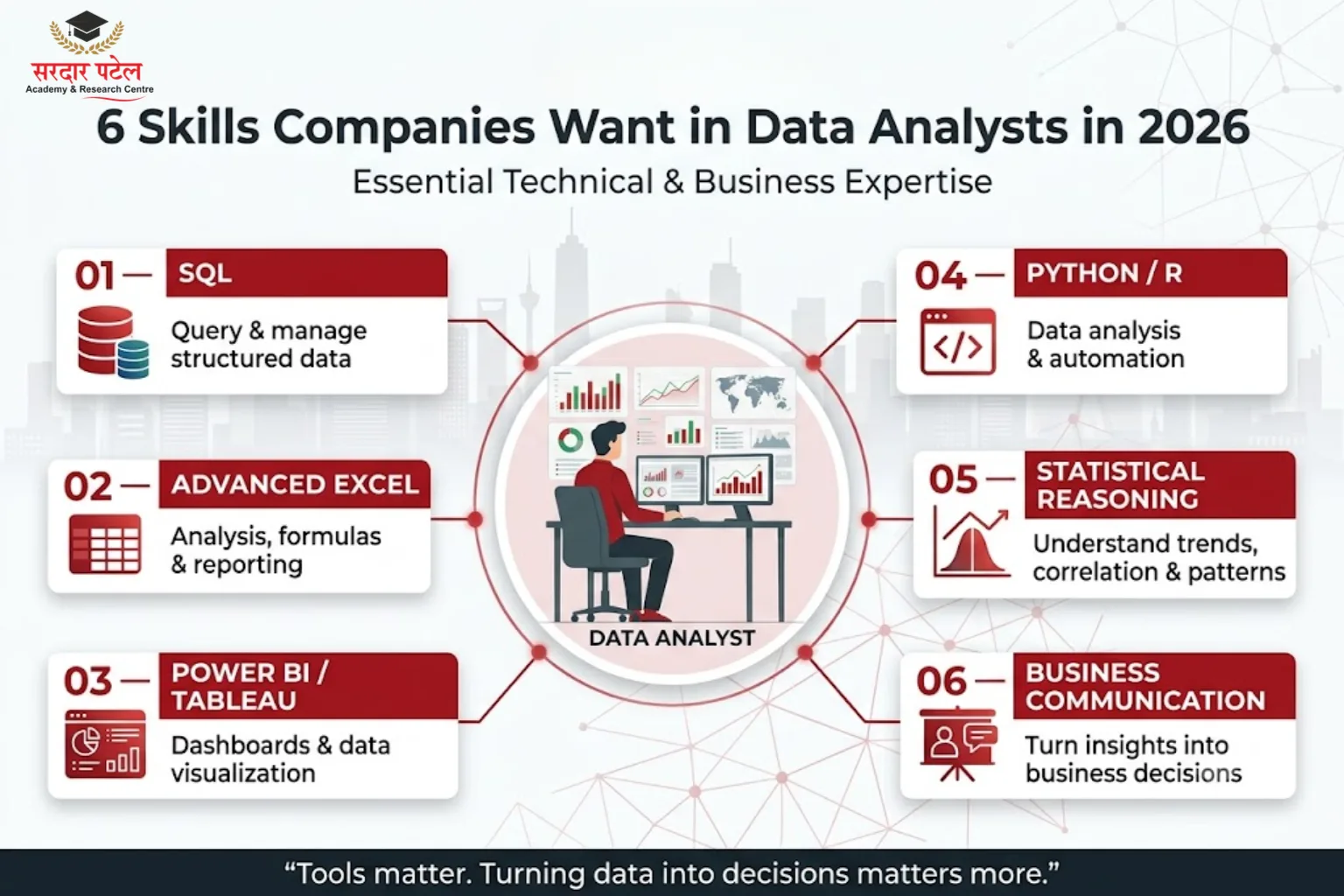
One thing that becomes clear when you study the data analyst hiring trends in Delhi is that companies aren't just looking for people who know Excel. The bar has moved up.
Here's what shows up consistently in current job listings:
- SQL — for querying and managing structured data
- Excel (advanced) — still widely used for quick analysis and reporting
- Power BI or Tableau — for building dashboards and visual reports
- Python or R (basic to intermediate) — increasingly expected, even for entry-level roles
- Statistical reasoning — understanding correlation, trends, and what the numbers actually mean
- Business communication — the ability to explain findings to non-technical stakeholders
A common mistake many beginners make is treating technical tools as the entire job. In reality, the analysts who stand out are the ones who can connect a chart to a business decision — for example, explaining why a drop in conversion rate happened, not just showing that it happened.
Entry-Level vs Experienced Hiring: What's Different
The data analyst hiring trends in Delhi also show a noticeable split between how companies hire freshers versus experienced professionals.
For entry-level candidates:
- Employers focus more on foundational skills (Excel, SQL basics, one visualization tool)
- Internships and project work often matter more than formal experience
- Willingness to learn on the job is a bigger deciding factor than perfect technical mastery
For experienced professionals:
- Domain expertise (e.g., BFSI analytics vs retail analytics) becomes important
- Employers expect independent handling of end-to-end projects
- Familiarity with automation and reporting pipelines is often preferred
If you're a student wondering whether to focus on certifications or hands-on projects first, projects generally carry more weight in early interviews, since they demonstrate applied thinking rather than memorized syntax.
Common Mistakes Job Seekers Make
Within the broader data analyst hiring trends in Delhi, a few patterns show up again and again among job seekers we've worked with.
- Learning tools without understanding the "why" — Knowing Power BI's interface doesn't help if you can't decide what to visualize and why it matters.
- Ignoring communication skills — A technically strong analyst who can't explain findings clearly often gets passed over for someone slightly less advanced but more articulate.
- Applying without tailoring the resume to the sector — A resume aimed at e-commerce analytics should look different from one aimed at BFSI roles.
- Underestimating basic statistics — Many candidates jump straight to tools and skip foundational concepts like distributions, sampling, and significance, which interviewers frequently test.
Avoiding these isn't complicated, but it does require a shift in how you prepare — treating the tools as a means to an end, not the end itself.
What This Means for Salaries
Compensation for data analyst roles varies by experience, industry, and company, so treat any single figure as a starting reference rather than a guarantee. According to Indeed's salary data for India (based on 895 reported salaries, last updated July 2026), the average base salary for a data analyst in India is around ₹6.5 lakh per year, with Delhi NCR cities like Gurugram and Noida ranking among the higher-paying locations for this role nationally.
These salary patterns are closely tied to the data analyst hiring trends in Delhi, since employers tend to pay more for analysts whose skills match current sector demand rather than generic experience alone.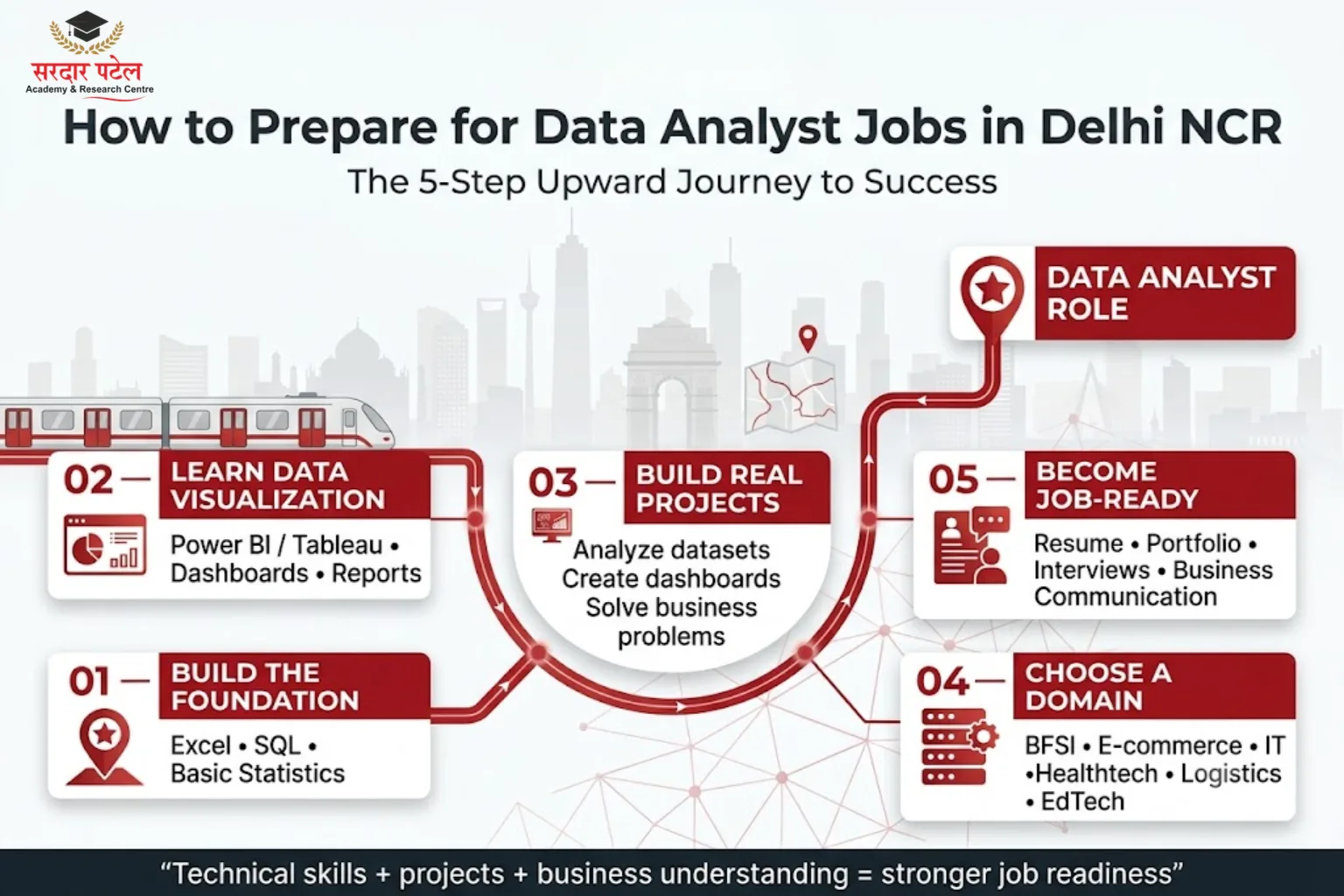
That said, a general pattern holds: analysts who combine technical skills with business understanding — and who can specialize in a particular industry — tend to have stronger negotiating power than generalists. It's worth cross-checking figures against current, company-specific listings before making decisions based on compensation alone, since ranges shift month to month. Our detailed breakdown on data analyst salary expectations for freshers in Delhi covers this in more depth if compensation planning is your main concern right now.
Should You Learn Online or Offline in Delhi NCR
This is a common question, especially among students weighing time and cost. There's no universally right answer — it depends on your learning style, schedule, and how much hands-on guidance you need.
- Online learning — works well if you're disciplined, already employed, or need flexible timing.
- Offline/classroom learning — tends to help those who benefit from structured pacing, in-person doubt-clearing, and peer accountability.
Whichever path you pick should ultimately be shaped by the data analyst hiring trends in Delhi you're personally targeting — the sector, skill level, and role type — not just convenience. If you're unsure which fits you better, our comparison of online vs offline data analytics courses in Delhi breaks down the trade-offs in more detail, including which format tends to suit different learning goals.
Final Thoughts
The data analyst hiring trends in Delhi point to a market that's maturing — companies aren't just hiring analysts for the sake of it; they're looking for people who can genuinely connect data to decisions. Whether you're a student building your first skill set, a professional considering a pivot, or a business owner rethinking your hiring approach, understanding where this demand is coming from puts you a step ahead.
If you're exploring how to build or strengthen your data analytics skills for this market, it's worth looking at what local data analyst hiring trends in Delhi actually reward — not just what's trending online.
Explore our Data Analytics course at Sardar Patel Academy & Research Centre (SPARC) to see how our program aligns with what Delhi NCR companies are currently looking for.
FAQs
Yes. Delhi NCR has a diverse mix of industries actively hiring analysts, including BFSI, e-commerce, IT, and healthtech, which gives job seekers multiple sectors to explore rather than relying on just one.
Basic SQL is generally expected, and familiarity with Python or R is increasingly preferred, especially for mid-to-senior roles. However, many entry-level roles still prioritize Excel and visualization tools.
This depends on your starting point, but most structured learners can build core skills (SQL, Excel, one visualization tool, and basic statistics) within a few months of focused, consistent effort.
Hiring activity is spread across BFSI firms, e-commerce platforms, IT consulting companies, and healthtech startups, rather than concentrated in one or two employers.
Employers generally look at a combination of demonstrated skills, project work, and relevant coursework or certification rather than a degree alone, especially for analyst (non-managerial) roles.
Broadly, data analysts focus on interpreting existing data to answer business questions, while data scientists often build predictive models and work with more advanced statistical or machine learning methods.
Most current listings in Delhi NCR are in-office or hybrid, particularly for BFSI and consulting roles, though this varies by company policy.