+91 9312966129
 sparc.enquiry01@gmail.com


How Delhi Companies Hire Data Analysts
Want a data analyst job in Delhi? Discover the exact hiring process Delhi companies follow, in-demand skills, real salary data, and how SPARC freshers land top analytics roles with structured placement support.
Table of Contents
- Introduction
- Why Delhi NCR Is a Strong Market for Entry-Level Analytics Roles
- Which Industries Are Actively Hiring Analysts in Delhi NCR?
- Information Technology
- Banking and Financial Services
- E-commerce and Retail
- Healthcare
- Digital Marketing Agencies
- How Delhi Companies Actually Hire: The Real Process
- Stage 1 — Resume Screening (ATS Filter + Human Review)
- Stage 2 — Online Assessment
- Stage 3 — Technical Interview
- Stage 4 — HR and Culture Fit Interview
- Skills That Delhi Recruiters Are Actually Looking For in 2026
- Technical Skills — by frequency of mention
- Business and Analytical Thinking
- Communication Skills
- Salary Benchmarks for Freshers in Delhi NCR
- How to Actually Become Job-Ready: A Practical Roadmap
- Month 1 — Build Your Technical Foundation
- Month 2 — Learn Power BI and Build Your First Project
- Month 3 — Polish Your Portfolio and Practice Interviews
- What Freshers Should Avoid
- The Future of Analytics Hiring in Delhi NCR
- A Fresher's Journey: From Training to Offer Letter
- Ankit S.*, BCom graduate, North Delhi —
Introduction
Delhi NCR has quietly become one of India's most active hiring markets for data professionals. According to LinkedIn's India Jobs on the Rise report, data analyst and insights-analyst roles across Delhi NCR have grown significantly year-on-year — with the Greater Delhi Area consistently ranking among the top hiring locations nationally, alongside Bengaluru and Hyderabad. Companies ranging from fintech startups in Gurugram to large IT firms in Noida are actively hiring, and many of these roles are open to fresh graduates Data Analytics Basics for Beginners
What has changed in the last two years is how companies hire. Recruiters are no longer simply scanning degrees. They want candidates who can open a dataset, ask the right business questions, and present clear insights. If you understand this shift, your chances of landing an entry-level analytics role in Delhi NCR increase significantly.
This guide explains the real hiring process Delhi companies follow, the skills that actually matter, current salary benchmarks, and practical steps to become job-ready as a fresher.
Why Delhi NCR Is a Strong Market for Entry-Level Analytics Roles
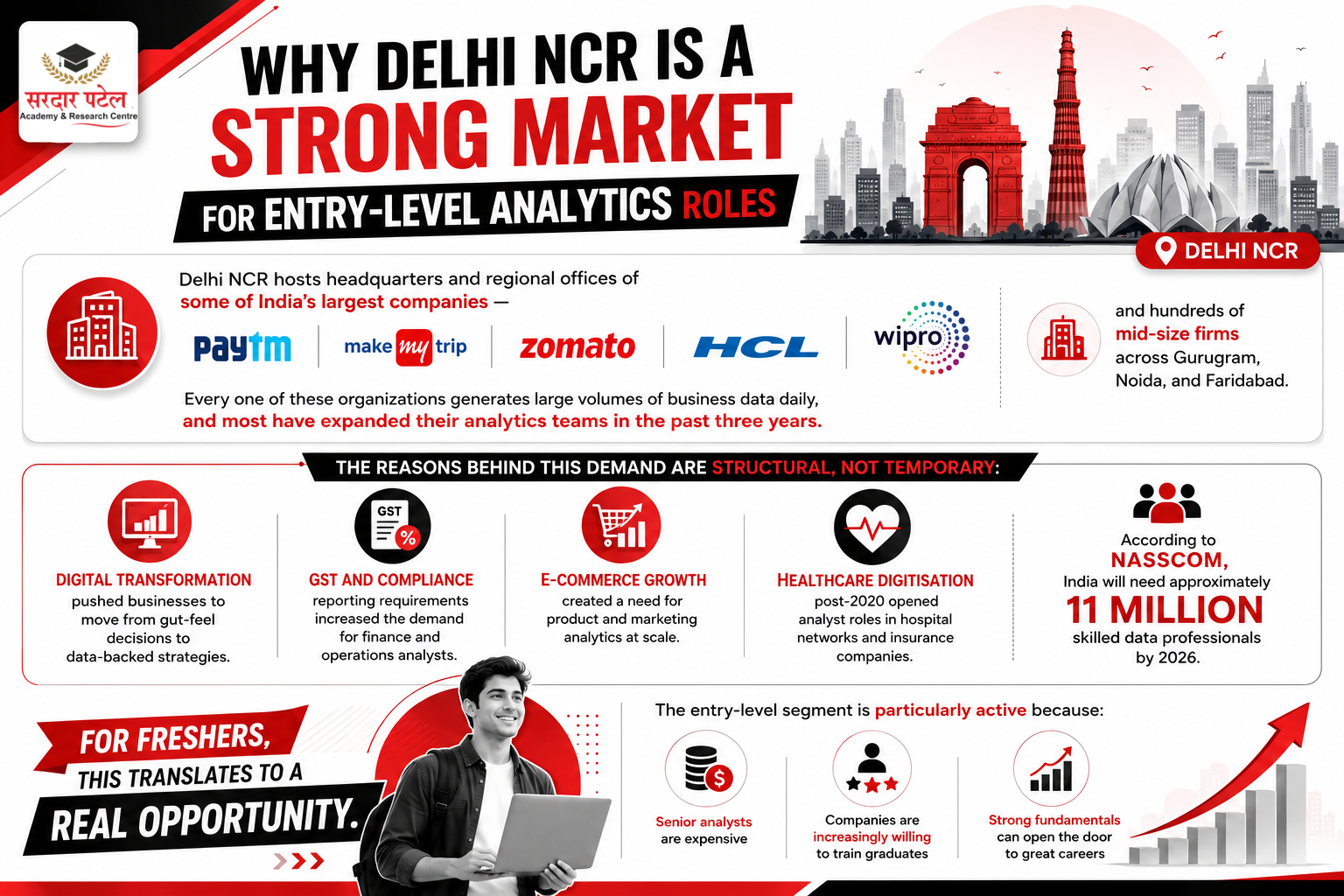
Delhi NCR hosts headquarters and regional offices of some of India's largest companies — Paytm, MakeMyTrip, Zomato, HCL, Wipro, and hundreds of mid-size firms across Gurugram, Noida, and Faridabad. Every one of these organizations generates large volumes of business data daily, and most have expanded their analytics teams in the past three years.
The reasons behind this demand are structural, not temporary:
- Digital transformation pushed businesses to move from gut-feel decisions to data-backed strategies
- GST and compliance reporting requirements increased the demand for finance and operations analysts
- E-commerce growth created a need for product and marketing analytics at scale
- Healthcare digitisation post-2020 opened analyst roles in hospital networks and insurance companies
According to NASSCOM, India will need approximately 11 million skilled data professionals by 2026, and Delhi NCR accounts for a significant share of current job postings in this category.
For freshers, this translates to a real opportunity. The entry-level segment is particularly active because senior analysts are expensive, and companies are increasingly willing to train graduates who show strong fundamentals.
Which Industries Are Actively Hiring Analysts in Delhi NCR?
Information Technology
IT companies — both product firms and service companies — form the largest single employer of analysts in Delhi NCR. Analysts here typically work on:
- Building and maintaining dashboards for internal teams
- Writing SQL-based reports for operations and product
- Conducting user behaviour analysis using web and app data
- Supporting business intelligence (BI) functions
Noida and Gurugram have dense clusters of IT firms, making them the easiest entry points for fresh graduates with technical skills.
Banking and Financial Services
Banks, NBFCs, and fintech companies use analysts extensively for risk management, fraud detection, and customer segmentation. According to AmbitionBox data, financial services is one of the highest-paying sectors for entry-level analysts in Delhi NCR, with average fresher packages ranging from ₹4.5 to ₹6.5 LPA.
Roles in this sector typically require stronger SQL and Excel skills, along with basic statistical knowledge.
E-commerce and Retail
Companies like Nykaa, Meesho, and regional e-commerce players have a significant presence in Delhi NCR. Analysts in this sector work on:
- Funnel analysis and conversion optimisation,
- Inventory forecasting and supply chain analytics
- Campaign performance tracking
- Customer lifetime value modelling
This sector tends to hire freshers who understand both tools and business context — someone who can look at a drop in conversion and ask why, not just chart it.
Healthcare
Apollo Hospitals, Max Healthcare, and several health-tech startups based in Delhi NCR hire analysts for patient data, operations reporting, and insurance analytics. This is one of the fastest-growing segments in analytics hiring, particularly since healthcare organisations began digitising patient records post-2020.
Digital Marketing Agencies
Delhi has a large ecosystem of digital agencies. Analysts here monitor SEO performance, manage Google Ads data, track social media metrics, and build client-facing dashboards. This is a practical entry point for freshers who want real-world exposure quickly, though salaries tend to be on the lower end of the spectrum initially.
How Delhi Companies Actually Hire: The Real Process
Understanding each stage helps you prepare more effectively and avoid common mistakes.
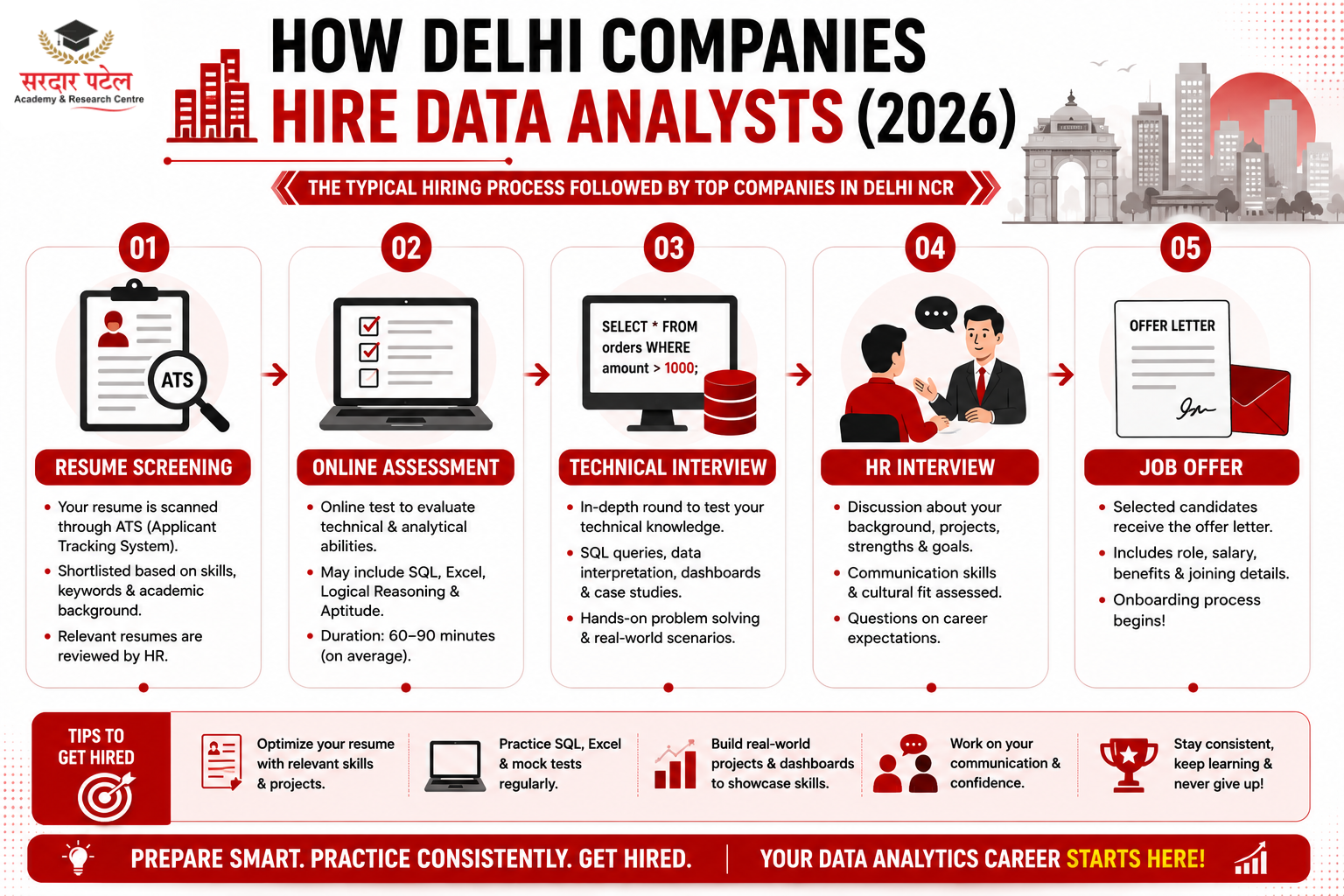
Stage 1 — Resume Screening (ATS Filter + Human Review)
Most mid-to-large companies in Delhi NCR use Applicant Tracking Systems (ATS) to filter resumes before a human ever reads them. Your resume needs to pass this filter first. Data Analyst Resume Guide
ATS systems scan for specific keywords: tool names (Power BI, SQL, Tableau), action verbs (analysed, built, visualised), and role-relevant terms. If these are missing, your resume may never reach a recruiter.
Beyond ATS, when a recruiter reviews your resume, they typically spend 6–10 seconds on the first scan. What they look for immediately:
- Tools listed clearly (Excel, SQL, Python, Power BI, Tableau)
- At least one data-related project with a business outcome mentioned
- Clean, uncluttered layout — no photos, no unnecessary design elements
- Quantified results where possible ("reduced report generation time by 40%").
Certifications matter less than projects. A Google Data Analytics Certificate, alongside zero projects, will be lost to someone with two solid portfolio projects and no certification.
Stage 2 — Online Assessment
Companies like HCL, Wipro, Genpact, and most mid-size analytics firms use online tests to screen large applicant pools. These typically cover:
- SQL queries — SELECT, WHERE, GROUP BY, JOINs, subqueries
- Excel functions — VLOOKUP, INDEX-MATCH, pivot tables, and conditional formatting
- Logical reasoning and data interpretation — reading charts, spotting patterns
- Basic statistics — mean, median, standard deviation, probability concepts
- Business aptitude — interpreting a scenario and choosing the most logical action
Freshers often underestimate this stage. Practising 20–30 SQL problems on platforms like HackerRank or LeetCode (easy/medium level) before applying significantly improves pass rates.
Stage 3 — Technical Interview
This is where most freshers either stand out or fall short. The interviewer is not just testing tool knowledge — they are evaluating how you think about business problems.
Common questions include:
- "Walk me through a project you've done. What was the business problem?""If sales dropped 20% last month, how would you investigate the cause?
- "Explain the difference between INNER JOIN and LEFT JOIN with an example.
- "You have a dashboard showing a high bounce rate on a product page. What would you do?
- Which visualisation would best show the month-over-month sales trend? Why?
"Notice that many of these questions are scenario-based, not just "define this term." Practising with real datasets and framing your projects around business outcomes — not just tool outputs — is what prepares you for this.
Stage 4 — HR and Culture Fit Interview
The HR round evaluates your communication, attitude, and alignment with the company. Frequently asked questions:
- Tell me about yourself (Keep this to 90 seconds — background, skills, one project, goal)
- Why data analytics?
- How do you handle tight deadlines or conflicting data?
- Where do you see yourself in 3 years?
One underrated tip: research the company before this round. Know what industry they're in, their main products, and if possible, what kind of data challenges that industry typically faces. Interviewers notice candidates who have done their homework.
Skills That Delhi Recruiters Are Actually Looking For in 2026
Based on analysis of active job postings on LinkedIn and Naukri for Delhi NCR analyst roles, here is what appears most frequently: Data Analytics Tools You Must Know
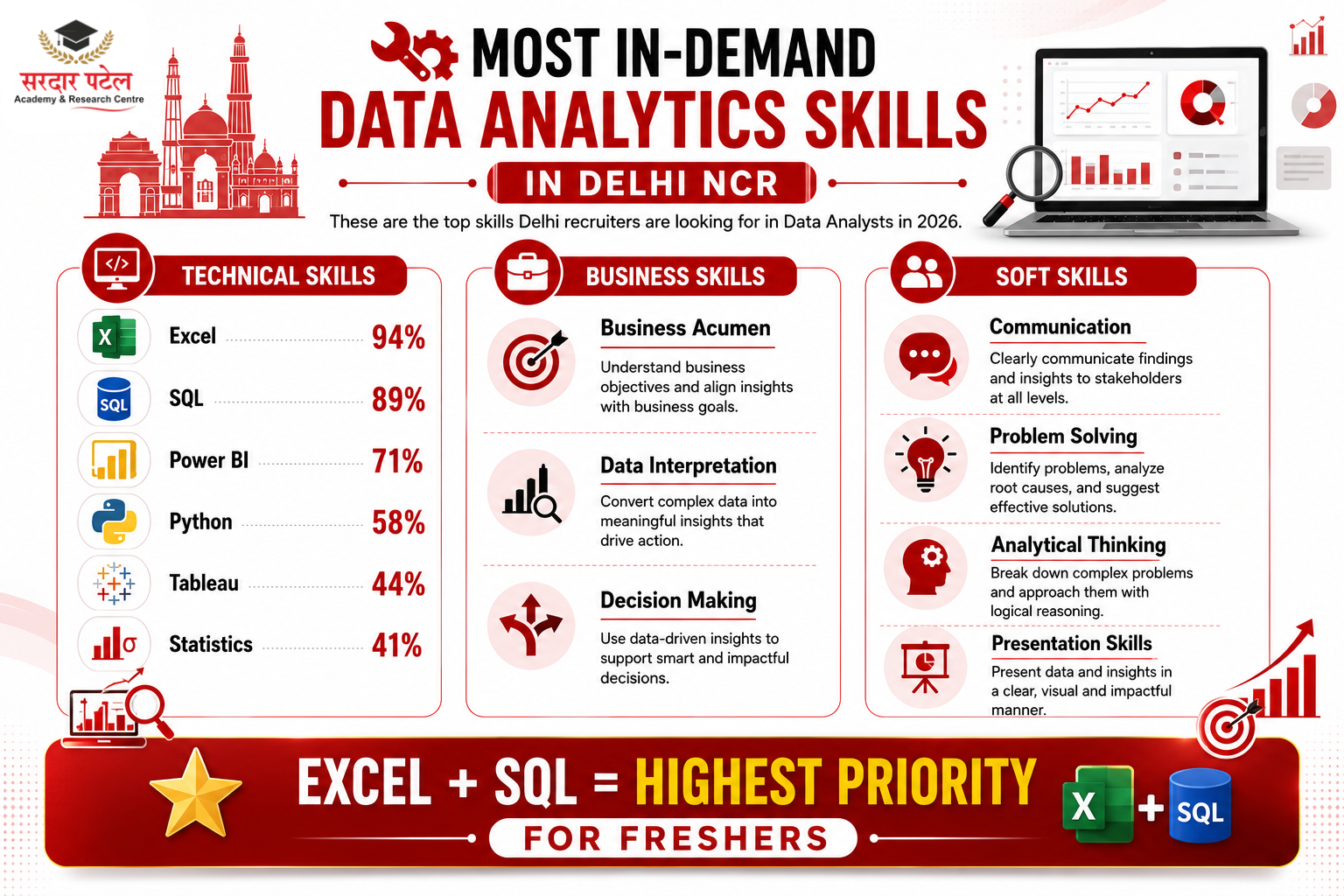
Technical Skills — by frequency of mention
| Skill |
% of Job Postings |
| Microsoft Excel |
94% |
| SQL |
89% |
| Power BI |
71% |
| Data Visualization |
65% |
| Python (basic) |
58% |
| Tableau |
44% |
| Statistics |
41% |
Excel and SQL are non-negotiable. Power BI has overtaken Tableau in Delhi NCR job postings over the past 18 months, largely because it integrates with Microsoft 365, which most corporate environments already use.
Business and Analytical Thinking
Recruiters increasingly mention "business acumen" in job descriptions — but what does that actually mean in practice?
It means being able to translate a data finding into a business recommendation. For example:
Instead of: "I found that sales in Q3 were lower."
A business-oriented answer: "Q3 sales dipped 18% in the North Delhi region. After segmenting by product category, I found premium SKUs underperformed while budget products held steady — suggesting a price sensitivity issue during that period."
This kind of thinking is what separates a data reporter from a data analyst in an interviewer's eyes.
Communication Skills
Analysts present to non-technical stakeholders — marketing heads, operations managers, finance directors. The ability to explain what a chart means in plain language, without jargon, is genuinely valued. Companies in Delhi NCR have noted a significant gap here: many technically strong candidates struggle to communicate insights clearly.
Salary Benchmarks for Freshers in Delhi NCR
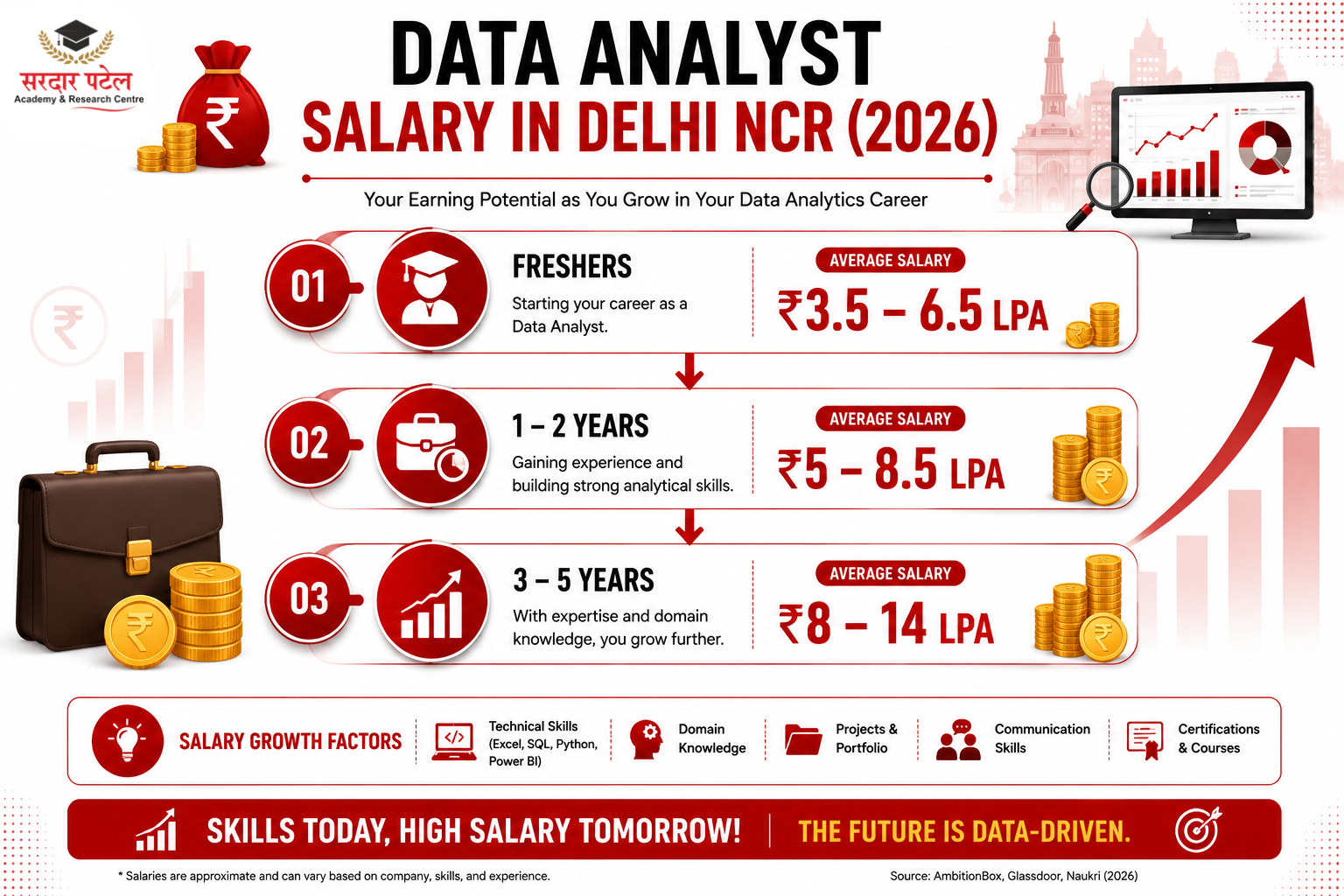
The following figures are based on data from AmbitionBox, Glassdoor India, and LinkedIn Salary Insights (Q1 2025, the most recent published benchmark available at the time of writing):
| Experience Level |
Average Annual Salary |
| Fresher (0–1 year) |
₹3.5 LPA – ₹6.5 LPA |
| 1–2 years |
₹5 LPA – ₹8.5 LPA |
| 3–5 years |
₹8 LPA – ₹14 LPA |
Want a detailed city-wise salary breakdown? Read our guide on Data Analyst Salary in Delhi for Freshers to understand salary trends, hiring companies, and career growth in Delhi NCR. Freshers with demonstrated Python skills and at least two portfolio projects typically land at the higher end of the fresher range. Domain specialisation — particularly in fintech or e-commerce analytics — also commands a premium.
Note: Salaries at IT service companies (Wipro, Infosys, HCL) tend to start at a lower level (₹3.5–4.5 LPA), while product companies and startups often offer ₹5–7 LPA for strong candidates.Data Analytics Career Scope, Skills & Salaries
How to Actually Become Job-Ready: A Practical Roadmap
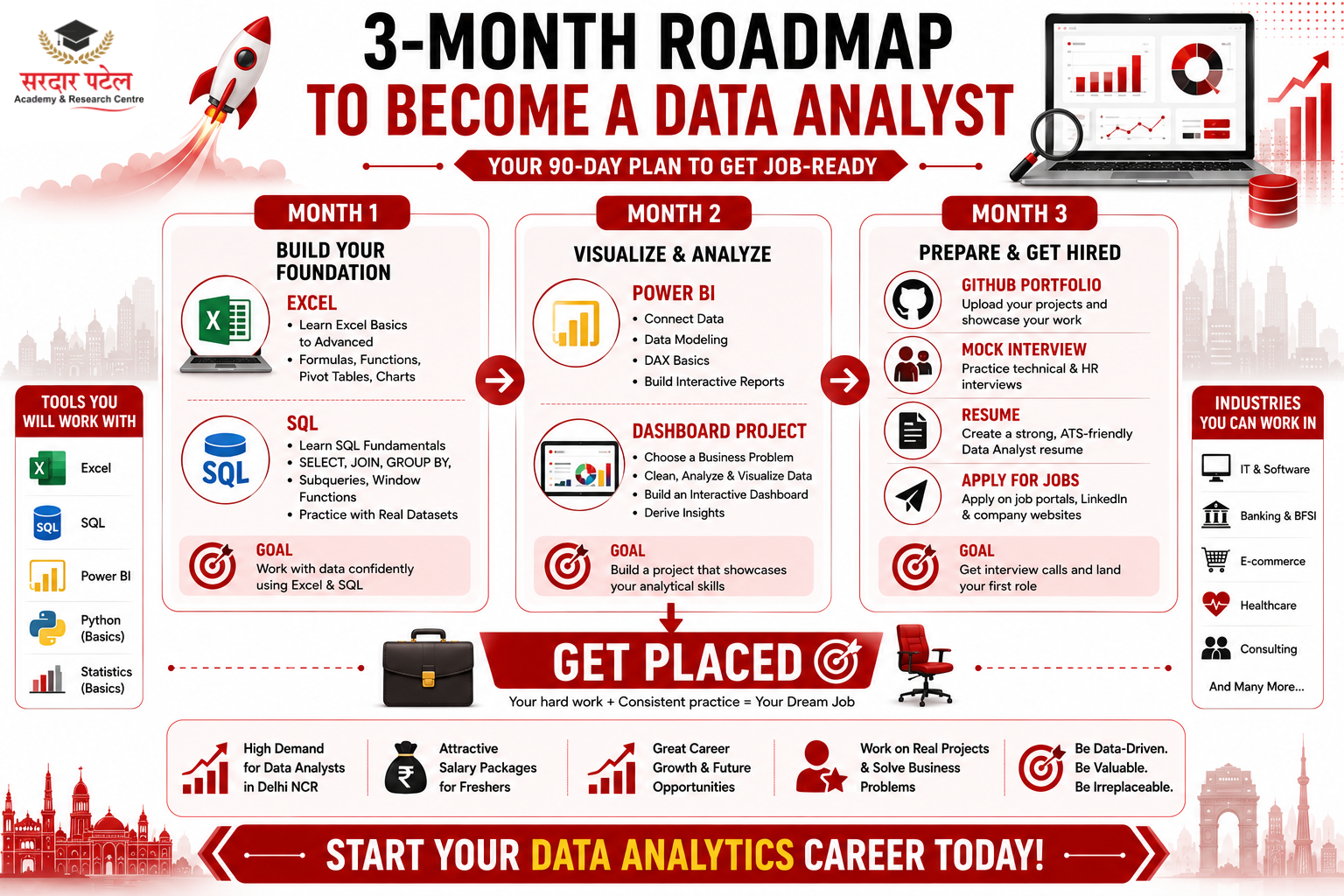
Month 1 — Build Your Technical Foundation
Focus on Excel and SQL first. These two skills appear in 89%+ of job postings and are tested in almost every online assessment.
For SQL: Practice writing queries on real datasets. HackerRank's SQL section (easy and medium difficulty) is a good benchmark. Focus on SELECT, WHERE, GROUP BY, HAVING, all JOIN types, subqueries, and window functions.
For Excel: Go beyond basic formulas. Practice pivot tables, VLOOKUP/INDEX-MATCH, conditional formatting, and building simple dashboards using charts and slicers.
Month 2 — Learn Power BI and Build Your First Project
Power BI is the most in-demand visualisation tool in Delhi NCR right now. Learn to connect data sources, create calculated columns and measures in DAX, and build interactive dashboards.
Your first project should solve a real business problem — even a hypothetical one. A sales performance dashboard, a customer churn analysis, or a marketing campaign tracker all work well. The key is to frame it around a business question, not just display data.
Month 3 — Polish Your Portfolio and Practice Interviews
Build 2–3 projects, each documented with: the business problem, your approach, key findings, and what you'd recommend to the business. Upload these to GitHub or a personal portfolio site.
Simultaneously, practice mock interviews — especially the scenario-based technical questions. The more comfortable you are explaining your thinking out loud, the better you perform in real interviews. You can also prepare using our SQL Interview Questions for Freshers guide, which covers common technical, HR, and scenario-based interview questions.
What Freshers Should Avoid
These mistakes appear consistently among candidates who struggle to get shortlisted or convert interviews:
- Listing skills you cannot demonstrate — If SQL is on your resume, expect SQL questions in the interview. Only list tools you can actually use.
- Projects without a business context — A dashboard is not impressive on its own. The business question it answers is what makes it memorable.
- Applying without researching the company — Even a 10-minute browse of the company's website, industry, and recent news noticeably improves interview performance.
- Neglecting communication — Technical ability gets you shortlisted; communication is often what converts an interview into an offer.
- Ignoring the ATS — sending a beautifully designed resume with text in image format or unusual fonts that the ATS cannot read means it never gets seen.
The Future of Analytics Hiring in Delhi NCR
AI tools like ChatGPT and Copilot are being integrated into analytics workflows, but they are not replacing analysts — they are changing what analysts spend their time on. Routine data cleaning and basic reporting are being automated, which means the human value-add is increasingly in interpretation, storytelling, and strategic recommendations.
For a deeper look at hiring trends, industry demand, and recruiter insights, explore our Online vs Offline Data Analytics Course in Delhi
This makes the communication and business thinking skills discussed above more important, not less. Companies hiring in 2026 and beyond will increasingly want analysts who can work with AI tools rather than compete against them.
Emerging areas seeing growing demand in Delhi NCR include cloud analytics (Azure, AWS), real-time dashboarding, and predictive analytics using Python — making these worth learning as you advance past the fresher level.
Read more: Latest SQL Trends for Data Analysts
A Fresher's Journey: From Training to Offer Letter
To make this practical, here's what this path actually looks like for one Delhi-based learner.
Ankit S.*, BCom graduate, North Delhi —
Ankit had no coding background and was unsure whether analytics was realistic for a commerce graduate. He started with structured Excel and SQL training, followed by Power BI, and built two projects: a sales dashboard for a fictional retail chain and an inventory forecasting model using a public dataset. Within a few months of consistent, project-based learning, he was appearing for online assessments and technical interviews at Delhi NCR firms — and secured an offer as a Junior Data Analyst at a Noida-based IT services company, with an Excel and SQL-heavy role that matched exactly what he had practised.
"The interview questions weren't theoretical — they were exactly like the practice scenarios. Knowing how to explain my project, not just build it, is what got me through the technical round." — Ankit S.*
*Name changed for privacy.
Build Your Analytics Career at SPARC
If you're based in Delhi NCR and want structured, practical training rather than trying to piece this roadmap together on your own, Sardar Patel Academy & Research Centre (SPARC) in GTB Nagar, Delhi, offers a Data Analytics Course built around exactly the hiring process described in this guide, covering Excel, SQL, Power BI, Python, real-world projects, and placement preparation. Data Analytics Course Eligibility and Career Opportunities
SPARC's training includes:
- Hands-on projects mapped to the kind of scenario-based questions Delhi recruiters actually ask
- Resume building aligned with what ATS systems and recruiters scan for
- Mock technical and HR interviews to prepare for both rounds covered in this guide
- Placement assistance to help you move from training into an actual analytics role
SPARC has trained and placed students across Delhi NCR for over 20 years, with 7,500+ students placed to date.
📞 +91 93129-66129 | 📍 GTB Nagar, North Delhi
Conclusion
Delhi NCR offers genuine career opportunities for freshers who approach analytics the right way. The hiring process is structured — resume screening, online assessment, technical interview, HR round — and each stage tests something specific. Understanding what recruiters are actually evaluating at each stage is the most direct way to improve your outcomes.
The skills that matter most right now are SQL, Excel, Power BI, and the ability to frame data findings as business insights. These are learnable skills. Candidates who combine technical ability with clear communication and real project experience are consistently getting hired, regardless of their academic background.
Sources: LinkedIn India Jobs on the Rise, NASSCOM Analytics Report, AmbitionBox Salary Data, Glassdoor India, Naukri Job Posting Analysis.
Editorial note: A few figures in this guide — the year-on-year growth rate for Delhi NCR analyst roles, the exact NASSCOM 11-million-by-2026 figure, Delhi NCR's specific share of job postings, and the internal count of job postings analyzed — are cited from third-party industry reports and should be re-checked against the latest published source figures before this piece goes live, since exact percentages can shift between report editions.
| Ready to begin your analytics journey? Visit SPARC to explore our industry-focused training programs, upcoming batches, and placement support. |
FAQs
Yes. Delhi NCR consistently ranks among the top cities in India for analytics job postings on Naukri and LinkedIn. IT, fintech, e-commerce, and healthcare are the most active sectors for fresh graduates.
Not always. SQL and Excel are more commonly required. Python appears in about 58% of postings and is a strong differentiator, but many companies are willing to hire freshers who demonstrate solid SQL + Power BI skills and train them on Python.
Power BI is currently more in demand in Delhi NCR, appearing in 71% of postings versus 44% for Tableau. This is partly because most Delhi NCR companies use Microsoft tools across their organization. Learn Power BI first; add Tableau later if your target companies require it.
Yes. Commerce, economics, and even arts graduates have successfully transitioned into analytics roles. The key is building technical skills (SQL, Excel, Power BI) and demonstrating them through projects — your degree matters less than what you can show in an interview.
In practice, many Delhi NCR companies use these titles interchangeably at the fresher level. Business analyst roles tend to include more stakeholder communication and requirement gathering, while data analyst roles lean more technical. Both require SQL, Excel, and visualization skills.
Based on Naukri and LinkedIn postings, consistent fresher hirers include Genpact, HCL Technologies, EXL Service, WNS, Paytm, and several mid-size analytics consulting firms in Gurugram and Noida.