+91 9312966129
 sparc.enquiry01@gmail.com


Digital Marketing Jobs for Commerce Students
Explore digital marketing jobs for commerce students — best roles, salary ranges, and career options after BCom. Find your commerce-friendly career path.
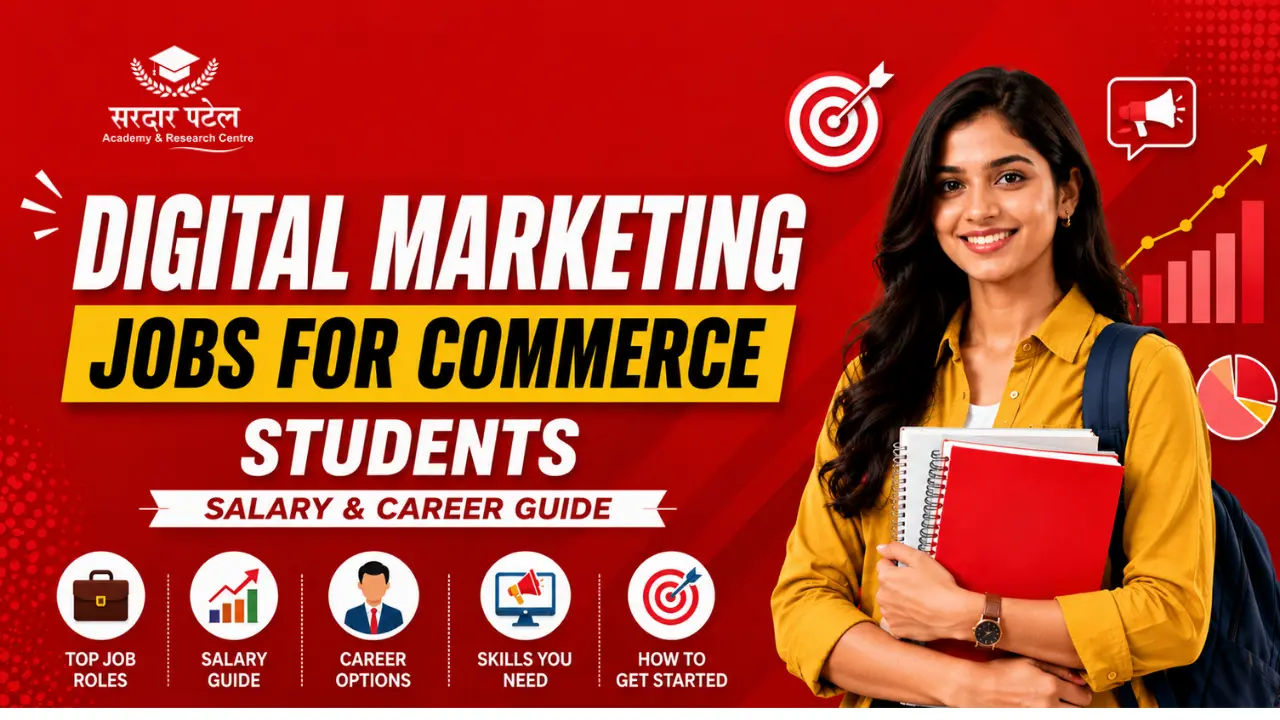
Table of Contents
- Why Commerce Students Are a Good Fit for Digital Marketing
- Transferable Skills from a BCom Background
- Digital Marketing vs. Traditional Commerce Careers
- Top Digital Marketing Jobs for Commerce Students
- Roles Suited to Numbers-Driven Graduates
- Roles Suited to Communication-Driven Graduates
- Digital Marketing Job Roles for Commerce Graduates
- Career Options After BCom in Digital Marketing
- Direct Entry Roles
- Certification-Backed Roles
- Higher Education Path: MBA vs. Certification
- Salary Expectations for Commerce Graduates in Digital Marketing
- Approximate Salary by Career Stage
- How a Commerce Background Affects Starting Pay
- Skills Commerce Students Need to Build for Digital Marketing
- The Skills Gap Most Commerce Students Have
- How to Start a Digital Marketing Career Right After BCom
- Step 1: Pick a Specialisation Based on Your Strengths
- Step 2: Get a Foundational Certification with Live Projects
- Step 3: Build a Portfolio Through Internships or Freelance Work
- Conclusion
Every year, over 9 lakh students in India complete a BCom degree, and a large share of them spend the final year asking the same question: what next? Accounts, taxation, and banking are the obvious paths, but they are not the only ones. Digital marketing jobs for commerce students have quietly become one of the fastest-growing entry points into the workforce, precisely because a commerce background already gives you half the skill set most marketing teams are hiring for — numbers, budgets, and business fundamentals.
This guide breaks down which roles suit commerce graduates best, what career options after BCom in digital marketing actually look like in practice, what they pay, and how to get job-ready without starting from zero.
Why Commerce Students Are a Good Fit for Digital Marketing
Marketing today runs on numbers as much as creativity. Ad budgets, conversion rates, cost-per-click, and return on ad spend are all things a commerce graduate is already comfortable reading.
Transferable Skills from a BCom Background
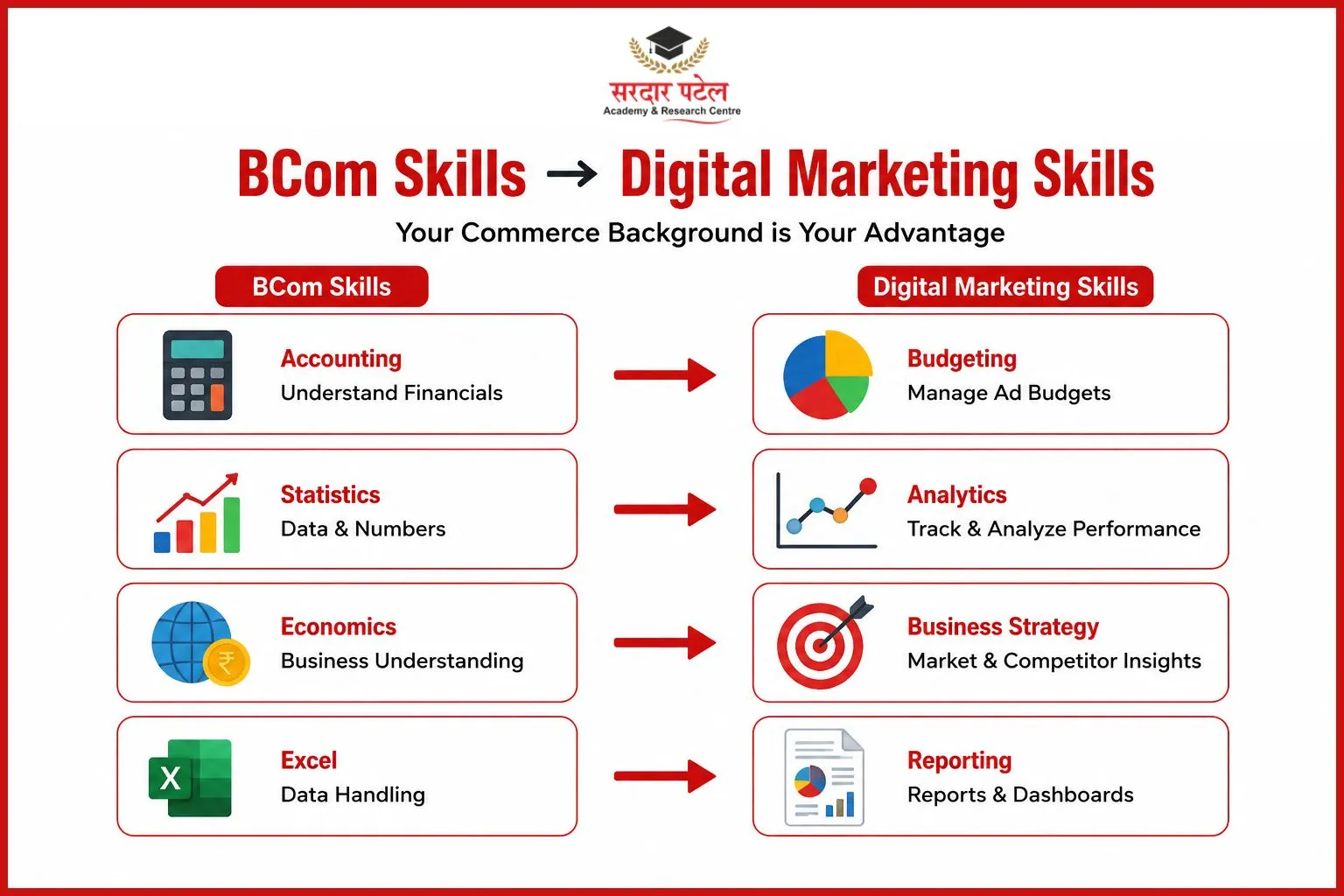
Subjects like business statistics, financial accounting, and business economics train you to read data, work within budgets, and understand how a business makes money — all of which map directly onto performance marketing, campaign budgeting, and e-commerce roles. Commerce students also tend to be stronger with Excel and basic reporting than students from purely creative backgrounds, which is a real advantage in marketing roles that involve tracking campaign performance.
Digital Marketing vs. Traditional Commerce Careers
Chartered Accountancy and banking remain solid, well-paying paths, with fresh CAs starting around ₹6–9 LPA and banking roles offering long-term stability (Source: Kraftshala Career Report, 2026). But these routes typically require multi-year exam cycles or slow-moving promotion ladders. Digital marketing, by contrast, lets a BCom graduate start earning within months of a focused certification, with faster early-career salary growth for those who build a specialised skill.
Can a commerce student do digital marketing?
Yes — commerce students are well-suited to digital marketing because their coursework in accounting, statistics, and economics already builds the analytical and budgeting skills that roles like performance marketing and e-commerce management require.
Top Digital Marketing Jobs for Commerce Students
Not every digital marketing job needs the same strengths. Broadly, commerce graduates tend to do well in two clusters of roles.
Roles Suited to Numbers-Driven Graduates
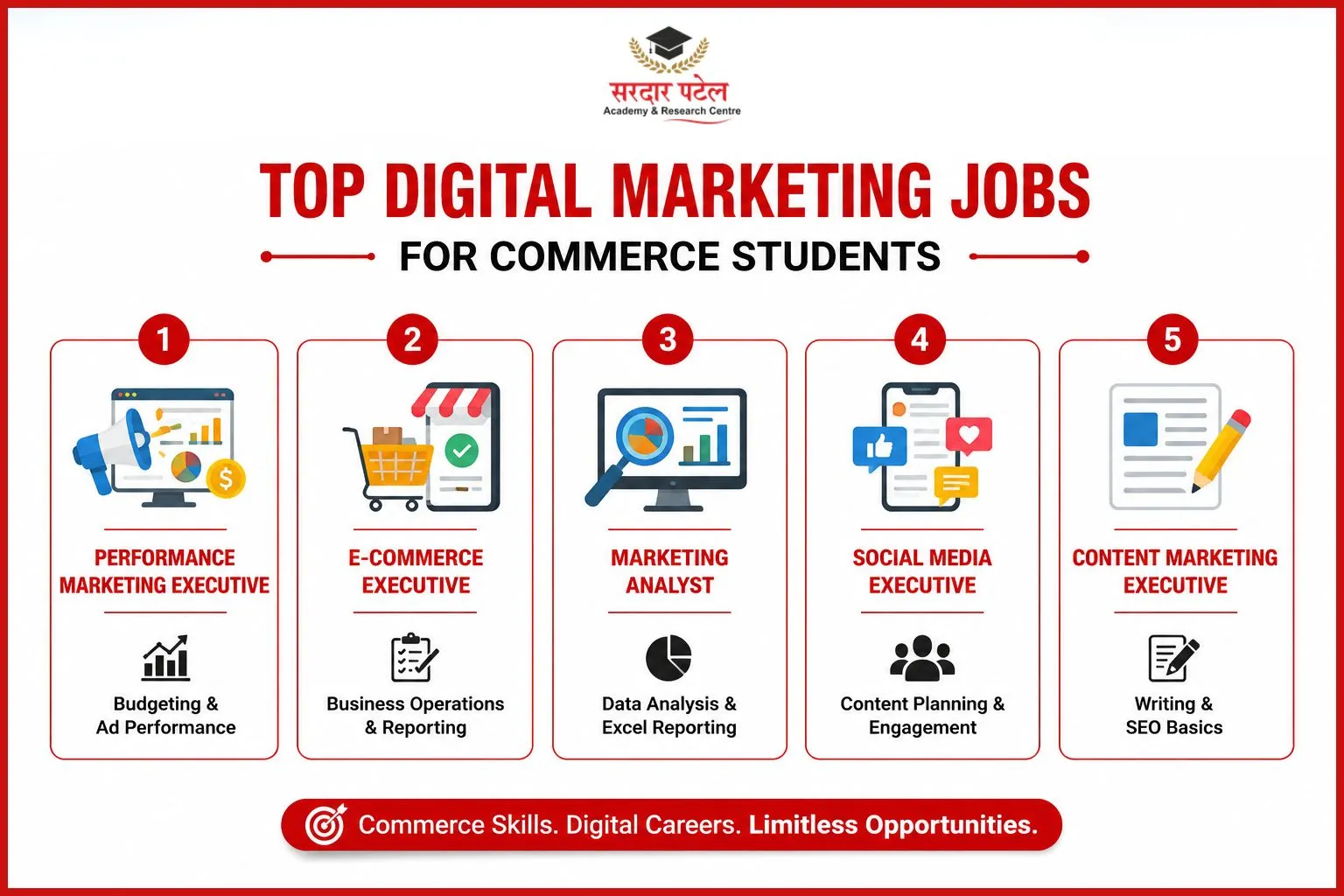
Performance Marketing Executive, Marketing Analyst, and E-commerce Executive roles lean heavily on budgeting, reporting, and campaign-data analysis — a natural extension of commerce training.
Roles Suited to Communication-Driven Graduates
Social Media Executive, Content Marketing Executive, and Email Marketing Executive roles suit commerce students who are stronger communicators than number-crunchers, and want to apply business understanding to brand messaging.
Digital Marketing Job Roles for Commerce Graduates
| Source: Role demand compiled from Naukri.com and LinkedIn Jobs listings, 2026 |
Career Options After BCom in Digital Marketing
There is more than one route into this field, depending on how much time and money you want to invest before your first job.
Direct Entry Roles
Some entry-level roles, particularly in social media and content support, hire BCom freshers directly and train them on the job, though a short course still improves your shortlisting chances significantly. Exploring job roles after completing a digital marketing course can also help you understand which positions best match your skills and career goals.
Certification-Backed Roles
Roles in SEO, paid advertising, and analytics almost always expect a certification with hands-on project work, since these are considered specialised, tool-heavy functions that employers don't expect you to pick up informally.
Higher Education Path: MBA vs. Certification
An MBA in Marketing builds strategic and leadership skills over one to two years and suits students aiming for managerial roles eventually, but it is a slower and costlier route. A focused digital marketing certification with live projects can make you job-ready in as little as three to six months, which is why recruiters increasingly hire based on demonstrated skills rather than degree level alone (Source: Kraftshala Career Report, 2026).
Do you need an MBA for a digital marketing career after BCom?
No — an MBA can help for leadership-track roles later, but most entry and mid-level digital marketing jobs value a certification backed by live projects and a strong portfolio over a management degree.
Salary Expectations for Commerce Graduates in Digital Marketing
Pay in this field depends heavily on specialisation and whether your training included real campaign experience. For a more detailed breakdown of entry-level compensation, check the digital marketing salary in Delhi for freshers guide
Approximate Salary by Career Stage
| Source: AmbitionBox, Naukri.com, and Boston Institute of Analytics salary data, 2026 |
How a Commerce Background Affects Starting Pay
E-commerce, fintech, and D2C brands specifically value candidates who understand margins, pricing, and business reporting, which means commerce graduates entering performance marketing or e-commerce roles often start slightly ahead of peers from non-commerce backgrounds in these sectors.
Skills Commerce Students Need to Build for Digital Marketing
A BCom degree covers the business fundamentals, but a few technical gaps usually need to be closed before you're job-ready.
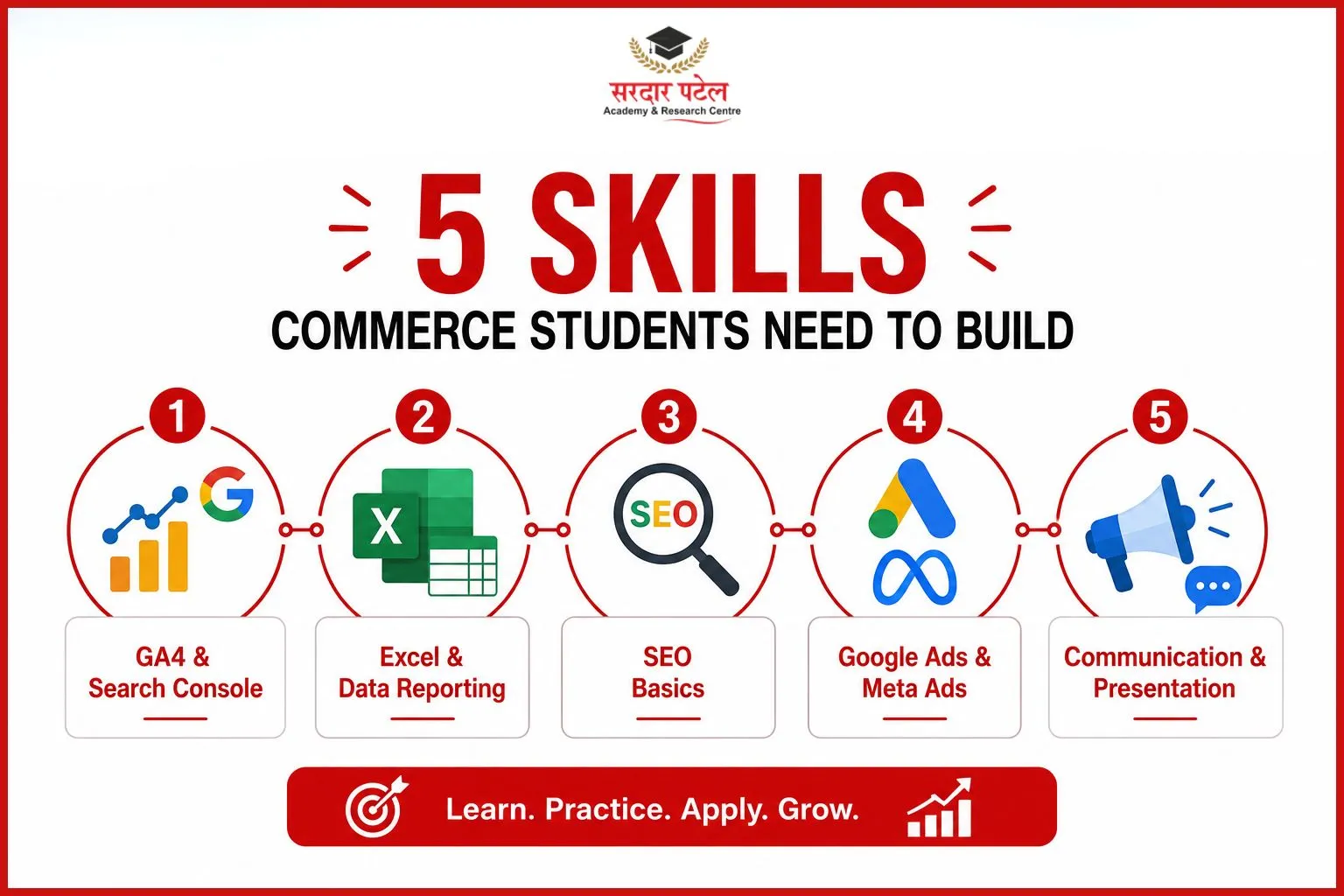
- Google Analytics and Search Console: to read website and campaign performance, building directly on your existing comfort with data.
- Excel/data reporting: already a commerce strength, but applied specifically to marketing dashboards and campaign reports.
- Basic SEO knowledge: understanding how content and websites rank on search engines.
- Ad platform basics: Google Ads and Meta Ads Manager, for anyone leaning toward performance marketing.
- Written and verbal communication: especially important for content, social media, and client-facing roles.
The Skills Gap Most Commerce Students Have
Most BCom graduates are strong on the business and numbers side but have had no formal exposure to marketing tools or platforms, which is the single biggest gap a short, project-based certification course is designed to close. Understanding the skills you learn in a digital marketing course can help commerce students identify and build these missing capabilities.
How to Start a Digital Marketing Career Right After BCom
Step 1: Pick a Specialisation Based on Your Strengths
If you enjoy numbers and budgets, lean toward performance marketing or analytics. If you enjoy writing and storytelling, lean toward content or social media.
Step 2: Get a Foundational Certification with Live Projects
Look for a programme that includes real campaigns, not just recorded lectures, so you graduate with practical, demonstrable skills rather than theory alone.
Step 3: Build a Portfolio Through Internships or Freelance Work
Even one or two real projects — managing a small social media page, running a mock ad campaign, or auditing a website's SEO — give you something concrete to show recruiters beyond your degree and certificate. These practical experiences can also help you build confidence for interviews when discussing your skills and projects.
Commerce students who follow this three-step sequence typically move from certification to their first digital marketing role within three to six months, according to placement patterns reported by multiple Delhi-based training institutes in 2026.
Conclusion
A BCom degree gives you a strong foundation in numbers, business, budgeting, and analysis—but adding digital marketing skills can open up a much wider range of career opportunities. Whether you choose performance marketing, SEO, e-commerce, analytics, or social media, the key is to build practical skills that employers can actually evaluate. A structured programme with live projects, hands-on tool training, internship exposure, and placement support can make that transition much easier. If you’re ready to turn your commerce background into a job-ready marketing skill set, explore SPARC’s Digital Marketing Course in Delhi and see how practical training can help you take the next step toward a digital marketing career.
FAQs
Yes, digital marketing is one of the fastest-growing career options after BCom, offering quicker entry into paid roles compared to routes like CA or banking, with strong long-term growth for those who specialise.
Performance marketing and e-commerce roles suit commerce students particularly well, since both rely heavily on budgeting, reporting, and data interpretation — skills already built during a BCom degree.
No, most digital marketing roles do not require coding. Basic familiarity with tools like Google Analytics, Meta Ads Manager, and SEO platforms is far more relevant than programming knowledge.
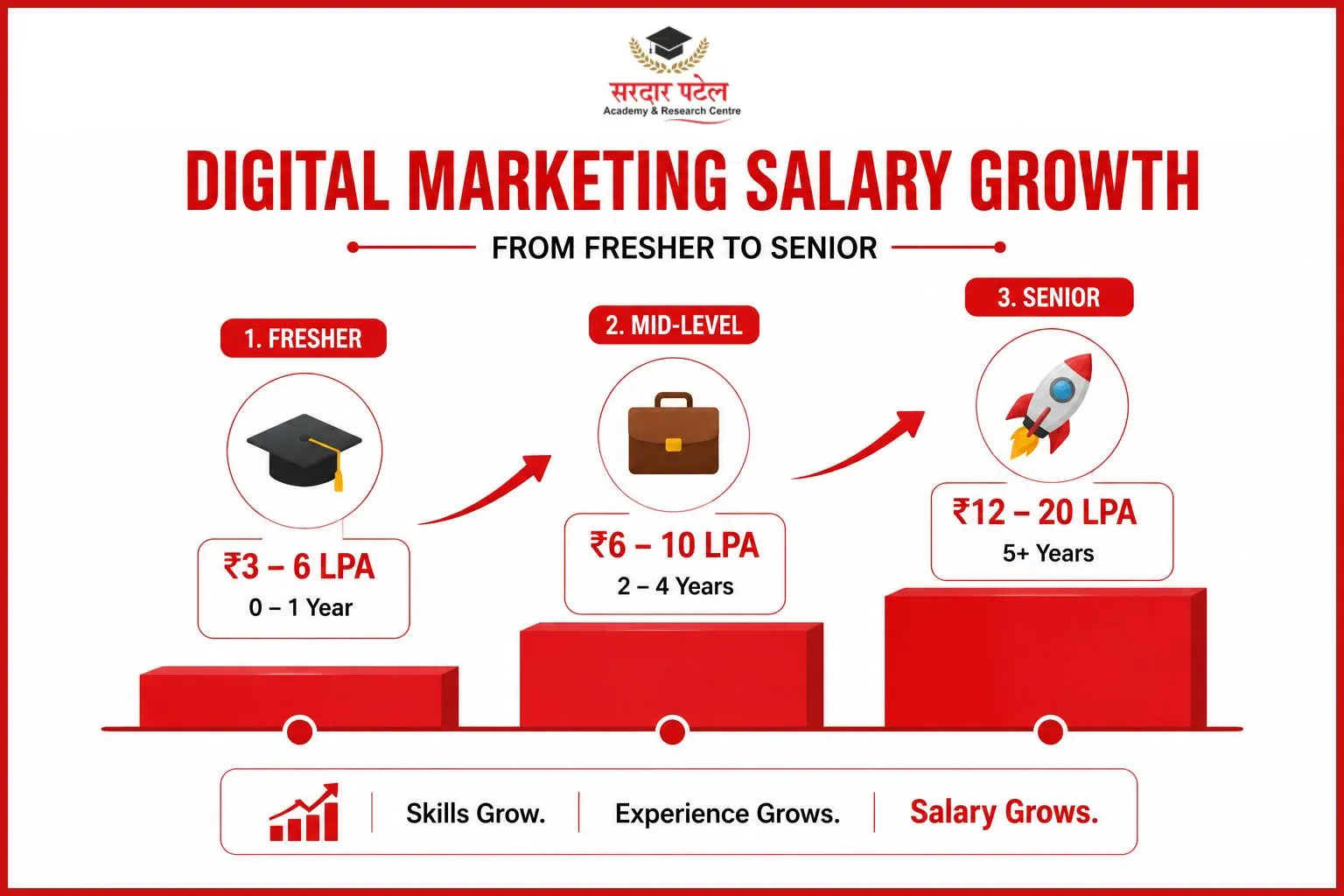
Fresher salaries typically range between ₹3–6 LPA, depending on the specific role, city, and whether the candidate has completed a certification with live project experience.
No, an MBA is not mandatory. Most entry and mid-level roles prioritise practical skills and a strong portfolio; an MBA becomes more relevant later for leadership or strategy-focused positions.
Yes, commerce students are particularly well-suited to performance marketing and analytics roles, given their existing comfort with budgets, numbers, and business reporting from their coursework.
Digital marketing focuses on customer acquisition, campaigns, and brand growth, while finance and accounts careers focus on managing, recording, and reporting a company's financial transactions — the required skill sets only partially overlap.
A foundational digital marketing certification covering SEO, social media, Google Ads, and analytics is a good starting point, followed by a specialisation once you know which area you enjoy most.
Digital marketing is a growing field with consistent hiring demand across industries, though like most modern careers, staying updated with tools and trends is necessary to maintain long-term stability.
Yes, most digital marketing certification programmes are designed for beginners and do not require prior marketing experience, making the switch accessible directly after a BCom degree.