+91 9312966129
 sparc.enquiry01@gmail.com


Accounting Skills Employers Look for in Freshers
Learn the accounting skills for freshers that employers look for, from Tally and Excel to GST basics, with a practical checklist and six-week plan.
Table of Contents
- What Employers Expect from Entry-Level Accounting Candidates
- Core Technical Skills Tested First
- Bookkeeping and the Accounting Cycle
- Reading Financial Statements
- GST and TDS Basics
- Awareness of Accounting Standards
- Software and Tools That Make You Job-Ready
- Tally Prime
- Microsoft Excel
- Workplace Skills That Often Decide the Offer
- Job-Ready Accounting Skills Checklist
- A Six-Week Plan to Build These Skills
- Common Mistakes Freshers Make
- Career Scope: Where These Skills Lead
- Conclusion
Most commerce graduates walk into interviews having revised debit and credit rules the night before. Then the interviewer asks them to reconcile a small bank statement, explain a mismatch in a GST return, or tidy a messy expense sheet in Excel, and the confidence disappears. It usually comes from not knowing which accounting skills for freshers actually count inside a working finance team.
This guide sorts out what employers genuinely test and what only looks good on a resume. You will find a checklist of accounting skills for freshers, a table linking each skill to a real workplace task, and a six-week plan. It suits B.Com graduates, CA Inter students, and career switchers.
What Employers Expect from Entry-Level Accounting Candidates
Nobody expects a fresher to run a month-end close alone. What hiring managers look for is proof that you can be trained quickly and trusted with routine work. That routine work is the backbone of any accounts team: booking vouchers, matching purchase invoices with payments, chasing pending bills, and preparing data for seniors who handle the final review.
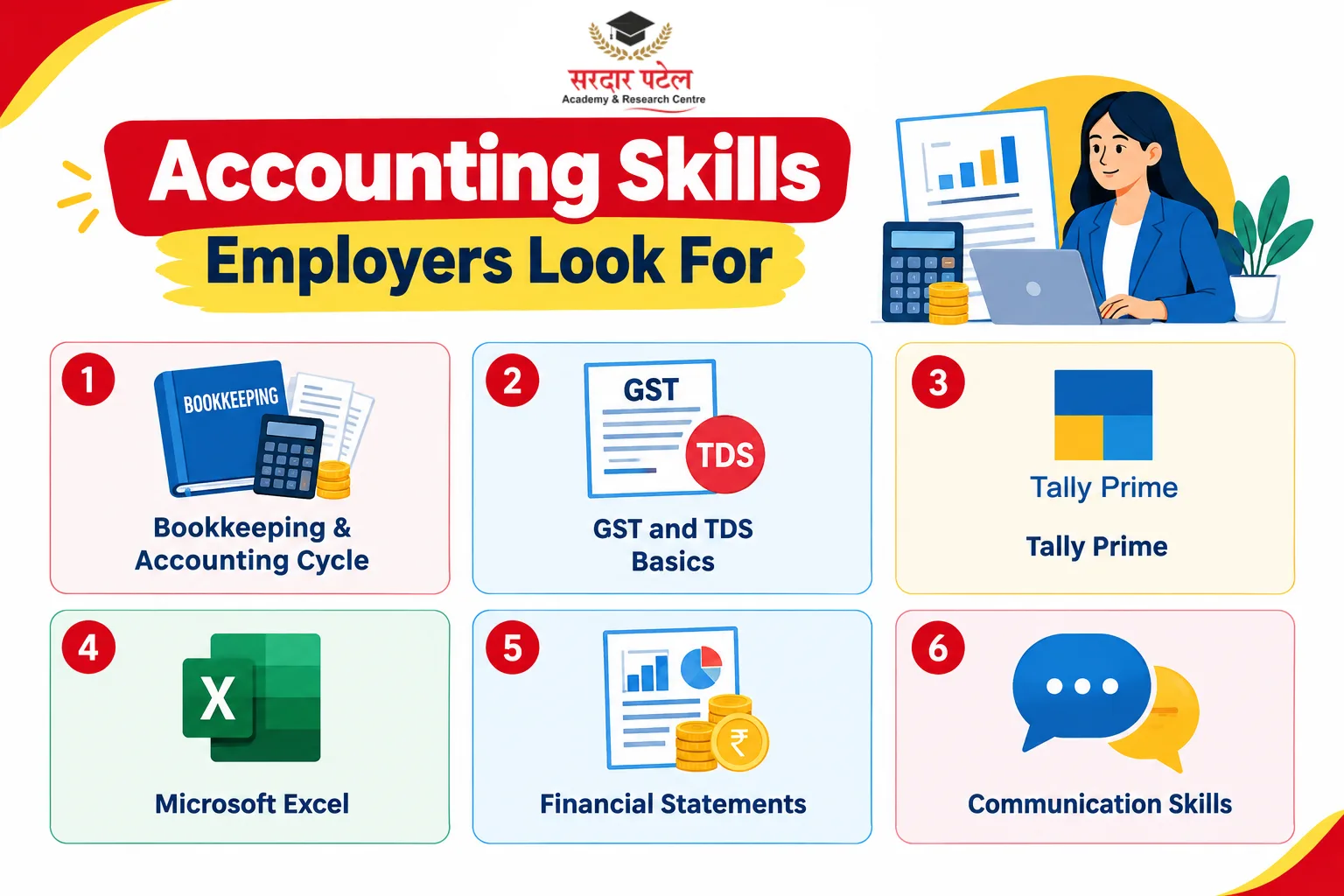
Because of that, the accounting skills employers want at entry level usually fall into three layers:
- Technical accuracy: you understand how a transaction travels from voucher to ledger to financial statement.
- Tool fluency: you can work in accounting software and spreadsheets without constant hand-holding.
- Reliability: you meet deadlines, ask sensible questions, and flag errors early.
Together, these make up the fresher accountant skills that screening rounds are designed to uncover. In most firms, the accounting skills for freshers that impress most are the ones you can demonstrate in ten minutes, not the ones merely listed on a resume.
Core Technical Skills Tested First
These are the accounting skills for freshers that almost every employer checks first, whatever the industry.
Bookkeeping and the Accounting Cycle
You should be able to take a raw transaction, identify the accounts involved, apply debit and credit rules, post to the ledger, and carry the result into a trial balance. A candidate who explains why cash falls when rent is paid, instead of reciting a rule, usually stands out.
Practise the whole cycle and give bank reconciliation extra time, because nearly every accounts team performs it every month.
Reading Financial Statements
A fresher who can read a balance sheet and a profit and loss account is more useful than one who can only prepare them from a textbook problem. Explaining the current ratio or gross margin in plain language is enough on day one.
GST and TDS Basics
In India, tax handling is part of everyday accounting, not a specialisation reserved for seniors. GSTR-1 reports outward supplies, while GSTR-3B is a self-declared summary return that carries the tax payment; this guide to GSTR-3B explains how the two differ. Mismatches between them are a classic reconciliation task handed to juniors. Add input tax credit, e-invoicing basics, and the TDS deduction and deposit cycle described in the Income Tax Department's TDS guidance, and you will be ahead of many applicants.
Software has blurred the line between bookkeeping and compliance. Tally's own GST resources for chartered accountants show how return preparation now sits inside everyday accounting tools, which is why employers expect juniors to understand it.
Awareness of Accounting Standards
It helps to know why two frameworks exist. Ind AS, notified by the Ministry of Corporate Affairs, applies to specified classes of companies, while other entities follow Accounting Standards. ICAI's overview of Ind AS is a readable starting point.
Software and Tools That Make You Job-Ready
Among all accounting skills for freshers, software comfort is the easiest to improve, because progress is measurable. For a wider view beyond this checklist, see our guide to the top software skills every accountant should know.
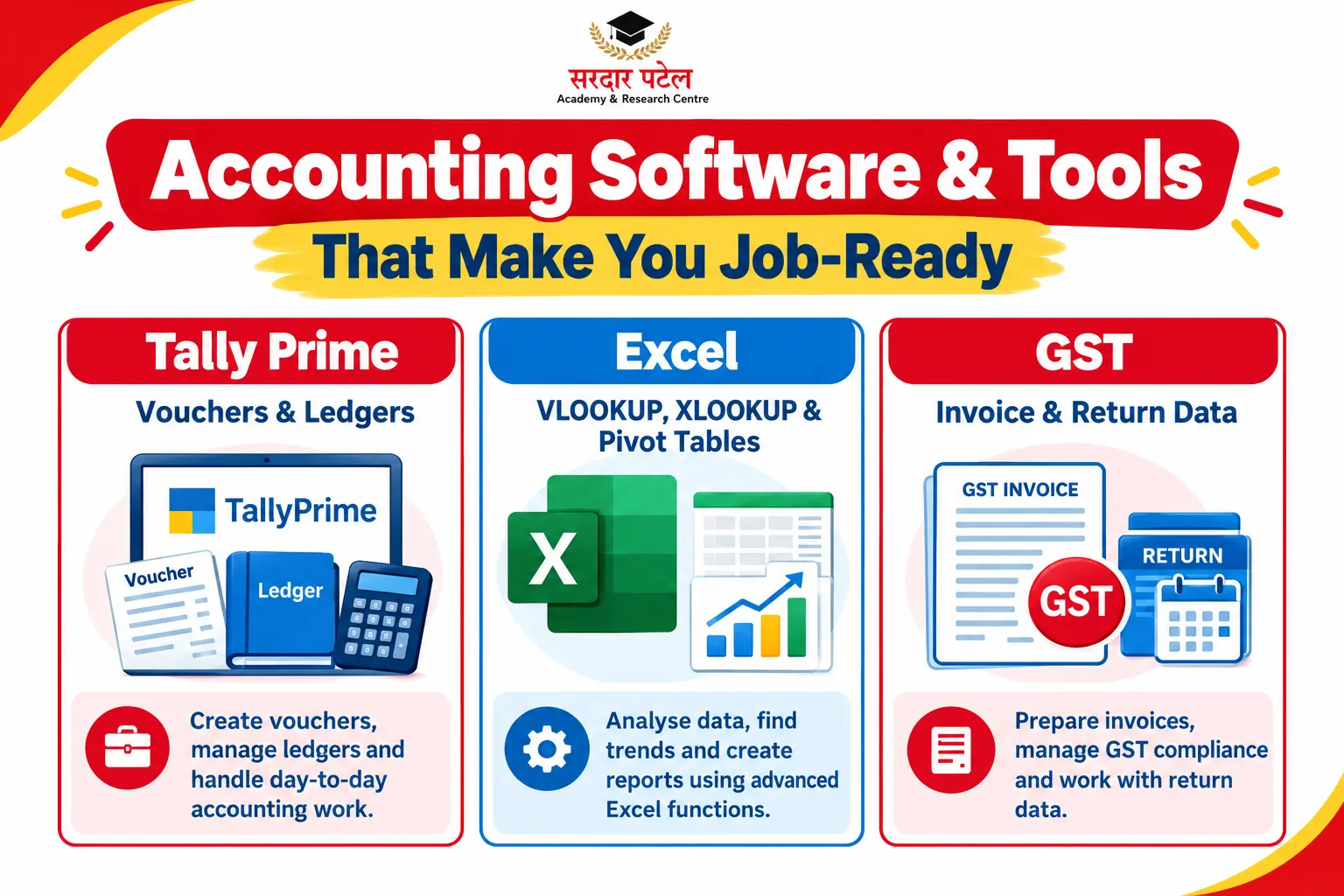
Tally Prime
For most small and mid-sized Indian businesses, Tally remains a default accounting tool. Employers expect you to create a company, set up ledgers and groups, pass sales, purchase, receipt, payment, and journal vouchers, generate reports, and handle GST ledgers. Our guide to the Tally Prime skills every fresher should learn before applying for jobs lists the exact features worth practising.
Here is a quick self-test. Record ten purchase invoices at different GST rates, include one purchase return, and check whether your input credit ledger agrees with the invoices. If not, you have found a gap to fix.
Microsoft Excel
Excel is the second language of every finance team and a core part of fresher accountant skills. Prioritise SUMIFS, IF, VLOOKUP or XLOOKUP, pivot tables, data validation, text clean-up functions and basic charts. One practical note: Microsoft states that XLOOKUP is not available in Excel 2016 and Excel 2019, so learn VLOOKUP as well, since many offices still run older versions.
Practise on a small expense dataset: clean it, summarise it, and reconcile two columns.
Workplace Skills That Often Decide the Offer
Technical ability is only half of what companies weigh when assessing accounting skills for freshers.
- Attention to detail. A transposed digit in an invoice number can cost hours later.
- Clear written communication. Emails to vendors and queries to seniors should be short and specific.
- Time management. Accounting runs on deadlines such as GST due dates, payroll cut-offs, and month-end closing.
- Confidentiality. You will see salary data and unreleased numbers. Discretion is part of the job.
- Willingness to learn. Saying "I haven't done this, but here is how I would approach it" beats bluffing every time.
Interviewers often test accounting skills for freshers through scenarios. Suppose a vendor says an invoice is unpaid, but your books show it as paid. A strong answer checks the payment voucher, the bank statement, and the vendor ledger in that order, then replies to the vendor with facts. Process beats panic.
Job-Ready Accounting Skills Checklist
Use the table below to see where you stand on accounting skills for freshers. It links each of the accounting skills employers want to the task you will perform in your first months.
| Skill area |
What you should be able to do |
Typical first-year task |
Priority |
| Bookkeeping |
Pass entries, post ledgers, prepare a trial balance |
Daily voucher entry |
Essential |
| Bank reconciliation |
Match statement with cash book and explain differences |
Monthly bank reconciliation |
Essential |
| Tally Prime |
Create ledgers, vouchers and reports |
Routine accounting in software |
Essential |
| Excel |
Lookups, pivots, conditional sums |
Reports and reconciliations |
Essential |
| GST basics |
Handle invoices, input credit and return data |
Support for return preparation |
Essential |
| TDS basics |
Know deduction, deposit and rate logic |
Vendor and salary payments |
Important |
| Financial statements |
Read and explain a balance sheet and P&L |
Support for management reports |
Important |
| Data analytics basics |
Clean data, build simple dashboards |
MIS reporting |
Growing |
| Communication |
Write clear queries and status updates |
Vendor and auditor coordination |
Essential |
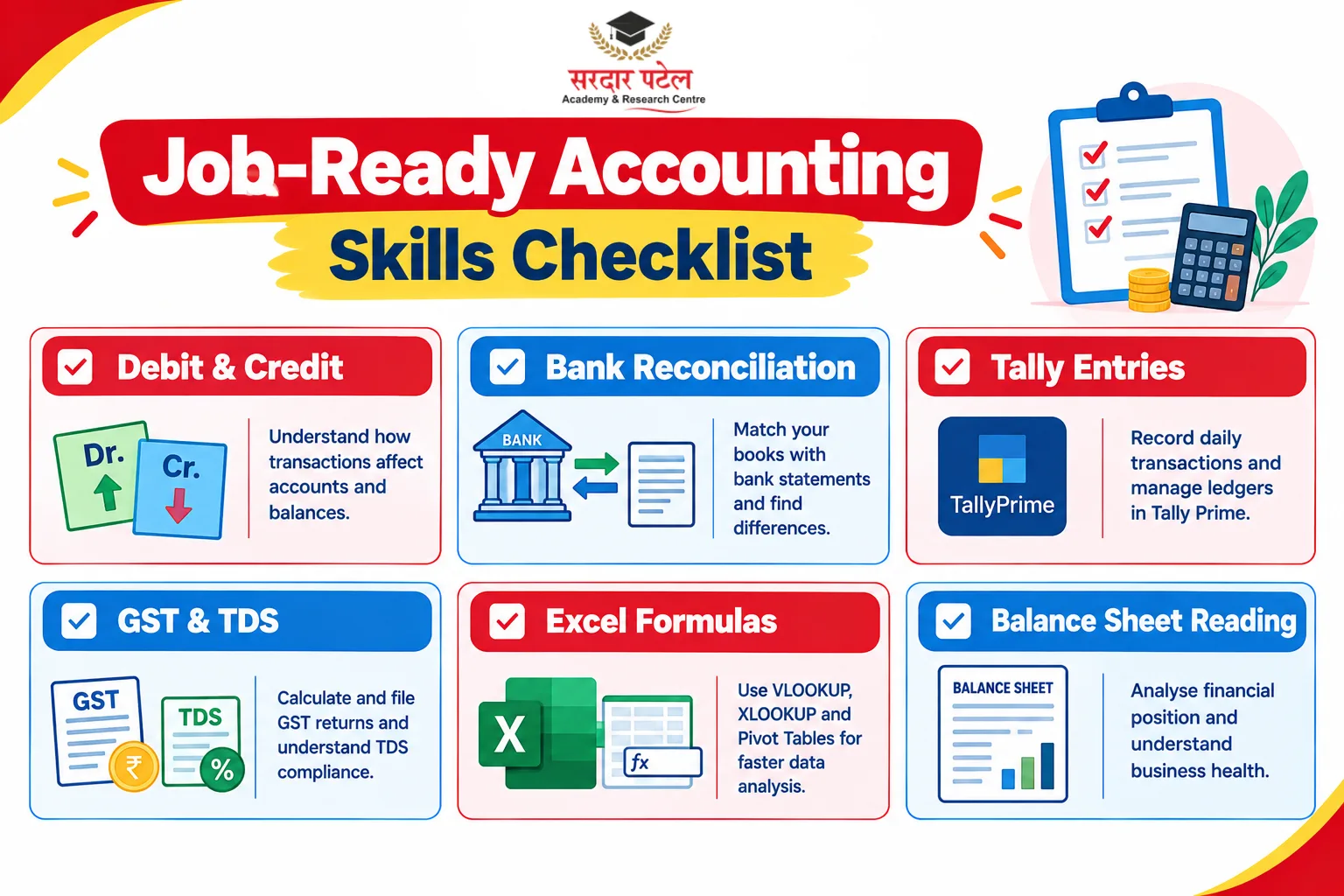
Now run a quick self-check of your accounting skills for freshers. Tick what you can do today without searching for help:
- I can explain debit and credit logic without relying on memorised rules.
- I can create a company in Tally Prime and record all common voucher types.
- I can explain the difference between GSTR-1 and GSTR-3B in two sentences.
- I can build a pivot table and a lookup formula from scratch.
- I can read a balance sheet and describe what changed from last year.
If you can tick most of these, you already have the job-ready accounting skills that screening rounds look for. If not, the next section turns the gaps into a plan.
A Six-Week Plan to Build These Skills
A steady sequence works better than random tutorials when you are building accounting skills for freshers from scratch.
- Week 1: Foundation. Work through twenty practice transactions covering the full accounting cycle and reconcile one sample bank statement.
- Week 2: Tally Prime. Create a practice company, set up ledgers, and pass every common voucher type.
- Week 3: GST and TDS. Enter sales and purchases at different rates, then run the GST reports and explain every figure to yourself.
- Week 4: Excel. Build a monthly expense summary using lookups, pivot tables, and conditional sums.
- Week 5: Statements and analysis. Read the balance sheet and profit and loss account of a listed company and write a half-page summary in your own words.
- Week 6: Interview readiness. Run mock interviews, tighten your resume, and package your practice files into a small portfolio.
Keep every file you create; showing a reconciled sheet or a Tally company file is more convincing than describing intentions. If you are worried about having no work history, this guide on how to get an accounting job without experience explains how to present projects and practice work as proof of ability.
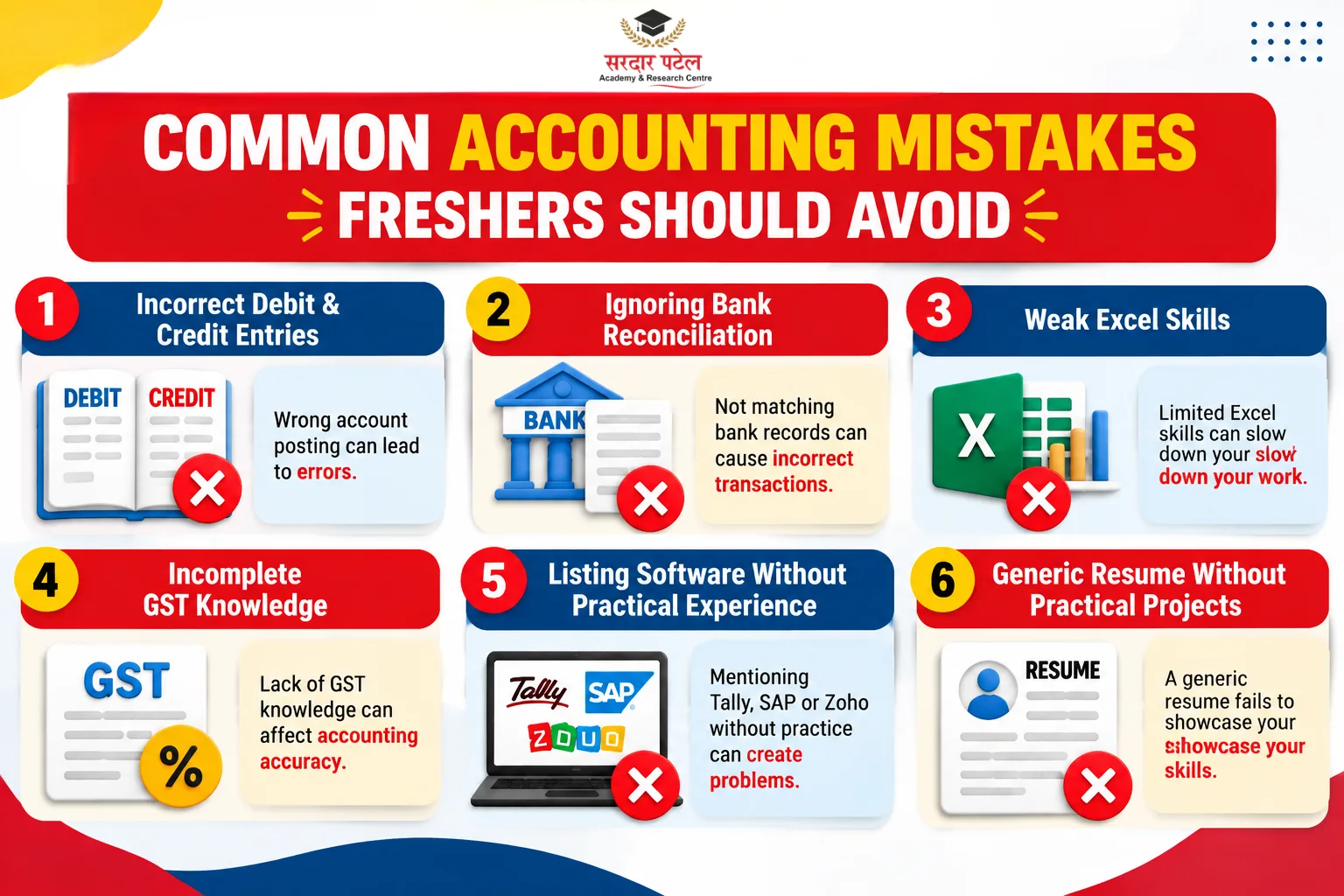
Common Mistakes Freshers Make
Avoiding these mistakes matters as much as adding new accounting skills for freshers to your resume.
- Listing software you have barely opened. Interviewers test this within minutes.
- Memorising entries without understanding them. A changed question exposes the gap.
- Ignoring Excel. Many candidates assume Tally is enough.
- Skipping GST because "seniors handle it." Juniors prepare much of the underlying data.
- Using a generic resume. Replace vague claims with specific tasks, such as "reconciled monthly bank statements in a practice project."
Career Scope: Where These Skills Lead
Strong fundamentals open several entry points, and accounting skills for freshers translate directly into role requirements. The table below shows how different roles lean on different skills.
| Entry role |
Skills it leans on most |
| Accounts assistant |
Bookkeeping, Tally Prime, voucher accuracy |
| Accounts payable or receivable executive |
Reconciliation, Excel, communication |
| GST or compliance executive |
GST returns, TDS, documentation |
| Audit associate |
Vouching, standards awareness, attention to detail |
| Junior MIS or finance analyst |
Excel, data analytics, financial statements |
Our overview of accounting jobs for freshers, with roles, skills and career opportunities, helps you match your strengths to the right openings. Over time, the skills you need to become a professional accountant grow to include judgment, ethics and specialised knowledge.
Conclusion
Employers hiring juniors rarely look for perfection; they judge freshers' accounting skills by practical readiness. The accounting skills employers want most are simple: sound basics, comfort with the tools, and careful routine work.
If you would like structured guidance, you can learn job-ready accounting skills through hands-on training at Sardar Patel Academy & Research Center, then use the checklist above to track your progress. Start with one skill this week, and let steady practice build the accounting skills for freshers that employers keep asking for
FAQs
Bookkeeping fundamentals, Tally Prime, Excel, GST and TDS basics, and clear communication form the core of accounting skills for freshers. Priorities vary by employer.
Tally is widely used by small and mid-sized Indian businesses, so it appears in many entry-level job descriptions.
Many entry roles, such as accounts assistant, ask for a commerce degree plus fresher accountant skills such as Tally and Excel. Requirements differ by employer.
It depends on your starting point. With the fundamentals in place, a focused six-week routine can build practical confidence; beginners should allow more time.
Use practice files, internship work, mock projects, and certificates. A small portfolio of reconciliations, Tally entries, and Excel summaries makes your claims believable.