+91 9312966129
 sparc.enquiry01@gmail.com


Google Ads Automation Trends You Must Know in 2026
Explore the top google ads automation trends for 2026 — Smart Bidding, Performance Max, and AI tools every PPC beginner and professional should know
Table of Contents
- Why Google Ads Automation Is Accelerating in 2026
- Key Google Ads Automation Trends to Watch
- 1. Performance Max Becoming the Default Campaign Type
- 2. Smart Bidding Getting More Granular
- 3. AI-Generated Ad Copy and Assets
- 4. Automated Audience and Signal Expansion
- 5. Predictive Budget Pacing
- PPC Automation Tools Worth Understanding
- The AI Google Ads Future: What's Realistic vs Hype
- Common Mistakes Advertisers Make With Automation
- Practical Tips for Beginners and Professionals
- Conclusion
Running a Google Ads campaign in 2026 looks very different from even two years ago. Manual bid adjustments, rigid keyword matching, and hours spent tweaking budgets are quietly being replaced by systems that learn and adjust on their own. If you've noticed Google pushing you toward automated campaign types more aggressively, you're not alone — this is one of the clearest google ads automation trends shaping the platform right now.
This guide is for anyone trying to make sense of where PPC is heading — students learning digital marketing, working professionals managing live ad accounts, or business owners in Delhi NCR wondering whether automation will help or hurt their ad spend.
You'll learn what's actually changing, which PPC automation tools are worth understanding, what the AI google ads future looks like in practice, and how to adapt your skills so automation works for you instead of leaving you confused.
Why Google Ads Automation Is Accelerating in 2026
Automation in Google Ads isn't new — Smart Bidding has existed for years. What's different in 2026 is the depth of automation and how much control advertisers are being asked to hand over.
A few reasons this shift is happening faster now:
- Machine learning models have more data to work with, making automated decisions more reliable than they were a few years ago.
- Manual campaign management is becoming harder to justify as automated campaigns increasingly outperform manually managed ones in controlled tests.
- Google's own product roadmap favors automation — newer campaign types like Performance Max are automation-first by design.
- Advertiser time constraints — agencies and in-house teams managing multiple accounts don't have bandwidth for hour-by-hour manual optimization.
Understanding why this is happening helps explain what to focus on as a PPC learner or professional — the skill isn't disappearing, it's shifting.
Key Google Ads Automation Trends to Watch
1. Performance Max Becoming the Default Campaign Type
Performance Max campaigns, which run across Search, Display, YouTube, and Gmail from a single automated setup, are increasingly positioned as Google's primary recommendation for many advertisers.
What this means practically: advertisers now spend more time on inputs — assets, audience signals, and conversion data quality — and less time on manual placement or bid control.
2. Smart Bidding Getting More Granular
Smart Bidding strategies like Target CPA and Target ROAS are becoming more responsive to real-time signals — time of day, device, location, and even weather in some retail use cases — rather than relying on historical averages alone.
- Works best with clean, well-structured conversion tracking
- Struggles in accounts with low conversion volume or messy data
- Needs a learning period after major changes, which catches many beginners off guard
3. AI-Generated Ad Copy and Assets
One of the more visible PPC automation tools in 2026 is AI-assisted asset generation — headlines, descriptions, and even basic creative variations generated directly inside Google Ads based on landing page content
Example: Instead of manually writing 15 headline variations for a Responsive Search Ad, advertisers can generate a starting set from the landing page and then edit for brand tone and accuracy — editing, not blind acceptance, is still the important human step here.
4. Automated Audience and Signal Expansion
Google Ads is increasingly using “audience signals” as a starting point rather than a strict targeting rule, letting the algorithm expand reach based on early conversion patterns. This is a shift from the older, more rigid audience-targeting approach many advertisers learned.
5. Predictive Budget Pacing
Automated budget pacing tools are getting better at predicting demand spikes — festive seasons, exam-result periods for education brands, or sale events — and adjusting daily spend accordingly instead of following a flat daily budget.
PPC Automation Tools Worth Understanding
Beyond what's built into Google Ads itself, several categories of ppc automation tools are relevant for anyone building PPC skills in 2026:
| Tool Category |
What It Does |
Best For |
| Native Google Ads automation (Smart Bidding, PMax) |
Built-in bidding and campaign automation |
Most advertisers, beginners to advanced |
| Script-based automation |
Custom rules using Google Ads Scripts |
Professionals managing multiple accounts |
| Third-party bid management platforms |
Cross-platform automation and reporting |
Agencies handling large ad spend |
| AI creative generation tools |
Ad copy, headlines, and asset variations |
Teams needing fast creative iteration |
The important point for beginners: you don't need to master every tool immediately. Understanding what each category solves is more useful early on than memorizing specific platforms.
The AI Google Ads Future: What's Realistic vs Hype
It's easy to find bold claims online about AI “running ads entirely on autopilot.” The realistic picture is more nuanced.
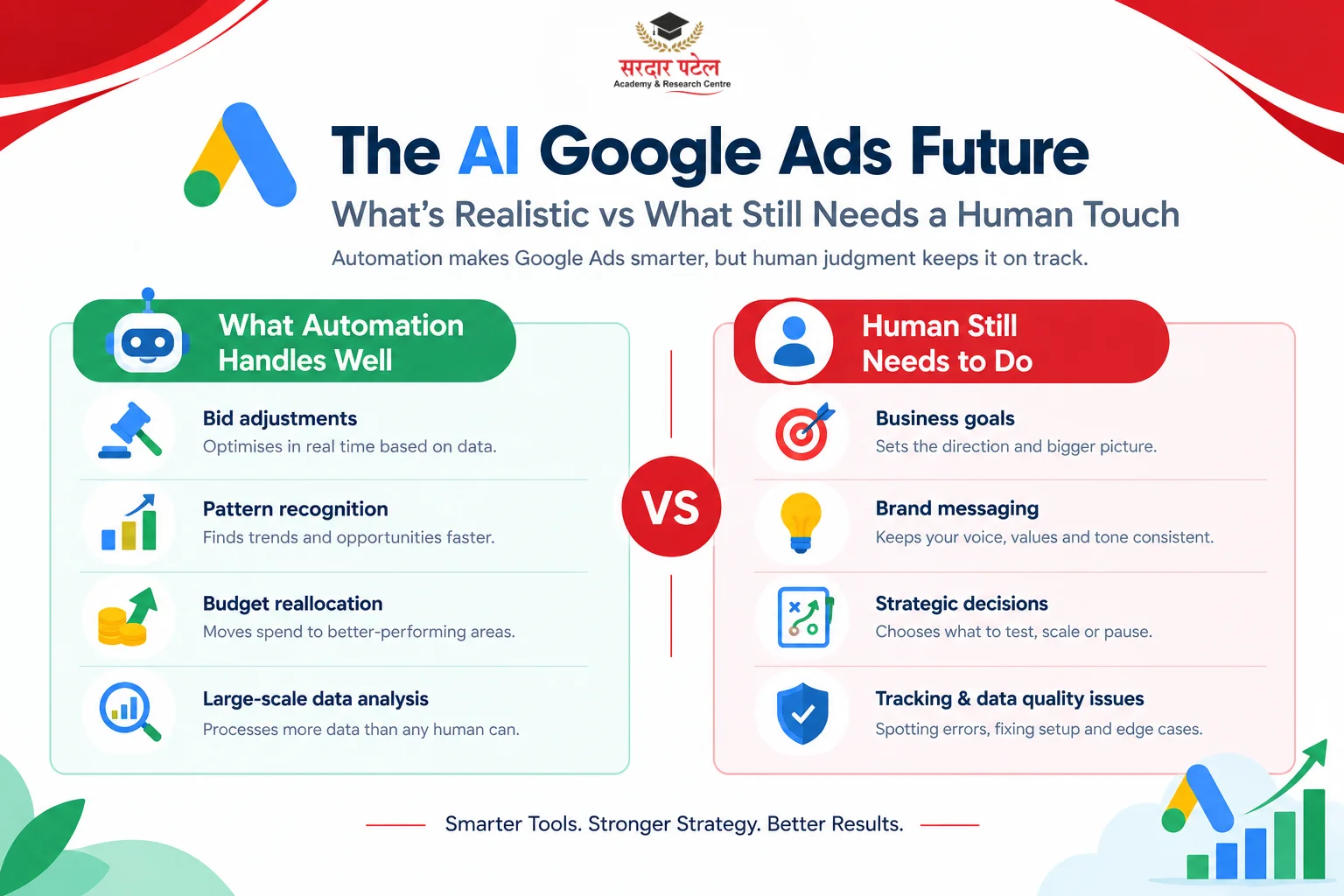
What automation genuinely handles well:
- Bid adjustments across thousands of auctions per second
- Pattern recognition across large conversion datasets
- Real-time budget reallocation
What still needs human judgment:
- Defining what “success” actually means for the business (not every conversion is equally valuable)
- Brand tone and messaging accuracy in AI-generated copy
- Strategic decisions — which markets, products, or campaigns deserve investment at all
- Catching tracking errors or data quality issues automation can't self-diagnose
The AI google ads future isn't about advertisers becoming unnecessary — it's about the role shifting from manual execution toward strategy, oversight, and data quality management.
Common Mistakes Advertisers Make With Automation
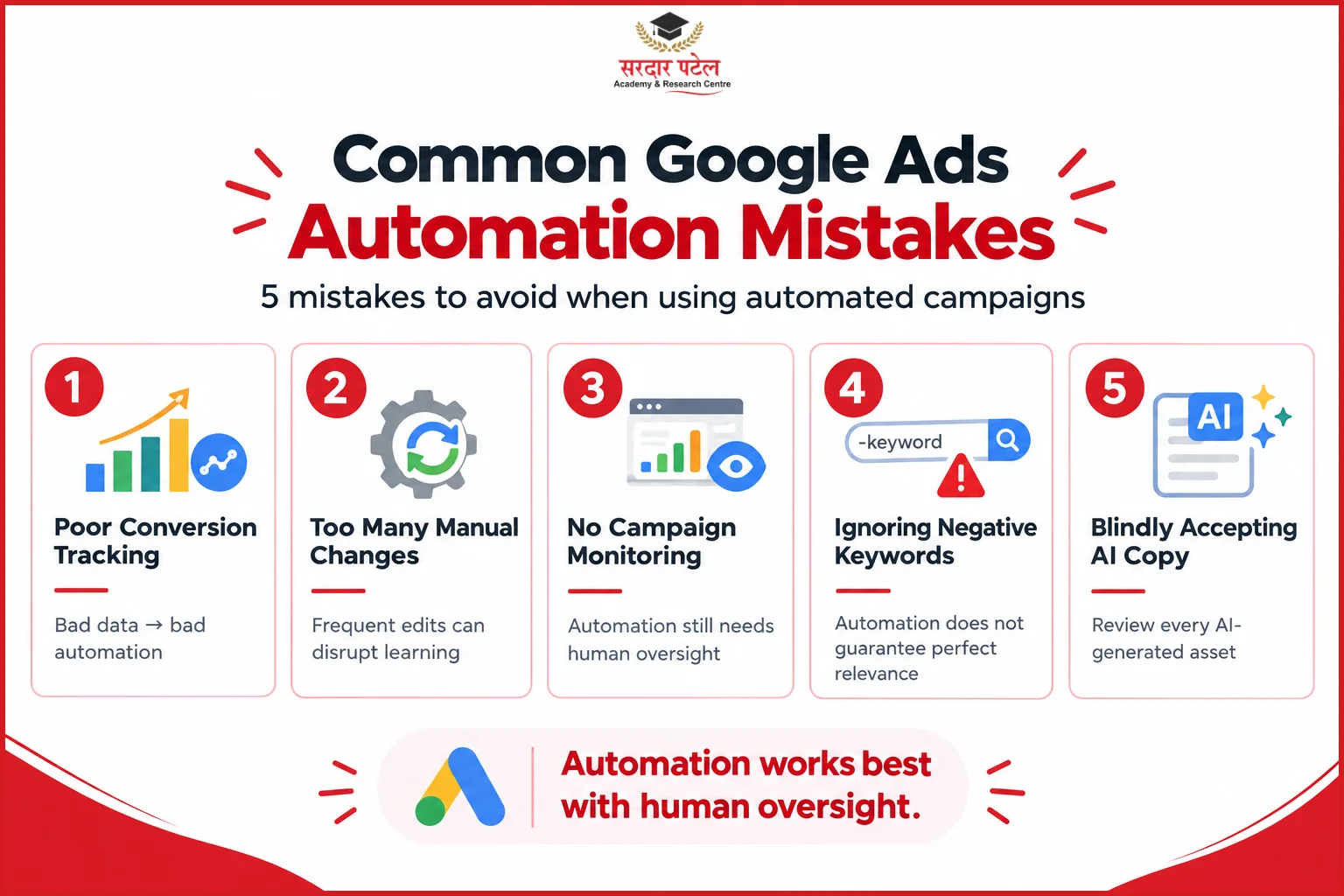
- Turning on automated bidding with poor conversion tracking, which teaches the algorithm the wrong lessons from the start.
- Making frequent manual changes during the learning period, which resets automated campaigns and delays stable performance.
- Assuming automation removes the need to monitor campaigns, when in reality it shifts monitoring toward inputs and outcomes rather than daily bid tweaks.
- Ignoring negative keywords in automated campaign types, assuming the algorithm handles relevance perfectly on its own.
- Accepting AI-generated ad copy without editing, which can lead to generic or inaccurate messaging reaching real customers.
Practical Tips for Beginners and Professionals
- Get comfortable with conversion tracking fundamentals first — automation is only as good as the data feeding it.
- Learn to read automated campaign reports critically, not just accept “optimization score” suggestions at face value.
- Practice writing and editing AI-generated ad copy rather than avoiding these tools — this is quickly becoming an expected skill.
- Understand audience signals and asset groups if you're working with Performance Max, since these are the main levers advertisers still control.
- Keep local market context in mind — for Delhi NCR businesses, factors like regional language preferences and local search behavior still require human input that automation doesn't fully account for.
If you're building a PPC career and want to strengthen these fundamentals with structured practice, this is exactly where a hands-on Google Ads tutorial for beginners is useful before jumping into fully automated campaign types.
Conclusion
Google ads automation trends in 2026 point toward a clear direction: less manual bid-tweaking, more emphasis on strategy, data quality, and overseeing what the algorithm is doing. The ai google ads future isn't about replacing advertisers — it's about changing where their judgment matters most. The PPC automation tools available today are genuinely useful, but they still depend on humans setting the right goals, tracking the right data, and editing AI-generated output with a critical eye.
If you're looking to build these skills properly — understanding both the automated systems and the strategic thinking behind them — exploring a structured digital marketing course can help you learn PPC the right way instead of piecing it together from scattered tutorials. You can also reach out to the SPARC team if you have questions about which learning path fits your goals.
Learn Smart PPC Skills — because in an automated advertising world, the advertisers who understand the why behind the automation will always have the edge.
Sardar Patel Academy & Research Centre (SPARC) | GTB Nagar, Delhi | sparc.org.in | +91 93129-66129
FAQs
No — it's shifting which skills matter most, from manual bid management toward data quality, strategy, and campaign oversight.
It's an automated campaign type that runs ads across Google's networks (Search, Display, YouTube, Gmail) from a single campaign using machine learning to optimize placements and bids.
They can be, but automated bidding generally needs a minimum volume of conversion data to work well, so very low-budget accounts may see inconsistent results initially.
Unlikely in the near term — automation handles execution well, but strategic decisions, brand accuracy, and data quality still require human oversight.
Typically one to two weeks after significant changes, during which performance can be less predictable — this is a normal part of the process, not a sign something is broken.
Understanding manual bidding concepts helps beginners interpret what automation is actually doing, even if they primarily use automated strategies in practice.
Conversion tracking setup, data analysis, AI-assisted copywriting and editing, and campaign strategy are becoming more valuable than manual bid adjustment skills.
Not entirely — many advertisers run Performance Max alongside traditional Search campaigns depending on business goals and the level of control they need.