+91 9312966129
 sparc.enquiry01@gmail.com



How ChatGPT, Gemini and Perplexity Are Changing Online Search
How are ChatGPT, Google AI Overviews and Perplexity changing search? See what Pew data says about clicks and what marketers and students should do next.
Table of Contents
- What Are AI Search Trends?
- How ChatGPT, Google AI Features and Perplexity Handle Search
- ChatGPT search
- Google AI Overviews and AI Mode (powered by Gemini)
- Perplexity
- What the Data Says About User Behaviour
- Five Shifts Behind the Move to Answer Engines
- Is SEO Dead? The Short Answer
- Getting Visible in AI Answers: The Essentials
- Common Mistakes to Avoid
- Career Scope: Why Digital Marketing Skills Matter Now
- Conclusion
AI search trends are changing how people look things up, and the answer to "How did you find that?" is no longer always "I Googled it." Some people typed a question into ChatGPT. Others read the AI-written answer at the top of Google. A few opened Perplexity because they wanted footnotes. Together, these small habit changes are reshaping how people find information, products and services.
This report explains what is changing, how each platform approaches search, what research says about clicks, and what marketers, students and site owners can do next.
What Are AI Search Trends?
AI search trends describe the shift from typing keywords and scanning ten links to asking full questions and receiving a composed, AI-written answer, often with citations and follow-up conversation. Tools such as ChatGPT, Google's AI features,and Perplexity lead this change.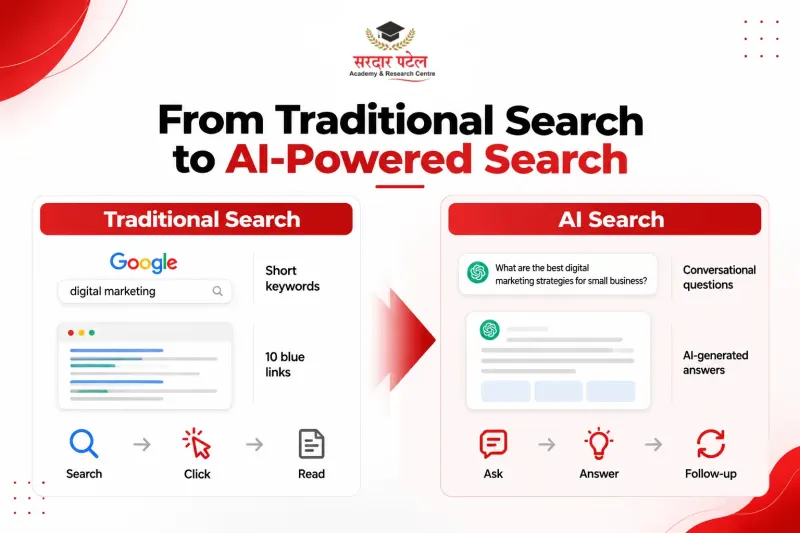
A language model reads web material, pulls out the relevant parts, and writes a response in plain language. Many tools then let you keep talking, so the second question builds on the first. Three changes define this shift:
| Old habit |
New habit |
Why it matters |
| Short keyword strings |
Full, conversational questions |
Content must answer questions, not just match terms |
| Content must answer questions, not just match terms |
A written answer, sometimes with citations |
Visibility can mean being cited, not just ranked |
One search, one result page |
A back-and-forth conversation |
Users refine intent inside the tool |
You will also hear related terms such as generative search, answer engines, conversational search and AI Overviews. They overlap, but they all point at the same thing: the search results page is turning into an answer page.
How ChatGPT, Google AI Features and Perplexity Handle Search
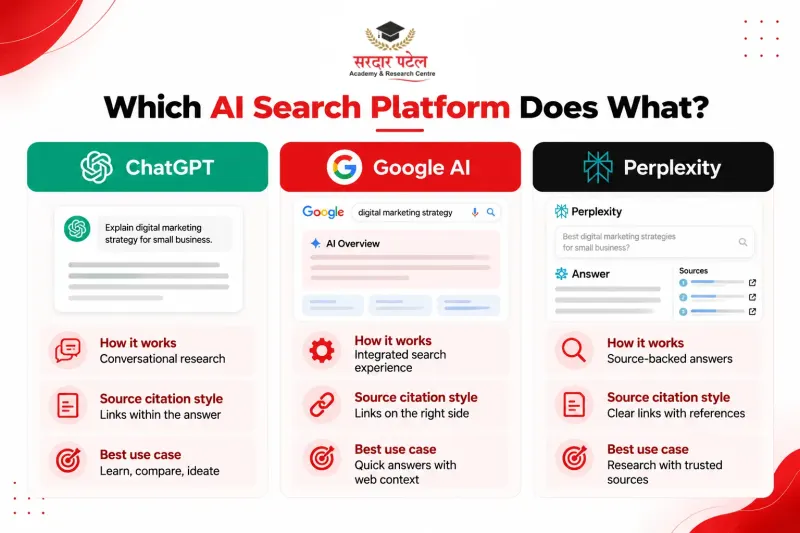
The three get grouped, yet they work differently. Understanding those differences helps you decide where your audience is likely to find you.
ChatGPT search
OpenAI introduced ChatGPT search on 31 October 2024, first for paying users and later for everyone (OpenAI announcement). Instead of replying only from training data, it looks up current web information and responds with links to the sources it used. At launch, OpenAI said the feature relied on a fine-tuned model together with third-party search providers, and that publishers could choose to appear in results.
For content teams, it behaves like a research assistant. People use it for explanations, comparisons and "help me decide" questions rather than quick brand lookups. This is also why roles are changing, as you can see in how ChatGPT is changing SEO careers.
Google AI Overviews and AI Mode (powered by Gemini)
Google builds Gemini-family models into the search engine people already use. There is no separate "Gemini search" product here. The features to know are AI Overviews, which appear above regular results for some queries, and AI Mode, a fuller conversational experience.
Google has described a technique called query fan-out. One question is split into several subtopics, and many related searches run at the same time before the results are combined (Google Search blog). In early testing, Google said people asked questions two to three times longer in AI Mode than in traditional search.
These features matter even to people who never open the Gemini app, because they reach users inside Google itself. They favour pages that cover a topic from several angles over pages built around one narrow keyword. For a deeper look, read our explainer on Google AI Mode and SEO.
Perplexity
Perplexity positions itself as an answer engine. According to its help documentation, it gathers relevant material, writes a compact answer and attaches numbered footnotes that link back to the originals. Because citations are built into the format, it suits people who want to verify claims, follow a trail of sources or run deeper research with follow-up prompts.
Other assistants, including Claude, Microsoft Copilot and the Gemini app, also offer web-connected answers, so the trend is wider than three names.
Side-by-side view
Platform |
Typical experience |
How sources appear |
Where it tends to shine |
ChatGPT search |
Conversation with web lookup |
Links and a sources view |
Explanations, planning, comparisons |
| Google AI Overviews / AI Mode |
AI summary or conversation inside Google |
Links within and around the answer |
Broad queries, local and shopping-style questions |
| Perplexity |
Cited answer, follow-up prompts |
Numbered inline citations |
Research and fact-checking |
What the Data Says About User Behaviour
Opinions are everywhere, so measured evidence helps. One of the most-cited studies comes from the Pew Research Centre, published in July 2025 (Pew Research Centre report). Using browsing records from 900 U.S. adults, Pew compared behaviour on Google pages with and without an AI summary in March 2025.
| Measure |
Result |
| Searches analysed |
68,879 |
| Searches that produced an AI summary |
about 18% |
| Clicks on a traditional result link, summary shown |
8% of visits |
Clicks on a traditional result link, no summary |
15% of visits |
Clicks on links inside the AI summary |
about 1% of visits |
Read these numbers with care. The sample covers American adults over a short window. It does not measure revenue or the quality of the visits that did happen. Google says in its AI features documentation that clicks from pages showing AI Overviews tend to be higher quality, with users spending more time on the site. Both can be true at once: fewer clicks overall, possibly more engaged ones. If you want practical steps for Google, see how to AI-Powered Content Strategy: What Should Marketers Automate? .
Measurement has also improved. Google announced dedicated generative AI performance reports in Search Console on 3 June 2026, covering AI Overviews and AI Mode (coverage of the announcement). The sensible reading is directional rather than dramatic: discovery is changing, so measure your own data instead of relying on headlines.
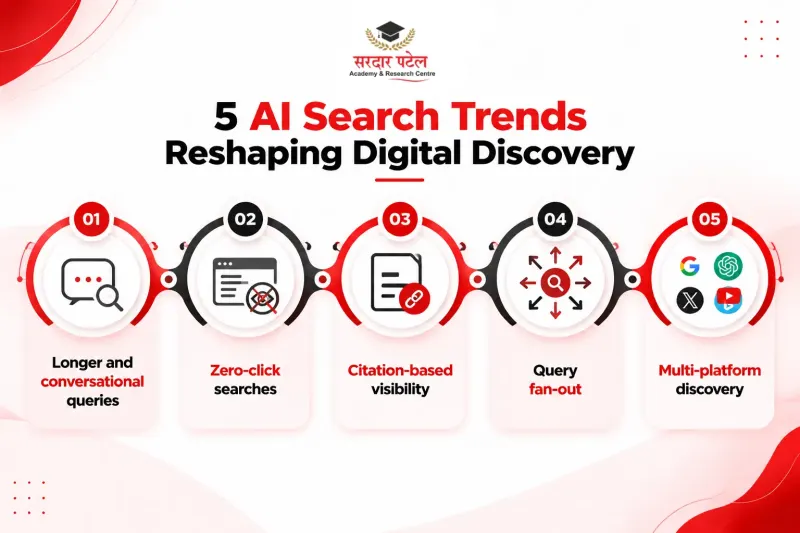
Five Shifts Behind the Move to Answer Engines
1. Questions are getting longer and more specific
People who once typed "best laptop student" now describe budget, course and battery expectations in a single prompt. Content that handles detail wins attention.
2. Answers are being consumed without a visit
When the summary satisfies the question, the click never happens. Marketers are already planning for this, a topic covered in our guide to zero-click search and what digital marketers need to know.
3. Citations are becoming a new kind of visibility
In an answer engine, being named as a source can matter as much as ranking first. That makes clarity, accuracy and original insight more valuable than ever.
4. One query now triggers many
Because of query fan-out, a page may be retrieved for a sub-question the user never typed. Covering the follow-up questions in your niche improves your odds.
5. Discovery is splitting across channels
One person may use Google in the morning, ChatGPT at lunch and Perplexity for research at night. Paid media is affected too, so keep an eye on Google Ads automation trends. Single-channel strategies are now riskier.
Is SEO Dead? The Short Answer
No. The evidence points to SEO changing its focus, not disappearing. Google's own guidance says there are no additional requirements to appear in AI Overviews or AI Mode. The basics still apply: keep pages crawlable, link them well, offer a good page experience and publish helpful, original content. Strong fundamentals remain the entry ticket, with more weight now on original insight, clear structure and topic depth. The full argument is in our guide on whether SEO is dead because of AI search.
Getting Visible in AI Answers: The Essentials
Nobody can guarantee a citation, but these five steps improve your chances across ChatGPT, Google's AI features and Perplexity.
- Check technical access. Make sure robots.txt, your CDN and your hosting do not block the crawlers you want. A page that cannot be fetched cannot be cited.
- Answer the main question early, then cover the follow-ups. Put a direct, plain-language answer near the top of each page, then give the next few questions a curious reader would ask their own headings.
- Add original value. Include first-hand examples, local context, your own data or a clear point of view that a generic summary could not supply.
- Structure for scanning and link internally. Use descriptive headings, short paragraphs, tables and lists, and connect related pages so crawlers and readers can move through your topic naturally.
- Measure what you can. Track branded searches, referral sources, Search Console trends and conversions month to month. Use the new generative AI reports in Search Console to see how your pages appear in Google's AI features.
For the complete walkthrough, read our guide on making your website visible in AI search results.
Common Mistakes to Avoid
- Chasing every new acronym. GEO, AEO, and similar labels come and go. Fundamentals keep working.
- Publishing generic AI-written pages in bulk. Content that anyone could have written gives AI tools little reason to cite you.
- Ignoring measurement. Without a baseline, you cannot tell whether AI search is affecting your traffic or something else is.
- Overclaiming results. Avoid unsupported statistics. Credibility is the asset AI systems and readers both reward.
Want to learn this hands-on? SPARC's Digital Marketing Course with AI covers SEO, content, Google Ads and analytics in a 7-month programme with 50+ projects. See the course details.
Career Scope: Why Digital Marketing Skills Matter Now
This shift is changing marketing job descriptions as much as websites. Specialists who understand content, SEO and measurement together are better placed, because every decision above depends on knowing which questions drive visits, which pages earn mentions and which channels convert.
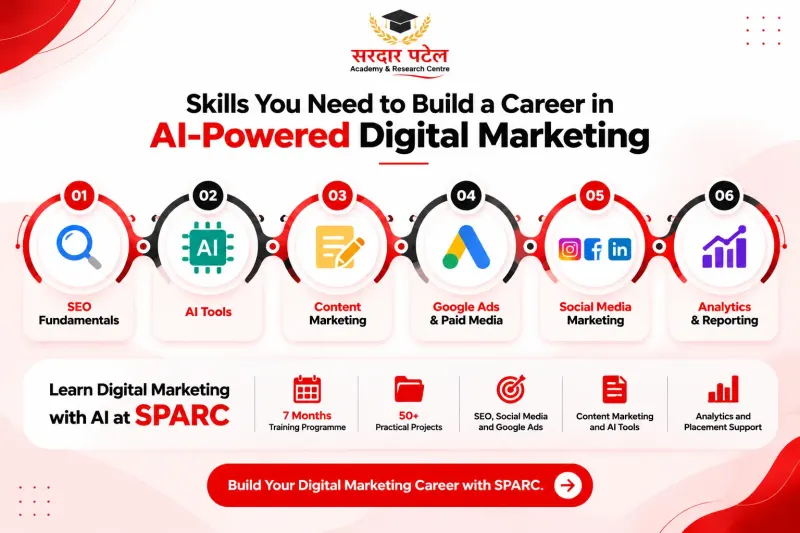
Beginners can start with AI tools every digital marketing student should know. A practical learning path covers SEO fundamentals, content strategy, paid media, social media and reporting, with AI tools used throughout. Sardar Patel Academy & Research Centre (SPARC) offers this kind of structured, hands-on training through its Digital Marketing Course with AI: a 7-month programme covering SEO, social media marketing, Google Ads, content marketing, AI tools and analytics, with 50+ projects and placement support.
Conclusion
AI search is not a single product or a fad. It is a change in how questions get answered, and ChatGPT, Google's AI features, and Perplexity are three expressions of it. The data so far points to fewer clicks on some searches, new value in being cited and a lasting role for sound fundamentals. Testing your own results is the most reliable way to stay visible.
For marketers and students, the next step is to build solid digital marketing skills so every strategy can be measured and improved. To see why this mix is valued, read why AI plus digital marketing professionals are in demand.
Explore the Digital Marketing Course with AI
FAQs
They are the changing patterns in how people look for information, moving from keyword-based link lists toward conversational questions and AI-written answers from tools like ChatGPT, Google's AI features and Perplexity.
The evidence does not show a simple replacement. Many people now use several tools, choosing by task. Google still reaches users at huge scale and is adding AI features of its own, while ChatGPT search suits conversational research.
Perplexity presents a written answer with numbered citations instead of a page of ranked links, so the sources are part of the answer itself.
This is the biggest open question. Pew's March 2025 study of U.S. adults found fewer clicks on traditional links when an AI summary appeared (8% versus 15%). Google says clicks from such pages tend to be higher quality. Results vary by industry and query type, so check your own analytics.
For Google's AI features, the company says no additional requirements or special optimisations are needed. Standard Search eligibility, quality content and good technical health are the focus. Other platforms may behave differently.
Start with content strategy and SEO fundamentals, then add measurement skills so you can see what works and report it clearly.