+91 9312966129
 sparc.enquiry01@gmail.com



Can AI Replace Data Analysts? A Realistic Look at 2027 and Beyond
Can AI replace data analysts by 2027? Explore AI's impact on analytics jobs, future career trends, essential skills, and how to stay relevant.
Table of Contents
- The Short Answer: Can AI Replace Data Analysts by 2027?
- What AI Already Does Well in Analytics
- Where AI Still Falls Short
- What the Data Says About AI Impact on Data Analyst Jobs
- Can AI Replace Data Analysts in Every Role?
- The Future of Data Analysis: Three Scenarios
- How to Future-Proof Your Analytics Career
- Common Mistakes to Avoid
- Conclusion
Every few months, another AI tool arrives that can build a dashboard from a single sentence, and the same anxiety resurfaces in analytics teams: can AI replace data analysts altogether? It deserves a better answer than a confident “never” or a panicked “yes.”
Here is the honest version. AI is very good at the repetitive layers of analysis and far weaker at judgment, such as deciding which question matters. This guide covers what is changing, what labour-market data suggests, and how to stay valuable as the AI impact on data analyst jobs becomes clearer.
The Short Answer: Can AI Replace Data Analysts by 2027?
Not completely, and probably not the way headlines suggest. By 2027, the likelier outcome is that analysts spend fewer hours cleaning data, writing first-draft queries and formatting charts, and more hours framing problems, validating results and presenting recommendations.
Nobody can forecast this precisely, so treat every prediction, including ours, as informed reasoning.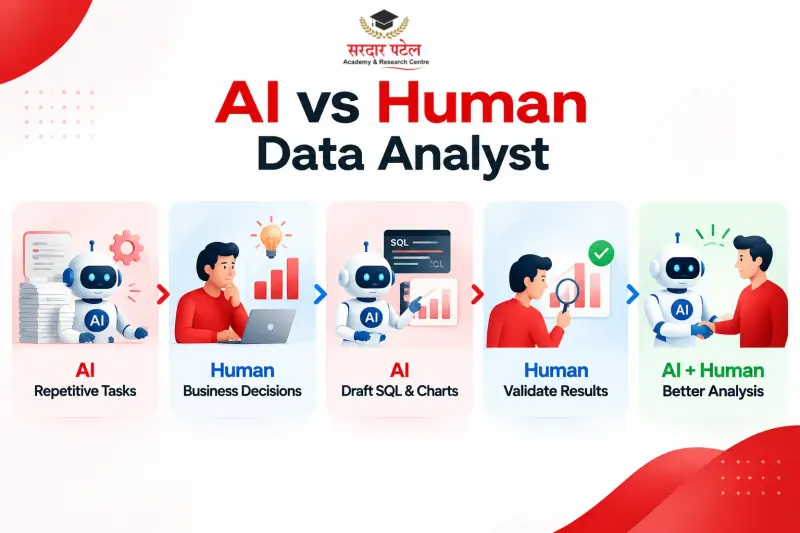
Weighing a career move? Our guide on whether data analytics is a good career in 2026 covers the wider picture.
What AI Already Does Well in Analytics
AI now handles much of the repetitive groundwork: data preparation, first-draft SQL, Python or DAX, chart creation and plain-English queries. Microsoft’s documentation describes how Copilot can help create reports, summarise content and answer questions about your data. Microsoft’s adoption guidance suggests that simply switching it on will not automatically lift productivity across an organisation. For the full list of tasks and tools, see our Generative AI in data analytics guide. For a feature-by-feature breakdown, see our Power BI Copilot guide.
Where AI Still Falls Short
For job-risk purposes, the gaps come down to three things: AI does not know your business context, it cannot be held accountable for a decision, and it can sound right while being wrong. Each one needs a person who understands the data and answers for the result. We cover the limits in detail, and how AI agents change them, in our AI Agents in Data Analytics guide.
What the Data Says About AI Impact on Data Analyst Jobs
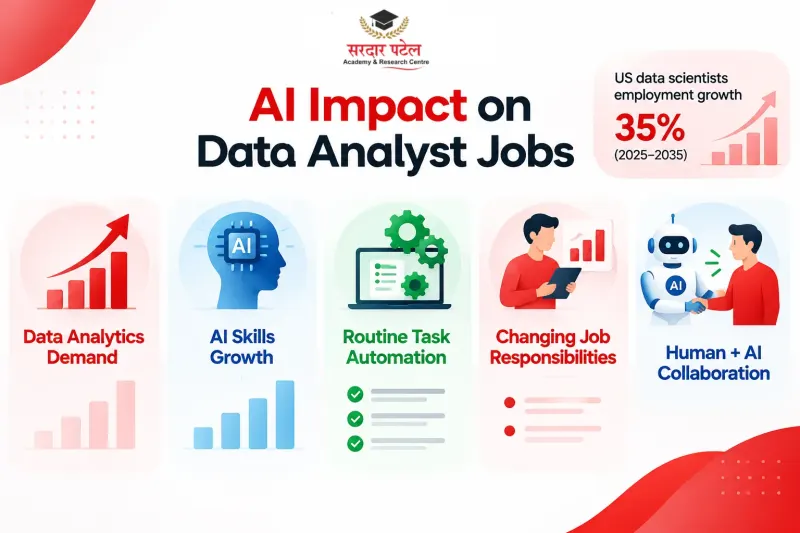
Official projections lean optimistic for data-focused work. The US Bureau of Labor Statistics projects that employment of data scientists will grow 35 percent between 2025 and 2035, compared with 3.5 percent across all occupations. The same projections show computer and mathematical occupations growing 7.3 percent, while office and administrative support is expected to decline 4.0 percent. The Occupational Outlook Handbook entry for data scientists adds about 24,800 projected openings a year.
Globally, the World Economic Forum’s Future of Jobs Report 2025 places big data specialists among the fastest-growing roles in percentage terms through 2030.
For India, the NASSCOM–BCG report on AI-powered tech services expects demand for AI talent to grow at about 15 percent a year until 2027. IndiaAI’s summary of the report adds that investment in the country’s tech services is concentrating heavily on data analytics, among other areas.
Two cautions apply. First, “data scientist” is not identical to “data analyst,” so these figures are signals, not proof. Second, the NASSCOM figures cover AI talent broadly, not data analysts specifically, and the BLS and WEF numbers describe the US and the world. For the local picture, read our overview of the future of data analytics jobs in India. Whether you ask “can AI replace data analysts” or simply “is my job safe,” the current evidence points to a changing role rather than a disappearing one.
Can AI Replace Data Analysts in Every Role?
Not equally. Roles built mostly on repeatable output are the most exposed.
- Higher pressure: pulling the same weekly report, refreshing spreadsheets by hand, answering simple “how many” queries
- Lower pressure: work that needs industry knowledge, stakeholder communication, experiment design, data modelling or governance
The more a role depends on context and trust, the harder it is to automate.
The Future of Data Analysis: Three Scenarios
By 2027, three outcomes are worth considering. These are reasoned scenarios, not predictions.
- Augmentation (most plausible): analysts use AI daily and deliver faster, with similar team sizes.
- Role compression: smaller teams handle the same workload, so routine entry-level positions shrink while strong generalists stay in demand.
- Agentic workflows: AI agents resolve routine questions end to end, while humans review exceptions and high-stakes calls.
In every scenario, analysts who understand both data and business stay central, which is likely why employers are looking for AI and analytics professionals, people who can use AI without being misled by it. So can AI replace data analysts in the long run? Only the ones who stop adapting.
How to Future-Proof Your Analytics Career
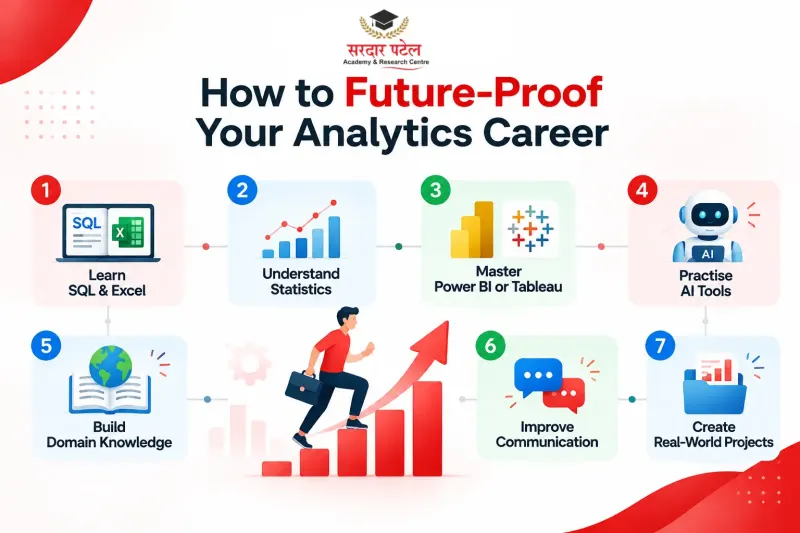
The practical answer to “can AI replace data analysts” is to become the analyst AI cannot easily substitute. Here is a sequence that works:
- Lock in fundamentals. SQL, Excel, statistics and data modelling keep their value because they let you check AI output.
- Learn one BI tool deeply. Power BI or Tableau, including their AI features.
- Treat AI as a junior colleague. Use it for drafts, then review everything. Our piece on how ChatGPT is changing analytics careers shows practical ways to do this.
- Build domain depth. Finance, healthcare, retail or logistics knowledge makes your analysis harder to replicate.
- Practise communication. Presenting findings clearly to non-technical colleagues is a skill AI does not replace.
- Build a portfolio using messy, real datasets.
At Sardar Patel Academy & Research Centre, the Data Analytics Course with AI combines core analytics skills with AI-driven workflows.
Still asking “can AI replace data analysts” and unsure where to start? Pick one fundamental skill this week and one AI tool to practise it with.
Common Mistakes to Avoid
- Treating it as a yes-or-no debate. Reducing “can AI replace data analysts” to a simple binary hides the real issue: which tasks change, and how fast.
- Ignoring AI tools. Analysts who refuse to learn them are likely to fall behind peers who do.
- Trusting output blindly. Always sanity-check totals, filters and joins.
- Collecting certificates instead of projects. Employers want evidence you can solve problems.
Conclusion
So, can AI replace data analysts? It will replace parts of the job and reshape the rest, but the analyst who frames questions, checks results and communicates decisions remains hard to substitute. The future of data analysis belongs to people who treat AI as a tool to direct rather than a rival to fear.
If you want to build that skill set deliberately, prepare for the future of analytics with our Data Analytics Course with AI at Sardar Patel Academy & Research Centre. If you are comparing options in the capital, our guide to the best data analytics course in Delhi with placement may help. The smartest next step is simple: learn the fundamentals, then learn to work alongside AI.
FAQs
Not on current evidence. AI can automate routine tasks, but analysts still define problems, validate results and take responsibility for recommendations. Full replacement would need AI to handle context and accountability without supervision, which today’s tools do not do reliably.
Entry-level work built around repetitive reporting is the most exposed, so beginners should build SQL, business understanding and communication skills early.
Statistics, SQL, one BI tool, domain knowledge and storytelling, combined with comfort using AI assistants and the discipline to verify their output.
Copilot speeds up drafting and exploration, but it works best on a well-built data model and still needs review. Analysts who design and govern those models become more important, not less.
There is no reliable evidence that it will do so soon. Adoption varies by company size and sector, so hiring is more likely to shift toward AI-literate analysts than to vanish. Checking current job listings in your target city gives a better read than any forecast.