+91 9312966129
 sparc.enquiry01@gmail.com


How Long Does It Take to Become Job Ready in Digital Marketing?
Wondering about digital marketing job ready time? See realistic month-by-month timelines, common mistakes, and a practical roadmap to get hired.

Table of Contents
- What Does "Job Ready" Actually Mean?
- So, How Many Months to Learn Digital Marketing?
- Why Timelines Vary So Much
- A Realistic Month-by-Month Roadmap
- Month 1: Foundations
- Month 2: Core Platforms
- Month 3: Applied Practice
- Month 4 onward: Specialisation and Portfolio Building
- Common Mistakes That Delay Job Readiness
- Job Ready vs Expert: Two Different Goals
- Does Location (Delhi NCR) Affect the Timeline?
- Final Thoughts: Plan Your Timeline, Don't Rush It
If you've been researching courses for the last few weeks, you've probably noticed that everyone gives a different answer to this question. Some institutes promise job readiness in 45 days. Others say it takes a full year. So what's the real answer?
The honest truth is that digital marketing job ready time depends on a few specific factors — how much time you can dedicate daily, whether you're starting from zero or already have some exposure, and how seriously you practice on live projects rather than just watching video lectures. In this guide, we'll break down realistic timelines, what "job ready" actually means, and how many months to learn digital marketing well enough to get hired — not just to collect a certificate.
This is written for beginners, students, and working professionals in Delhi NCR who are trying to plan their next 3-6 months without wasting time on guesswork.
What Does "Job Ready" Actually Mean?
Before we talk about timelines, it's worth defining the term properly, because this is where most confusion starts.
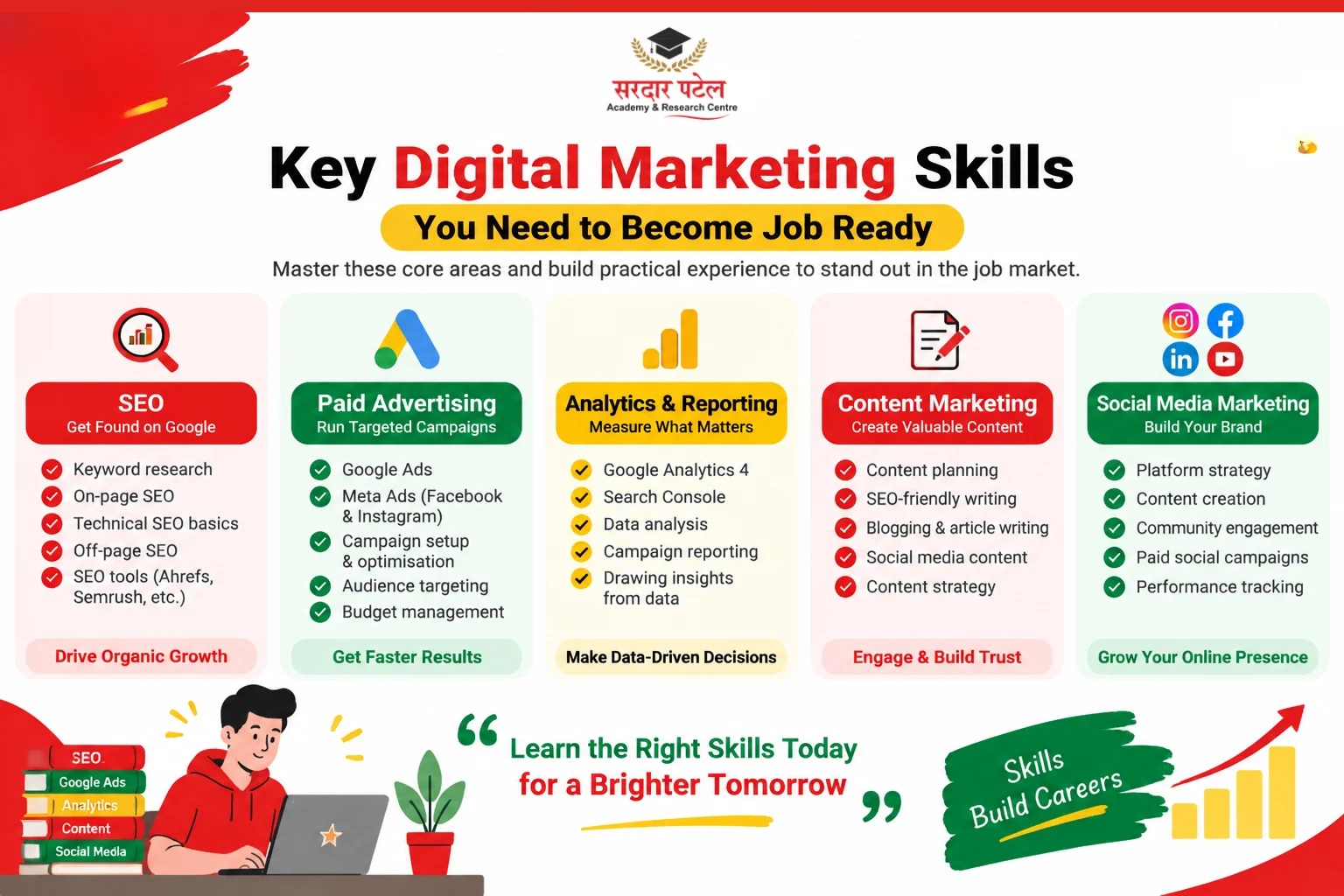
Being job ready in digital marketing means you can:
- Run and optimise a basic paid ad campaign (Google Ads or Meta Ads) without hand-holding.
- Explain and apply core SEO principles — on-page, off-page, and basic technical SEO.
- Read analytics data (Google Analytics, Search Console) and draw simple conclusions from it.
- Write content that's structured for both readers and search engines.
- Handle at least one full-funnel project independently, from planning to reporting
It does not mean knowing every tool or platform on the market. Most entry-level digital marketing roles in Delhi NCR expect a solid grip on 2-3 core skills, not mastery of everything. Employers are generally more interested in whether you can actually execute a task than how many buzzwords you know.
So, How Many Months to Learn Digital Marketing?
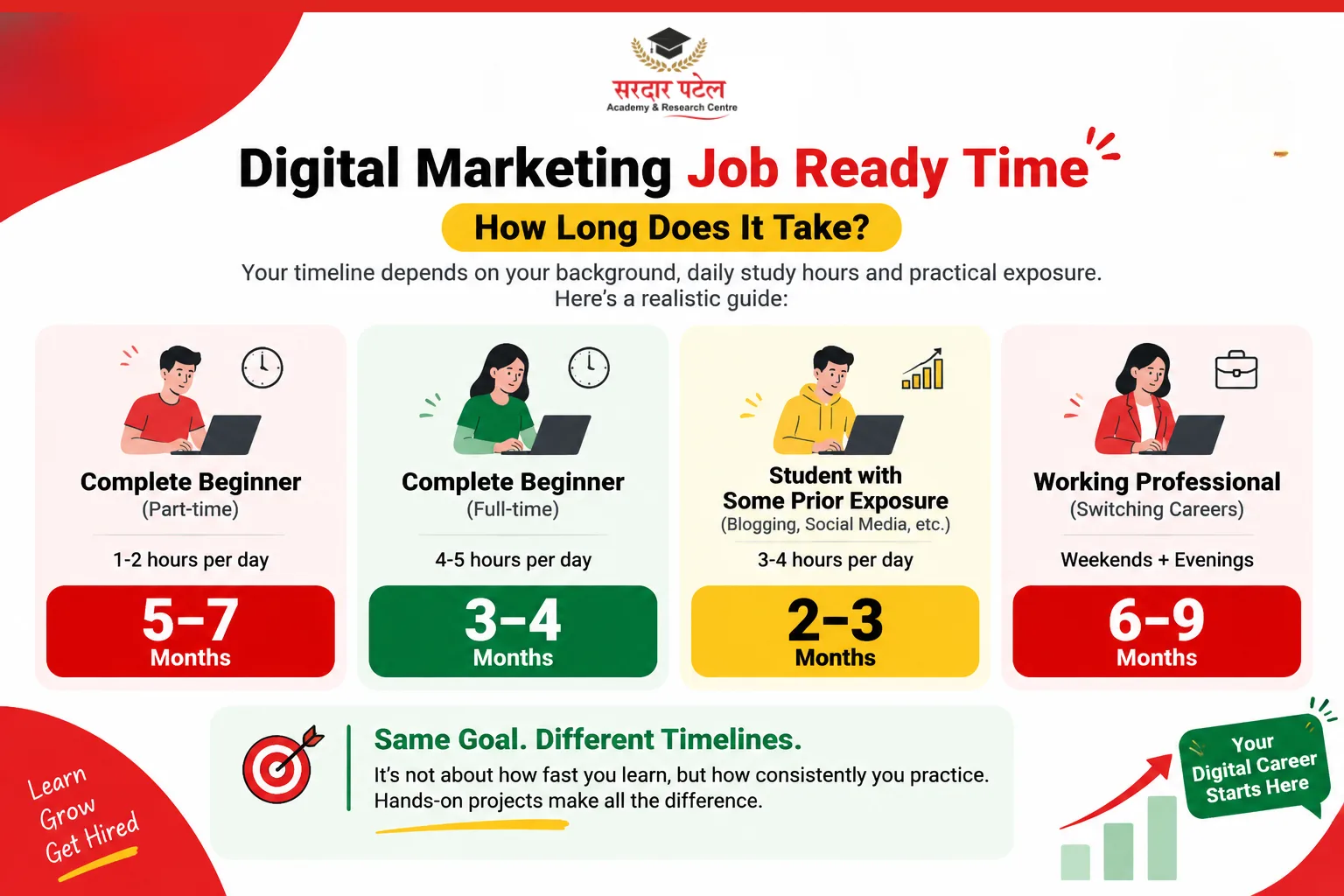
There's no single number that applies to everyone, but here's a realistic breakdown based on different starting points and study patterns.
| Learner Profile |
Study Pattern |
Realistic Job-Ready Timeline |
| Complete beginner, studying part-time |
1-2 hours/day |
5-7 months |
| Complete beginner, studying full-time |
4-5 hours/day |
3-4 months |
| Student with some prior exposure (blogging, social media handling) |
3-4 hours/day |
2-3 months |
| Working professional switching careers |
Weekends + evenings |
6-9 months |
| Business owner learning for own brand |
Flexible, project-based |
Varies — often faster since there's a real business to apply skills on |
These numbers assume consistent practice, not just passive learning. Watching 100 hours of YouTube tutorials without doing a single live campaign will not get you job ready, no matter how many months you spend on it.
Why Timelines Vary So Much
A few things genuinely change how fast someone becomes employable:
- Daily practice hours — Someone doing 4 hours a day will naturally move faster than someone doing 45 minutes every other day.
- Access to real tools — Practicing on a live Google Ads account or an actual website teaches you far more than theory-only classes.
- Feedback quality — Learners who get their campaigns and content reviewed by someone experienced correct mistakes faster.
- Prior digital comfort — Someone already comfortable with spreadsheets, basic design tools, or content writing tends to pick up digital marketing skills quicker.
- Specialisation vs generalist path — Focusing on one skill (say, Meta Ads) can make you job ready faster than trying to learn everything at once.
A Realistic Month-by-Month Roadmap
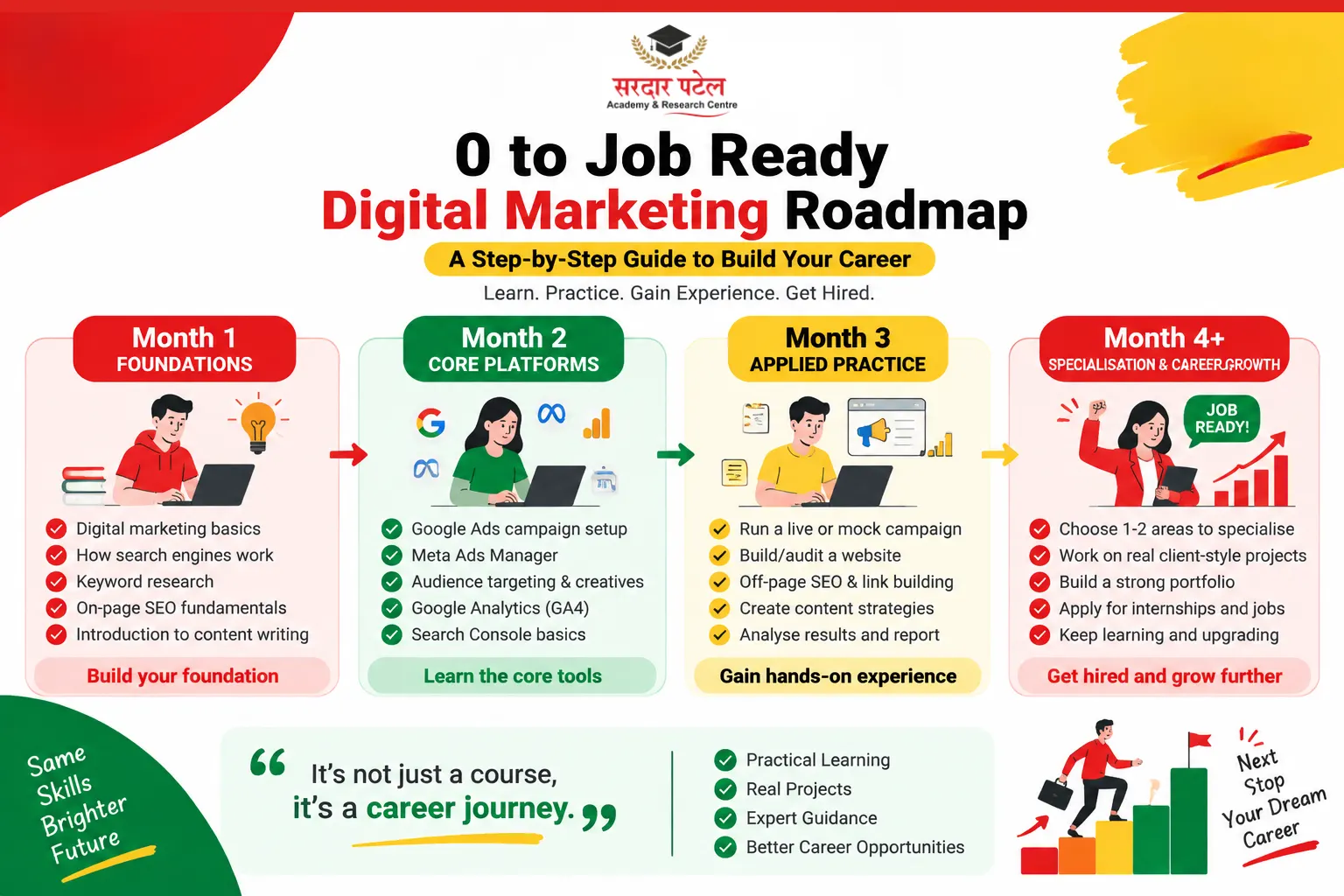
Here's a general outline of how a structured learning path typically progresses. This isn't a rigid formula, but it reflects how most learners actually move from zero to employable.
Month 1: Foundations
- Digital marketing fundamentals — how search engines and social platforms work
- Basic SEO concepts, keyword research, and on-page optimisation
- Introduction to content writing for the web
Month 2: Core Platforms
- Google Ads structure — campaigns, ad groups, keywords, bidding basics
- Meta Ads Manager — audience targeting, creative testing, budgets
- Google Analytics and Search Console basics
Month 3: Applied Practice
- Running a mock or live campaign end-to-end
- Building and auditing a small website or landing page
- Off-page SEO and basic backlink strategy
Month 4 onward: Specialisation and Portfolio Building
- Choosing 1-2 areas to go deeper (SEO, paid ads, or analytics)
- Working on real client-style projects or internships
- Building a portfolio that shows actual results, not just certificates
If you're comparing a shorter, focused programme against a longer, broader one, it helps to understand the practical differences between an advanced and a basic digital marketing course before you commit your time.
Common Mistakes That Delay Job Readiness
Even motivated learners slow themselves down in predictable ways.
- Skipping practice for theory. Reading about SEO doesn't teach you SEO. Auditing a real site does.
- Trying to learn everything at once. Jumping between SEO, ads, email marketing, and design without finishing any one properly usually means finishing none properly.
- Ignoring analytics. Many learners avoid Google Analytics because it feels intimidating, but employers specifically look for candidates who can read data, not just create campaigns.
- No portfolio. A certificate tells an employer you attended a course. A portfolio with 2-3 real (even mock) projects tells them you can actually do the job.
- Underestimating soft skills. Client communication, reporting, and basic presentation skills matter more in real jobs than most learners expect.
Job Ready vs Expert: Two Different Goals
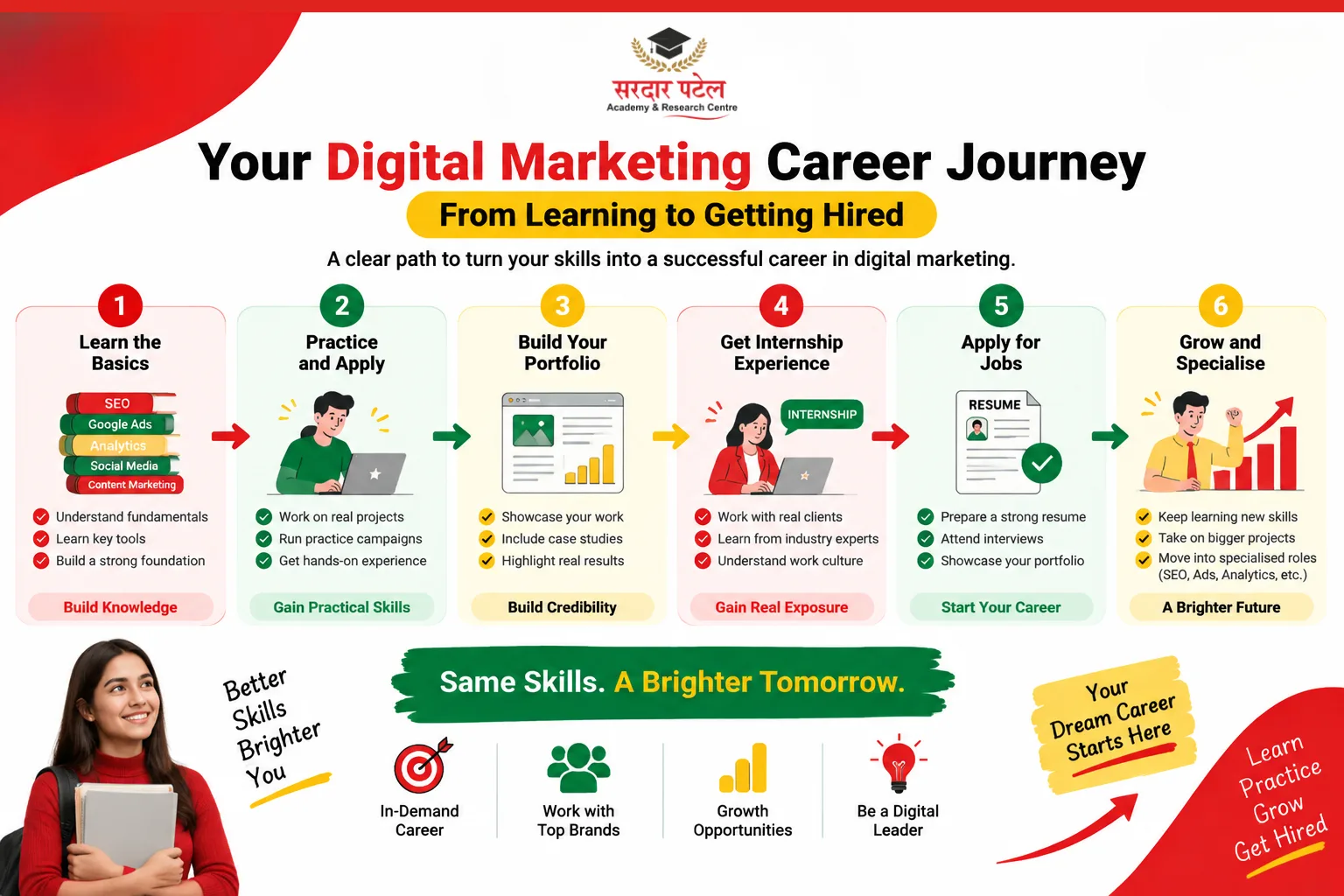
It helps to separate these two stages clearly, because conflating them is a common source of frustration.
Job Ready means you can handle an entry-level role competently — running campaigns, writing SEO content, reporting basic metrics — with some supervision and room to grow on the job.
Expert level takes years of hands-on experience across multiple industries, budgets, and challenges. No course, regardless of duration, can compress years of applied experience into a few months. What a good course can do is get you to the point where you're genuinely useful in your first role and able to keep learning from there.
If you're a student or fresher weighing digital marketing against other career paths, it may also help to look at other career-oriented courses available after graduation in Delhi for context.
Does Location (Delhi NCR) Affect the Timeline?
Not dramatically, but it does affect a few practical things. Delhi NCR has a fairly active digital marketing job market, particularly for entry-level SEO, content, and social media/ads roles, given the concentration of agencies, D2C brands, and startups in the region. This means:
- More opportunities to intern alongside your learning, which speeds up practical exposure
- Easier access to in-person mentorship and doubt-clearing sessions, which many learners find faster than fully online formats
- A reasonably competitive entry-level market, so having a portfolio genuinely matters more here than in smaller markets
None of this changes the core learning timeline, but it does mean learners in Delhi NCR often have more chances to gain real project exposure while still studying, which can shorten the gap between "course-complete" and "job ready."
Final Thoughts: Plan Your Timeline, Don't Rush It
There's no shortcut that skips practice, and there's no fixed number that applies to every learner. Your digital marketing job ready time depends largely on how consistently you show up, how much of what you learn you actually apply, and whether you build real project experience along the way rather than relying on certificates alone.
If you're trying to figure out how many months to learn digital marketing based on your own schedule and starting point, it helps to talk to someone who can map out a realistic plan rather than a generic one.
Want a clearer, faster path to becoming job ready? Start the Fast Track Course at Sardar Patel Academy & Research Centre (SPARC), or get in touch with our team to discuss a timeline that fits your specific situation.
FAQs
For most beginners studying consistently (around 3-4 hours a day), 3 to 5 months is a realistic range to reach a genuinely employable skill level, assuming hands-on practice is included alongside theory.
Part-time learners (1-2 hours daily) typically need 5 to 7 months, since less daily practice means slower skill retention and fewer opportunities to apply concepts.
It's possible to learn the basics of one specific skill (like running simple Meta ad campaigns) in that time, but genuine job readiness across core digital marketing skills usually needs more than a few weeks of consistent effort.
No. Basic HTML awareness helps for technical SEO tasks, but most entry-level roles don't require coding skills. Tools handle most of the technical execution.
A certificate helps at the resume-shortlisting stage, but interviewers typically ask about real work. A small portfolio of practice campaigns, audits, or content pieces makes a noticeably stronger impression.
There's no universally correct answer. SEO tends to suit people who enjoy research and writing, while paid ads suit those comfortable with numbers, testing, and quick iteration. Many learners eventually pick up both.
Yes, generally. Existing comfort with writing, basic design, or handling social accounts often shortens the learning curve, since some fundamentals are already familiar.
Often, yes. Internships provide real feedback and exposure to actual client or business scenarios, which tends to accelerate practical readiness compared to classroom learning alone.