+91 9312966129
 sparc.enquiry01@gmail.com


Latest Google SEO Updates Students Must Learn
Confused by the latest Google SEO updates? Here's what students need to know about 2026's core updates, AI Mode, and SEO trends.

Table of Contents
- Why Tracking New Google Algorithm Updates Matters for Students
- A Quick Recap: What Happened Through 2026
- Core Updates Kept Reinforcing E-E-A-T
- Spam Updates Went After Scaled, Low-Value Content
- AI Mode Became a Default Part of Search
- New Google Algorithm Updates vs. Old SEO Habits
- SEO Trends 2026: What Students Should Actually Focus On
- 1. E-E-A-T Isn't Optional Anymore
- 2. Structured Data Helps You Get Cited, Not Just Ranked
- 3. Topical Depth Beats One-Off Articles
- 4. Zero-Click and AI-Answer Visibility Are Now Real Metrics
- 5. Technical SEO Fundamentals Still Matter
- Common Mistakes Students Make When Learning SEO Right Now
- Conclusion
If you're studying digital marketing right now, you've probably already heard someone say "SEO has completely changed." It's a bit dramatic, but not entirely wrong. The latest Google SEO updates in 2026 have shifted how search results are generated, how visibility is measured, and what actually gets a page noticed.
For students, this isn't just background news — it's core curriculum. The tactics that worked two or three years ago (keyword stuffing, backlink volume, thin content published at scale) are exactly what recent updates have targeted. This article walks through what's changed, why it matters for anyone starting a career in SEO, and what to actually focus on instead.
Why Tracking New Google Algorithm Updates Matters for Students
Google doesn't announce every change it makes. Most updates go live quietly, and only the broader "core updates" or major spam updates get an official confirmation. Even so, keeping an eye on new Google algorithm updates is one of the most practical habits a student can build, because:
- Employers expect junior SEO hires to at least recognise recent update names and their general focus.
- Case studies and client reporting depend on knowing whether a traffic dip is update-related or a technical issue.
- SEO fundamentals taught a few years ago (like heavy exact-match keyword targeting) can now actively hurt rankings if applied without adjustment.
You don't need to memorise every update's release date. What matters more is understanding the direction Google has been moving in — and that direction has been consistent for a while now: reward genuinely useful, expert-backed content, and reduce the value of manipulation tactics.
A Quick Recap: What Happened Through 2026
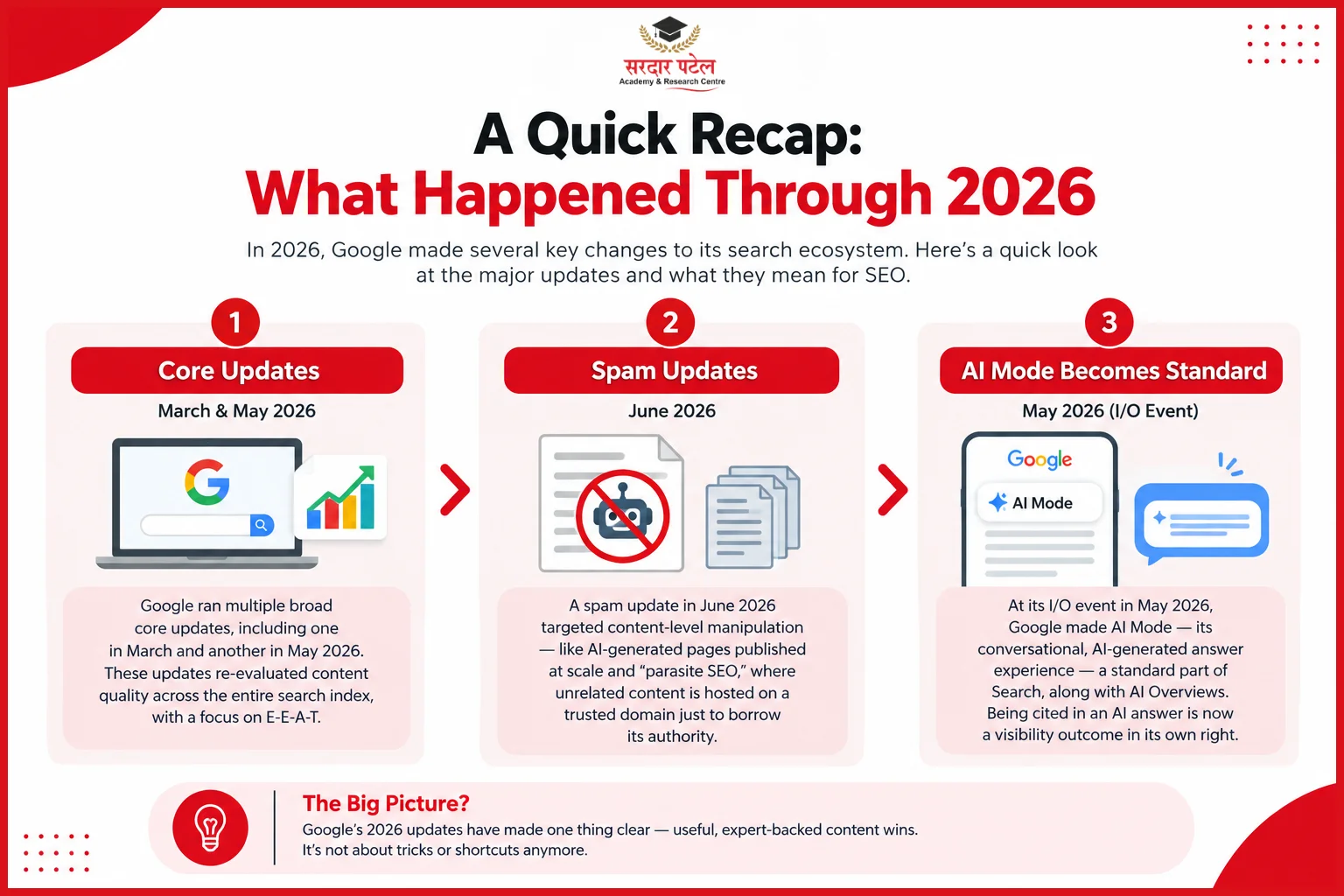
Rather than listing every minor tweak, here's the pattern worth understanding.
Core Updates Kept Reinforcing E-E-A-T
Google ran multiple broad core updates through the year, including one in March and another in May 2026. Broad core updates are re-evaluations of content quality across the entire search index rather than a fix aimed at one tactic. Reporting on the May 2026 update indicated that the rollout took close to twelve days. Rather than assuming that any single content characteristic determined performance, students should use Google’s official documentation and their own Search Console data to assess how a site responded to a core update.
Spam Updates Went After Scaled, Low-Value Content
A spam update in June 2026 specifically targeted content-level manipulation — things like AI-generated pages published at scale with little editorial oversight, and "parasite SEO," where unrelated content is hosted on a trusted domain purely to borrow its authority. This matters for students because it's a clear signal: publishing more content isn't the strategy anymore. Publishing content that's actually reviewed and useful is.
AI Mode Became a Default Part of Search
At its I/O event in May 2026, Google made AI Mode — its conversational, AI-generated answer experience — a standard part of how many people use Search, alongside a broader redesign of the results page. Combined with AI Overviews appearing on a growing share of informational queries, this has changed what "ranking well" even means. Being cited inside an AI-generated answer is now a visibility issue in its own right, separate from a traditional blue-link ranking.
What Is a Google Core Update?
A core update is a broad change to Google's overall ranking systems, not a fix targeting one specific tactic. It re-evaluates content quality across the entire index and can cause noticeable ranking shifts, both up and down, without Google disclosing exactly which signals changed.
New Google Algorithm Updates vs. Old SEO Habits
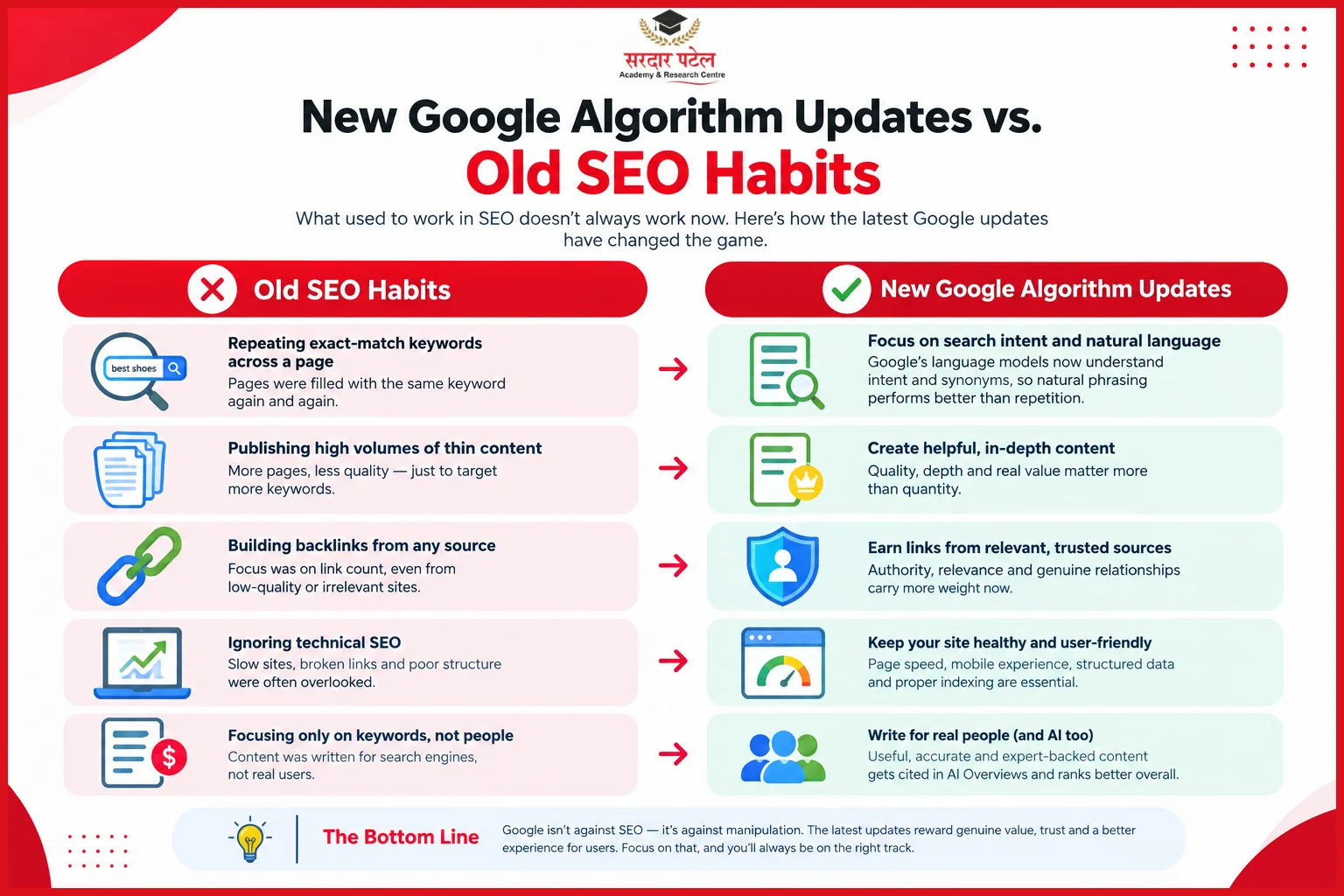
One of the clearest ways to understand new google algorithm updates is to compare what used to work against what tends to hold up now.
| Old SEO Habit |
What's Changed |
| Repeating exact-match keywords across a page |
Google's language models now understand intent and synonyms, so natural phrasing performs better than repetition |
| Publishing high volumes of thin content |
Recent spam updates specifically target scaled, low-effort content |
| Buying or exchanging backlinks in bulk |
Link schemes are treated as a spam signal; fewer, more relevant links matter more |
| Writing only for the search engine |
Content is increasingly judged on whether it reflects real expertise and experience (E-E-A-T) |
| Ignoring page speed and mobile layout |
Mobile-first indexing and user experience remain baseline ranking factors |
SEO Trends 2026: What Students Should Actually Focus On
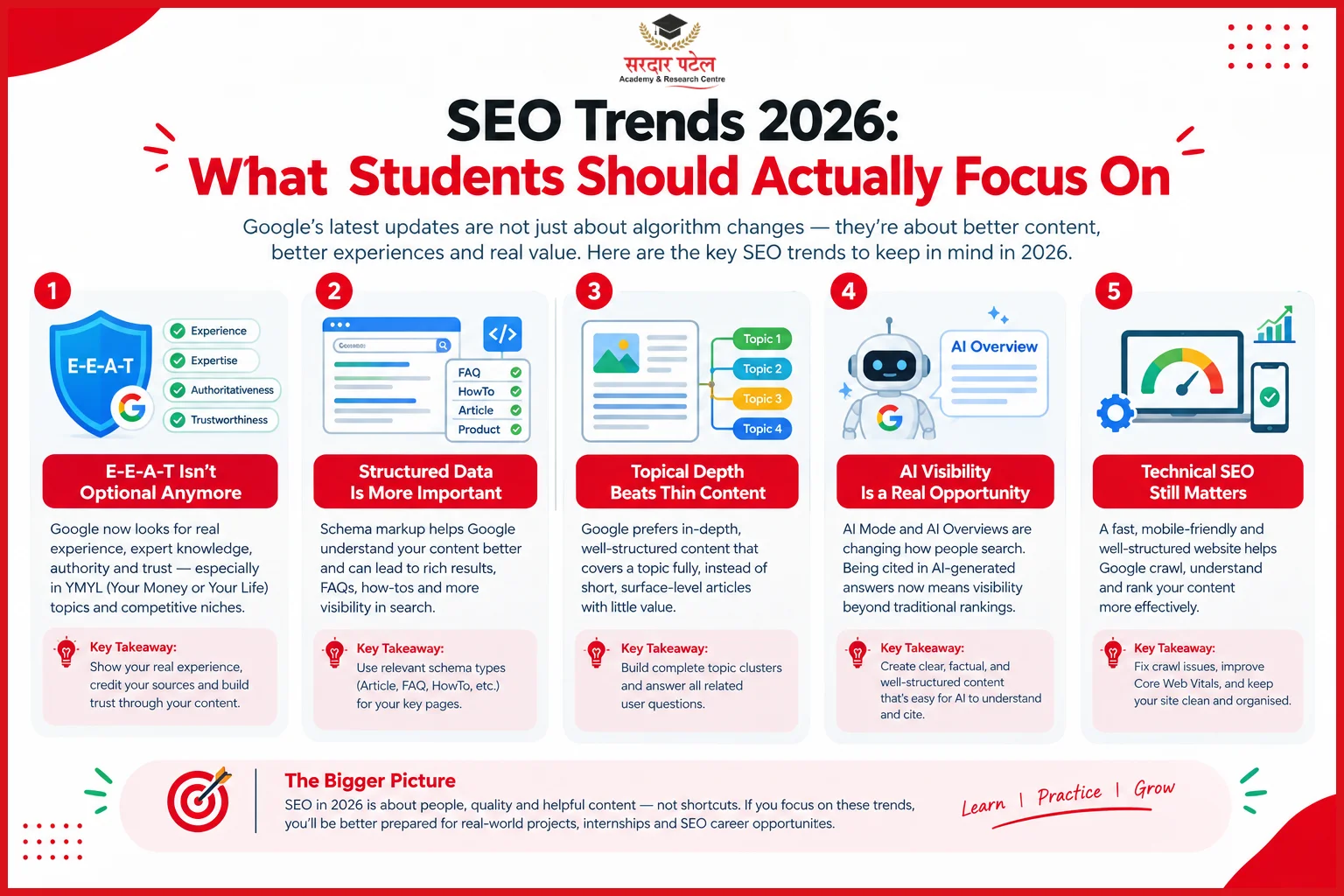
Given everything above, here's where it makes sense to put your energy if you're building SEO skills right now.
1. E-E-A-T Isn't Optional Anymore
Experience, Expertise, Authoritativeness, and Trustworthiness has moved from "nice to have" to a core evaluation lens. Practically, this means author bios, transparent sourcing, and content written by someone who understands the topic — not just someone who researched it quickly — carry more weight.
2. Structured Data Helps You Get Cited, Not Just Ranked
With AI Overviews and AI Mode pulling information from multiple sources to construct an answer, well-implemented schema markup (FAQ, Article, HowTo) makes it easier for these systems to parse and extract your content accurately. It doesn't guarantee a citation, but it removes friction.
3. Topical Depth Beats One-Off Articles
A single well-optimised blog post rarely competes with a site that has built genuine depth around a topic over time. Covering a subject from multiple angles — beginner guides, comparisons, FAQs — signals topical authority in a way one article can't.
4. Zero-Click and AI-Answer Visibility Are Now Real Metrics
Many searches, especially informational queries, can now be answered directly within the search results through features such as AI Overviews and featured snippets, reducing the need for users to visit an external website. This doesn't make SEO pointless — it changes what success looks like. Tracking whether your content gets cited in an AI-generated answer is becoming as relevant as tracking a position-one ranking.
5. Technical SEO Fundamentals Still Matter
None of this replaces the basics. Fast-loading pages, clean mobile layouts, proper indexing, and crawlable site structure remain the foundation everything else is built on. Skipping these to chase AI-search tactics is a common and avoidable mistake.
Common Mistakes Students Make When Learning SEO Right Now
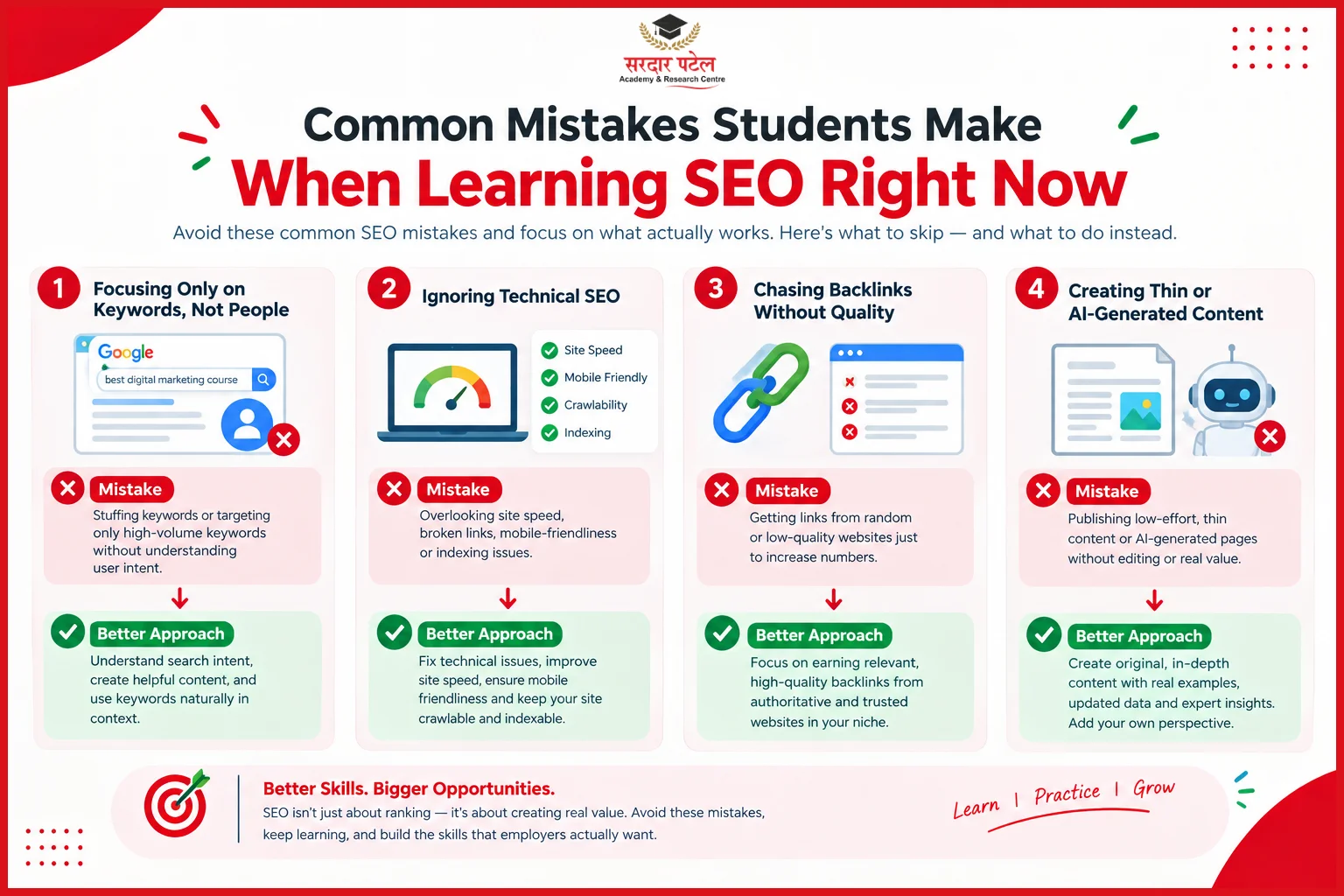
- Learning outdated tutorials. A lot of free content online still teaches keyword-density thinking from years ago. Cross-check anything you learn against current update behaviour.
- Chasing every algorithm rumour. Not every ranking fluctuation is a confirmed update — sometimes it's a technical issue or seasonal change. Verify before reacting.
- Ignoring AI Overviews entirely. Some students still plan purely around traditional blue-link rankings, missing an increasingly important visibility channel.
- Treating SEO as a one-time task. Given how often core updates roll out, SEO work needs ongoing monitoring, not a single setup phase.
It also helps to see how these skills come together in practice. SPARC's student portfolio showcase the kind of applied SEO and content work students build during training, and the email marketing basics guide is a useful next read if you want to see how SEO connects with other digital channels.
Conclusion
Keeping up with the latest Google SEO updates can feel overwhelming, especially as a student trying to learn the fundamentals at the same time. But the underlying pattern is consistent: Google keeps rewarding genuine expertise, useful content, and solid technical foundations, while making it harder for shortcuts to work.
Rather than trying to track every single change, focus on understanding why these updates keep happening, and build your skills around content quality, E-E-A-T, and technical fundamentals. That approach holds up regardless of which specific update rolls out next.
If you want structured, hands-on guidance on building these skills rather than piecing it together from scattered articles, it's worth exploring a course that keeps pace with these changes.Learn Updated SEO Skills
Sardar Patel Academy & Research Centre (SPARC) | GTB Nagar, Delhi
sparc.org.in | +91 93129-66129
FAQs
Through 2026, Google rolled out multiple core and spam updates. Exact update names, dates, and rollout details should be checked against Google's Search Status Dashboard before being quoted in coursework or client reports.
No. Understanding algorithm updates is more about content strategy, user intent, and site structure than programming. Basic HTML familiarity helps with technical SEO, but it isn't a requirement to start.
Google makes small changes continuously, but broad core updates and major spam updates — the ones worth tracking closely as a student — tend to happen a few times a year.
AI Overviews are AI-generated summaries that appear above traditional search results for many queries. AI Mode is a more conversational, in-depth search experience that Google expanded significantly in 2026. Both affect how visibility and clicks are measured.
Not entirely. Fundamentals like site speed, mobile optimisation, and clear site structure still matter. What's outdated is relying on manipulation tactics like keyword stuffing or bulk link-building instead of genuine content quality.
Follow a small number of reliable sources (Google's own Search Central blog is the most authoritative), practice on real or mock websites, and focus on understanding the reasoning behind updates rather than memorising every name and date.
Yes. AI has changed how search results are presented, but the underlying need — helping the right content reach the right audience — hasn't gone away. If anything, understanding both traditional SEO and AI-search visibility makes a candidate more valuable, not less.