+91 9312966129
 sparc.enquiry01@gmail.com


3 Month vs 6 Month Data Analytics Course
Compare 3-month vs 8-month data analytics courses — pace, projects, and practical training — and see why SPARC's 8-month model takes a different approach.

Table of Contents
- 3 Month vs 6 Month: At a Glance
- What You Can Learn in a 3-Month Course
- What You Can Learn in a 8-Month Course
- Key Differences Between the Two
- Who Should Choose a 3-Month Course
- Who Benefits More from a 8-Month Course
- Where an 8-Month Format Fits In
- What to Check Before Enrolling in Any Duration
- Does Duration Actually Affect Practical Learning?
- How to Choose Based on Your Career Goal
- Conclusion
Choosing between a 3-month and 8 month data analytics course can be difficult, especially when both options appear to cover similar tools. The real difference is often not just the number of months. It comes down to learning depth, practice time, project work, pace, and your personal schedule.
A student starting from scratch may need more time to understand analytics fundamentals and practise them. Someone with existing experience in Excel, reporting, statistics, or business operations may prefer a shorter learning path. If you're starting from scratch, our data analytics learning guide can help you understand what to learn and how to build your skills step by step.
This guide compares both durations, then looks at why some institutes — including SPARC — deliberately choose neither, and structure their program around a longer, project-heavy 8-month format instead.
3 Month vs 6 Month: At a Glance
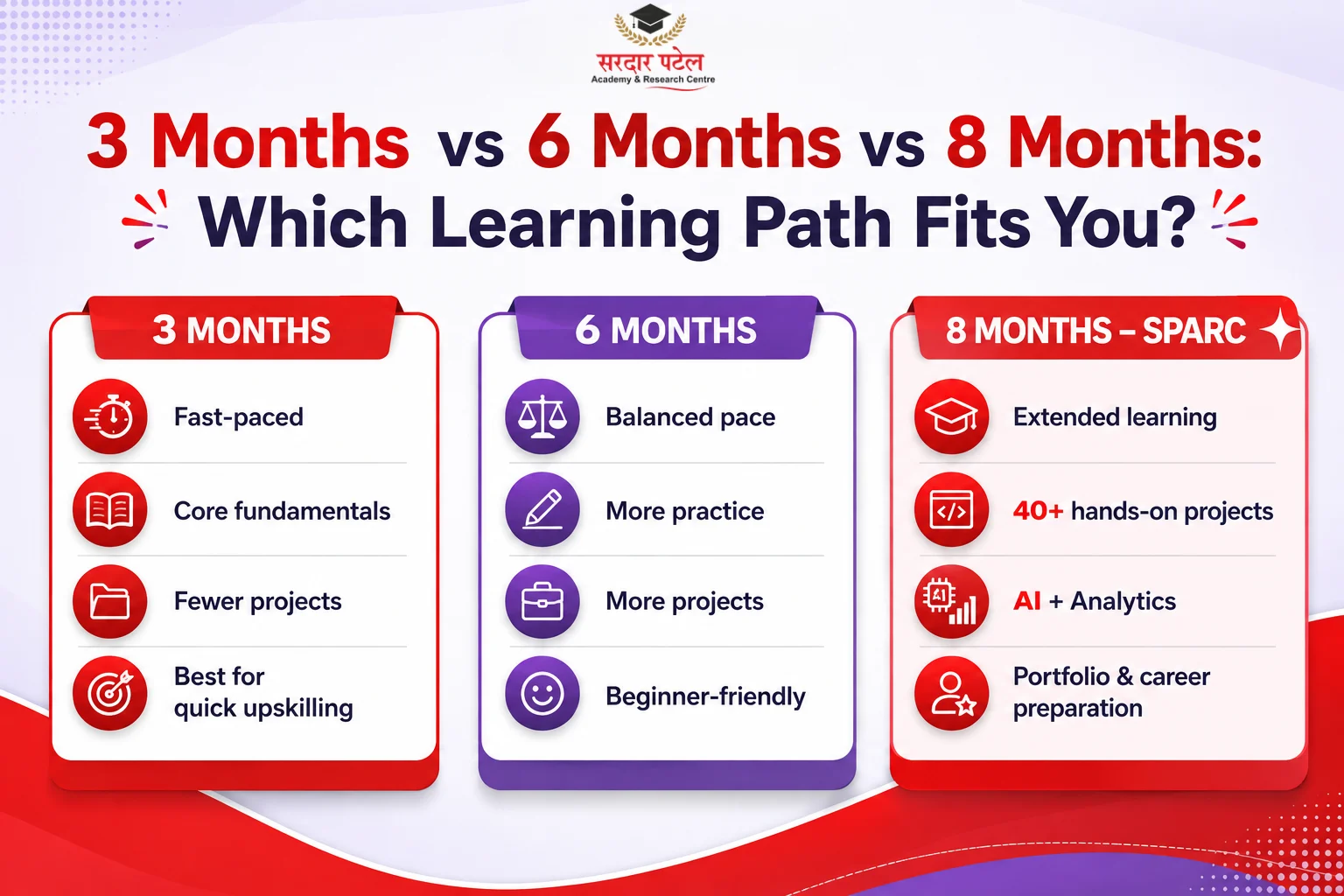
A 8-month course is not automatically better than a 3-month one. The syllabus depth, trainer access, and how much of that time is actually spent building things — versus watching lectures — matter more than the number printed on the brochure.
What You Can Learn in a 3-Month Course
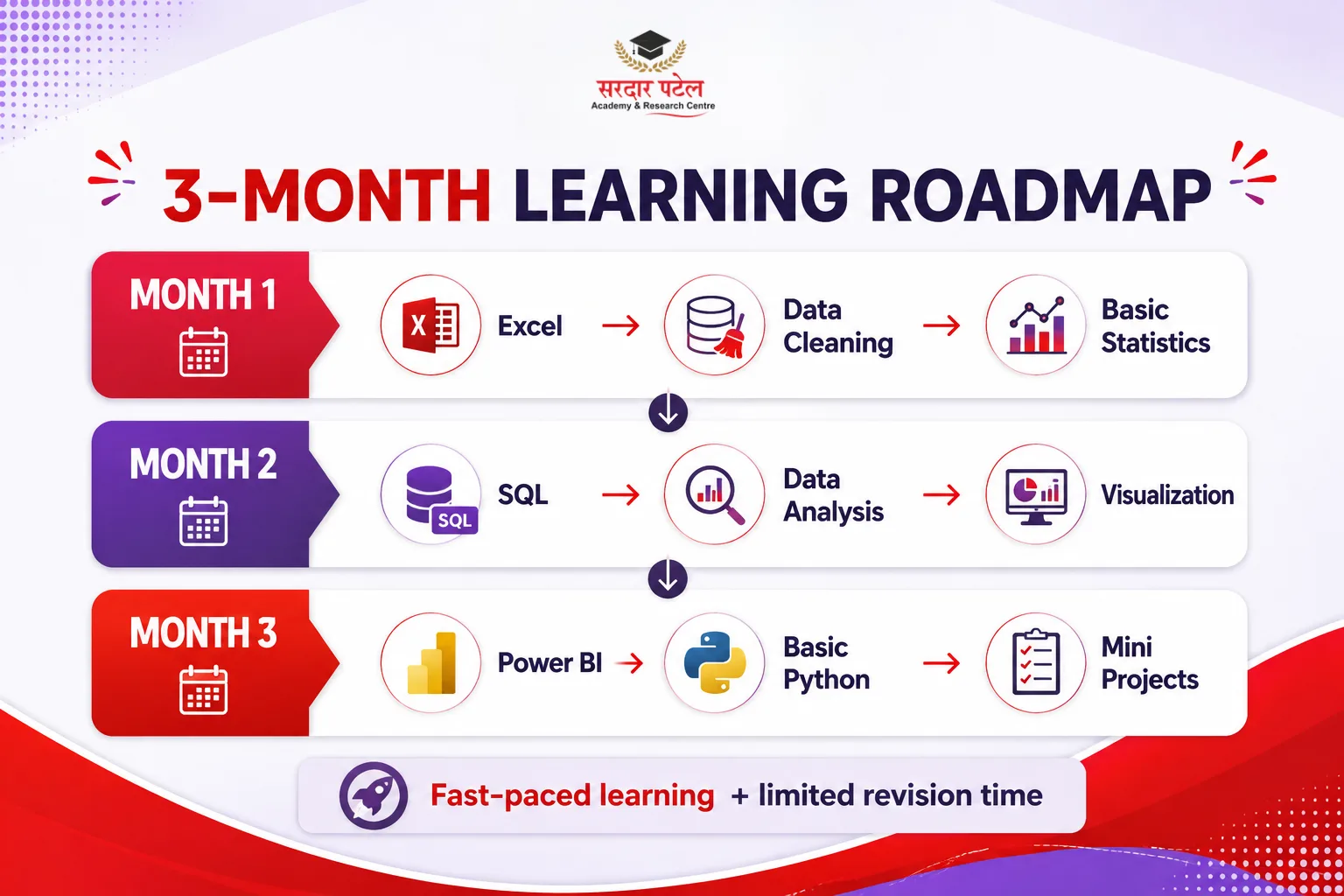
A 3-month program can provide a focused introduction to the core areas of data analytics, provided you can maintain a consistent weekly study routine.
A well-structured short-term analytics course typically covers:
- Excel for data analysis
- SQL fundamentals
- Basic statistics
- Data cleaning
- Data visualisation
- Power BI or another BI tool — learners can also use Microsoft's Power BI training resources to explore data preparation, modelling and reporting. Introductory Python
- A small number of practical assignments
For learners who want a structured introduction to analytics and Power BI, Microsoft's data analytics learning path is another useful reference.
If you want to understand the most commonly used tools in the field, see our guide to data analytics tools you must know.
The advantage is speed — if you already have some spreadsheet or reporting background, you can move through fundamentals without a long gap between starting and finishing.
The limitation: less room for extended revision and repeated practice. If a topic doesn't click the first time, a compressed schedule gives you less time to circle back before the course moves on.
If you are beginning with spreadsheet-based analysis, you can also explore Google Sheets for Data Analysis to understand how spreadsheets can be used for everyday analytical tasks.
What You Can Learn in a 8-Month Course
A 8-month program gives learners a longer runway to build understanding, with more time to practise each concept before moving to the next.
A longer analytics course typically adds:
- Advanced Excel techniques
- SQL queries and deeper database concepts Statistics for analytics
- Python for data analysis
- Data cleaning and transformation
- Power BI and Tableau
- Business-focused analytics projects
- Early portfolio development
- Interview preparation
The advantage is revision time — Analytics skills are interconnected, so being able to return to an earlier topic (say, SQL joins) while learning something new (Power BI data modelling) reinforces both. Learners can also refer to the SQL joins documentation for additional practice.
The catch: a longer duration only helps if the extra months add real teaching and practice time. A short syllabus simply stretched over six months with the same number of projects doesn't deliver proportionally more value — always ask what specifically fills the additional weeks.
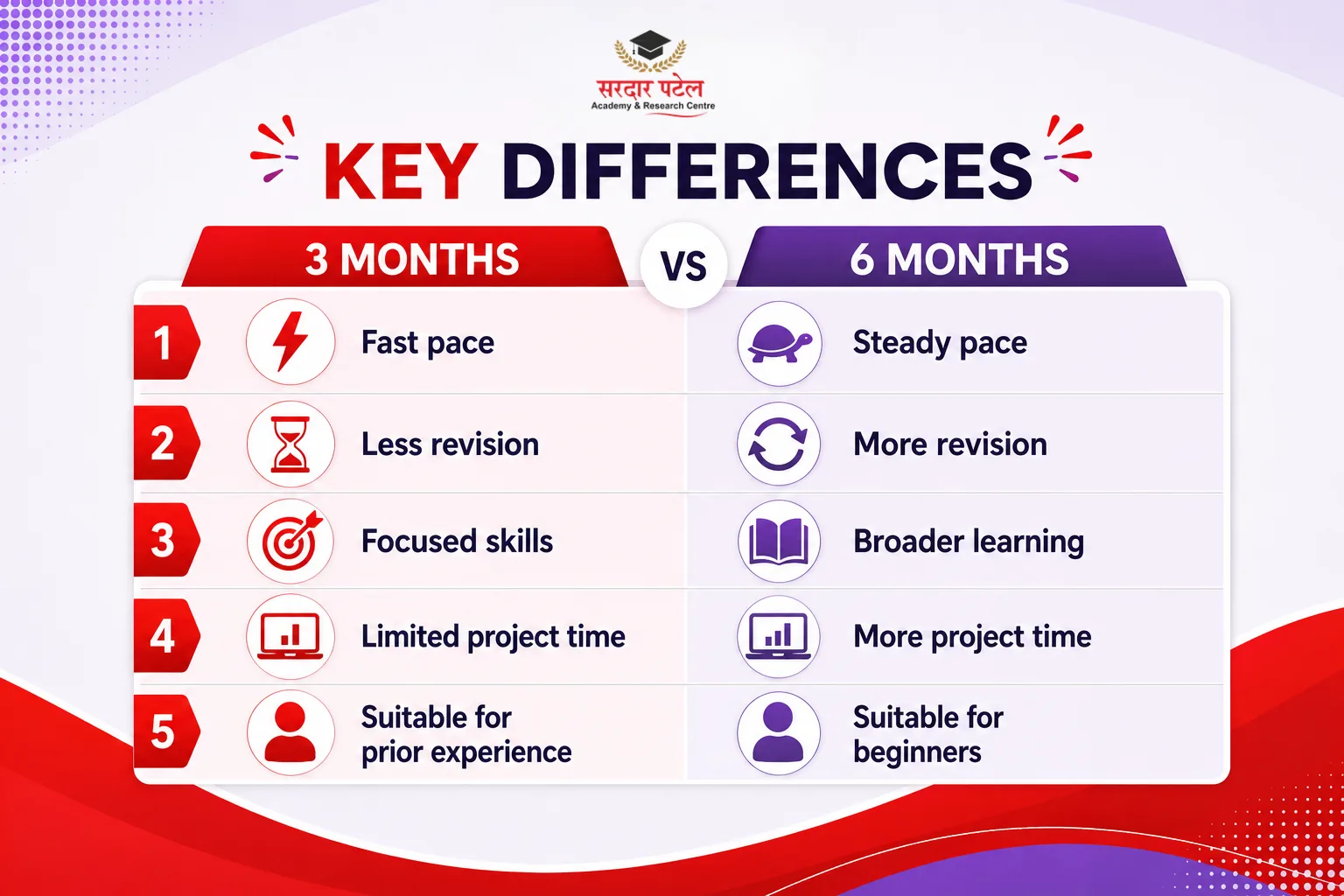
Key Differences Between the Two
- Learning speed — 3-month courses move fast by necessity; 8-month courses distribute the same (or more) content over a longer period, which suits learners who prefer mastering one concept before the next.
- Practice time — analytics is a practical skill; reading about SQL and actually writing 50 queries against a real database are different experiences. Ask directly: how many hours per week are hands-on versus lecture?
- Project work — ask exactly how many projects are included and whether you build them yourself or watch a guided walkthrough. This number varies hugely by institute — some 8-month courses include 15 projects, others include 30+.
- Revision — particularly important for beginners; ask if revision sessions are built into the schedule or left to you outside class hours.
- Schedule fit — a student with several free hours daily may manage an intensive 3-month course comfortably. A working professional balancing a job usually does better with a format that spreads the same material across more weeks at a lighter weekly load.
Who Should Choose a 3-Month Course
A short-term program can make sense if you:
- Want structured training completed within a shorter timeframe
- Can study consistently every week without long breaks
- Already understand basic spreadsheet or reporting concepts
- Want to focus on essential, high-priority analytics skills
- Prefer an intensive pace over a spaced-out one
- Have a specific, near-term goal (e.g., an upcoming job application). Before setting your target, you can also review current Data Analyst jobs on LinkedIn to understand the skills employers are asking for.
Before choosing this route, confirm the course still gives real hands-on exposure rather than rushing through slides to hit the syllabus in time.
Students who are wondering whether they can start analytics after school can also read Can 12th Pass Students Learn Analytics? for a clearer understanding of the starting requirements.
Who Benefits More from a 8-Month Course
A longer course tends to suit learners who:
- Are completely new to analytics and coding concepts
- Need more time to absorb technical topics like SQL joins or Python loops
- Want built-in revision and repeated practice
- Prefer a slower, steadier pace
- Want to complete several substantial projects, not just a few
- Are balancing learning with college or a full-time job
- Want real time to build an interview-ready portfolio
If you're completely new to the field, you can start with these data analytics basics for beginners before moving into more advanced tools and projects.
Where an 8-Month Format Fits In
Not every institute frames its program as strictly 3-month or 8-month. SPARC's Data Analytics Course with AI, for example, runs for 8 months (2-hour classes on alternate days), which sits deliberately outside this usual duration split.
The reasoning is straightforward: 35+ hands-on projects simply need more calendar time than a compressed 3-month format allows, while still moving faster than some 8-month programs that spread a lighter syllabus over the same period.
If you're comparing 3-month and 8-month options and finding that neither gives you enough practical project time, it's worth asking any institute — SPARC included — exactly how many projects and practice hours are built into their specific duration, rather than assuming longer automatically means more thorough.
See SPARC's full 8-month Data Analytics curriculum
What to Check Before Enrolling in Any Duration
Regardless of whether you pick 3 months, 6 months, or a different format entirely:
- Full syllabus — actual topics and sequence, not just the course title.
- Practical assignments — will you build real dashboards and write real SQL, or mostly watch demonstrations?
- Project structure — guided walkthroughs versus independent assignments. The latter builds stronger interview-ready skills.
- Trainer support — how doubts get resolved, especially for SQL, Python, and dashboard work where beginners commonly get stuck.
- Certification — who issues it, and what completing it actually requires. For example, learners considering Power BI can review the Microsoft Certified: Power BI Data Analyst Associate requirements before evaluating certification claims made by training institutes.
- Class schedule — confirm timings genuinely fit around your college or job before enrolling, not after.
Before making a final decision, go through our detailed Questions to Ask Before Joining Analytics Institute guide to evaluate a training provider more carefully.
Does Duration Actually Affect Practical Learning?
It can, but duration alone doesn't determine practical learning quality.
Consider two hypothetical programs: one runs 3 months with regular assignments, projects, and feedback; another runs 6 months but spends most sessions on lectures with limited hands-on work. The shorter program, in that scenario, would likely deliver stronger practical learning despite the shorter timeline.
This is why the more useful question when comparing any data analytics course in Delhi isn't "how many months," but:
"How many of those hours will I actually spend practising tools and building projects, versus watching someone else do it?"
That single question tells you more than the number on the brochure.
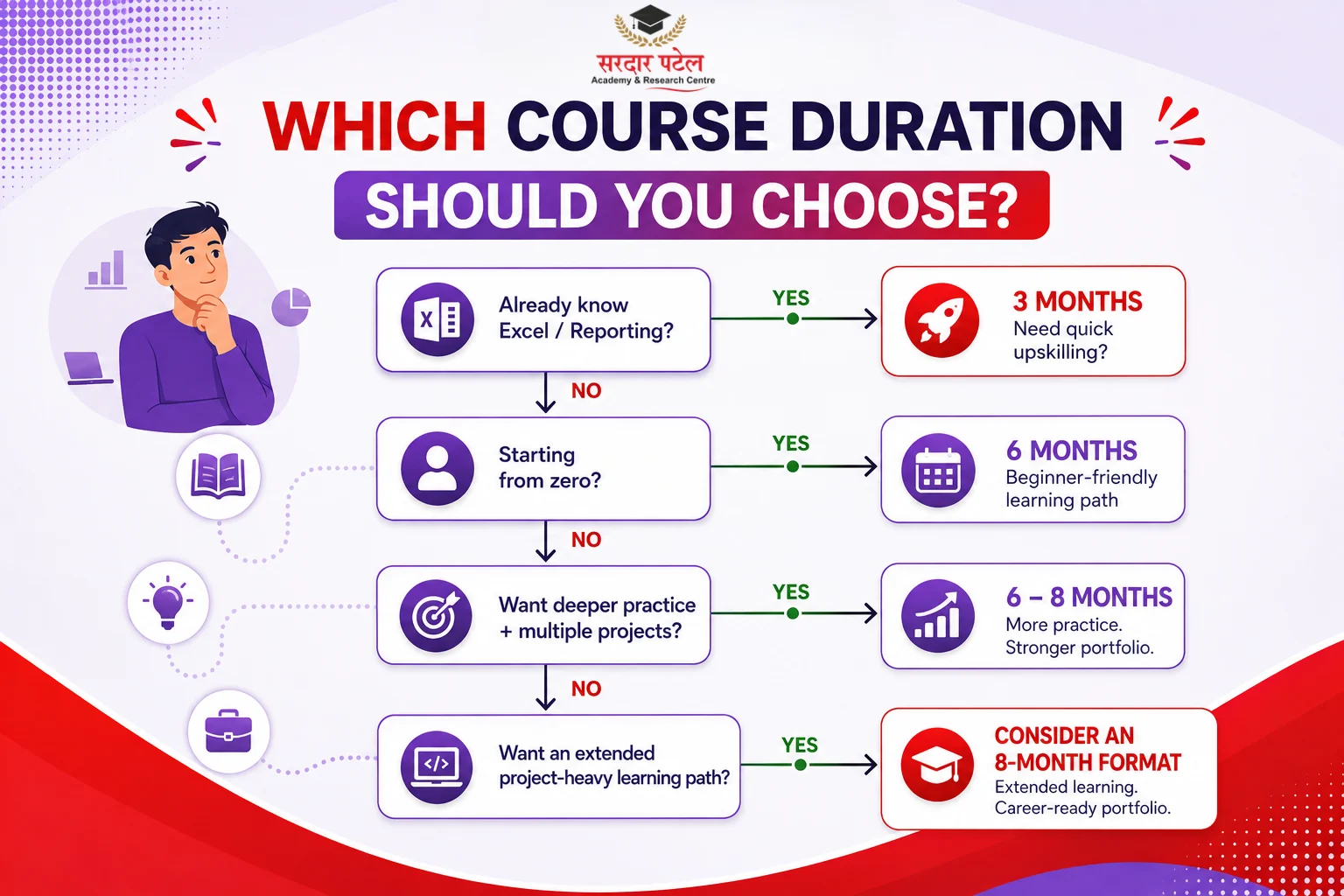
How to Choose Based on Your Career Goal
- Quick skill upgrade — a 3-month program may suit you if you already have relevant background and want specific analytics skills within a focused timeframe.
- Starting from zero — a 8-month (or longer, project-heavy) program gives more room to build fundamentals, practise tools, and gain confidence before job-hunting.
- Working full-time — look at weekly workload rather than total duration. A 8- or 8-month course with a manageable weekly schedule is often easier to sustain than an intensive 3-month sprint alongside a job.
- Building a portfolio — compare project count and independence (built by you vs. shown to you) rather than choosing on duration alone.
Understanding how analytics is used in real organisations can also help you see the importance of data analytics in business.
- Preparing for an analytics role specifically — prioritise practical skills, project depth, communication practice, and placement support. You can also explore data analytics course eligibility and career opportunities to understand the skills and career paths available in this field.
Reviewing current Data Analyst job listings on Indeed can also help you identify the skills and experience employers commonly mention.
Conclusion
There's no universal answer to the 3-month vs 8-month question. Choose a 3-month option if you're comfortable with a fast pace and want focused training on a shorter timeline. Choose an 8-month option if you're a beginner who wants more practice and a spaced-out schedule. And if neither gives you enough project depth, a longer, project-heavy format — like SPARC's 8-month Data Analytics Course with AI, built around 35+ live projects — may be worth comparing directly against both.
The best course is the one that gives you enough time and support to understand the concepts, practise the tools, complete meaningful projects, and walk into interviews with something real to talk about.
👉 Talk to a SPARC Career Counsellor · 👉 Download the Course Brochure 📞 +91 93129 66129 · ✉️ sparc.enquiry01@gmail.com
FAQs
It can provide a foundation, but check the teaching pace and practical coverage carefully. If you need more time for practice and revision, a longer format will likely feel more manageable.
Not necessarily. Curriculum quality, practical training hours, project count, and trainer support matter more than the duration printed on the brochure.
Usually because the curriculum includes more hands-on project work that needs additional calendar time — SPARC's 8-month format, for instance, is built around 35+ projects.
Depends on your schedule. A 3-month intensive course may work if you can dedicate several hours weekly; a 8- or 8-month format spread across alternate days is often easier to sustain alongside a full-time job.
Yes, when they provide focused training, real practical exercises, and a clear project structure. Before enrolling, verify exactly what skills and how many projects are included — a short course with strong hands-on time can outperform a longer one that's mostly lecture-based.
No. Compare the syllabus, tools, project count, practice-to-lecture ratio, trainer support, certification, and schedule fit.
Completing a course builds relevant skills, but employment also depends on your practical ability, project portfolio, communication skills, and how the institute's placement support connects you with hiring companies.
The complete syllabus, number of hands-on projects, trainer access, class schedule, certification requirements, and exactly what placement support includes (resume help, mock interviews, hiring-partner connections).