+91 9312966129
 sparc.enquiry01@gmail.com



Canva + ChatGPT + AI Tools for Marketers
Discover the best AI tools for digital marketers in 2026 with a step-by-step Canva and ChatGPT marketing tutorial, fresh stats, and expert sources.
Table of Contents
- Why AI Tools Have Become Non-Negotiable for Marketers in 2026
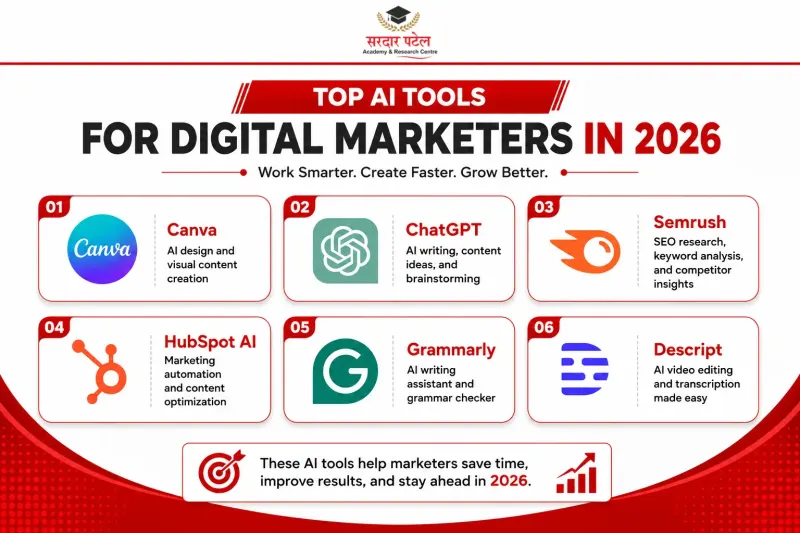
- Top AI Tools for Digital Marketers in 2026
- Canva Magic Studio — AI Design for Non-Designers
- ChatGPT — Content, Copy, and Ideation
- Semrush AI Toolkit — Keyword and SEO Research
- Jasper AI — Brand-Voice Content at Scale
- Surfer SEO — On-Page Optimisation
- HubSpot AI (Content Assistant + Campaign Assistant)
- Grammarly — Editing and Brand Tone
- Meta Advantage+ and Google Performance Max
- Descript — AI Video and Podcast Editing
- Perplexity AI — Research and Fact-Checking
- Zapier + AI Agents — Workflow Automation
- Canva and ChatGPT Marketing Tutorial: A Step-by-Step Workflow
- Which AI Skill Pays the Most? A Quick Comparison
- Common Mistakes Marketers Make With AI Tools
- Conclusion
Every marketer today juggles five jobs at once — writer, designer, strategist, analyst, and social media manager. The gap between marketers who thrive in 2026 and those who burn out comes down to one thing: how well they use AI tools for digital marketers to handle repetitive work so they can focus on strategy. Two names dominate this shift — Canva for design and ChatGPT for content — but the real advantage comes from combining them with the right supporting tools.
This guide breaks down the best AI tools for digital marketers, walks through a practical Canva and ChatGPT marketing tutorial, shares fresh 2026 adoption data with sources, and shows exactly which AI skills recruiters are paying premiums for right now.
Why AI Tools Have Become Non-Negotiable for Marketers in 2026
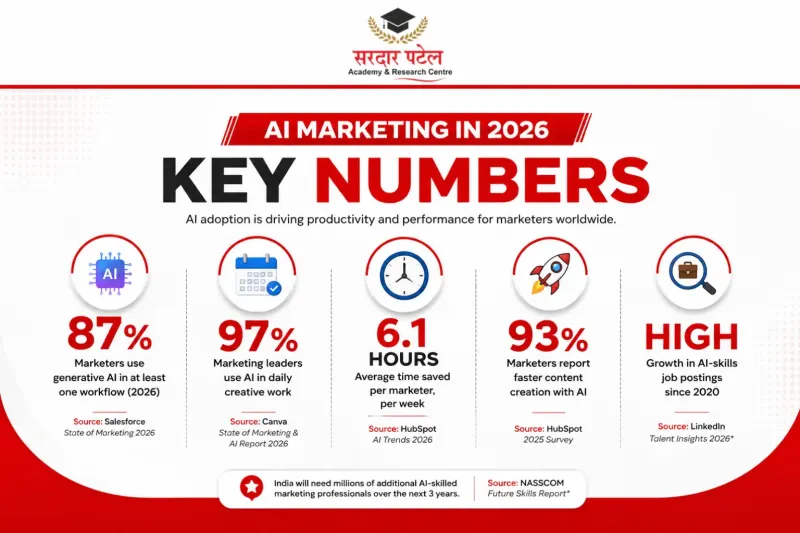
AI is no longer an experiment in a corner of the marketing department — it is the daily workflow. According to Salesforce's State of Marketing 2026 report, 87% of marketers now use generative AI in at least one workflow, up sharply from 51% in 2024. That figure measures any use of generative AI in a workflow — a broader bar than "daily" use. Canva's 2026 State of Marketing & AI report, by contrast, measures daily habitual use and found 97% of marketing leaders now use AI in their daily creative work. Read together, the two numbers aren't contradictory — they describe different thresholds of the same trend: broad-workflow adoption is near-universal, and for most of those marketers it has become a daily habit. HubSpot's AI Trends 2026 survey puts average time saved at 6.1 hours per marketer, per week.
The India story is sharper still. LinkedIn Talent Insights 2026 reports job postings demanding AI skills in marketing have grown sharply since 2020, and NASSCOM's Future Skills Report estimates India will need a significant number of additional AI-skilled marketing professionals over the next three years, with current training output covering only a fraction of that demand.
Featured Snippet Answer: AI tools for digital marketers are software platforms — such as Canva, ChatGPT, Semrush, and HubSpot AI — that use machine learning to automate content creation, design, SEO research, and campaign optimisation, helping marketing teams work faster and make data-backed decisions.
Top AI Tools for Digital Marketers in 2026
Canva Magic Studio — AI Design for Non-Designers
Canva's Magic Studio suite (Magic Design, Magic Write, Magic Eraser, and Background Remover) lets marketers without a design background produce social creatives, ad banners, and presentations in minutes. A large majority of creative professionals now use generative AI somewhere in their workflow, and marketing teams use it most for Instagram carousels, LinkedIn banners, and pitch decks.
ChatGPT — Content, Copy, and Ideation
ChatGPT remains one of the most-used AI tools among marketers. Teams using it consistently report producing more content per marketer per month. It's best used for first drafts, headline variations, meta descriptions, and campaign brainstorming — not final, unedited copy.
Semrush AI Toolkit — Keyword and SEO Research
Semrush's AI-powered content and SEO tools cut keyword research and content-gap analysis time significantly. (Correction: the original draft attributed a "47% more content" figure to Semrush. That specific number could not be verified — the closest independently confirmed statistic is Ahrefs' 2025 survey of 879 marketers, which found companies using AI publish 42% more content per month (a median of 17 articles vs. 12 for non-AI users). That figure is now cited to its correct source below rather than to Semrush.)
Jasper AI — Brand-Voice Content at Scale
Jasper is built for teams that need consistent brand voice across dozens of writers. Its own 2026 survey data points to a large majority of marketers now using AI daily — Jasper users specifically lean on it for long-form blog production and ad variations.
Surfer SEO — On-Page Optimisation
Surfer scores content against top-ranking pages in real time, helping writers hit the right keyword density, structure, and word count before publishing — a natural companion to a ChatGPT-drafted article.
HubSpot AI (Content Assistant + Campaign Assistant)
HubSpot bakes AI directly into its CRM, so marketers can generate email copy, ad copy, and blog outlines without leaving their existing workflow. This is one of the biggest reasons content marketers lead internal AI adoption, per HubSpot's 2026 AI Trends survey.
Grammarly — Editing and Brand Tone
Grammarly's AI layer checks grammar, clarity, and tone-of-voice consistency — essential for teams publishing across multiple writers and platforms, and a final quality gate before anything goes live.
Meta Advantage+ and Google Performance Max
Both platforms use AI to automatically test creative combinations and audience segments. (Correction: the original draft cited a specific "2.7x ROI" figure attributed to McKinsey, which could not be located in McKinsey's published research. McKinsey's actual, widely-cited figure on this topic is that personalisation can deliver 5 to 8 times the ROI on marketing spend, with an associated 10%+ lift in sales — that figure is used here instead.) This makes AI-driven testing and targeting essential for paid media managers.
Descript — AI Video and Podcast Editing
Descript lets marketers edit video by editing text, auto-generate captions, and remove filler words — a major time-saver for short-form video, which now dominates organic reach on Instagram and YouTube Shorts.
Perplexity AI — Research and Fact-Checking
Perplexity pulls live, cited web sources, making it useful for competitive research, trend-spotting, and verifying statistics before they go into a blog or client report.
Zapier + AI Agents — Workflow Automation
Zapier's AI-powered automations connect tools like Canva, ChatGPT, and HubSpot so leads, content approvals, and social posting happen without manual handoffs — closing the loop between creation and distribution.
Canva and ChatGPT Marketing Tutorial: A Step-by-Step Workflow
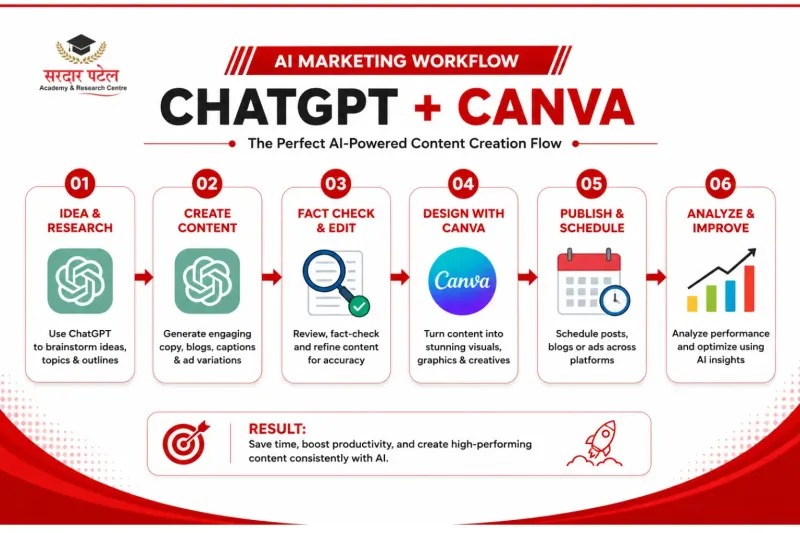
This is the practical part most listicles skip. Here's how a real campaign moves from brief to publish using just these two tools.
Featured Snippet Answer: To combine Canva and ChatGPT for marketing, first use ChatGPT to draft and refine your copy (headlines, captions, ad text), then paste the finalised text into Canva's Magic Design tool to generate on-brand visuals, and finally resize the output for each platform using Canva's Resize feature.
The biggest mistake teams make here is skipping step 3. AI tools can generate confident-sounding but incorrect statistics, so every number that goes into client-facing content needs a manual source check — exactly the discipline covered in SPARC's applied SEO and content modules.
Learn AI Marketing Skills with SPARC's hands-on digital marketing programme
Which AI Skill Pays the Most? A Quick Comparison
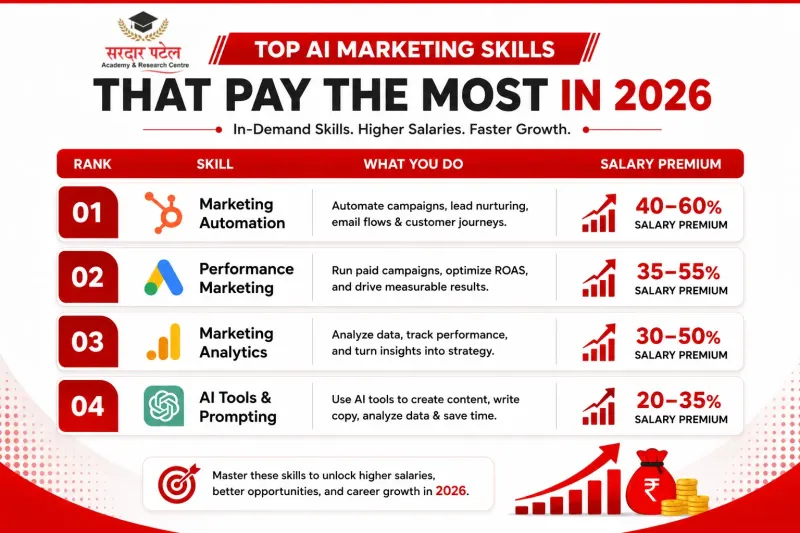
Note: Marketing automation carries the single highest premium in this comparison. AI tool fluency (Canva, ChatGPT, prompting) shows a smaller premium on its own, but it's typically the fastest and cheapest skill to pick up, and in practice most marketers now build it alongside automation, performance, or analytics skills rather than as a standalone specialism — which is why it's the natural starting point.
Common Mistakes Marketers Make With AI Tools
Most teams don't fail because they use AI — they fail because they use it carelessly. Common mistakes: publishing AI drafts without human editing (unedited AI-only posts tend to show weaker ranking longevity over time), skipping fact-checks, ignoring brand-voice consistency, and treating AI output as strategy rather than a starting draft. The strongest results come from marketers who use AI to speed up production while keeping judgment and final editing in human hands.
Building this discipline is what structured, mentor-led training solves — it's the difference between "knowing ChatGPT exists" and running a repeatable, AI-assisted content pipeline for a real client account.
Conclusion
AI tools for digital marketers aren't optional anymore — they are the baseline. The marketers pulling ahead in 2026 aren't the ones who know the most tools; they're the ones who know how to combine Canva, ChatGPT, and the rest into one clean, repeatable workflow while keeping strategy and judgment in human hands. If you want to build exactly that skill set with real projects and mentor feedback,
Learn AI Marketing Skills at Sardar Patel Academy & Research Centre (SPARC) — call +91 93129-66129 or visit sparc.org.in to know more
FAQs
The most widely used are Canva (design), ChatGPT (content and ideation), Semrush and Surfer SEO (research and optimisation), HubSpot AI (CRM and campaigns), and Grammarly (editing). Most marketing teams combine three to five of these rather than relying on one.
Yes, ChatGPT's free tier supports basic content drafting and ideation. Paid tiers unlock faster response times, longer context, and advanced features better suited to daily professional use in content-heavy marketing teams.
For fast, templated social content, yes. For brand identity, complex campaigns, or print design, a trained designer using tools like Photoshop and Illustrator alongside Canva still delivers stronger, more original results.
HubSpot's AI Trends 2026 survey reports marketers save an average of 6.1 hours weekly, with senior practitioners saving more through drafting, summarising, and research automation.
Yes, if they are human-edited, fact-checked, and add original insight or data. Fully AI-generated, unedited content tends to show weaker long-term ranking stability compared to human-reviewed articles.
Prompt engineering is the skill of writing clear, specific instructions to get accurate, useful AI output. It's increasingly listed as a core skill in Indian digital marketing job postings alongside SEO and analytics.
No — it is reshaping them. Demand for AI-skilled marketers is currently outpacing the supply of trained talent, and roles requiring strategic thinking alongside AI fluency are growing, while purely execution-based roles are shrinking.
Marketing automation tools (HubSpot, Zoho) add the highest premium at 40–60%, followed by performance marketing skills (35–55%) and AI tool fluency itself (20–35%), according to 2026 India salary data — see the note on this data above.
Start with free tutorials on Canva and ChatGPT, then move to structured, project-based training that covers SEO, paid ads, analytics, and AI workflows together — this combination is what most employers screen for on LinkedIn and Naukri today.
Not necessarily. Canva and ChatGPT both offer functional free tiers, and most SEO and automation tools offer trial periods. The real cost for small teams is usually training time, not subscription fees.