+91 9312966129
 sparc.enquiry01@gmail.com


Accounting Jobs for Freshers: Roles, Skills and Career Opportunities
Explore accounting jobs for freshers: entry-level roles, Tally, GST, and Excel skills, career growth and Delhi NCR hiring tips from SPARC.
Table of Contents
- What Are Accounting Jobs for Freshers?
- Why Accounting Is a Steady Career Choice
- Common Entry-Level Accountant Jobs
- 1. Accounts Assistant
- 2. Junior Accountant
- 3. Accounts Executive
- 4. Data Entry Operator (Accounts)
- 5. GST Assistant or Tax Assistant
- 6. Accounts Payable / Receivable Executive
- 7. Billing Executive
- Quick Comparison of Fresher Accounting Roles
- Skills That Help You Get Hired
- Core Accounting Knowledge
- Software Skills
- GST and Tax Basics
- Soft Skills
- A Day in the Life of a Fresher Accountant
- How to Get Your First Accounting Job: Step by Step
- Accounting Career Opportunities After Your First Job
- Fresher Accounting Jobs in Delhi NCR: Local Points to Keep in Mind
- Common Mistakes Freshers Make
- Practical Tips from the Hiring Side
- Should You Take a Training Course?
- Conclusion
You have finished your studies, and now you are wondering: what accounting jobs can I actually get, and what do employers expect from someone with no experience?
This guide answers both questions in simple words. It covers the most common accounting jobs for freshers, the skills that help you get hired, what a typical first job looks like, and how to plan your first two years. If you live in or near GTB Nagar, you will also find some local points that matter when you start your search.
What Are Accounting Jobs for Freshers?
Accounting jobs for freshers are entry-level roles where you handle the daily money records of a business. This includes recording sales and purchases, checking bills, preparing invoices, and keeping books ready for tax filing.
You do not need years of experience for these roles. You need clean basics, comfort with accounting software, and a careful way of working.
Fresher accounting jobs are found in:
- Small and medium businesses (traders, shops, distributors)
- Chartered accountant (CA) and tax consultant firms
- Manufacturing and service companies
- Startups and e-commerce sellers
- Schools, hospitals, and trusts
Why Accounting Is a Steady Career Choice
Every business, big or small, needs someone to keep its accounts. That need does not go away, even when trends change.
Here is why many students choose this path:
- Demand is spread across industries – retail, logistics, education, healthcare, and IT all need accounts staff.
- Skills are portable – if you can handle books in one company, you can do it in another.
- There is a clear growth path – you can move from assistant to executive, then to senior roles.
- You can work in many setups – full-time jobs, CA firms, or even freelance bookkeeping later on.
A small caution: salaries differ by city, company size, and skill level. Before setting expectations, compare Indeed's current accountant salary estimates in India and remember that general accountant salary figures are not necessarily fresher-specific.
Common Entry-Level Accountant Jobs
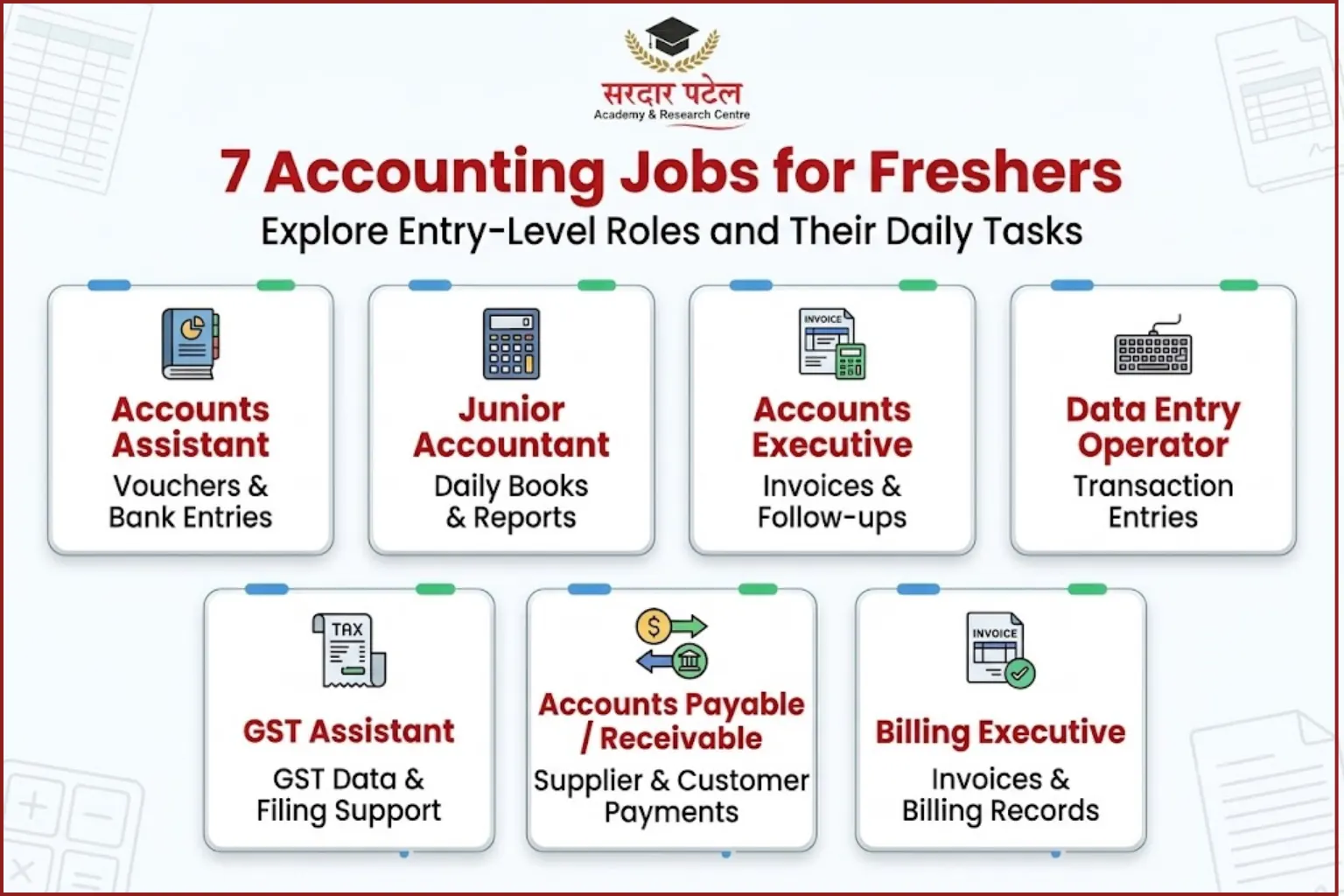
Not every job is called 'accountant'. Many entry-level accountant jobs have different titles. Knowing them helps you search better. For a closer look at local opportunities, explore the top accounting job roles for beginners in Delhi.
1. Accounts Assistant
You support the main accounts team. Typical work includes entering vouchers, filing bills, and matching bank entries.
2. Junior Accountant
You handle day-to-day bookkeeping on your own, often in Tally. You may also help with GST data and monthly reports.
3. Accounts Executive
This role is a little wider. You may manage invoices, follow up on payments, and prepare simple reports for your manager.
4. Data Entry Operator (Accounts)
You enter transactions into software. It is a good starting point if you want to learn how real books work.
5. GST Assistant or Tax Assistant
You help prepare GST data, check invoices and support return filing. This is common in CA and tax consultant offices.
6. Accounts Payable / Receivable Executive
In accounts payable, you process supplier bills and payments. In accounts receivable, you track money customers owe the business. Mid-size companies usually have these roles.
7. Billing Executive
You create invoices and make sure every sale is billed correctly. This is common in distribution, logistics and service companies.
Quick Comparison of Fresher Accounting Roles
| Role |
Main Work |
Software Used |
Best For |
| Accounts Assistant |
Vouchers, filing, bank entries |
Tally, Excel |
Absolute beginners |
| Junior Accountant |
Daily books, basic reports |
Tally, Excel |
Learners with Tally skills |
| Accounts Executive |
Invoices, follow-ups, reports |
Tally, Excel |
Candidates with good communication |
| Billing Executive |
Invoices and billing records |
Tally, ERP tools |
Detail-orientated freshers |
| GST Assistant |
GST data, invoice checking |
Tally, GST portal |
Those who like tax work |
| Payable/Receivable Executive |
Supplier and customer payments |
Tally, Excel |
Candidates who want finance exposure |
Skills That Help You Get Hired
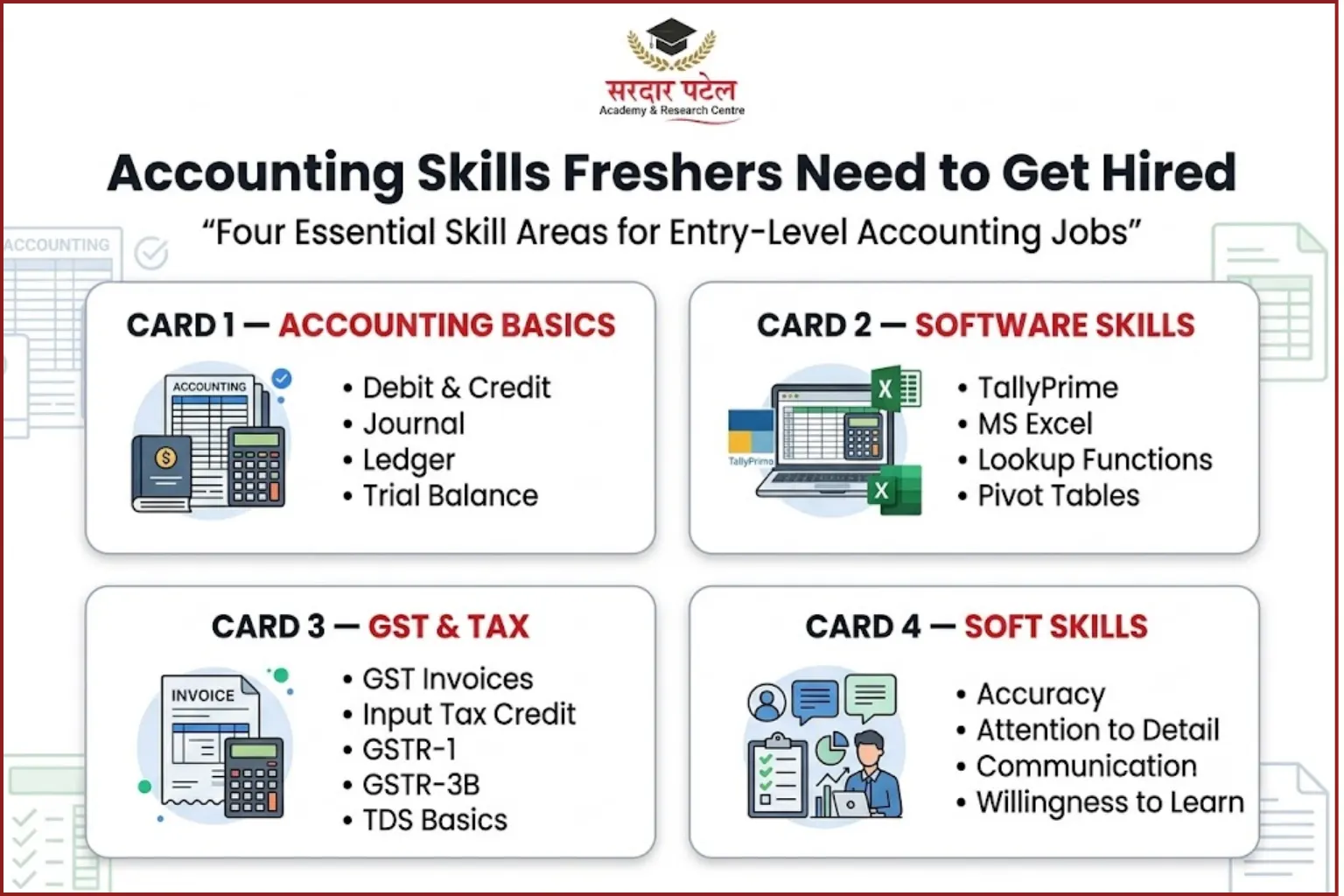
Employers hiring for fresher accounting jobs usually look for practical ability more than big degrees. Here are the skills that matter most. You can also explore the accounting skills employers look for in freshers to identify areas to strengthen before an interview.
Core Accounting Knowledge
- Debit and credit rules
- Journal, ledger, and trial balance
- Basic final accounts (profit and loss, balance sheet)
- Bank reconciliation
Software Skills
- Tally / TallyPrime: The most common accounting software in Indian small and medium businesses. Beginners can follow the official Getting Started with TallyPrime guide to understand company setup, accounting masters, and transaction recording. Before applying, review the TallyPrime skills every fresher should learn to understand which practical tasks to practise.
- MS Excel: Formulas like SUM, IF, VLOOKUP or XLOOKUP, and pivot tables. To practise common calculations and lookup functions, explore Microsoft's official Excel formulas guide.
- Basic: computer typing and data handling.
GST and Tax Basics
- What GST is and how invoices are prepared
- Input tax credit in simple terms
- Return types such as GSTR-1 and GSTR-3B. For details on invoice information and filing requirements, refer to the GST portal's official GSTR-1 user guide.
- Basic idea of TDS: For official guidance on tax deduction at source, review the Income Tax Department's TDS compliance FAQs.
Soft Skills
- Attention to detail
- Honesty with numbers
- Clear communication with colleagues and clients
- Willingness to learn and take feedback
Practical tip: Many freshers know theory but struggle when they see a real bill. Practise with sample invoices, purchase bills and bank statements, not just textbook examples.
A Day in the Life of a Fresher Accountant
Let us take an example. Ravi joins a small trading company as a junior accountant. His day may look like this:
- Check the bills received from suppliers.
- Enter purchase and sales entries in Tally.
- Match bank entries with the passbook.
- Prepare GST invoice data for his senior.
- Send payment reminders to customers.
- Update the daily cash and bank report.
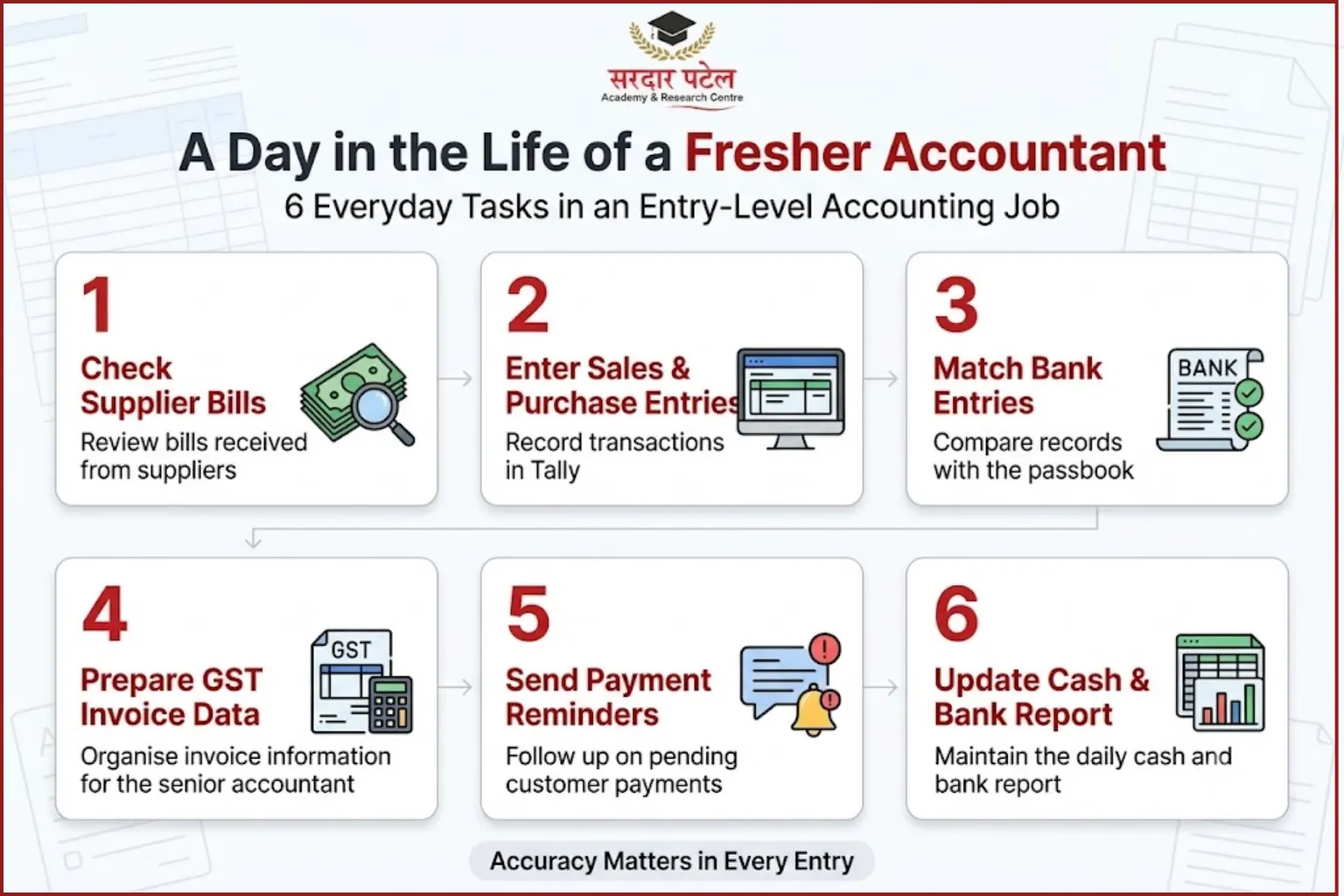
It sounds simple, but accuracy matters. One wrong ledger or wrong GST rate can create a mismatch that takes hours to fix. That is why employers value careful freshers.
How to Get Your First Accounting Job: Step by Step
Follow this simple plan.
- Build your basics – learn accounting concepts properly before jumping to software.
- Learn Tally and Excel – Practise with real-looking data.
- Understand GST – Even basic GST knowledge makes your profile stronger.
- Make a clean resume – Keep it to one page. List your skills, software, and practical work. If you are starting from scratch, read our guide on how to get an accounting job without experience for practical steps to improve your chances.
- Create practice work- Prepare a sample set of books for a small imaginary business. You can speak about it in interviews.
- Apply widely – use job portals, company websites, local CA firms, and your own contacts. You can also search for suitable vacancies through the Government of India's National Career Service job portal.
- Prepare for interviews – Expect basic questions on journal entries, GST, and Tally. For more preparation tips, follow our practical guide to getting your first job as an accountant.
Accounting Career Opportunities After Your First Job
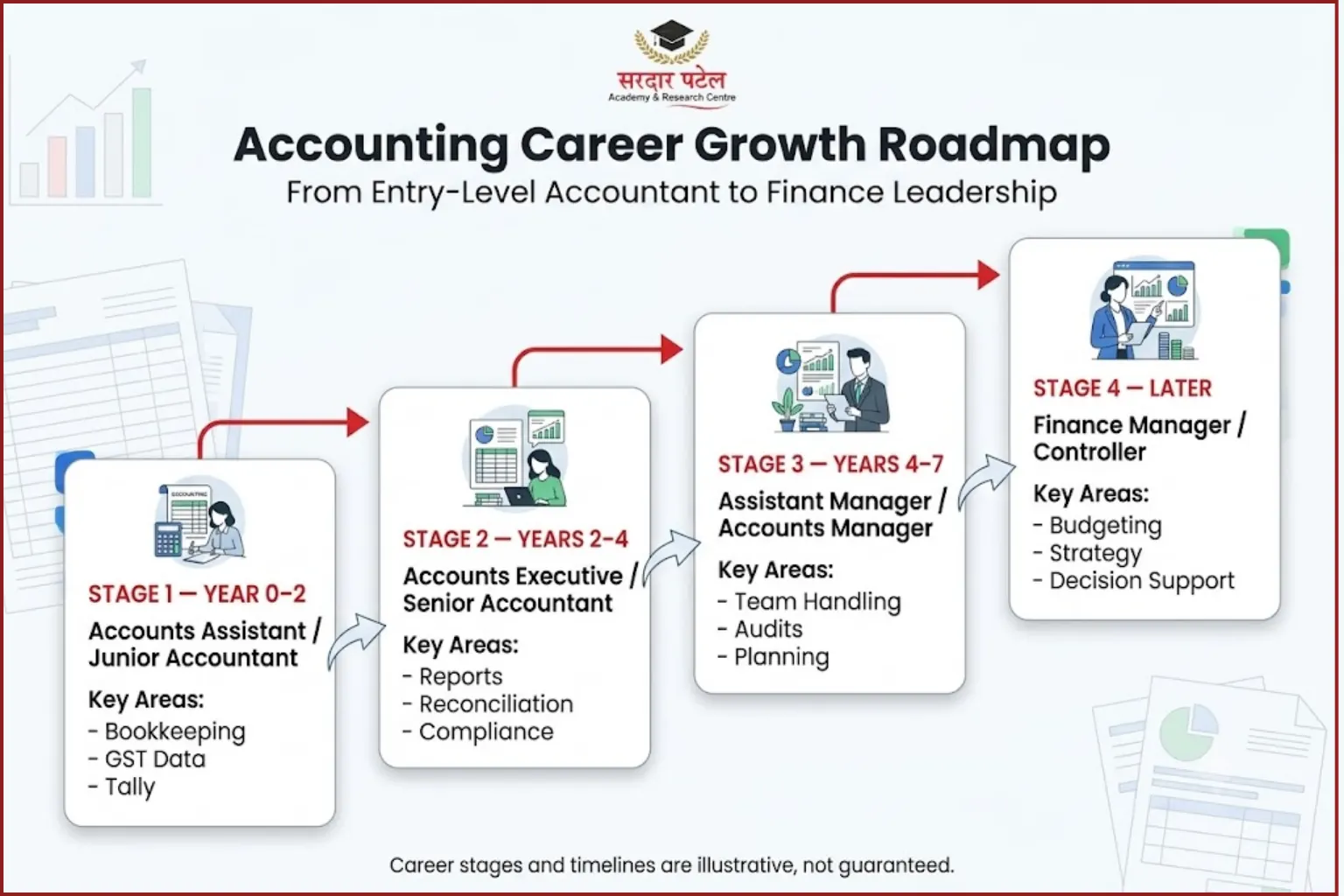
The first job is only the start. Here is how accounting career opportunities often grow.
| Stage |
Typical Role |
What You Learn |
| Year 0–2 |
Accounts Assistant / Junior Accountant |
Daily bookkeeping, GST data, Tally |
| Years 2–4 |
Accounts Executive / Senior Accountant |
Reports, reconciliations, compliance |
| Years 4–7 |
Assistant Manager / Accounts Manager |
Team handling, audits, planning |
| Later |
Finance Manager / Controller |
Budgeting, strategy, decision support |
Some people also move into taxation, audit support, payroll, or start their own bookkeeping practice. Growth depends on your skills, learning habits, and the company you work for. The timelines above are only a general picture, not a promise.
Fresher Accounting Jobs in Delhi NCR: Local Points to Keep in Mind
Delhi NCR has a large number of small traders, wholesalers, distributors, and professional offices. That means many businesses need accounts staff, often with Tally and GST knowledge.
If you live near GTB Nagar, Kamla Nagar, Model Town, Civil Lines or Mukherjee Nagar, consider these tips:
- Look at nearby CA and tax offices – many of them hire freshers for data entry, GST work, and filing support.
- Check commute time – offices in Connaught Place, Nehru Place, Noida or Gurugram may pay differently, but travel can be long. Compare the whole package, not only the salary.
- Trading and wholesale markets hire often – these businesses usually prefer people who can handle Tally and GST invoices quickly.
- Be ready for practical tests – some employers ask you to enter sample vouchers on the spot.
Local salary ranges change often, so check live job listings before negotiating.
Common Mistakes Freshers Make
Avoid these, and you will already stand out.
- Applying with only theory – Employers want to see software skills.
- Ignoring GST – Many entry-level job posts now mention it.
- A messy resume – spelling mistakes in an accounting resume send the wrong signal.
- Not practising Excel – basic formulas save a lot of time at work. Taking the first offer without checking the role – Some “accounts” jobs are only data typing with no learning.
- Stopping learning after getting the job – Accounting rules and GST updates change, so keep reading.
Practical Tips from the Hiring Side
These are general observations, not official rules:
- Small employers often prefer someone who can start working quickly with Tally.
- Freshers who explain a real practice project usually sound more confident than those who only recite definitions.
- Honesty helps. If you do not know something, say you are willing to learn it.
- Being punctual and neat counts more than people think.
Should You Take a Training Course?
A course is not compulsory, but it can help if you want faster, structured practice. A good job-oriented accounting course should cover:
- Accounting basics with real examples
- Tally / TallyPrime with practical sessions
- GST entries and return basics
- Excel for accounting work
- Interview and resume guidance
Before you join anywhere, check the syllabus, ask about practical sessions, and meet the trainers if possible. Choose based on what you will actually learn, not just the fee.
Conclusion
Starting is easier when you know where you are heading. Accounting jobs for freshers are open in many types of businesses, and the main requirements are clear basics, Tally and Excel skills, GST understanding, and careful work habits. Begin with a role that teaches you real accounting, keep learning, and your accounting career opportunities will grow step by step.
Your next steps:
- Revise your accounting basics.
- Practise Tally and Excel with sample data.
- Learn GST fundamentals.
- Build a one-page resume.
- Apply and prepare for practical tests.
If you want guided practice, you can build practical GST, Tally, and accounting skills with SPARC.
Related reading: How to Become an Accountant in India | Accounting Career Options After 12th Commerce
FAQs
Common starting roles are accounts assistant, junior accountant, accounts executive, GST assistant and billing executive. The best one is the role where you will learn real accounting work, not just typing.
Yes. Many employers hire freshers for entry-level roles. Strong basics, Tally skills and a neat resume help a lot.
Not always, but it is very common in Indian businesses. Knowing Tally or TallyPrime gives you a clear advantage.
A B.Com or commerce background is common, but practical skills matter too. Some employers accept candidates from other streams if they can show accounting and software knowledge.
It depends on the city, company and your skills. Check current job listings for the latest range
If you already know basic accounting, a few months of focused practice in Tally, GST and Excel can make you job-ready. The time varies for each person.
No. You can work in CA firms, banks, NGOs, schools, hospitals and more. Later, you can also move into taxation, audit support or your own practice.