+91 9312966129
 sparc.enquiry01@gmail.com


How to Become an Accountant in India? Step-by-Step Career Guide
Learn how to become an accountant in India: courses, Tally, GST, and Excel skills, fresher jobs, and practical tips. Start your accounting career today.
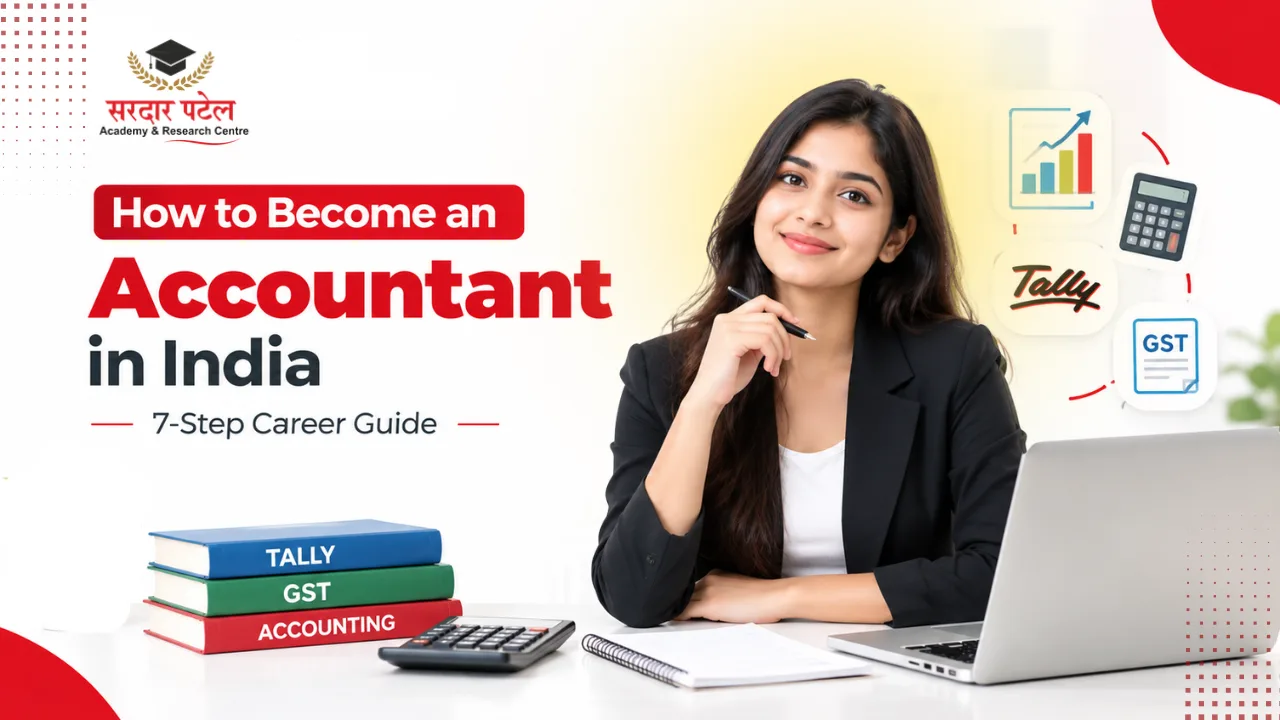
Table of Contents
- What Does an Accountant Actually Do?
- Accountant Career in India: What Are Your Options?
- How to Become an Accountant in India: 7 Steps
- Step 1: Start with the Right School Background
- Step 2: Choose Your Education Path
- Step 3: Learn the Basics of Accounting
- Step 4: Learn Tally and Other Accounting Software
- Step 5: Understand GST and Basic Taxation
- Step 6: Build Excel and Computer Skills
- Step 7: Get Real Experience
- Accounting Courses in India: What Should You Choose?
- Accounting Skills Employers Look For
- Accounting Jobs for Freshers: Where Do You Begin?
- Accountant Salary in India: What Can You Expect?
- Common Mistakes Beginners Make
- Practical Tips to Start Faster
- Conclusion
Maybe you are finishing Class 12. Maybe you are a graduate who wants a stable job with numbers. Or maybe you already work in an office and want to move into accounts. In all three cases, the first question is the same: where do I start?
This guide explains how to become an accountant in India in simple steps. You will learn about the qualifications you need, the courses worth considering, the skills employers look for, and the kind of jobs you can aim for as a fresher.
What Does an Accountant Actually Do?
An accountant keeps track of a business's money. They record daily transactions, prepare reports, handle tax work, and help owners understand where the money is going.
On a normal day, that could mean:
- Entering sales and purchase invoices
- Matching bank statements with company records
- Preparing GST data for return filing
- Checking expenses and payments
- Helping prepare monthly and yearly financial reports
The work is detailed, but it is also practical. Once you learn the basics, you can apply them in almost any business.
Accountant Career in India: What Are Your Options?
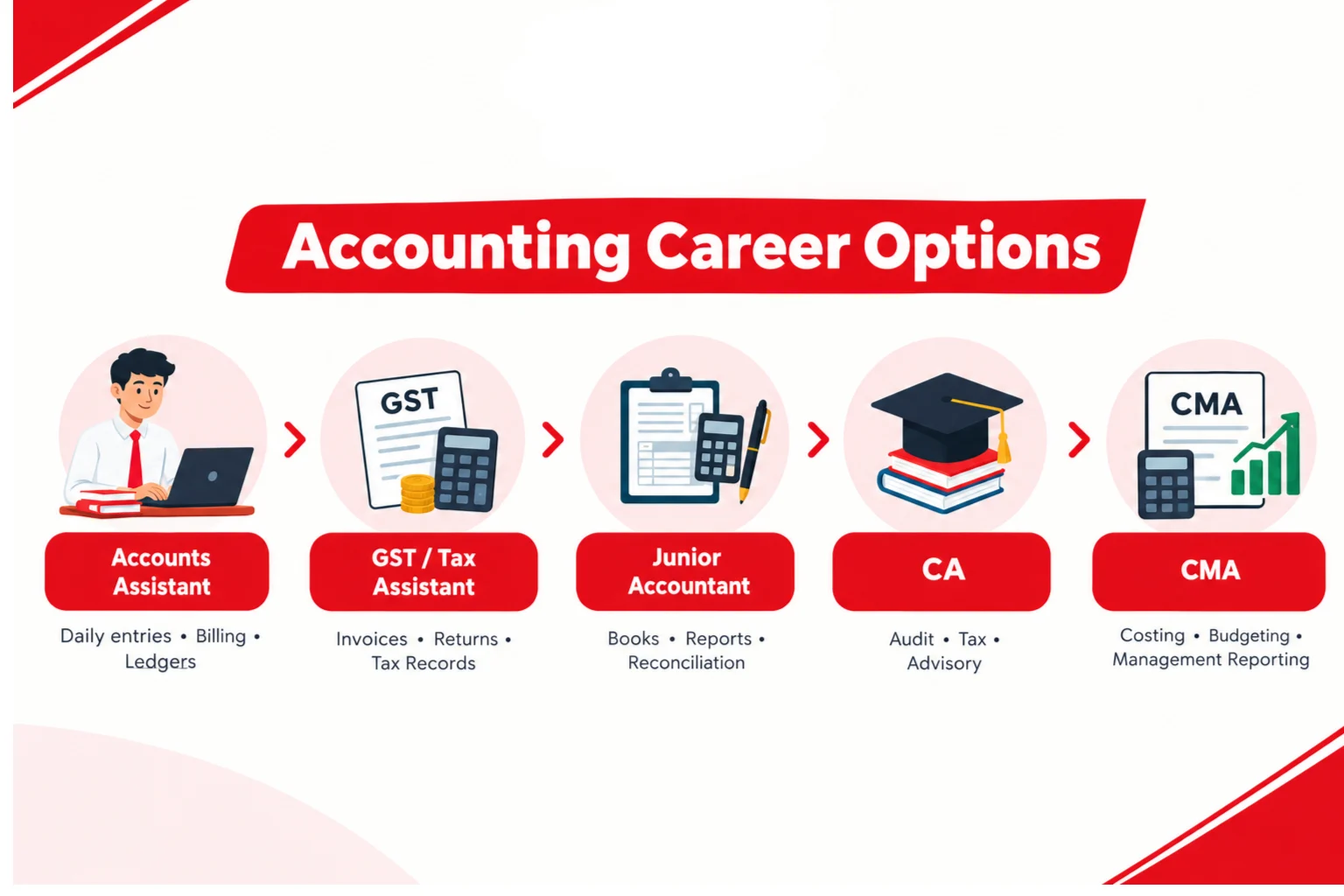
The term "accountant" covers many roles. Knowing the difference helps you plan your path.
| Role |
What it involves |
Typical starting point |
| Accounts Assistant/Executive |
Daily entries, billings, ledgers |
Graduate (B.Com or other streams) plus software skills |
| GST/tax assistant |
Invoices, returns, tax records |
Accounting basics plus GST knowledge |
| Junior Accountant |
Books of accounts, reports, bank reconciliation |
Graduate with accounting and tally skills |
| Chartered Accountant (CA) |
Audit, tax, advisory, financial reporting |
Professional exam route through ICAI |
| Cost and Management Accountant (CMA) |
Costing, budgeting, management reporting |
Professional exam route through ICMAI |
Many people start with an entry-level role and study further while working. That path is common and completely valid.
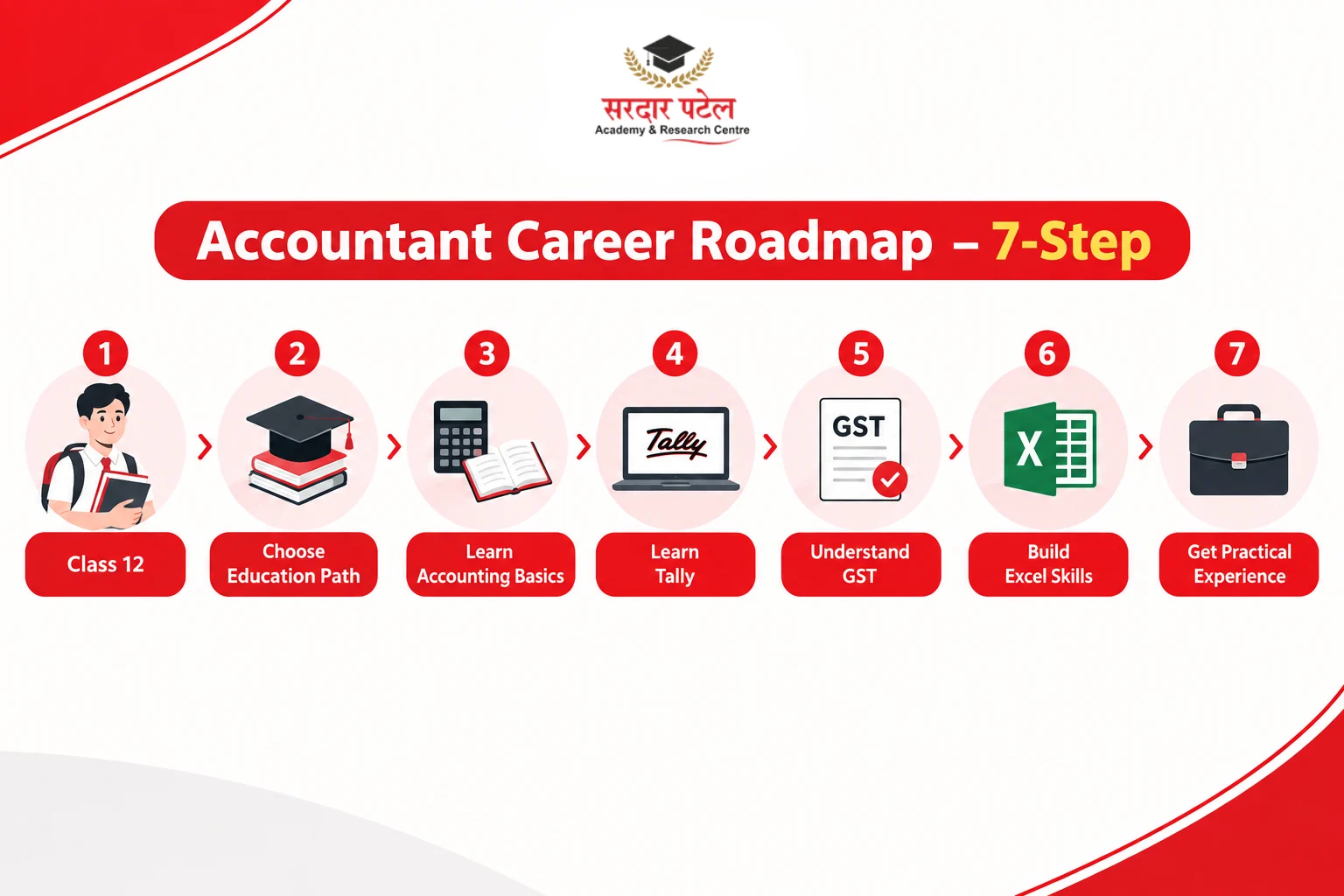
How to Become an Accountant in India: 7 Steps
Here is a clear path you can follow. You can adjust the order based on your situation.
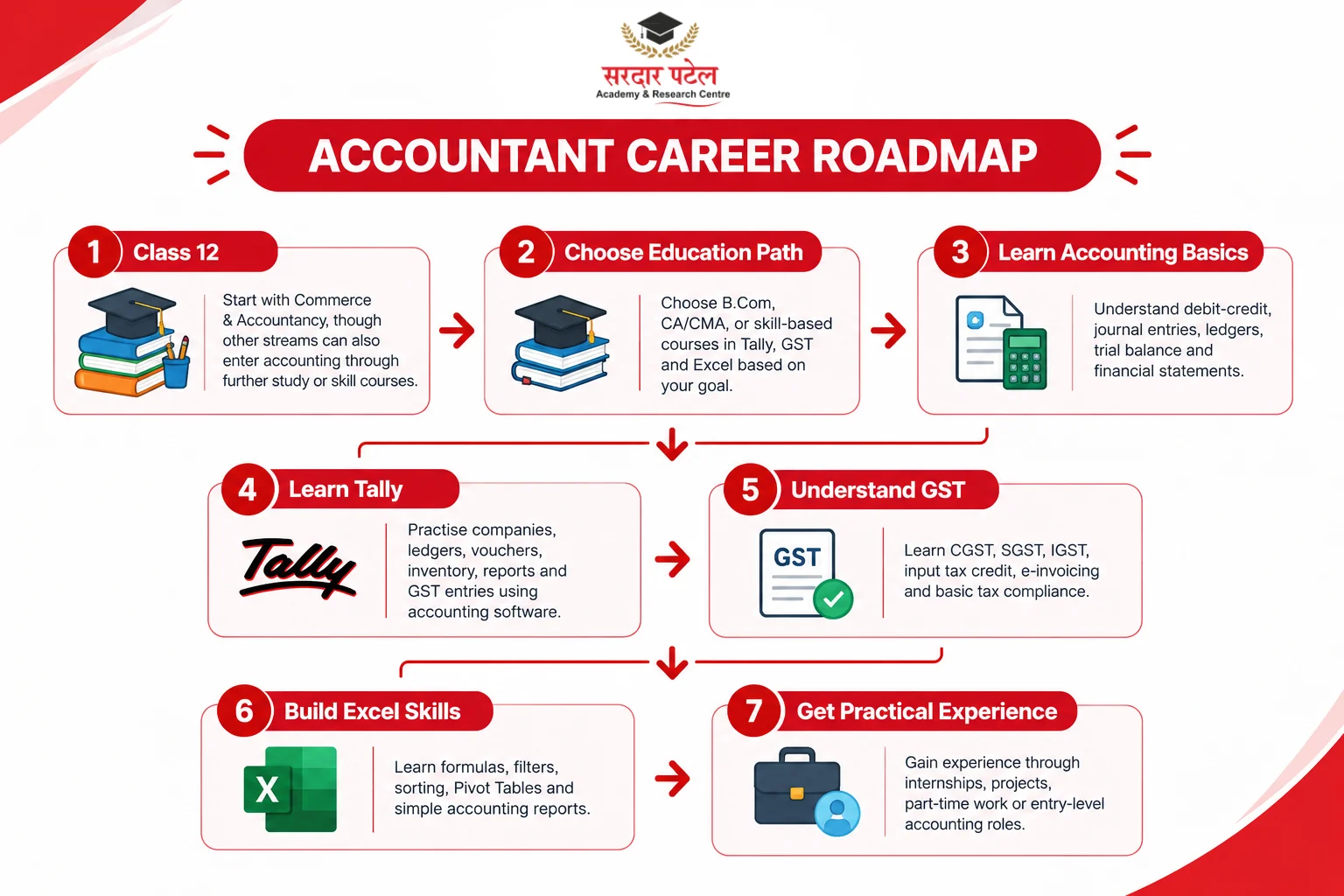
- Complete Class 12, ideally with commerce.
- Choose your education path (graduation, professional course, or both).
- Learn core accounting concepts.
- Learn accounting software, especially Tally.
- Understand GST and basic taxation.
- Build Excel and computer skills.
- Get practical experience through an internship or entry-level job.
Let us look at each step.
Step 1: Start with the Right School Background
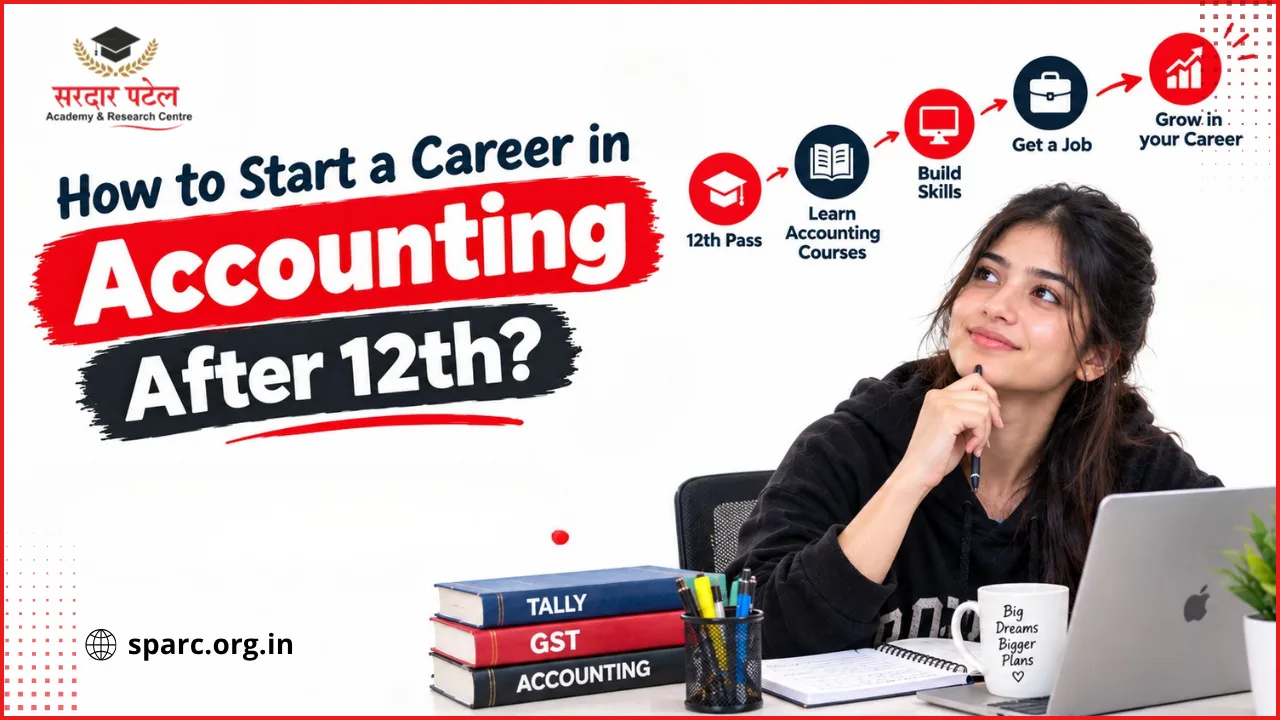
Commerce with accountancy is the most direct start. But it is not the only door. Students from arts and science backgrounds can also enter accounting through a B.Com or through short skill courses. It may take more effort to learn the basics, but it is possible. If you are planning to start a career in accounting after 12th, choosing the right education and skill-building path can make the transition easier.
Step 2: Choose Your Education Path
You have three common routes:
- Graduation: A B.Com degree is the usual choice. It covers accounting, business law, taxation, and economics.
- Professional courses: Such as CA and CMA are well-known routes; you can check the latest CMA course eligibility before applying. They take longer and require strong commitment. Check the latest eligibility and exam structure on the official websites, because rules can change.
If you are not planning to pursue a B.Com, you may still become an accountant without a B.Com degree by building practical accounting and software skills
- Skill-based courses: Short courses in Tally, GST, and Excel help you start working sooner.
You do not have to pick only one. Many learners do a degree, add a skill course, and later decide whether to attempt a professional exam.
Step 3: Learn the Basics of Accounting
Before any software, understand the language of accounting. Focus on:
- Debit and credit rules
- Journal entries and ledgers
- Trial balance
- Profit and loss account and balance sheet
- Bank reconciliation
- Depreciation and basic adjustments
A simple example helps. Suppose a shop buys goods worth ₹50,000 on credit. Purchases go up, and the amount owed to the supplier also goes up. If you can explain why, you are already thinking like an accountant.
Step 4: Learn Tally and Other Accounting Software
Most small and mid-sized businesses use software to keep books. TallyPrime is a widely used accounting solution in India, and learning TallyPrime accounting software can help you practise invoicing, accounting, GST, and reporting tasks. That is why Tally accountant jobs are a common search among freshers.
Learn how to:
- Create companies and ledgers
- Pass vouchers (sales, purchase, payment, receipt, journal)
- Handle stock items
- Print reports
- Record GST entries
Practise with realistic data, not just textbook examples. Employers want to know you can handle real invoices, not only classroom problems.
Step 5: Understand GST and Basic Taxation
In India, tax knowledge is close to a must. Even at the entry level, you may be asked to prepare invoices, reconcile purchase data, or help with return filing.
Start with these topics. For practical understanding of GST entries and invoicing, beginners can also refer to this TallyPrime GST guide.
- How GST works (CGST, SGST, IGST)
- Input tax credit
- E-invoicing and e-way bills, where they apply
- Basics of TDS and income-tax compliance
For current information on TDS and other tax requirements, refer to the Income Tax Department's official portal.
Tax rules change from time to time, so always check the official GST portal for current rules, rates, filing requirements, and dates.
Step 6: Build Excel and Computer Skills
Excel is used almost everywhere. Learn these first:
- Basic formulas (SUM, IF, VLOOKUP or XLOOKUP)
- Filters and sorting
- Pivot tables
- Simple formatting and reports
Good typing speed and email etiquette also help in an office setting. They may seem small, but they make you look ready for the job.
Step 7: Get Real Experience
Theory alone will not carry you far. Try to work on live or realistic tasks as early as possible. Options include:
- Internships at a CA firm or accounts office
- Part-time work with a small business
- Project work during a training course
- Helping a family business with its books
Even three to six months of experience can make your resume stronger than one with only certificates.
Accounting Courses in India: What Should You Choose?
There is no single "best" course. It depends on your time, budget, and goal.
| Course Type |
Best for |
Time Commitment |
| B.Com or similar degree |
Long-Term Foundation |
Around 3 years |
| CA/CMA |
Those aiming for senior or specialised courses |
Several years; depends on exam progress |
| Tally and GST Course |
Freshers who want to start working soon |
Usually a few months (varies by institute) |
| Excel for accounting |
Anyone in accounts |
Short-term |
Course duration varies by institute and by learner. Confirm details directly before enrolling.
When you compare accounting courses in India, ask these questions:
- Do you get hands-on practice?
- Are trainers experienced in real accounting work?
- Does the course cover GST and Excel?
- Is there support for interviews and resumes?
- Can you attend at a time that suits you?
Accounting Skills Employers Look For
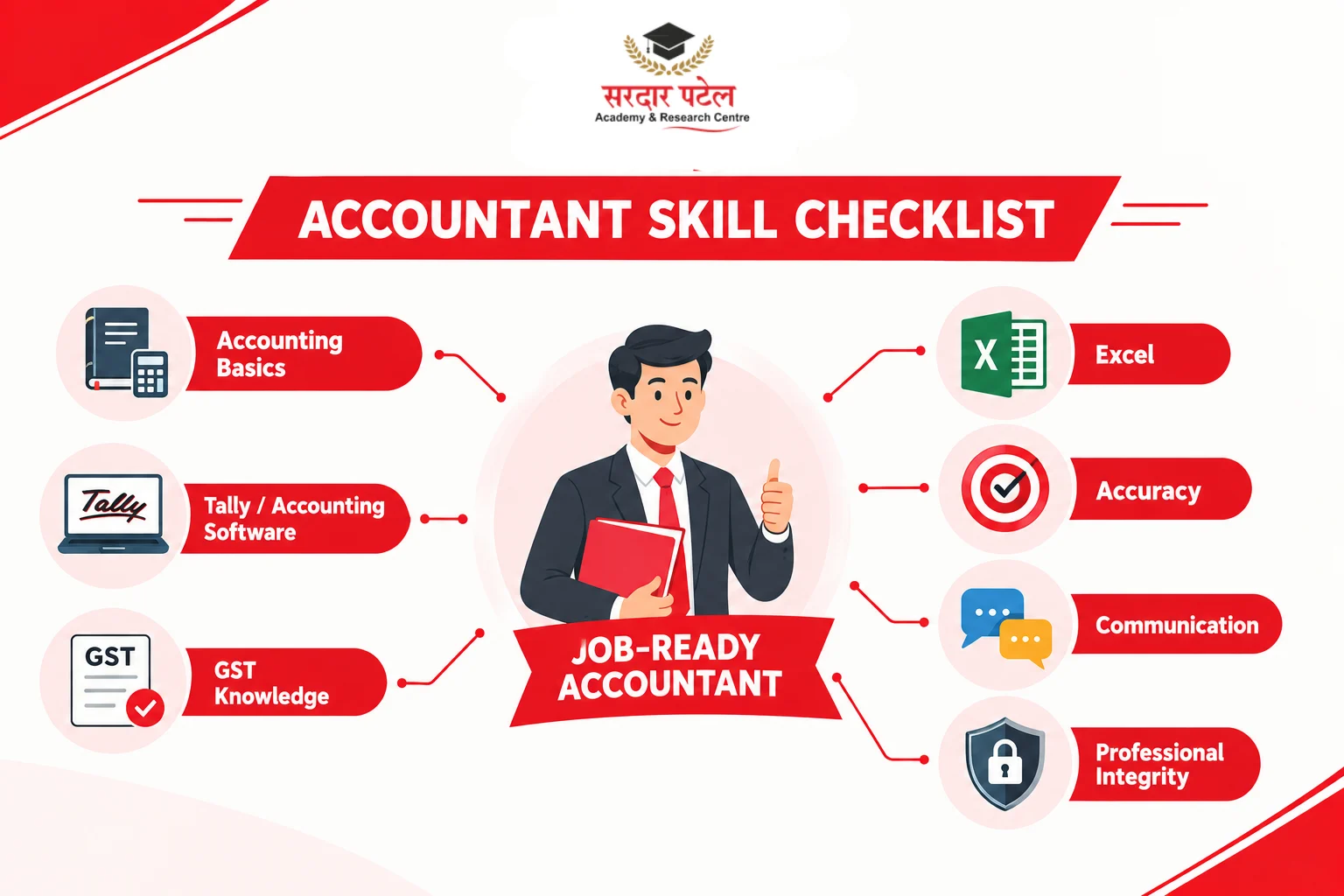
Qualifications get you noticed. Skills get you hired. Here are the ones that matter most. Understanding the skills you need to become a professional accountant can help you focus your learning on what employers actually expect :
- Accounting knowledge: ledgers, vouchers, reports
- Software skills: Tally and, where needed, other tools
- GST awareness: invoicing and return basics
- Excel: for data checking and reports
- Accuracy: small mistakes can create big problems later
- Communication: explaining figures to managers and clients
- Honesty: accountants handle sensitive money data
If you want to widen your options later, you can also pick up a business skill such as digital marketing. It can help if you plan to work with small business owners or freelance.
Accounting Jobs for Freshers: Where Do You Begin?
Once you have the basic skills, the next challenge is learning how to get your first job as an accountant and present your skills effectively to employers
Some common entry-level roles are:
- Accounts assistant
- Accounts executive
- Billing executive
- GST assistant
- Data entry operator (accounts)
- Junior accountant
- Article assistant at a CA firm (for CA students)
In Delhi NCR, opportunities often come from traders, manufacturers, service companies, CA firms, and startups. Areas like Nehru Place, Karol Bagh, Okhla, Noida, and Gurugram have plenty of business activity. Students in North Delhi, including those around GTB Nagar and Delhi University campuses, often find it easy to combine classes with part-time learning because of good metro connectivity.
Fresher roles usually ask for Tally, Excel, and basic GST knowledge. So Tally accountant jobs are a sensible target while you build experience.
Accountant Salary in India: What Can You Expect?
Pay depends on your city, company size, skills, and experience. A CA firm, a trading company, and a large corporation may all offer very different packages.
We have not quoted any figures here because salary numbers change often and vary widely. For a realistic idea of the accountant salary in India, check recent listings on job portals and salary reports from trusted sources. A useful trick is to look at 10–15 openings in your city for the role you want, then note the range.
Generally, salary tends to grow as you add skills, take on responsibility, and gain experience. That is an observation from how most careers work, not a guarantee.
Common Mistakes Beginners Make
- Skipping the basics and jumping straight into software
- Ignoring GST, which is part of everyday work
- Collecting certificates without practising on real data
- Waiting to feel "fully ready" before applying for jobs
- Not learning Excel, even though most account roles use it
- Choosing a course by price alone
Practical Tips to Start Faster
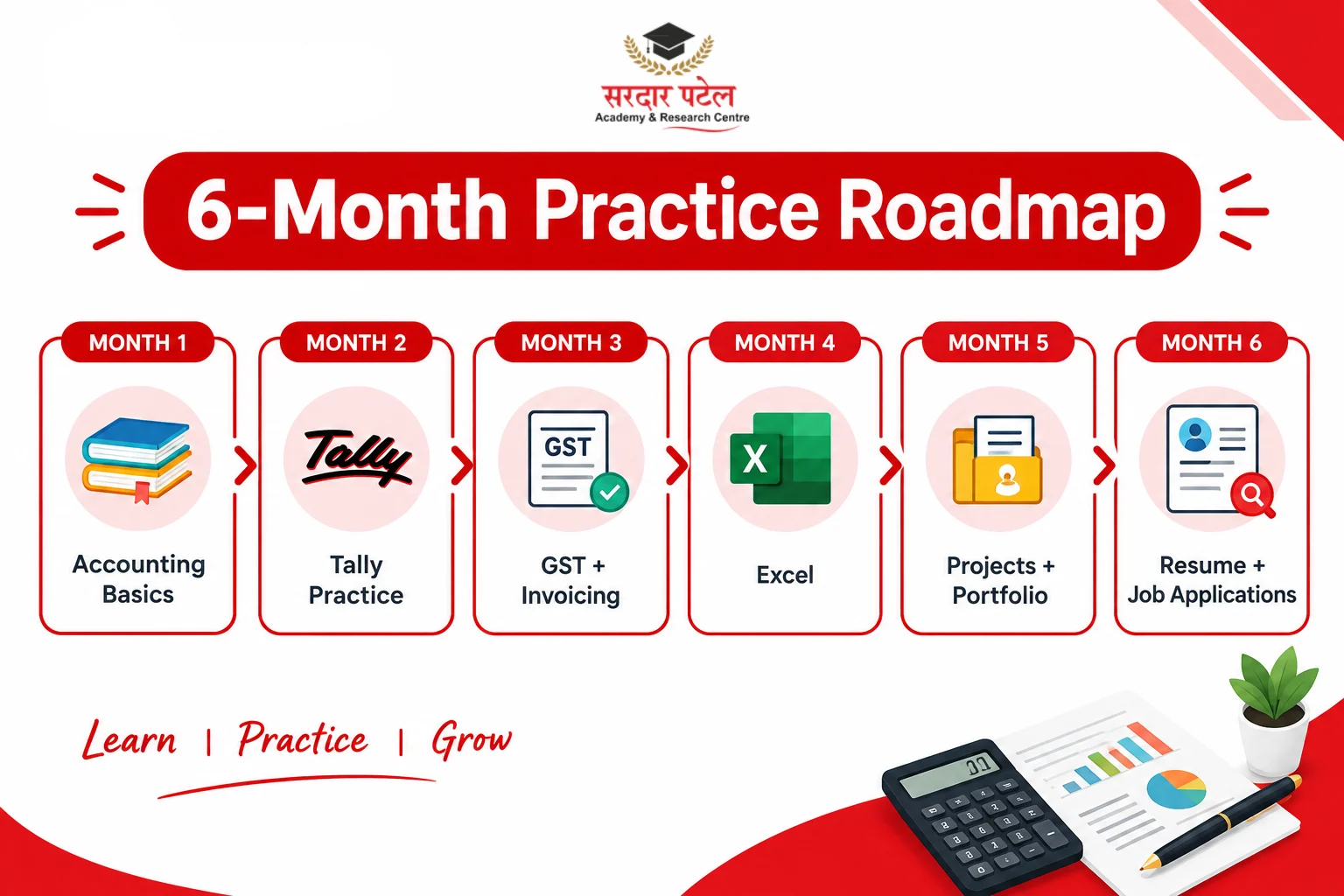
With consistent practice and a focused learning plan, you can work toward becoming job-ready for an accounting career in 6 months.
- Set a small daily practice goal, even 45 minutes.
- Create a mock company in Tally and enter a month of transactions.
- Read simple business news to understand how companies earn and spend.
- Keep a short portfolio with sample reports you have prepared.
- Ask working accountants what tasks they do most often.
- Update your resume with tools and skills, not only marks.
Conclusion
If you are wondering how to become an accountant in India, the answer is straightforward: build a strong accounting base, learn Tally and GST, improve your Excel, and get hands-on experience. Whether you continue to CA, CMA, or a job-focused route, each step adds to your profile.
You do not need to have everything figured out on day one. Start with the basics, practise regularly, and apply for entry-level roles as your skills grow.
If you want guided practical learning, SPARC offers Tally and accounting training designed to help you build real work skills for entry-level roles. You can contact the SPARC team to learn about course details and find a plan that fits your goals.
FAQs
Take up a B.Com or similar degree, learn Tally, GST, and Excel, and try to get internship experience. If you are aiming higher, you can also start a professional course like CA or CMA.
Yes, it is possible. Some people start with skill courses in accounting, Tally, and GST, then move into entry-level roles. However, many employers still prefer a degree, so it can help to study alongside.
Tally helps a lot, but it is not enough alone. You also need accounting basics, GST knowledge, and Excel skills.
A course that combines accounting basics, Tally, GST, and Excel with practical work is a strong choice for freshers. Check the syllabus and practice hours before you enrol.
No. Many accountants work without a CA qualification. CA is needed for certain roles, such as signing audit reports, but there are many accounting jobs that do not require it.
It depends on your route. A skill course can take a few months, a degree usually takes around three years, and professional courses take longer.
Accounts assistant, accounts executive, billing executive, GST assistant, and junior accountant are common starting points.
It can be, especially if you keep learning. Every business needs its books maintained and taxes filed, so accounting skills stay useful. Your growth will depend on your skills, effort, and experience.