+91 9312966129
 sparc.enquiry01@gmail.com



What Does an Accounts Executive Do? Skills and Responsibilities
Accountant vs Accounts Executive: Compare job roles, duties, salary factors, skills and career growth to choose the right accounting career.

Table of Contents
- Accountant vs Accounts Executive: The Short Answer
- What Is the Accountant Job Role?
- What Is an Accounts Executive Job?
- Accountant vs Accounts Executive: Side-by-Side Comparison
- Where the Two Roles Overlap
- Skills Compared: What Employers Expect
- A Day in Each Role: Same Company, Different Work
- Accounting Career Path: How the Two Roles Connect
- Which Role Should You Choose? A Simple Decision Guide
- Start as an accounts executive if you:
- Aim for the accountant role if you:
- Pros and Cons of Each Role
- Common Mistakes When Comparing the Two
- Interview Questions That Reveal the Real Job
- What This Means for Job Seekers in Delhi NCR
- Conclusion
Open a few job portals, and you will see both titles everywhere, often for similar-looking jobs. One company hires an accountant to handle everything. Another hires an accounts executive to do almost the same work. So what actually separates the two?
This guide explains accountant vs accounts executive in practical terms. You will see how the duties, responsibility levels, skills, tools and career paths differ, where the roles overlap, and how to pick the right starting point for your accounting career.
Job titles in India are not standardised, so the same title can mean different work in different companies. Treat this as a general pattern and read the full duties in every listing.
Accountant vs Accounts Executive: The Short Answer
An accountant is usually responsible for the complete accuracy of the books, financial statements and compliance. An accounts executive usually handles the day-to-day operational work: billing, payables, receivables, entries, follow-ups and reports that support the accountant.
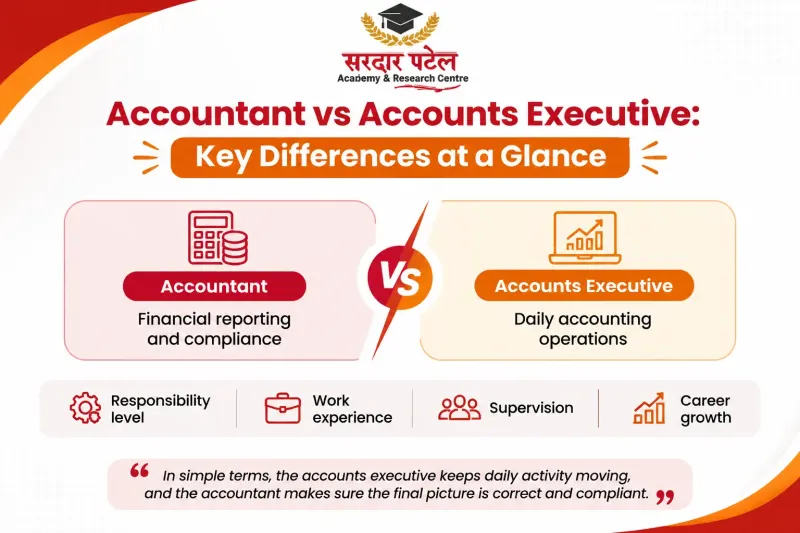
In simple terms, the accounts executive keeps daily activity moving, and the accountant makes sure the final picture is correct and compliant. In small firms, one person often does both jobs under either title.
What Is the Accountant Job Role?
The accountant job role centres on ownership of the accounts. An accountant answers questions from owners, auditors and tax consultants, and is accountable for the final figures. Core duties include:
- Maintaining complete books of accounts
- Reviewing entries made by juniors and executives
- Preparing the trial balance, profit and loss account and balance sheet
- Coordinating GST, TDS and other compliance with consultants
- Supporting audits and responding to queries
- Giving management insight into costs and cash flow
Example: in a manufacturing firm, the accountant reviews the month’s entries, reconciles key accounts, prepares schedules for the auditor and flags unusual costs to the owner. The complete duty list for the profession is covered in what an accountant does, so this guide focuses on how the role differs from the executive position.
What Is an Accounts Executive Job?
An accounts executive job focuses on operations. The work is varied and often involves regular contact with vendors, customers and other departments, so communication matters as much as accounting knowledge. Typical tasks include:
- Raising invoices and tracking customer payments
- Checking supplier bills and scheduling payments
- Recording transactions in accounting software
- Following up on overdue receivables
- Supporting GST and TDS data preparation
- Preparing basic reports such as outstanding statements and cash summaries
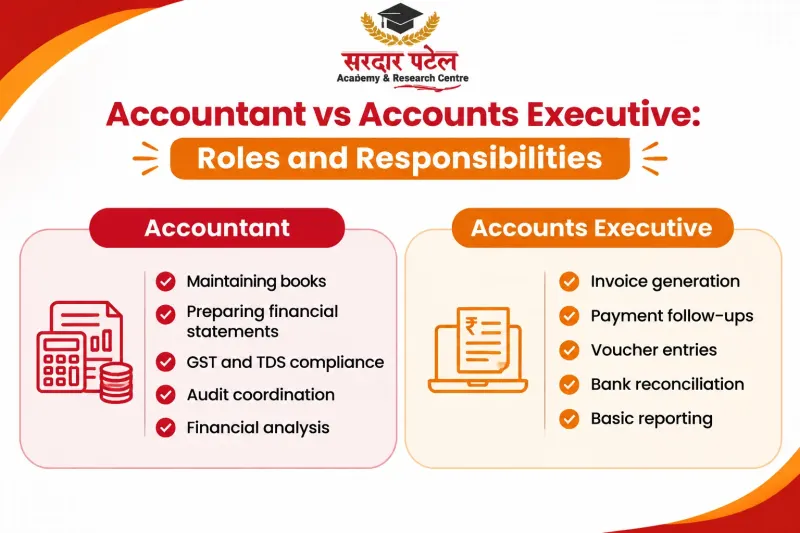
Example: in a distribution company, the accounts executive sends invoices, chases unpaid dues, verifies supplier bills against delivery notes and sends the owner a weekly dues summary.
Accountant vs Accounts Executive: Side-by-Side Comparison
| Factor |
Accountant |
Accounts executive |
| Main focus |
Reliable books and compliance |
Daily operations: billing, payables, receivables, entries, follow-ups |
| Level of responsibility |
Higher; answerable for final figures |
Moderate; responsible for assigned processes |
| Supervision |
Often supervises juniors and executives |
Usually reports to an accountant or accounts manager |
| Typical level |
Mid to senior |
Entry to mid |
| Interaction |
Auditors, tax consultants, management |
Vendors, customers, banks, internal teams |
| Tools |
Accounting software, Excel, tax portals, reporting tools |
Tally, Excel, billing tools, banking and GST portals |
| Common growth |
Senior accountant, accounts or finance manager |
Senior executive, accountant, accounts manager |
Read this as a general pattern. A small company may give the title accountant to someone who does mostly data entry, and executive to someone who handles real responsibility.
Where the Two Roles Overlap
The overlap is why people get confused when they compare accounts executive vs. accountant postings. Both roles commonly involve:
- Voucher entry in Tally
- Bank and party reconciliations
- Basic GST and TDS awareness
- Excel for checks and reports
- Month-end support and documentation
- Coordination with auditors and senior staff
The difference between an accountant and accounts executive grows with responsibility. As you gain experience, you move from doing tasks to reviewing, deciding and explaining. For a closer look at the software side of both jobs, see what a Tally accountant does day to day.
Skills Compared: What Employers Expect
| Skill area |
Accountant |
Accounts executive |
| Accounting knowledge |
Strong: accounting standards, final accounts, adjustments |
Good: entries, ledgers, reconciliations |
| Tally and software |
Advanced, with review and data control |
Strong practical entry and reporting |
| Excel |
Analysis, schedules, MIS |
Trackers, reports, reconciliations |
| GST and TDS |
Deeper understanding, often with compliance duties |
Hands-on data and invoice checks |
| Communication |
Explaining numbers to owners and auditors |
Follow-ups with vendors, customers and teams |
| Decision making |
High: judges adjustments and treatments |
Moderate: follows procedures and escalates doubts |
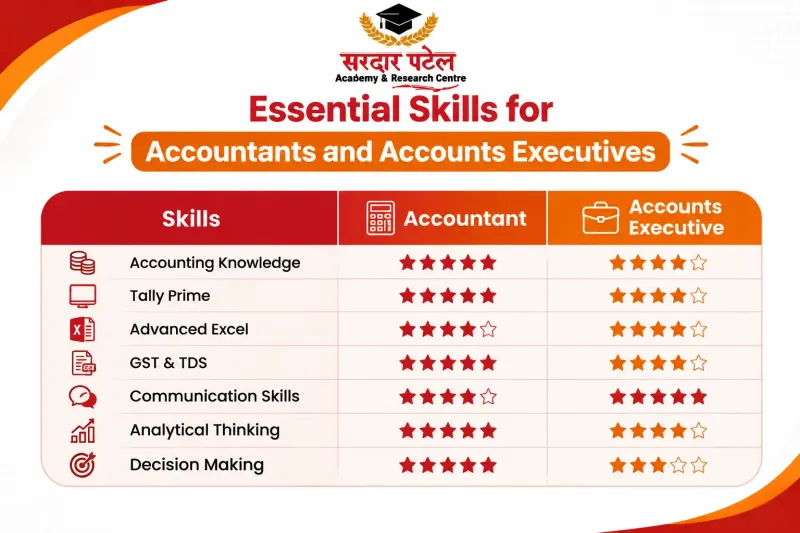
Tax rules change often, so in either job the safest habit is to confirm current GST rates and due dates on the official GST portal instead of relying on old notes.
A Day in Each Role: Same Company, Different Work
| Time |
Accountant |
Accounts executive |
| Morning |
Reviews the previous day’s entries and checks key ledger balances |
Updates bank receipts and customer dues |
| Midday |
Prepares adjustments and schedules for month-end |
Verifies supplier bills against delivery notes and schedules payments |
| Afternoon |
Coordinates with the tax consultant or auditor on queries |
Calls customers about overdue payments and raises invoices |
| End of day |
Notes issues to resolve before closing the books |
Sends a short cash and dues summary to the manager |
Both are doing accounts work, but one leans toward review and ownership, and the other toward operations and coordination.
Accounting Career Path: How the Two Roles Connect
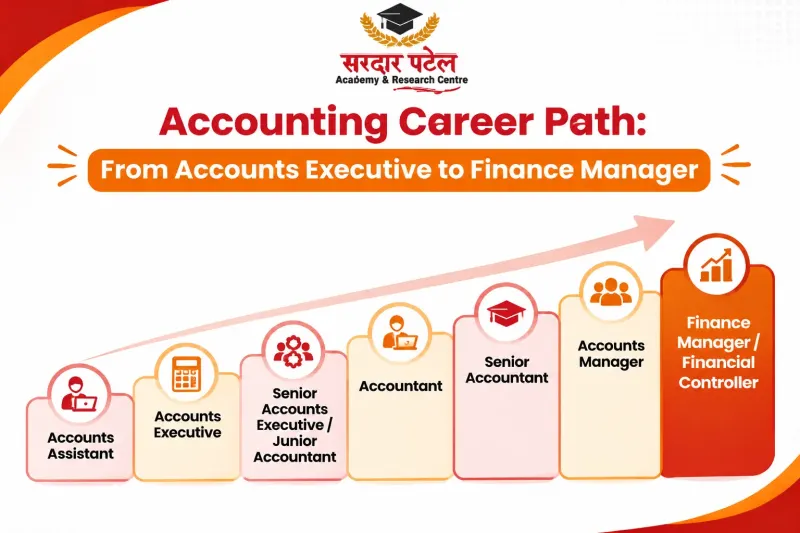
For many people, an accounts executive is a stepping stone to the accountant role. But the path is not rigid. Here is an illustrative pattern:
- Early stage: accounts assistant or accounts executive, learning processes, Tally and reconciliations
- Growth stage: senior executive or junior accountant, owning more tasks and reviewing others’ work
- Accountant stage: responsible for books, statements and compliance coordination
- Senior stage: senior accountant, accounts manager or finance manager
- Leadership: finance controller or similar roles, depending on skills and employer
Some professionals branch into a speciality along the way. If you are weighing two common ones, Tally accountant vs GST accountant: which job is better? Compare them side by side.
What speeds growth? Practical Tally and Excel skills, solid GST and TDS basics, clean work habits and the ability to explain numbers clearly. This is an observation rather than a guaranteed outcome. Those who lean toward the tax side can look at how to become a tax accountant in India for a route that builds on accountant-level skills.
Which Role Should You Choose? A Simple Decision Guide
The accountant vs. accounts executive choice mostly depends on where you are in your career.
Start as an accounts executive if you:
- Are an entry-level candidate with limited professional experience
- Enjoy variety, communication and follow-ups
- Want to learn how daily accounting operations work
- Plan to grow into accountant roles later
Aim for the accountant role if you:
- Have strong accounting fundamentals and some experience
- Enjoy review, analysis and ownership of results
- Are comfortable with compliance and explaining numbers
- Want to move towards senior and finance roles
If you are unsure, choose the role with the best learning and a supportive team. Your first job matters less than how much you learn in it. If you have no experience yet, the practical steps on how to get an accounting job without experience will help you reach either role.
Pros and Cons of Each Role
| Role |
Advantages |
Challenges |
| Accountant |
More ownership, stronger career path, deeper accounting work |
Higher responsibility, compliance pressure, closing deadlines |
| Accounts executive |
Broad exposure, faster learning of operations, easier entry for freshers |
Multitasking, follow-up pressure, some repetitive tasks |
These are practical observations, not guarantees. Your experience will depend on your employer and team.
Common Mistakes When Comparing the Two
- Trusting the title alone. Read the duties and ask what a typical day looks like.
- Assuming one always pays more. Pay depends on employer, skills and city, so compare current listings.
- Ignoring learning value. A good senior can teach more than a bigger title.
- Skipping fundamentals. Weak accounting basics will limit growth in either role.
- Not asking about tools. Confirm whether you will use Tally, Excel or other software. The maker’s own site, Tally Solutions, is a good place to see what the current version offers.
- Neglecting compliance skills. GST and TDS basics help you in both roles.
Interview Questions That Reveal the Real Job
- What does a typical day look like in this role?
- Which software and reports will I handle?
- Will I deal with vendors and customers, or mostly internal work?
- Who reviews my work, and who will I report to?
- How do people usually grow in this team?
Listen for specific answers. Clear details about tasks and review processes usually point to a well-organised team. For your resume, keep it to one page, match your wording to the listing, and include one small practice project, such as maintaining books for a sample company.
What This Means for Job Seekers in Delhi NCR
Delhi NCR has many small and mid-sized businesses, CA firms, distributors and start-ups, and many of them use both titles loosely. That makes reading the duties in each listing especially important. Many accounting listings mention Tally, GST and Excel, so practical examples of these skills strengthen your application.
If you live in GTB Nagar, Kamla Nagar, Mukherjee Nagar or nearby North Delhi areas, you can compare o
penings across the wider NCR before choosing. Sardar Patel Academy & Research Centre is at 2514, Ground Floor & First Floor, Hudson Lane, Kingsway Camp (Opposite Laxmi Dairy), near GTB Nagar Metro Station, Gate No. 4, Delhi – 110009. You can call +91 93129 66129 for course details.
Conclusion
To sum up accountant vs accounts executive: the accountant owns the accuracy of the books and compliance, while the accounts executive keeps daily accounting operations running. The roles overlap, and company practices differ, so duties matter more than titles.
Your next steps are practical. Build Tally, Excel and basic GST skills, practise on sample data, read each listing’s duties carefully and choose the role that offers the best learning for your stage.
Ready to start? Build accounting job skills with hands-on training at Sardar Patel Academy & Research Centre through the E-Accounting Course (E-DAFA), a 12-month programme covering Tally Prime, Busy, GST, TDS and Excel.
FAQs
Not always. Titles overlap, but an accountant usually owns the books, statements and compliance, while an accounts executive handles daily operations like billing, payables, receivables and follow-ups.
Pay depends on the employer, skills, city and experience, not only the title. Check current listings for the roles you want.
Yes. With stronger accounting fundamentals, GST and TDS knowledge, and experience in reviewing and reporting, many executives move into accountant roles.
Usually, yes. Tally is a commonly used accounting package, so knowing it well helps in both roles. Some employers use other software, so check each listing.
Accounts executive is a common starting point because it offers broad exposure. The best choice depends on the duties, team and learning on offer.
A commerce background is often preferred, but requirements vary by employer. Practical skills and short courses can also help.
How do I choose between the two for my accounting career?