+91 9312966129
 sparc.enquiry01@gmail.com



How to Become a Tax Accountant in India?
Learn how to become a tax accountant in India, including qualifications, Tally Prime, GST, TDS skills, courses, career opportunities and salary.
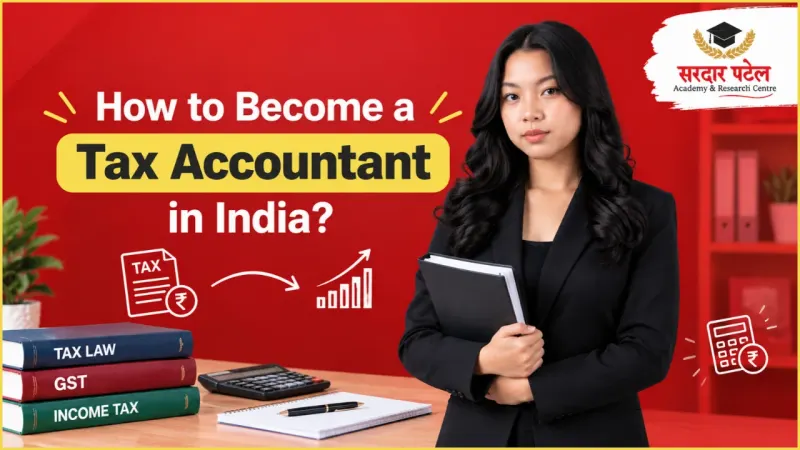
Table of Contents
- What a Tax Accountant Does Before You Plan Your Career
- How to Become a Tax Accountant in India: Step by Step
- Tax Accountant Qualifications: Which Route Suits You?
- Skills That Employers Look For in Tax Accountants
- Choosing a Tax Accountant Course in India
- Tax Accountant Jobs for Freshers, Career Scope and Salary
- Common Mistakes When Learning How to Become a Tax Accountant in India
- Conclusion
Ask any small business owner what costs them sleep, and tax deadlines come up within minutes. Returns, notices, invoices that refuse to match: most owners would rather hand it all to someone who understands it. That person is often a tax accountant, and because compliance never stops, neither does the demand.
If you are wondering how to become a tax accountant in India, the good news is that there is more than one road. You can take the Chartered Accountancy route, or build a practical profile through a degree, accounting software training and real work with returns. This guide covers both and flags the mistakes that slow beginners down.
Note on the new law: the Income-tax Act, 2025 has applied since 1 April 2026. It replaces the 1961 Act, so some form names, section numbers and terms have changed (for example, “Tax Year” now replaces “assessment year” and “previous year”). Always confirm current details on the official portals.
What a Tax Accountant Does Before You Plan Your Career
A tax accountant sits between a business’s books and the government’s rules: part bookkeeping, part interpretation of law, part careful paperwork.
Everyday tax accountant responsibilities:
- Preparing tax computations and income tax return filing for individuals, firms and companies
- Handling the GST return filing cycle: matching sales and purchase data, accepting, rejecting or holding supplier invoices on the Invoice Management System (IMS), reviewing input tax credit in GSTR-2B, and submitting returns on time.
- Maintaining tax preparation and documentation such as invoices, challans, the salary TDS certificate (earlier Form 16, now Form 130 under the new Act; confirm on the Income Tax portal) and ledgers
Replying to departmental notices with supporting records - Advising clients on how to stay within the rules of income tax laws in India
TDS is a daily task in its own right: deducting the right rate and reconciling deposits. How to Become a TDS and TCS Executive explains that side of the job.
Where they work
Many start in CA firms or accounting practices. Others join a company’s finance team and manage tax compliance in India for one employer. Some eventually go independent and build a tax consultant career.
How to Become a Tax Accountant in India: Step by Step
No single licence is mandatory for everyone who works with taxes, so the path differs from person to person. Here is a sensible sequence for how to become a tax accountant in India.
- Start with commerce subjects if you can. Accountancy and economics make later stages easier, though students from other streams do enter the field.
- Complete graduation. A B.Com or similar degree is the most common starting point and teaches accounting, business law and basic taxation. If you want the wider accounting picture first, read How to Become an Accountant in India? Step-by-Step Career Guide.
- Learn the software offices actually use. Accounting software training in Tally Prime for taxation tasks, covering vouchers, GST set-up and TDS entries, makes you useful from week one. Not sure where to begin? GST Accountant vs Tax Accountant: Which Career Is Better? can help you decide.
- Study the tax laws properly. Understand how an ITR form is chosen, how GST invoices flow into returns, and when TDS applies. Official pages are the safest reference; for instance, the Income Tax Department’s guidance on filing an income tax return.
- Get practical exposure. Internships, assisting a practising accountant, or structured practical accounting training teach what classrooms cannot: messy data, missing bills and impatient clients.
- Decide on a professional qualification. Some people work first
That is the core of how to become a tax accountant in India: education, software skills, legal knowledge and real practice.
Tax Accountant Qualifications: Which Route Suits You?
The right tax accountant qualifications depend on how far you want to go and how soon you want to earn. Anyone researching how to become a tax accountant in India should weigh these routes first.
Route |
What it involves |
Best suited for |
| Graduation + skill courses |
B.Com or equivalent, plus training in Tally, GST, TDS and ITR |
Those who want to start working early |
| Chartered Accountancy (ICAI) |
Foundation, Intermediate and Final levels, plus practical training |
Those aiming for audit, advisory or independent practice |
| Short certification programmes |
Focused training in one area such as GST or income tax filing |
Working professionals or career switchers |
If you are considering the CA route, check the current eligibility, exam pattern and registration rules directly on the ICAI scheme of education, since these details are revised from time to time.
Skills That Employers Look For in Tax Accountants
Knowledge gets you shortlisted; habits keep you employed.
Skill |
Why it matters |
| Tally Prime and spreadsheet fluency |
Most daily entries, reports and reconciliations happen here |
GST and IMS knowledge |
Monthly cycles leave little room for delay |
TDS understanding |
Wrong rates or late deposits create avoidable penalties |
| Detail, communication and ethics |
One mismatched PAN or GSTIN can hold up a return, and clients need plain explanations |
Picture a trader handing you purchase bills in a bag. A good tax accountant sorts them, enters them in Tally Prime, checks them against GST portal data (GSTR-2B and IMS) and flags bills where credit may be at risk. Software opens the door but cannot carry a career, a point explored in Is Tally Enough to Get an Accounting Job?
Choosing a Tax Accountant Course in India
Many institutes advertise a tax accountant course in India, so know what a good one contains. A course is only one part of becoming a tax accountant in India, but a well-chosen one speeds up the practical side. Look for accounting and taxation courses with live software practice, case files covering GST, TDS and the ITR filing process, trainers with real compliance experience, and clear placement assistance. Ask for the syllabus and how much of it is hands-on, and ask for verifiable details of any placement assistance offered.
One example: Sardar Patel Academy & Research Centre (SPARC) runs the E-Diploma in Financial Computer Accounting (E-DFCA), a 9-month offline programme. Its listed syllabus covers accounting fundamentals, Tally Prime (Volumes 1–3), BUSY, Income Tax, TDS and GST e-filing. Check the course page for the current syllabus and fees before you decide.
To see how a dedicated indirect-tax programme is structured, read GST Course: Skills, Benefits and Career Opportunities.
Tax Accountant Jobs for Freshers, Career Scope and Salary
Tax accountant jobs for freshers mostly appear as assistant or executive roles: GST assistant, TDS and compliance executive, accounts and taxation executive, or ITR filing associate. The work usually begins with data entry, return preparation and reconciliation under supervision. A fuller list of beginner positions is in Accounting Jobs for Freshers: Roles, Skills and Career Opportunities.
A taxation career in India can later lead to senior compliance roles, audit support, advisory work or independent practice, and the direct-tax side is covered in How to Build a Career in Income Tax and ITR Filing? Tax accountant salary in India depends on location, employer size, your GST and TDS skills, and whether you hold a professional qualification. Check recent job listings for your target role and city to see what employers pay.
Common Mistakes When Learning How to Become a Tax Accountant in India
- Studying law without practising entries. Knowing a section is not the same as filing a clean return. A mix of tools and tax knowledge works best, as Tally + GST + TDS: The Best Skill Combination for Accounting Jobs? shows.
- Skipping the official sources. Rely on notified rules and government portals, such as the GST portal’s guide on creating and submitting GSTR-3B, rather than secondhand summaries.
- Collecting certificates without applying them. Employers prefer people who can complete a return.
- Not learning TDS filing. The Income Tax Department explains the Form and section numbers changed under the new Act, so always check the portal for the current ones.
Conclusion
Knowing how to become a tax accountant in India is less about one perfect degree and more about building a reliable stack: education, software skills, working knowledge of GST, TDS and income tax, and steady practice. Pick the route that fits your situation, add skills in a sensible order, and keep checking official sources as rules change. Whatever your starting point, a clear plan for how to become a tax accountant in India beats waiting for the perfect moment.
Ready to take the next step? Visit SPARC at 2514, Hudson Lane, Kingsway Camp (opposite Laxmi Dairy), near GTB Nagar Metro Station Gate No. 4, Delhi – 110009, call +91 93129 66129, or contact the SPARC team to book a free demo class for the accounting and taxation programme.
FAQs
No. Many people work in tax roles with a degree and practical training in software, GST, TDS and ITR. CA opens more doors, especially in audit and independent practice.
It depends on the route. A degree takes its usual duration and skill courses add a few months; the CA route takes longer because of its levels and practical training.
Yes, with extra effort on accounting basics. A structured beginner course closes that gap quickly.
Tally Prime is widely used for accounting and compliance, so it is a common first choice, alongside spreadsheet skills.
It can be, if it includes hands-on practice with real compliance scenarios. Check the syllabus first.
An accountant mainly prepares and files returns and maintains records; a consultant advises on planning and complex matters, usually with more experience.