+91 9312966129
 sparc.enquiry01@gmail.com



WhatsApp Marketing in 2026: From Messaging to Customer Acquisition
WhatsApp marketing in 2026 explained: new per-message pricing, the 1 October changes, opt-in rules and a chat-to-customer funnel for Indian businesses.
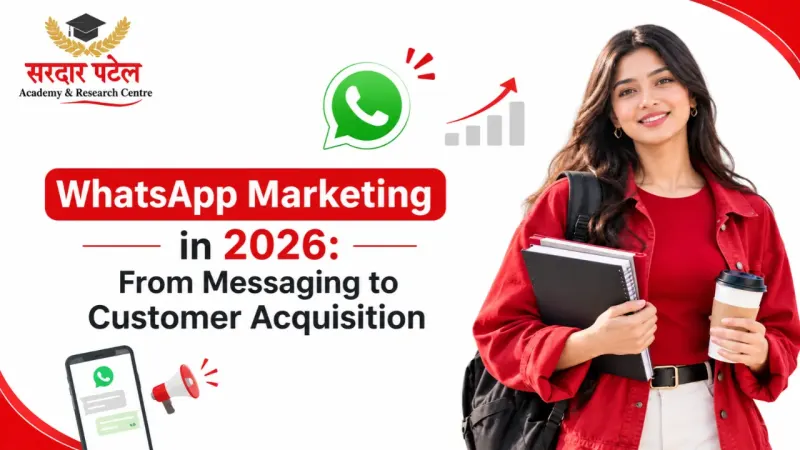
Table of Contents
- What WhatsApp Marketing Means in 2026
- WhatsApp Business App vs WhatsApp Business Platform
- Rules and Pricing Changes in 2026
- Pricing is charged per message
- What changed on 1 October 2026
- Meta Business Agent: a new message category
- The free entry window
- Rules for AI assistants
- How WhatsApp Lead Generation Works
- Getting opt-in right
- Build the Funnel from Chat to Customer
- Setting up a Click-to-WhatsApp ad
- Message templates you can adapt
- Utility example (booking reminder):
- Marketing example (follow-up offer):
- Creative that earns replies
- Three Illustrative Scenarios
- Metrics That Matter
- Common Mistakes to Avoid
- Skills and Career Scope
- Conclusion
For years, most brands treated WhatsApp as a helpdesk. A customer asked a question, an agent replied, and that was the end of it. In 2026, the same app does far more commercial work. It sits between the ad someone taps and the purchase they eventually make, and the businesses seeing the best returns treat every chat as one step in a journey rather than a megaphone.
This guide explains how the channel works today, what changed in Meta’s pricing and policies, how a chat becomes a customer, and which mistakes quietly drain budgets. It is written for marketers, business owners and students who want practical clarity instead of hype. Where a rule or figure comes from an outside source, we link to it, and where something may change, we say so.
What WhatsApp Marketing Means in 2026
WhatsApp marketing is the practice of attracting, qualifying, converting and retaining customers through permission-based, two-way conversations. Two phrases carry the weight: permission-based and two-way. A promotional blast sent to a purchased number list is spam. A quick reply to someone who tapped “Message us” on your Instagram ad is marketing.
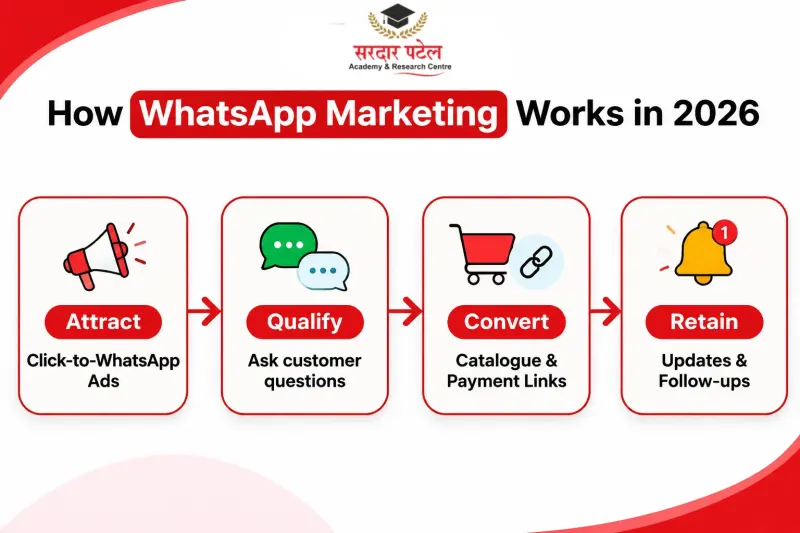
Customer acquisition doesn't start with ads or direct messages alone; businesses must also understand how AI search is reshaping digital marketing and online discovery as search behaviour evolves.
In practice, the channel now handles four jobs:
- Attract: click-to-chat ads, website buttons and QR codes start the conversation.
- Qualify: two or three quick questions show whether the person is a serious buyer.
- Convert: catalogues, payment links and appointment slots close the loop inside the chat.
- Retain: order updates, reminders and carefully timed offers bring customers back.
For businesses promoting products through social media, selecting the right influencer category for a brand campaign can also help attract relevant audiences before moving interested prospects into WhatsApp conversations.
Look at it from the customer’s side. Filling in a long web form feels like work, while sending “Hi, I’m interested” feels like talking to a shop assistant. That low friction is the main reason chat-based selling has moved from the support team to the growth team.
WhatsApp Business App vs WhatsApp Business Platform
Before planning anything, decide which product you are actually using. They share a name but serve different stages of growth.
| Feature |
WhatsApp Business App |
WhatsApp Business Platform (API) |
| Best for |
Solo sellers, small shops, freelancers |
Growing teams and higher message volumes |
| Access |
Phone app with a few linked devices |
Through an approved provider, with a shared team inbox |
| Automation |
Greeting, away message, quick replies |
Chatbots, workflows, CRM triggers |
| Campaigns |
Basic broadcast lists |
Pre-approved templates sent to opted-in segments |
| Cost |
Free to use |
Meta’s per-message charges plus a provider fee |
A one-person business can achieve a lot with the free app and a tidy catalogue. At scale, however, the app rarely lasts long enough. Once several agents need to answer, leads must be tagged in a CRM, or you want to run template campaigns, the Platform becomes the sensible choice.
Rules and Pricing Changes in 2026
Four changes shape how you should budget and design campaigns this year.
Pricing is charged per message
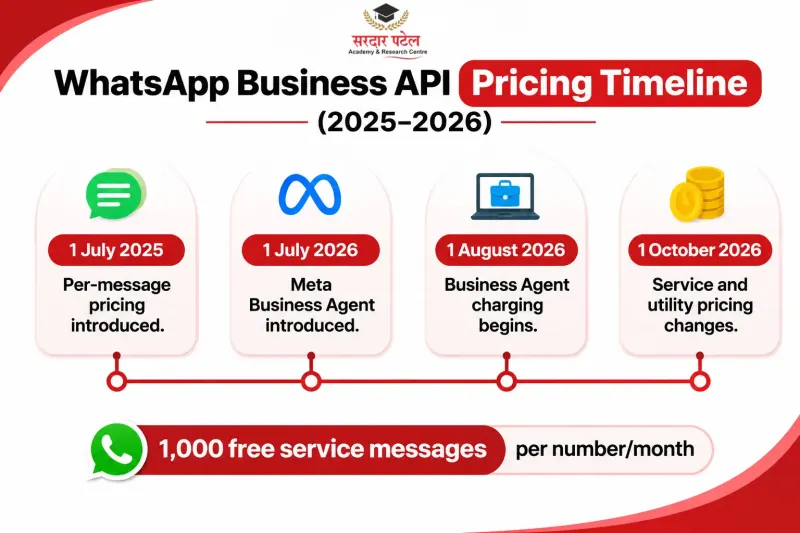
On 1 July 2025, Meta moved from conversation-based billing to charging per delivered message. Messages fall into categories such as marketing, utility, authentication and service, and rates vary by country and category. Meta publishes the current rate cards on its WhatsApp Business Platform pricing page, so use that page rather than third-party figures when you build a budget.
What changed on 1 October 2026
Two things became chargeable on that date. Service replies, meaning free-form answers inside an open 24-hour window, now carry a per-message charge at the same rate as utility and authentication messages in each market, and volume tiers do not apply to them. Each business phone number still gets 1,000 free service messages a month, with charging starting from the 1,001st. Utility templates sent inside that window, which had been free since July 2025, are charged too.
Meta also asked for a payment method to be on file before the switch. Without one, service messages are still delivered inside the free allowance but stop being delivered once it is used up. If you work through a provider, ask how it handles billing and balances.
- Marketing templates remain the costliest category, so reserve them for people who have shown real interest. As customer communication becomes more automated, businesses are recognising the increasing need for marketers who understand AI-powered digital strategies and can combine technology with effective campaign planning.
- Do not send a promotional template when an order update or a free-form reply would do the job.
- Messaging people who never engage is the quickest way to inflate your cost per sale, so prune your lists often.
Meta Business Agent: a new message category
Meta Business Agent arrived on 1 July 2026 as a fifth message category. Since then, a non-template reply is either a service message or a Business Agent message, depending on whether Meta’s own AI agent wrote it. Charging began a month later, on 1 August 2026. Meta’s pricing update for service and agent messages explains that these are billed per token, at one global rate of US$2.00 per million tokens, which Meta puts at roughly 4–5 US cents per message. They are billed through a credit line or card, and they are not free inside the free entry window.
Each message carries a single category and incurs a single charge. If you use a third-party AI tool instead of Meta’s agent, its replies count as service messages, and you pay that provider separately.
The free entry window
When someone messages you from a Click-to-WhatsApp ad on the Android or iOS app, and you answer within the 24-hour service window with a marketing, utility, authentication or service message, that reply is not charged and opens a free entry window. Meta says the window may stay open for up to seven days, and while it is open, those four categories are not charged. Two cautions apply. The ad spend itself is separate, and once the 24-hour service window closes, you can only send approved templates. Confirm the details in your provider’s dashboard, because billing rules get refined over time.
Rules for AI assistants
Since 15 January 2026, Meta’s business terms bar providers of general-purpose AI assistants from distributing them through WhatsApp’s business tools, a change TechCrunch reported when it was announced. The restriction targets open-ended assistants. A bot built for a defined business purpose, such as answering product questions, booking appointments or tracking orders, is a different matter. If you are exploring automation, stay on the right side of that line.
How WhatsApp Lead Generation Works
Lead generation here means collecting contact details and intent through conversation rather than a form. The person tells you who they are and what they want, and you reply while their interest is still fresh. Entry points include click-to-chat ads, website buttons, QR codes and landing pages. Our guide to generating leads using WhatsApp marketing walks through entry points and qualification flows in detail, so this report stays on pricing, policy and the funnel.
Businesses that want to understand how prospects move from initial interest to conversion can start by understanding the different stages of a lead generation funnel before designing their WhatsApp communication strategy.
Getting opt-in right
Opt-in is both a platform requirement and plain good manners. A solid opt-in tells people what they will receive, roughly how often, and how to stop. Record when and where each consent was given. India notified its Digital Personal Data Protection Rules in November 2025, and the government’s explainer presents them as a citizen-centric framework. Different provisions start on staggered timelines, with the bulk of business duties arriving about 18 months after notification. This is general information rather than legal advice, so check which provisions already apply to your business.
Build the Funnel from Chat to Customer
The generic stages of a lead funnel are covered in our beginner tutorial on lead generation funnels. Here we stay with what is specific to WhatsApp: which message type fits each stage, and what each one costs you.
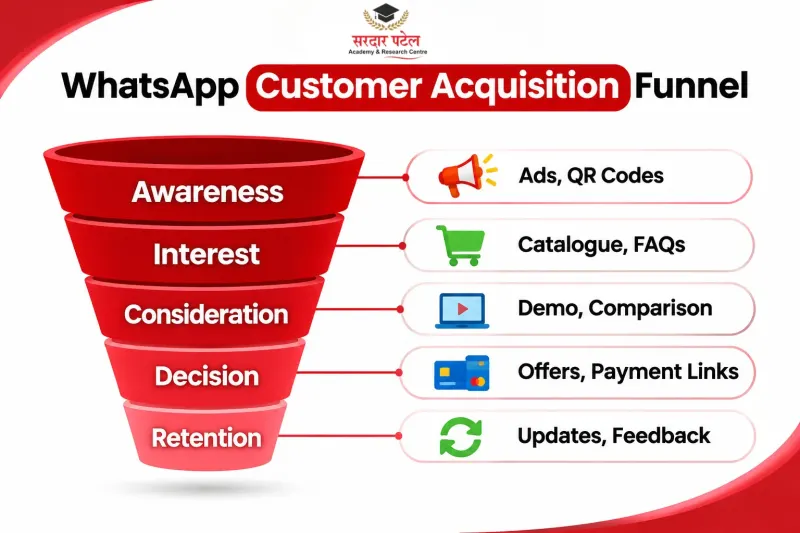
Awareness: ad, QR code, website button.
Interest: catalogue and FAQ replies.
Consideration: demo, comparison, reminder.
Decision: payment link, offer.
Retention: updates
- Pick entry points that open a free window. Click-to-WhatsApp ads and similar buttons let you reply without a charge if you answer within 24 hours.
- Reply within minutes during working hours. Greet the person, confirm what they asked about and ask one useful question.
- Match the message type to the stage. The table below shows the usual fit.
- Hand over to a human early. Route warm or confused chats to a person, and tag each lead by interest and stage.
- Review transcripts weekly. Read actual chats, not just dashboards, and fix the points where people drop off.
| Funnel stage |
WhatsApp tactic |
Usual message type |
| Awareness |
Click-to-WhatsApp ad, QR code |
Customer starts the chat |
| Interest |
Catalogue browsing, FAQ replies |
Service (free-form) |
| Consideration |
Demo reminder, product comparison |
Service or utility |
| Decision |
Limited-time offer for opted-in contacts |
Marketing template |
| Retention |
Delivery update, feedback request |
Utility or marketing |
Meta decides each template’s category under its own template categorisation guidelines, so write the message for its real purpose and check how your provider labels it.
Setting up a Click-to-WhatsApp ad
Menu names inside Meta’s ad tools change often, so follow the screens you see. The overall flow stays stable:
- Create a campaign with a messaging-focused objective and choose WhatsApp as the destination.
- Link the WhatsApp number your team will actually monitor.
- Write a pre-filled opening message that matches the ad, such as “I’d like details about the May batch”. It tells your team what the person clicked for.
- Set up a short welcome reply with two or three quick options, then route people to a human. Start with a modest budget, watch cost per chat and reply speed for a week, and only then scale.
To understand how automated conversations work beyond basic welcome messages, explore how automated WhatsApp chatbots support digital marketing campaigns through lead qualification, customer support and follow-ups.
Message templates you can adapt
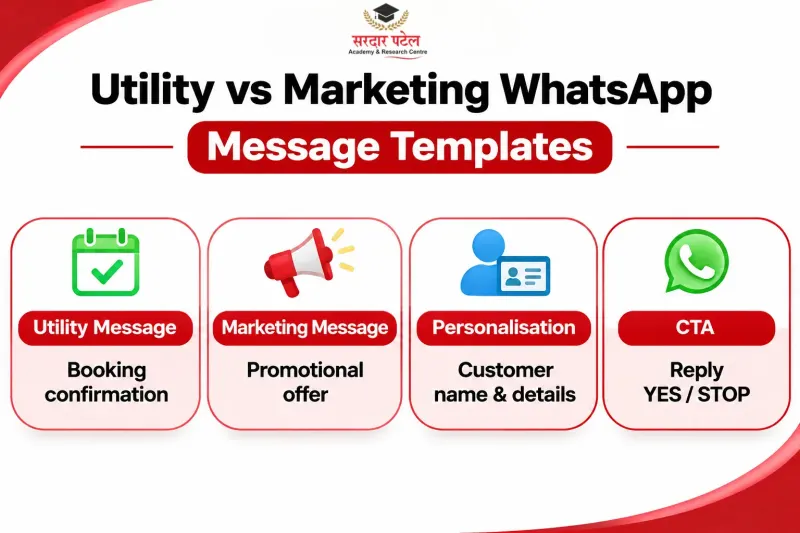
These two samples are original and use placeholders for personal details. Submit your own wording for approval. Meta has the final say on a template’s category, and it may reclassify a message that reads as promotional, so keep utility templates free of sales language.
Utility example (booking reminder):
Hi {{1}}, your counselling session is booked for {{2}} at {{3}}. Reply 1 to confirm or 2 to choose another slot.
Marketing example (follow-up offer):
Hi {{1}}, thanks for asking about {{2}}. Seats in the next batch close on {{3}}. Reply YES, and we will send fees and demo timings. Reply STOP to opt out.
Creative that earns replies
Keep each template to one image, one idea and one action. AI tools can speed up first drafts and design, provided a human checks facts and tone before anything goes for approval. Marketers can improve their creative workflow by combining Canva, ChatGPT and AI tools for marketing tasks, from drafting promotional messages to designing campaign visuals and generating content ideas.
Three Illustrative Scenarios
These examples are hypothetical. They show how the channel adapts to different businesses, and they describe structure, not results.
- A coaching institute. An ad invites students to ask about the next batch. The chat asks which exam they are preparing for, shares a brochure and offers two counselling slots. A reminder template goes out the evening before the call.
- A local clinic. Patients book through a website button. They receive confirmation and a reminder as utility messages, then a short feedback request after the visit. Promotions go only to patients who opted in.
- An online skincare brand. Businesses exploring creator-led campaigns can understand why Indian brands are partnering with smaller content creators to reach specific audiences and build more relatable brand communication.
Metrics That Matter
| Metric |
What it tells you |
How to calculate |
| Cost per chat started |
Efficiency of your ads |
Ad spend ÷ chats started |
| First-response time |
Speed and care |
Time from first message to first reply |
| Qualified lead rate |
Quality of traffic |
Qualified leads ÷ total chats |
| Template read rate |
Relevance of messages |
Messages read ÷ messages delivered |
| Opt-out rate |
Signs of over-messaging |
Opt-outs ÷ messages sent |
| Cost per acquisition |
True return |
Total spend ÷ new customers |
Count ad, messaging, tool and staff costs in the cost per acquisition row. Exporting chat and CRM data into a spreadsheet or dashboard lets you compare campaigns by source, which is where the real insight sits.
We have not listed benchmark values for read rate or opt-out rate, because published figures vary by industry and are rarely sourced well. Build your own baseline over a few weeks, then judge each campaign against it. When you compare sources of chats, keep the offer and opening message identical.
Common Mistakes to Avoid
- Messaging people who never opted in. It damages trust and can put your number at risk.
- Treating the channel as a one-way broadcast. People expect to reply and get an answer. Brands planning promotional campaigns should also focus on choosing between customer-created content and influencer promotions, depending on whether their priority is building customer trust, increasing reach or encouraging purchases.
- Replying slowly to ad leads. A fast first response is what makes click-to-chat ads work, and it keeps the free window open.
- Overusing marketing templates. Useful utility updates build the relationship that offers depend on.
- Sending long, unbroken messages. Short paragraphs and buttons are easier to act on.
- Skipping human handover. Bots should know when to step aside.
- Launching an open-ended AI assistant. Build bots around a specific business task instead.
- Learning only theory. Practise on small real projects while you study.
Skills and Career Scope
Employers hiring for chat-based marketing roles want people who combine channel knowledge, creative judgement and comfort with numbers. Writing a clear template, reading a funnel report and knowing the platform’s rules matter as much as knowing how to run an ad. Students planning to enter this industry should also consider choosing a recognised digital marketing certification in Delhi that combines practical assignments with knowledge of current marketing platforms.
If you prefer a structured route, SPARC runs a Digital Marketing Course with AI. According to the institute, it runs for seven months and covers SEO, social media marketing, Google Ads, AI tools, content marketing and analytics through hands-on projects.
Whichever programme you consider, look for three things:
- live practice on real or realistic campaigns, not slides alone;
- coverage of messaging, paid ads and analytics together;
- clear support after the classes end.
Fresher openings in marketing and analytics are listed on SPARC’s jobs page.
Beginners who want to gain experience alongside their education can explore opportunities for earning through practical digital marketing projects while studying, such as freelance assignments, internships and small business campaigns.
Conclusion
The brands winning on WhatsApp in 2026 are not the loudest. They ask permission, reply quickly, qualify with a light touch and watch their numbers closely. With per-message pricing now reaching most of what a business sends, and only a few categories staying free, every send should have a reason.
Start small: one goal, one entry point, one clean flow. Then refine it using real conversations. If you would like guided practice, SPARC’s Digital Marketing Course with AI teaches this channel alongside SEO, paid ads and analytics, and a free demo class is available.
FAQs
It is the use of WhatsApp for permission-based promotion, lead capture, sales conversations and customer care. It combines ads, chat flows, templates and human follow-up.
The Business App is free to use. The Business Platform charges per delivered message, and running click-to-chat ads costs money. Some messages stay free, such as the first 1,000 service messages per number each month and messages inside a free entry window. Check Meta’s rate card for your country.
No. The channel works only with people who agreed to receive messages, using approved templates. Unsolicited bulk messaging can hurt your quality rating and your account.
Set up a business profile, add a click-to-chat link or QR code to your website and ads, write a short qualification flow, and respond quickly. Tag every lead so you know where it came from.
Not at first. If you have a small team and moderate volume, the app may be enough. Move to the Platform when you need multiple agents, automation, CRM integration or template campaigns.
Yes, if it serves a defined business purpose, such as support, bookings or order tracking. General-purpose AI assistants have been barred since 15 January 2026.