+91 9312966129
 sparc.enquiry01@gmail.com


Best Accounting Courses After 12th Commerce
Compare the best accounting courses after 12th commerce: Tally with GST, Excel, B.Com, CA/CMA/CS. Know the duration, skills, and jobs in Delhi NCR.
Table of Contents
- Quick Answer: Which Accounting Courses Can You Do After 12th Commerce?
- How to Choose the Right Course
- Best Accounting Courses After 12th Commerce: Options Explained
- 1. Tally Prime with GST
- 2. Digital Accounting or Computerised Accounting Certificate
- 3. Advanced Excel for Accounting
- 4. GST, Income Tax and Payroll Certificates
- 5. B.Com (Bachelor of Commerce)
- 6. CA, CMA or CS Foundation
- Course Comparison Table
- Accounting Course Duration: How to Plan Your Time
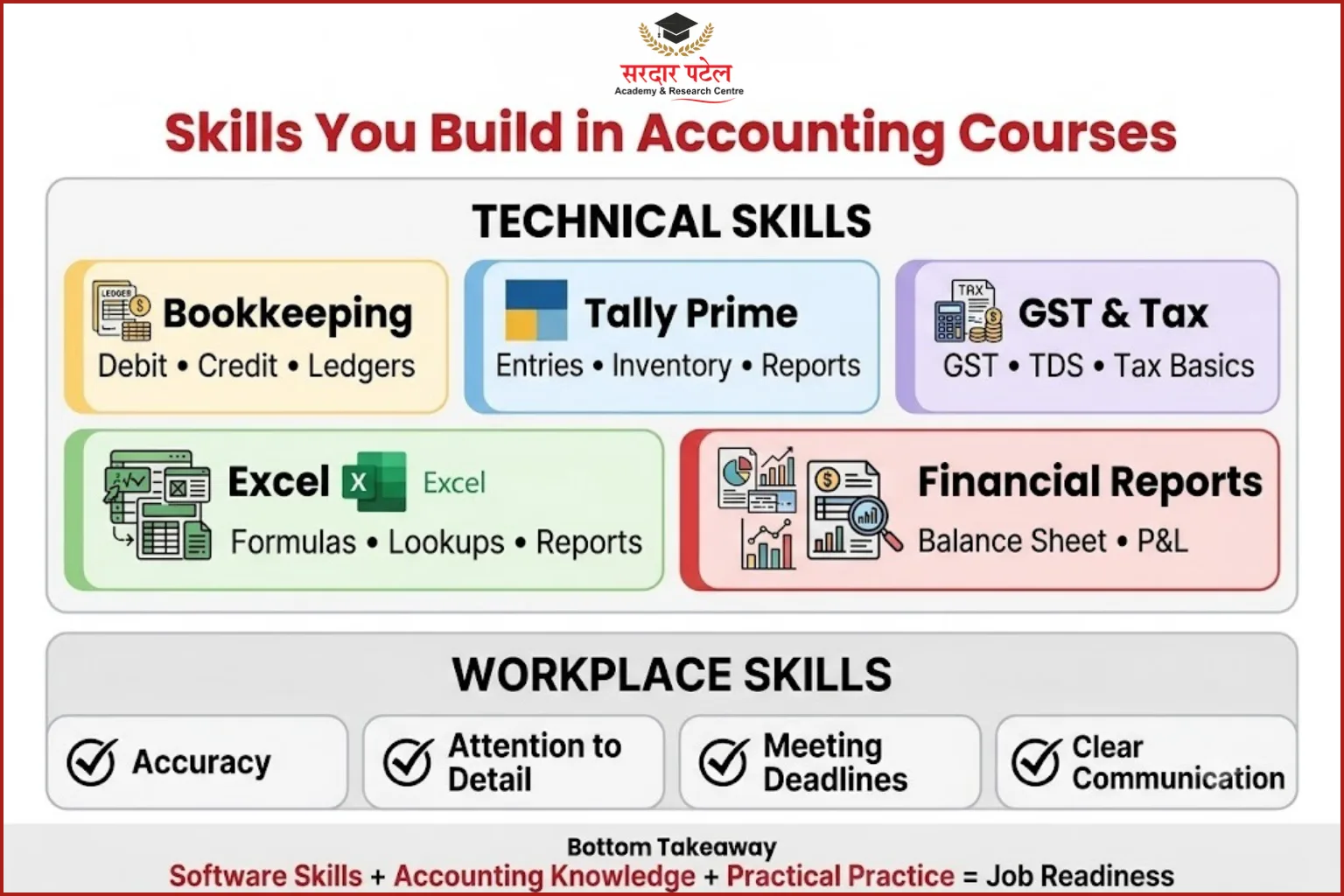
- Skills You Build in Accounting Courses
- Technical skills:
- Workplace skills:
- Career Opportunities After an Accounting Course
- Common Mistakes Students Make
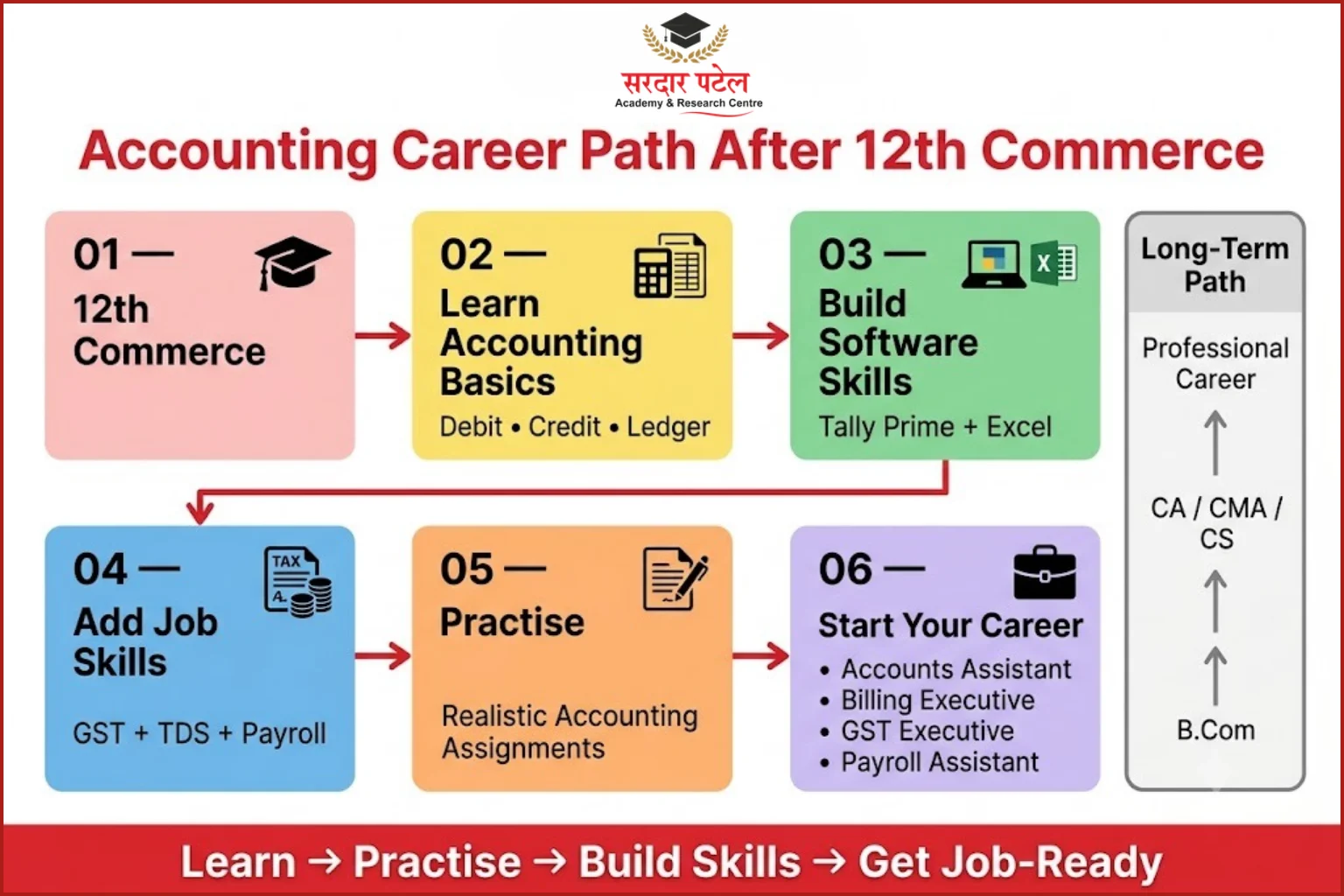
- How to Get Started: A Simple 6-Step Plan
- Learn Accounting With Practical Training at SPARC
- Conclusion
You have finished 12th Commerce, and now everyone has an opinion. One relative says CA. A cousin says just do B.Com. A neighbour says learn Tally and start working.
All of them can be right, depending on your goals. This guide covers the best accounting courses after 12th commerce, how long each one takes, what you will learn, and what jobs they can lead to. It is written for students and parents in Delhi NCR who want a clear picture before committing time and money.
Quick Answer: Which Accounting Courses Can You Do After 12th Commerce?
Accounting courses after 12th teach bookkeeping, taxation, accounting software and financial reporting. Some are short skill courses of a few months. Others are professional qualifications that take several years.
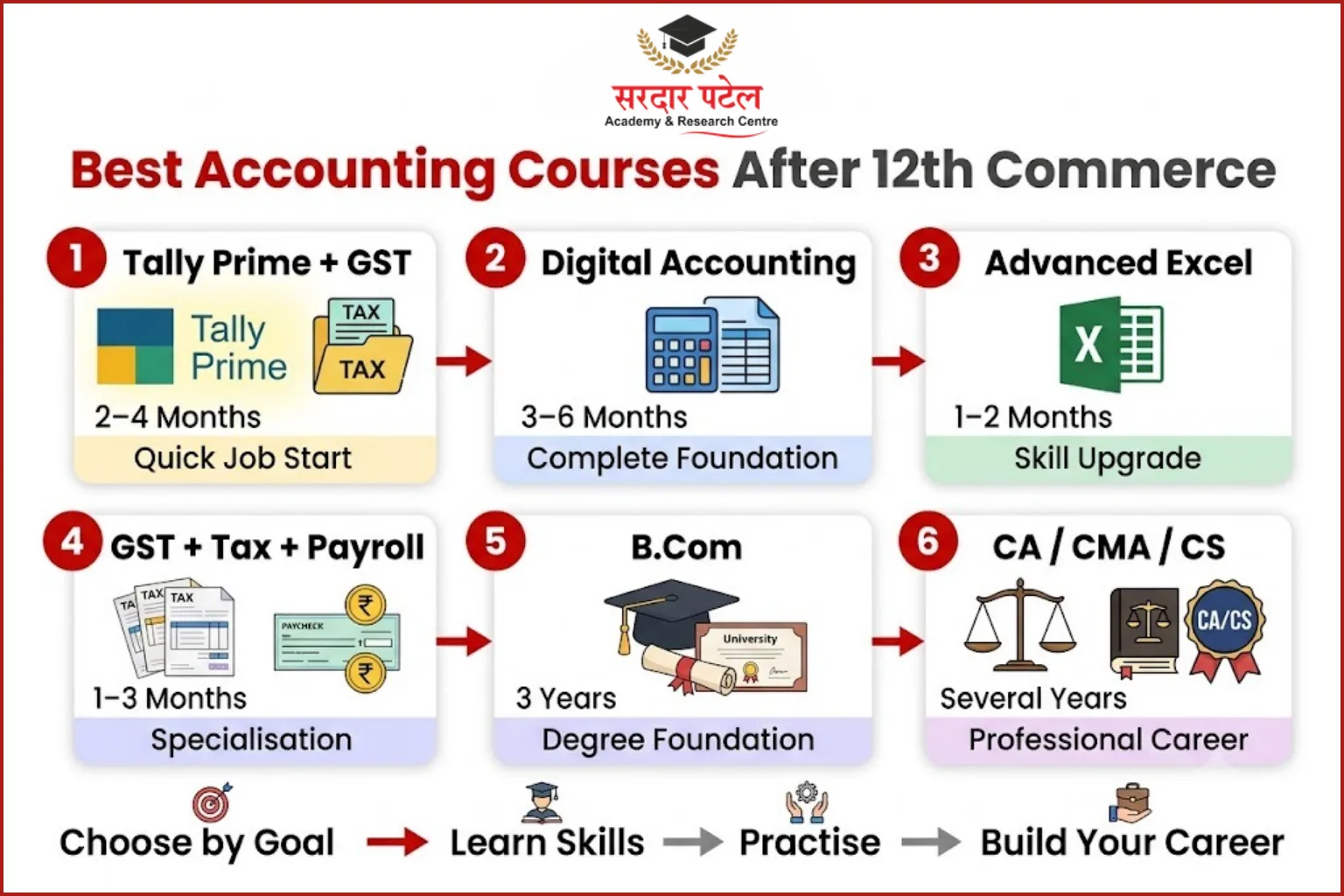
The main options are:
- Tally Prime with GST
- Digital accounting or computerised accounting certificate
- Advanced Excel for accounting
- GST, income tax and payroll certificates
- B.Com degree
- CA, CMA or CS Foundation
You do not have to pick only one. Many students combine a degree with a short skill course. You do not have to pick only one. Many students combine a degree with a short skill course. You can also explore the different accounting career options after 12th commerce before choosing your path.
How to Choose the Right Course
Before you compare course names, ask yourself four questions:
- Do I want a job soon or a long professional path? A short course can get you job-ready in months. A professional exam route takes years.
- How much time and money can I spend? Be honest about this. A course you cannot finish helps nobody.
- Can I study alongside college? Many students in North Campus, Kamla Nagar, or Mukherjee Nagar prefer evening or weekend batches.
- Will I practise on real work? Watching lectures is not the same as passing entries and filing GST yourself.
If you are still unsure about the overall path, read our complete guide on how to start a career in accounting after 12th for a step-by-step roadmap.
Small businesses and accounting firms often care most about whether you can do the work from week one. That is a general hiring pattern, not a rule. But it is why practical skills matter as much as certificates.
Best Accounting Courses After 12th Commerce: Options Explained
1. Tally Prime with GST
A Tally course after 12th Commerce is the most common starting point, and for good reason. Tally is widely used by small and mid-sized businesses across India.
You typically learn:
- Creating companies, ledgers, and vouchers
- Sales, purchase, and inventory entries
- GST billing and returns basics
- TDS basics
- Bank reconciliation
- Balance sheet and profit and loss reports
Typical duration: 2 to 4 months, depending on the institute and batch type.
Best for: Students who want to start working early or earn while studying.
2. Digital Accounting or Computerised Accounting Certificate
A digital accounting course is broader than a Tally course. It usually combines accounting fundamentals with software, Excel, and sometimes payroll or online tax filing.
Typical duration: 3 to 6 months.
Best for: Students who want a complete foundation, not just one piece of software.
Among accounting certification courses, these are often the most balanced choice for beginners. If you are comparing a short-term accounting course with a diploma in financial accounting, this comparison can help you understand which option fits your career goals. Always ask what the certificate is based on and whether it is recognised by employers.
3. Advanced Excel for Accounting
Almost every accounting job uses Excel. You should be comfortable with formulas, lookups, pivot tables, data cleaning and simple reports.
Typical duration: 1 to 2 months.
Best for: Anyone doing Tally or a degree who wants an edge in interviews.
4. GST, Income Tax and Payroll Certificates
These are add-on courses. They help you move from data entry to accounts and compliance roles. Students interested in income tax work can also learn how income tax returns are filed through the official Income Tax e-Filing portal.
Typical duration: 1 to 3 months each.
Best for: Students who already know basic accounting and want to specialise.
5. B.Com (Bachelor of Commerce)
B.Com gives you a strong theoretical base in accounting, business law, economics and taxation. It usually takes 3 years, though some universities now offer a 4-year format under NEP, so check your university's structure.
On its own, a degree may not make you job-ready in software. That is why many students pair it with a short skill course. If you are deciding between a traditional commerce path and practical computerised accounting training, read our comparison of Commerce vs Computer Accounting Course.
6. CA, CMA or CS Foundation
These are professional qualifications run by ICAI, ICMAI, and ICSI. They suit students who are ready for long-term study and competitive exams.
Duration: Several years, including exams and practical training. The exact scheme and timeline change, so check current details on the official ICAI, ICMAI, and ICSI websites.
Best for: Students aiming for chartered accountant, cost accountant or company secretary careers.
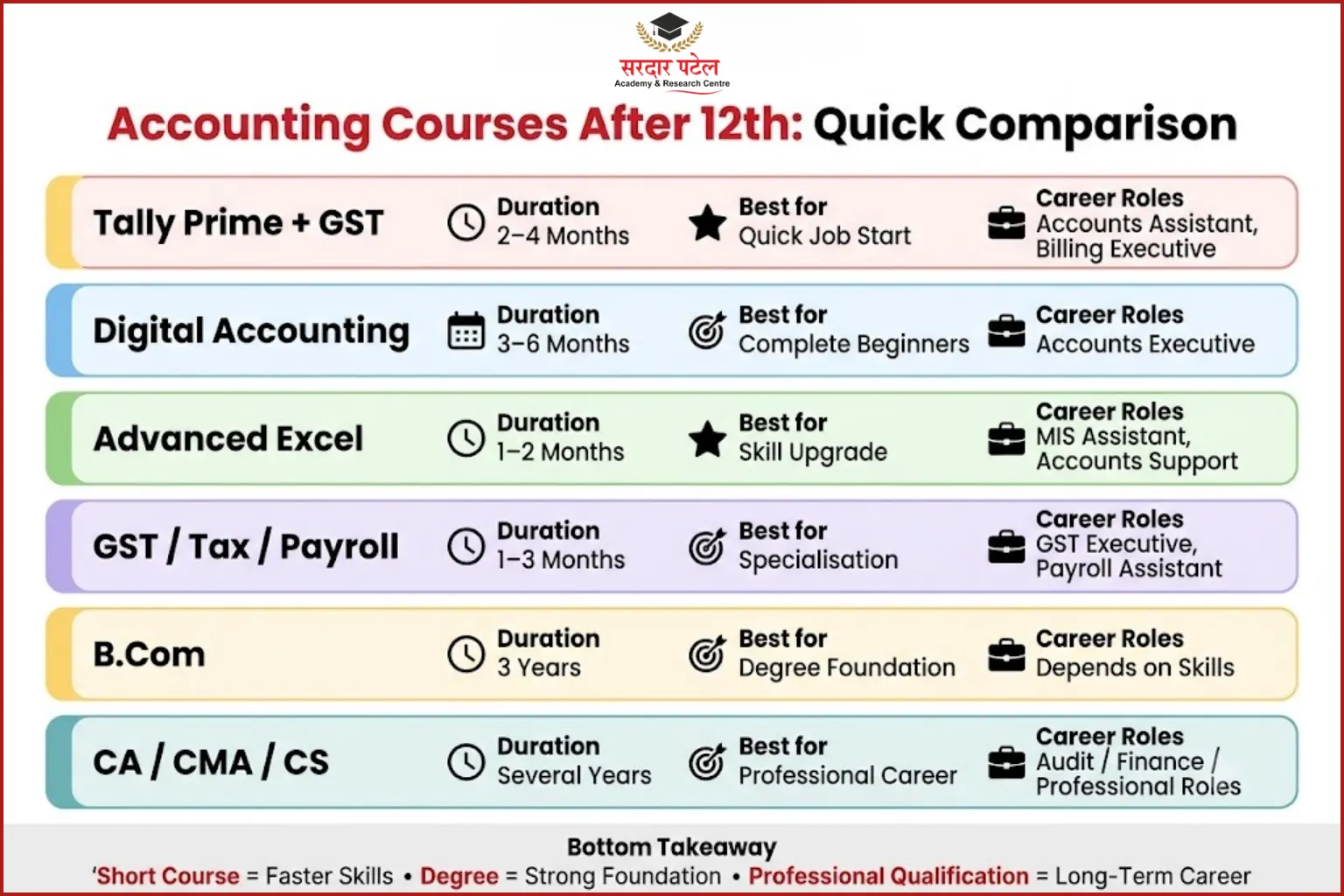
Course Comparison Table
| Course |
Typical Duration |
Best For |
Common Entry Roles |
| Tally Prime with GST |
2-4 Months |
Quick job start |
Accounts assistant, billing executive |
| Digital accounting certificate |
3-6 Months |
Complete beginners |
Accounts executive, data entry with accounts |
| Advanced Excel |
1-2 Months |
Skill upgrade |
MIS assistant, accounts support |
| GST / Income tax / Payroll |
1-3 Months |
Specialisation |
GST executive, payroll assistant |
| B.Com |
3 years (check university) |
Degree foundation |
Varies; better with skill courses |
| CA / CMA / CS Foundation |
Several years |
Professional careers |
Article assistant, audit trainee |
These are typical ranges. Actual duration depends on the institute, batch timing and how much you practise.
Accounting Course Duration: How to Plan Your Time
Here is one realistic example. Suppose you join a B.Com at a Delhi University college.
- Vacations after year 1: Complete a Tally with GST course.
- Year 2: Add Advanced Excel and a short GST or tax module.
- Year 3: Apply for internships or part-time accounts work.
By graduation, you have a degree and hands-on skills. That is a stronger profile than either alone.
If you are not doing a degree, a Tally plus Excel plus GST combination can often be finished in 4 to 6 months with regular practice.
Skills You Build in Accounting Courses
The best job-oriented accounting courses teach both technical and workplace skills.
Technical skills:
- Double-entry bookkeeping
- Tally Prime and GST entries
- Bank reconciliation
- Basic TDS and income tax knowledge
- Excel for reports and data checking
- Reading a balance sheet
Workplace skills:
- Accuracy and attention to detail
- Meeting deadlines during month-end and GST filing time
- Clear communication with managers and clients
- Keeping financial information confidential
Career Opportunities After an Accounting Course
Depending on your course and skills, you can look at roles such as:
- Accounts assistant or accounts executive
- Billing or invoicing executive
- GST or compliance assistant
- Payroll assistant
- Audit or article assistant in a CA firm
- Tax return assistant
Salary depends on the employer, your skills, your experience, and the role. Check current job listings for realistic ranges instead of trusting any single number.
Local job market context: Delhi NCR has a large base of traders, distributors, CA and tax consultancy offices, schools, hospitals, and growing startups in Noida and Gurugram. All of them need people who can maintain accounts. GTB Nagar has good metro connectivity and sits close to Mukherjee Nagar, Kingsway Camp, Model Town, and Kamla Nagar. That makes regular classes easy to attend for students from these areas.
Common Mistakes Students Make
- Choosing by name, not content. Ask for the syllabus and see how much is practical.
- Learning only theory. Accounting is a doing skill. You need assignments on real-looking data.
- Skipping GST. Most Indian businesses deal with GST, so entry-level employers often expect basic knowledge.
- Ignoring Excel. It is a small investment with a big payoff.
- Believing job guarantees. No honest institute can guarantee a job. Look for training quality instead.
How to Get Started: A Simple 6-Step Plan
- Decide your goal: early job, degree plus skills, or professional exams.
- Learn accounting basics: debit, credit, ledgers, and trial balance.
- Join a Tally Prime with GST course.
- Add Excel and one tax or payroll module.
- Practise with assignments until you can work without help.
- Build a simple resume and apply for internships or entry-level roles.
 Learn Accounting With Practical Training at SPARC
If you want to build real skills instead of just collecting certificates, Sardar Patel Academy & Research Centre (SPARC) offers job-oriented accounting and Tally training with practical assignments and hands-on learning. The focus is on doing the work you will actually face in an accounts job.
Have questions about batches, syllabus or fees? Contact SPARC and speak to the team.
Conclusion
Choosing among the best accounting courses after 12th commerce comes down to your goal, your timeline, and how much practical learning you get. Short courses like Tally with GST can get you job-ready faster. Degrees and professional exams build long-term depth. A mix of both is a smart path for many students.
Start with the basics, practise on real tasks, and keep adding skills. That combination matters more than any single certificate.
FAQs
It depends on your goal. For a quick start, Tally Prime with GST is a strong choice. For a long-term professional career, CA, CMA or CS is the route. Many students do a degree plus a short skill course.
It can help you qualify for entry-level accounting roles, especially in small businesses. Adding GST and Excel skills makes you more competitive. No course can guarantee a job.
Short courses like Tally usually take 2 to 4 months. Digital accounting certificates take about 3 to 6 months. Degrees and professional courses take years.
Yes. Many students take evening or weekend batches while attending college. Vacations are also a good time for a short course.
Basic arithmetic is enough for most skill courses. You should be comfortable with percentages and simple calculations.
It can be, if it includes regular practice and doubt support. Many beginners find classroom sessions easier because they can ask questions and get feedback immediately.
Yes, roles exist across trading firms, CA offices, startups, and service businesses. Your skills, practice level, and interview performance decide your success.