+91 9312966129
 sparc.enquiry01@gmail.com


Best Career Courses After Graduation in Delhi
Compare the best career courses after graduation in Delhi NCR — fees, salary ranges, and course depth — to pick the right one for your goals.

Table of Contents
- Why Career Course Choice Matters More in Delhi NCR
- How to Choose the Right Course After Graduation
- Match the Course to Your Background
- Check the Practice-to-Lecture Ratio
- Ask About Fees and Placement Support Directly, Not Just Online
- 6 Best Career Courses After Graduation (With Realistic Salary Ranges)
- Data Analytics
- Digital Marketing
- Full Stack Web Development
- Financial Modelling and Investment Banking Fundamentals
- HR Analytics and HR Management
- Content Writing, SEO, and Copywriting
- Career Courses: Freshers vs Working Professionals
- What to Check Before Enrolling in Any Course
- Common Mistakes Graduates Make When Choosing a Career Course
- Where to Get Free, Government-Backed Career Guidance
- How SPARC Approaches Career-Focused Training in Delhi
- Final Thoughts
Finishing college is exciting, but it also brings one big question most graduates face sooner or later: what next? If you're searching for the best career courses after graduation, chances are you already know a degree alone doesn't guarantee a job anymore — recruiters in Delhi NCR increasingly look for practical, job-ready skills alongside your degree.
This guide covers six career paths that see genuine hiring activity in Delhi NCR, what each one actually involves, realistic salary ranges reported across industry salary trackers, and what to check before you commit your time and money to any program.
A quick note on the numbers below: salary figures vary a lot between companies and individual skill levels — the ranges here reflect what's commonly reported across multiple salary-tracking platforms as of 2026, not a fixed guarantee for any specific job offer.
Why Career Course Choice Matters More in Delhi NCR
Delhi NCR is home to a dense mix of corporate offices, startups, consulting firms, and IT parks spread across Gurgaon, Noida, and central Delhi. This creates real opportunity, but also real competition — thousands of graduates from Delhi University, Amity, IP University, and other colleges enter the job market every year with similar degrees.
A well-chosen professional course can be the difference between two similar resumes. It signals to an employer that you've gone beyond your syllabus and picked up a skill they actually need — whether that's analysing data, running digital campaigns, or writing production-ready code.
That said, not every course delivers on this promise. Some run on outdated syllabi or are heavy on theory with almost no hands-on practice. Choosing well matters more than choosing fast.
How to Choose the Right Course After Graduation

Match the Course to Your Background
A commerce graduate moving into financial modelling has a shorter learning curve than one jumping straight into software development. That doesn't rule out cross-domain switches — many working data analysts started in humanities or commerce — but it does mean you should expect a slightly longer runway if the subject is genuinely new to you.
Check the Practice-to-Lecture Ratio
Ask directly: how many hours per week go into building things — dashboards, campaigns, code, models — versus watching lectures? Interviews rarely test theoretical recall; they usually ask you to walk through something you've actually built.
Ask About Fees and Placement Support Directly, Not Just Online
Many reputable institutes don't publish exact fees on their websites — SPARC, for instance, shares fee structure and instalment options directly through its counselling team rather than listing a fixed number online, and separately offers scholarship support of up to 65% for eligible students as part of its self-financed, no-profit model. This isn't unusual, but it does mean you should call or visit before assuming a number. Similarly, be wary of "100% placement guarantee" claims — no institute can promise this ethically, since final hiring decisions rest with employers. Ask instead: how many companies visited the last batch, what roles and rough salary bands were offered, and whether support includes resume review and mock interviews or just a job-alerts group.
6 Best Career Courses After Graduation (With Realistic Salary Ranges)

Data Analytics
Data analytics remains one of the most versatile post-graduation courses because nearly every industry — retail, banking, healthcare, e-commerce — now runs on data-driven decisions. To see how organisations use analytics to improve decisions and performance, read our guide on the business value of data analytics.
A solid program covers Excel, SQL, Python basics, Power BI or Tableau, and applied statistics, backed by project work on real business datasets. If you want to understand these technologies in more detail, explore our guide to the essential data analytics tools for beginners.
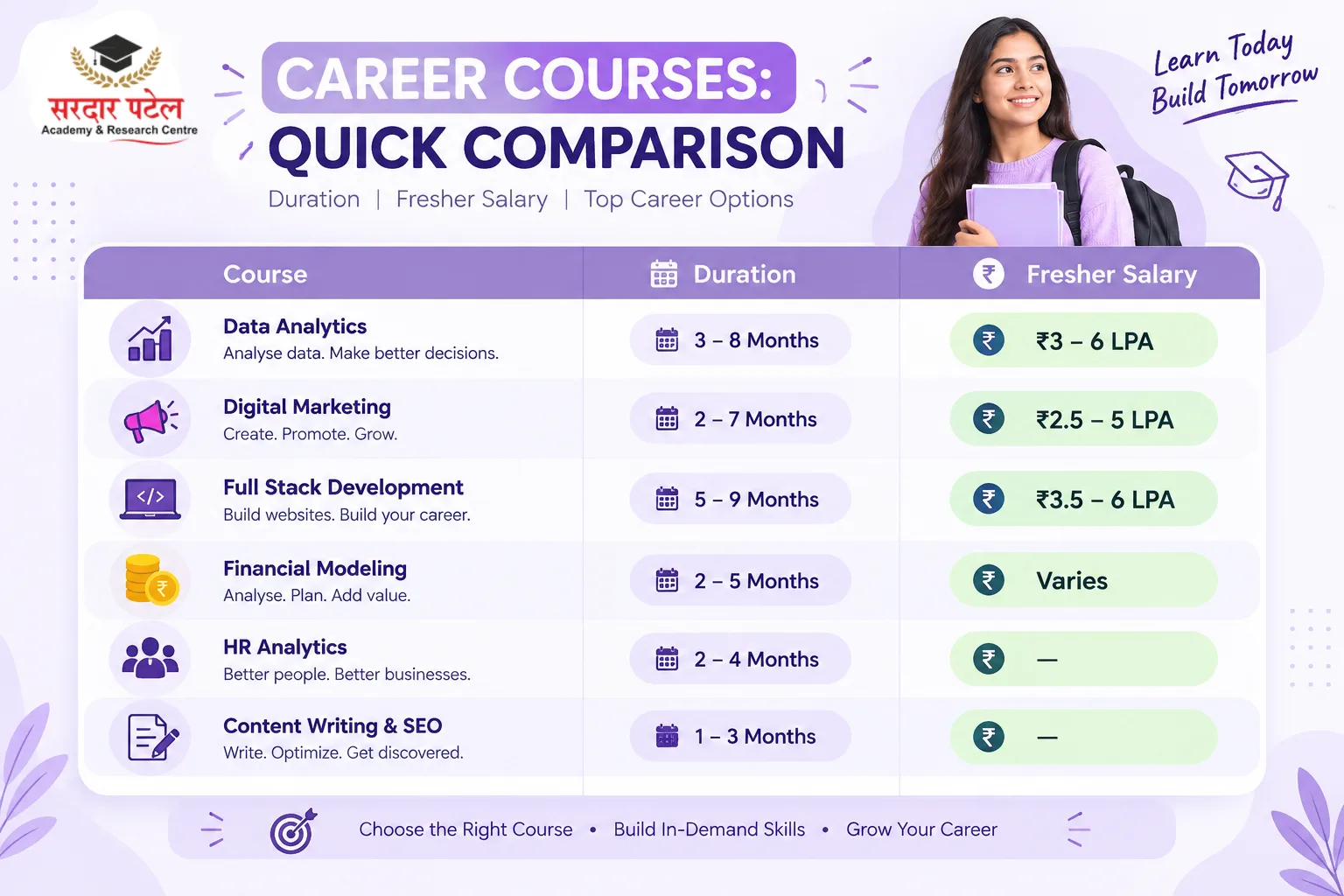
Typical course duration: 3–8 months, depending on depth and project load. SPARC's Data Analytics Course with AI in Delhi, for example, runs for 8 months and includes 40+ hands-on projects covering Advanced Excel, SQL, Python, and Power BI, with no coding background required to join.
As AI continues to influence analytics workflows and tools, it's also useful to understand how AI is changing data analytics and what these changes mean for learners and professionals.
Indicative fresher salary range: roughly ₹3–6 LPA, based on entry-level figures reported across platforms like Glassdoor and AmbitionBox through 2026, with candidates who show strong SQL, Python, and a built portfolio often landing toward the higher end
Industry context: NASSCOM's analytics and data science research has repeatedly flagged a wide gap between hiring demand and the supply of trained talent, which is part of why entry-level analytics roles have stayed relatively accessible even for freshers with the right project experience
Who it suits: graduates from any background — commerce, engineering, or arts — comfortable working with numbers and logic. If you're from a commerce background and considering a switch into analytics, our guide on Can Commerce Students Learn Data Analytics? can help you understand the transition and skills involved. (link pending — this guide is still in review within the same batch and isn't published yet)
Institutes like SPARC in Delhi structure their data analytics programs around live projects rather than only theory, which matters when you're trying to build an interview-ready portfolio from scratch. If you're specifically comparing placement-focused options, you can also explore our guide to the Best Data Analytics Course in Delhi with Placement to understand what to evaluate before enrolling. It's worth noting that course durations for the same program can be described slightly differently across an institute's own pages (SPARC's course page, for instance, lists both an 8-month headline duration and a 7–10 month range in its FAQ) — always confirm the exact duration and batch schedule directly with the counsellor before enrolling, regardless of which institute you're considering.
Digital Marketing
Digital marketing courses cover SEO, paid ads, social media strategy, content marketing, and tools like Google Analytics. Delhi NCR's large base of D2C brands, agencies, and startups keeps hiring activity fairly steady for this skill set.
Typical course duration: 2–7 months, depending on depth. SPARC's Digital Marketing Course with AI, for instance, runs 7 months with 50+ projects, a one-month live internship, and training across 40+ tools including Google Ads, Meta Ads Manager, Google Analytics, and SEO platforms like Semrush.
Indicative fresher salary range: roughly ₹2.5–5 LPA for generalist entry-level roles, with specialisations like performance marketing or analytics-heavy roles often starting higher
Who it suits: graduates who enjoy a mix of creativity and data — comfortable writing ad copy but also curious about what's actually converting
Full Stack Web Development
Full stack courses teach front-end and back-end programming — commonly JavaScript-based frameworks, databases, and API integration. Delhi NCR's IT and product companies, especially around Gurgaon and Noida, continue to hire developers who can build and deploy complete features, not just write isolated code.
Typical course duration: 5–9 months for a project-ready level
Indicative fresher salary range: roughly ₹3.5–6 LPA at IT services firms, with product companies and well-funded startups sometimes paying meaningfully more for candidates with strong deployed-project portfolios
Who it suits: graduates who enjoy structured problem-solving; engineering and computer science backgrounds adapt fastest, though non-tech graduates do make the switch with enough practice time
Financial Modelling and Investment Banking Fundamentals
For commerce and finance graduates, courses covering valuation, Excel-based financial modelling, and investment banking basics remain a strong option, given Delhi NCR's concentration of finance, consulting, and audit firms.
Typical course duration: 2–5 months
Who it suits: commerce and finance graduates aiming at roles in equity research, corporate finance, or financial analysis
Note on pay: entry-level pay in this field varies enormously by firm type (boutique vs. Big 4 vs. corporate finance teams), so it's worth asking any institute for placement-specific numbers rather than relying on general estimates
HR Analytics and HR Management
HR roles have shifted from purely administrative work to data-informed decisions around hiring, attrition, and performance. Courses combining core HR concepts with HR analytics tools give graduates — particularly from psychology, sociology, or commerce backgrounds — a more specialised edge over generalist HR applicants.
Typical course duration: 2–4 months
Who it suits: graduates interested in people-facing work who are also comfortable interpreting basic data and metrics
Content Writing, SEO, and Copywriting
This suits graduates who write well and want to work in media, marketing, or publishing. A good course covers SEO fundamentals, different content formats, and editing discipline — a skill set that's genuinely testable through a writing sample, which makes it a relatively fast way to prove capability to an employer.
Typical course duration: 1–3 months
Who it suits: graduates from any stream with strong writing ability who want quicker entry into a content or marketing role
Career Courses: Freshers vs Working Professionals
| Course |
Best Suited for Freshers |
Best Suited for Working Professionals |
| Data Analytics |
Yes — no prior work experience required |
Yes — commonly used for an internal role shift |
| Digital Marketing |
Yes |
Yes — often a lateral move into marketing |
| Full Stack Development |
Yes, especially with time to practise daily |
Possible, but needs consistent evening hours |
| Financial Modeling |
Yes, for finance/commerce graduates |
Common for those targeting IB or equity research roles |
| HR Analytics |
Yes |
Yes — useful for HR generalists specialising further |
| Content Writing & SEO |
Yes |
Less common as a first course, but useful for a content-side pivot |
If you're planning to build analytics skills while continuing your current work or other commitments, you may also want to explore Can I Earn While Learning Data Analytics? for practical ways to think about learning and earning together. (link pending — this guide is also still in review within the same batch and isn't published yet)
What to Check Before Enrolling in Any Course
- Full curriculum — ask for the actual topic list and sequence, not just a brochure headline.
- Project count and independence — how many projects will you build yourself, versus watch demonstrated?

- Trainer background — do trainers have real industry experience in what they're teaching?
- Batch size — smaller batches usually mean more individual doubt-resolution time.
- Certification value — understand what completing the course actually certifies, and whether employers you're targeting recognise it.
- Schedule fit — confirm timings genuinely work around your job or other commitments before enrolling.
- Fee structure and scholarships — many institutes share this only on request rather than publishing it; ask about instalment options and any scholarship eligibility upfront.
- Placement process specifics — resume support, mock interviews, and real hiring-partner connections, not just job alerts.
Common Mistakes Graduates Make When Choosing a Career Course
- Choosing based on duration alone. A shorter course with strong hands-on training can outperform a longer one that's mostly lecture-based.
- Not asking about the practice-to-lecture ratio directly. This single question reveals more than any brochure.
- Assuming every course under the same title covers the same syllabus. Depth and tool coverage vary a lot between institutes, even for "data analytics" or "digital marketing" courses.
- Skipping prerequisite checks. Some technical courses assume basic comfort with logic or Excel — confirm this before committing.
- Overlooking career guidance and mentorship. A course that only teaches tools, without resume or interview support, leaves half the job undone.

Where to Get Free, Government-Backed Career Guidance
Before or alongside any paid course, it's worth knowing that the Government of India runs the National Career Service (NCS) portal under the Ministry of Labour and Employment, which offers free career counselling, aptitude assessments, and job listings — a useful starting point for anyone still deciding on a direction. For a broader look at how India's analytics and digital-skills job market is evolving, NASSCOM's knowledge centre publishes periodic research on talent demand and supply that's worth a look if you want data-backed context beyond any single institute's claims.
How SPARC Approaches Career-Focused Training in Delhi
SPARC (Sardar Patel Academy & Research Centre) has been running as a self-financed, not-for-profit NGO educational institute in Delhi since 2003, with its flagship campus at Hudson Lane, GTB Nagar, and branches across Rani Bagh, Janak Puri, Nangloi, Dwarka Mor, and Najafgarh. It's ISO 9001:2015 certified and operates as an NIELIT-authorised CCC training centre.
Its Data Analytics and Digital Marketing programs are both structured around project-based learning rather than passive lectures — the Data Analytics course includes 40+ live projects, and the Digital Marketing course includes 50+ projects along with a one-month live internship. Neither course requires a technical or coding background to join. Fee details and scholarship eligibility (up to 65%) are shared directly by their counselling team rather than published as a fixed number online.
For graduates weighing multiple institutes and formats, comparing actual project counts, trainer access, and placement specifics tends to be far more useful than comparing brochures side by side.
If you're still weighing your options, it's worth comparing career programs directly rather than deciding on advertising alone — you can reach SPARC's counselling team at +91 93129 66129 / +91 93129 77129 or enquiry@sparc.org.in.

Final Thoughts
Picking the right career course after graduation isn't about following whichever trend is loudest this year — it's about matching a course to your background, learning style, and the kind of role you want in a year or two. Delhi NCR offers no shortage of options across data, marketing, design, finance, and technology; the graduates who benefit most are the ones who ask specific questions before enrolling instead of choosing based on brochure claims alone.
If you're comparing multiple programs and want a clearer picture of project depth, curriculum, and placement support, it's worth talking to a counsellor directly and comparing career programs side by side before you commit.
FAQs
There's no single "best" course — it depends on your degree background, interests, and career goals. Data analytics, digital marketing, and full-stack development currently see steady hiring activity, but the right fit depends on your strengths.
Yes. Courses like data analytics, digital marketing, financial modeling, and content writing are designed for freshers and don't require prior work experience.
A certification adds to your resume but works alongside your existing degree rather than replacing it. Employers generally look at both your educational background and demonstrated practical skills.
This varies — anywhere from a few weeks for short workshops to 7–10 months for in-depth, project-heavy programs like SPARC's Data Analytics or Digital Marketing courses. Longer isn't automatically better; ask what specifically fills the extra time.
No responsible institute can guarantee a job, even where "placement support" is offered. A good course provides relevant skills, project experience, resume help, and interview practice — the outcome still depends on your performance in interviews. It's worth asking any institute for specific placement numbers from recent batches rather than relying on general claims.
Data analytics, digital marketing, full stack development, and financial modeling see fairly steady hiring activity given Delhi NCR's mix of corporate offices, startups, and consulting firms across Gurgaon, Noida, and central Delhi.
No — they're indicative ranges reported across salary-tracking platforms as of 2026. Actual offers vary by company, city, skill level, and portfolio strength, so treat them as a starting reference, not a guarantee.