+91 9312966129
 sparc.enquiry01@gmail.com


The Future of Data Analytics Jobs in India
India's data analytics market hits $21B by 2026. Discover top jobs, salaries, in-demand skills & your complete career roadmap for 2026–2027.
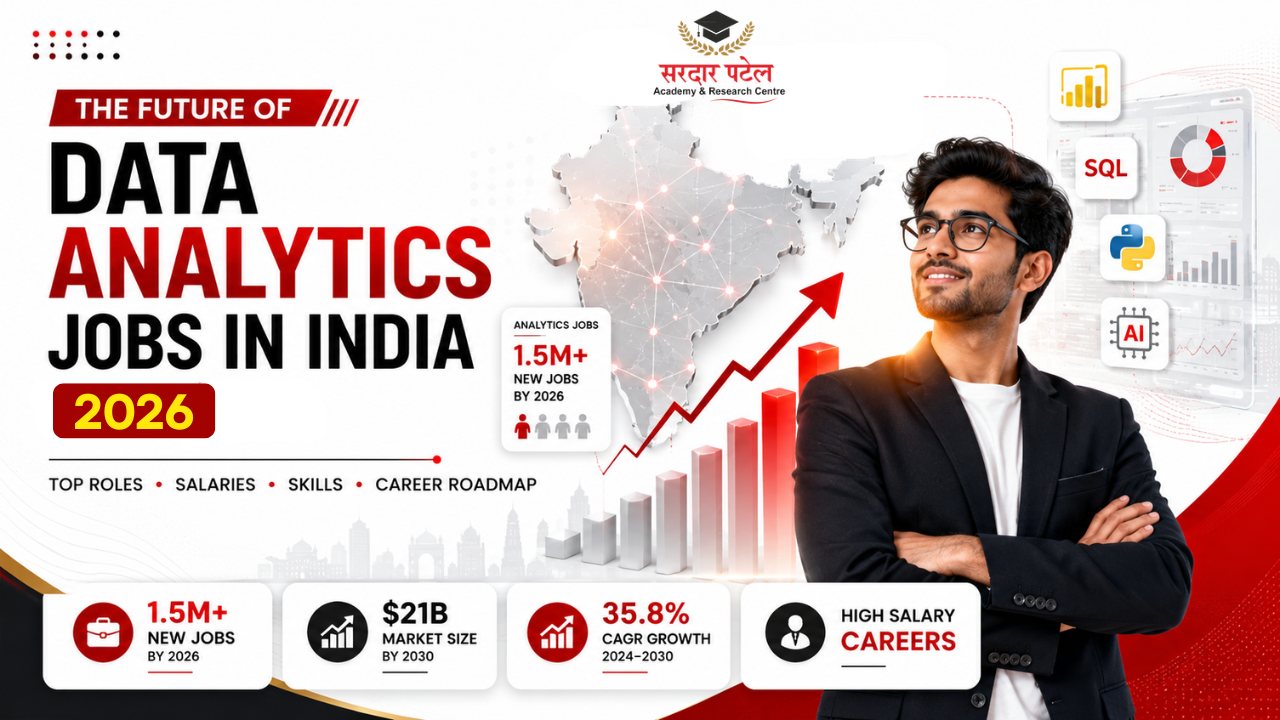
Table of Contents
- Why India Is Becoming a Global Data Powerhouse
- Digital payments explosion:
- E-commerce growth:
- Government initiatives:
- Startup ecosystem:
- Healthcare digitisation:
- The Numbers Behind the Boom: Future of Data Analytics Jobs in India
- Analytics Career Future 2030: Roles That Will Define the Decade
- 1. Data Analyst
- 2. Business Intelligence (BI) Analyst
- 3. Data Scientist
- 4. Data Engineer
- 5. ML Engineer / AI Specialist
- 6. Analytics Manager / Head of Data
- 7. AI Ethics & Data Governance Specialist
- Salary Snapshot: What Data Analytics Jobs Pay in India
- Which Industries Are Hiring Data Analytics Professionals in India?
- BFSI (Banking, Financial Services & Insurance):
- E-Commerce & Retail:
- Healthcare & Pharma:
- IT & Consulting:
- EdTech & Startups:
- Government & Public Sector:
- Skills You Need to Future-Proof Your Data Analytics Career in India
- Core Technical Skills
- Emerging Skills for the Analytics Career Future Through 2030
- Soft Skills That Still Define Great Analysts
- Top Cities for Data Analytics Jobs in India
- Tier 1 Cities — Highest Demand and Pay:
- Challenges Honest Enough to Mention
- How to Build a Winning Data Analytics Career in India: Step-by-Step Roadmap.
India is sitting on a goldmine — and it's made entirely of data.
By 2030, India's data analytics market is projected to cross USD 21 billion, growing at a CAGR of 35.8%. Over 1.5 million new data analytics jobs in India are expected by the end of 2026 alone. These aren't just statistics — they represent real career opportunities for real people across every industry and every city in the country.
The future of data analytics jobs in India is being shaped right now by companies scrambling to hire faster than talent can be trained. Whether you're a fresh graduate, a mid-career professional looking for a switch, or someone exploring this field for the first time, this authoritative report covers everything you need to know — market numbers, top roles, salary benchmarks, required skills, and a practical roadmap to get started.
Learn more about data analytics career scope, skills, and salary trends.
Let's get into it.
If you're still deciding whether analytics is the right career path, read our complete guide on Is Data Analytics a Good Career in 2026? to understand job demand, salaries, and long-term growth opportunities.
Why India Is Becoming a Global Data Powerhouse
India has a unique advantage: scale.
With over 900 million internet users, a booming startup ecosystem, and aggressive government-led digitisation programmes, India generates more data every day than most countries produce in a week. This structural shift is creating sustained, long-term demand for data analytics professionals across every sector.
Here's what's driving the surge:
Digital payments explosion:
UPI now processes billions of transactions monthly. Each one is a data point waiting to be analysed.
E-commerce growth:
Platforms like Meesho, Flipkart, and Amazon India generate real-time behavioural data at a massive scale — and need analysts to turn it into strategy.
Government initiatives:
Programmes like Digital India and the National Data Governance Framework are pushing data analytics adoption across public services.
Startup ecosystem:
India has the third-largest startup ecosystem in the world, and data-driven decision-making is now standard in most funded companies.
Healthcare digitisation:
Telemedicine and electronic health records are creating vast datasets that require skilled professionals to interpret and act on.
Over 70% of large Indian enterprises have now adopted business intelligence or analytics platforms. The implication for job seekers is clear: the demand for data analytics professionals in India is not cyclical. It's structural, and it's here to stay well beyond 2030.
The Numbers Behind the Boom: Future of Data Analytics Jobs in India
If you want to understand where data analytics jobs in India are headed, start with the numbers.
- India's data analytics sector is projected to create over 1.5 million new jobs by the end of 2026, according to NASSCOM.
- Data analytics job openings in India have increased by 52% over the past five years.
- NASSCOM projected a shortfall of 200,000+ data analytics professionals by the end of 2025 — a gap that has continued to persist through 2026.
- India is projected to have over 11 million data-related job openings by 2026 across all levels.
- The World Economic Forum's Future of Jobs Report 2025 forecasts 11 million new AI and data processing jobs globally by 2030.
What does this mean for you? Employers are actively competing for good talent. Salaries are rising year on year. And professionals who invest in the right analytics skills today will be in an extremely strong position through the rest of this decade. The analytics job market in India rewards those who show up prepared.
Analytics Career Future 2026: Roles That Will Define the Decade
The data analytics landscape is evolving quickly. Roles that barely existed five years ago are now among the most sought-after positions in corporate India. Here's a look at the key job profiles shaping the analytics career future through 2030.
1. Data Analyst
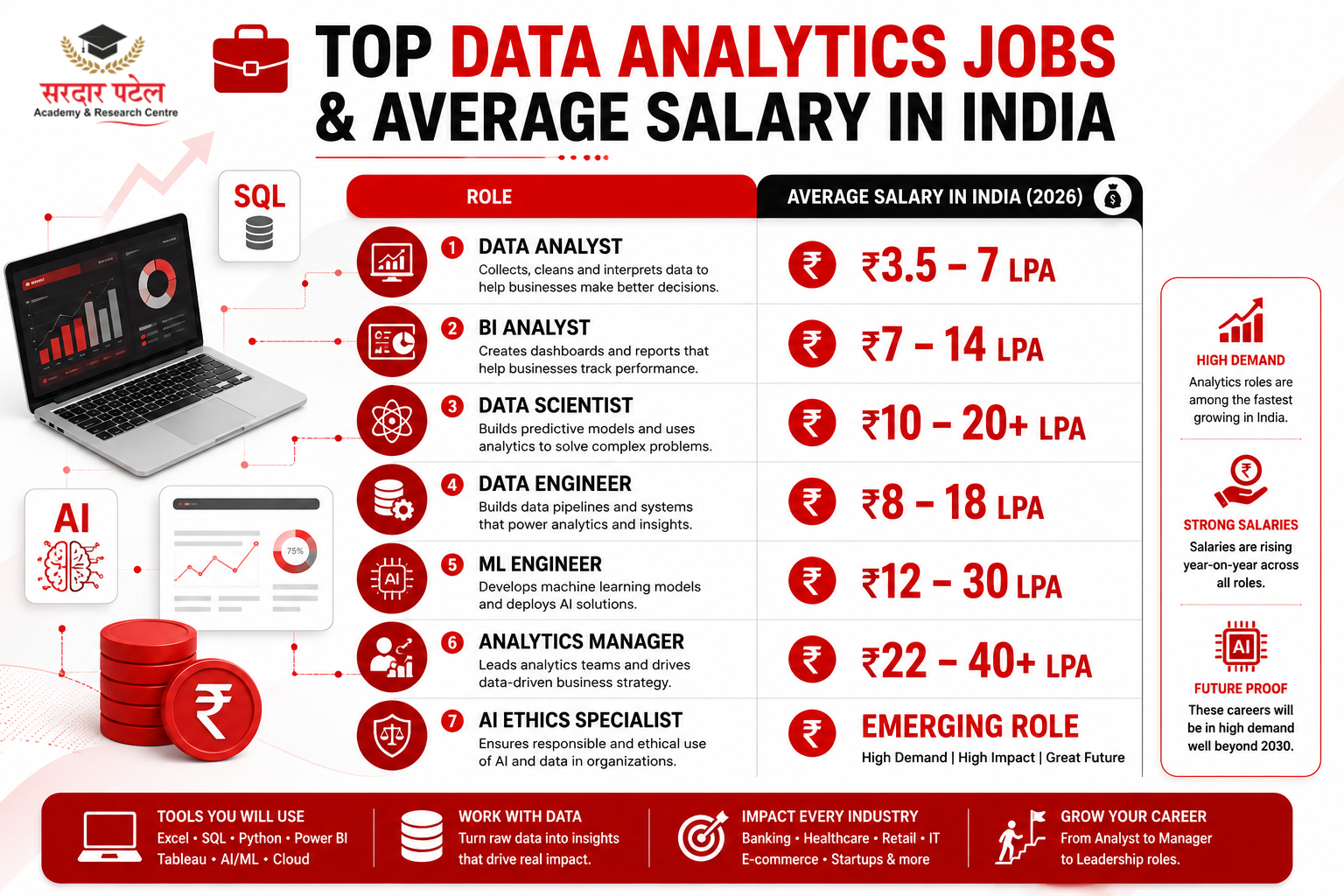
The primary entry point for most analytics professionals. Data analysts collect, clean, and interpret datasets to help businesses make faster, smarter decisions. They work with tools like SQL, Excel, Power BI, and Tableau, and are hired across every major industry in India. Average salary in 2026: ₹6–7 LPA (freshers: ₹3.5–6 LPA)
2. Business Intelligence (BI) Analyst
BI analysts convert raw data into business-friendly dashboards and executive reports. They bridge the communication gap between data teams and senior leadership — a role that's critical in India's fast-scaling companies. Average salary: ₹7–14 LPA
3. Data Scientist
A step above data analysts in technical depth, data scientists build predictive models and work with machine learning algorithms. They need stronger programming skills and statistical knowledge. This is one of the most in-demand analytics career options for the next decade. Average salary: ₹10–20 LPA (senior level: ₹25+ LPA)
4. Data Engineer
Data engineers build and maintain the pipelines and infrastructure that make analytics possible. As cloud adoption accelerates across Indian enterprises, demand for this data analytics role is rising sharply. Average salary: ₹8–18 LPA
5. ML Engineer / AI Specialist
With AI now at the core of business strategy, professionals who can build and deploy machine learning models are among the highest-paid in India's analytics job market. Average salary: ₹12–30 LPA
6. Analytics Manager / Head of Data
Senior leadership roles that involve overseeing the full analytics strategy, managing data teams, and presenting data-driven recommendations to C-suite executives. The analytics career path leads naturally here with 7–10 years of experience. Average salary: ₹22–40+ LPA
7. AI Ethics & Data Governance Specialist
An emerging data analytics role that's gaining importance as Indian data privacy regulations tighten. These professionals ensure that data practices are transparent, compliant, and fair — a function that will be mandatory in most large organisations by 2030.
This role barely existed a few years ago. By 2030, it will be a standard hire.
Salary Snapshot: What Data Analytics Jobs Pay in India
Compensation in India's analytics sector directly reflects the demand-supply gap. Companies are paying well to attract and retain skilled talent.
| Experience Level |
Typical Annual Salary (INR) |
| Fresher (0–2 years) |
₹3.5 LPA – ₹6 LPA |
| Mid-Level (2–5 years) |
₹7 LPA – ₹14 LPA |
| Senior Level (5–7 years) |
₹15 LPA – ₹25 LPA |
| Leadership / Specialist (7+ years) |
₹22 LPA – ₹40+ LPA |
A few important salary factors for data analytics jobs in India:
- Professionals with strong Python and SQL skills consistently earn 20–35% more than peers without them.
- Certified professionals (Google Data Analytics, Power BI, Tableau) earn 15–25% more on average.
- Product-based companies like Swiggy, PhonePe, and Razorpay pay 30–50% more than IT services firms for equivalent analytics roles.
- Bengaluru, Hyderabad, Mumbai, and Pune offer the highest packages, though remote work has significantly reduced the location barrier.
The average data analyst salary in India across all experience levels sits at approximately ₹6.5–7.5 LPA — and it continues to climb each year as demand outpaces the available talent pool.
Which Industries Are Hiring Data Analytics Professionals in India?
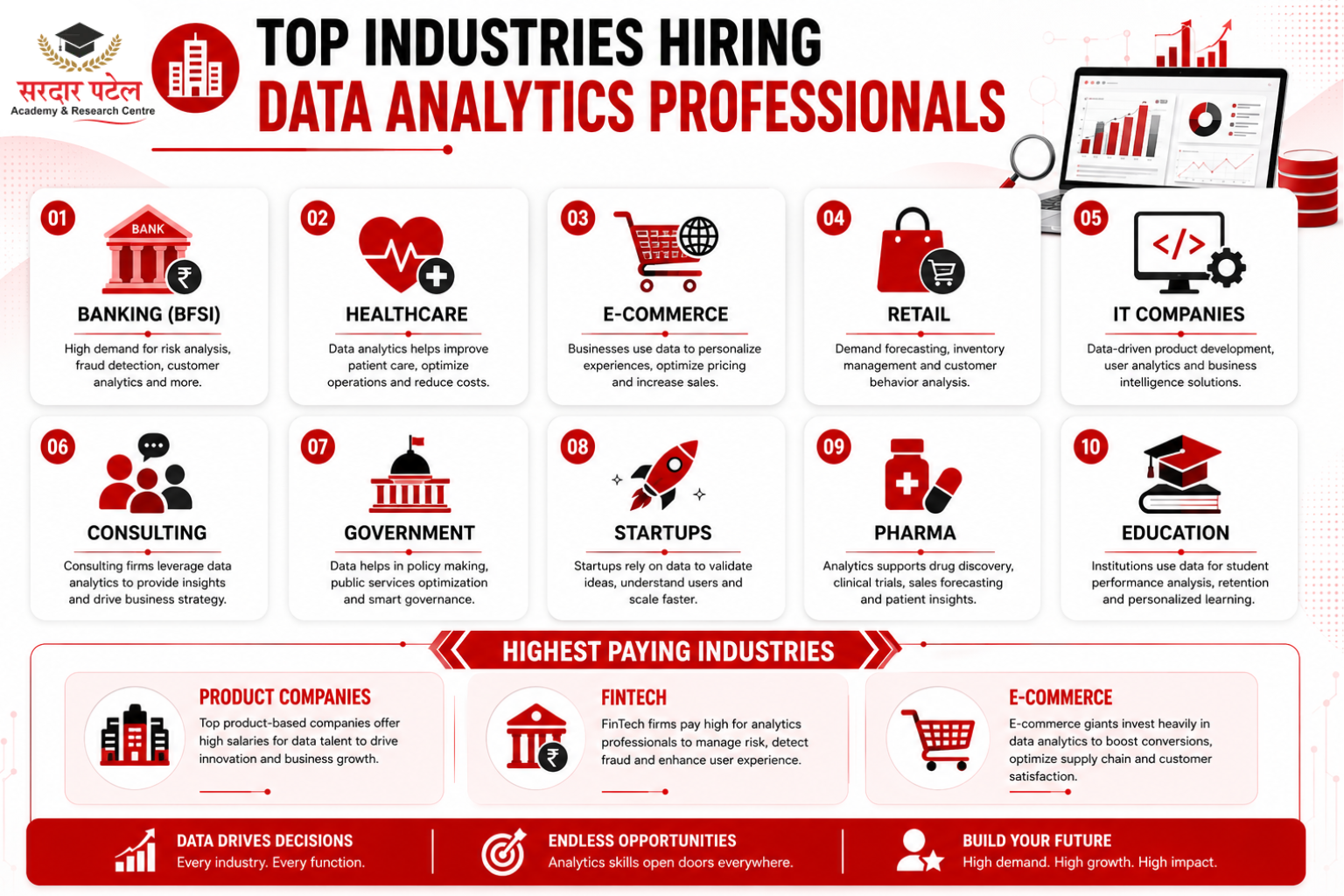
Data analytics jobs in India are no longer confined to IT companies. Here are the sectors generating the most demand right now.
BFSI (Banking, Financial Services & Insurance):
Banks like HDFC and ICICI use analytics for fraud detection, credit risk modelling, and personalised product recommendations. BFSI is consistently one of the highest-paying sectors for data analytics professionals in India.
E-Commerce & Retail:
Platforms like Flipkart, Myntra, and Meesho rely on data analytics to drive personalisation, dynamic pricing, and supply chain optimisation. The volume of real-time data here is extraordinary — and so is the hiring.
Healthcare & Pharma:
Apollo, Cipla, and other healthcare majors use data analytics to predict patient outcomes, manage hospital resources, and accelerate drug discovery. Healthcare is one of the fastest-growing sectors for analytics jobs in India today.
IT & Consulting:
TCS, Infosys, Wipro, Accenture, and Capgemini all run large analytics practices and hire thousands of data professionals each year — both freshers and experienced both.
EdTech & Startups:
India's startup ecosystem — especially in fintech, edtech, and logistics — runs almost entirely on data. These companies offer faster career growth and broader hands-on exposure than traditional enterprise roles.
Government & Public Sector:
Programmes like Smart Cities Mission and Ayushman Bharat are generating significant demand for public-sector analytics roles — a space that was historically underserved but is now opening up fast.
Skills You Need to Future-Proof Your Data Analytics Career in India
Knowing the tools matters. Knowing which tools matter most saves years of wasted effort.
Core Technical Skills
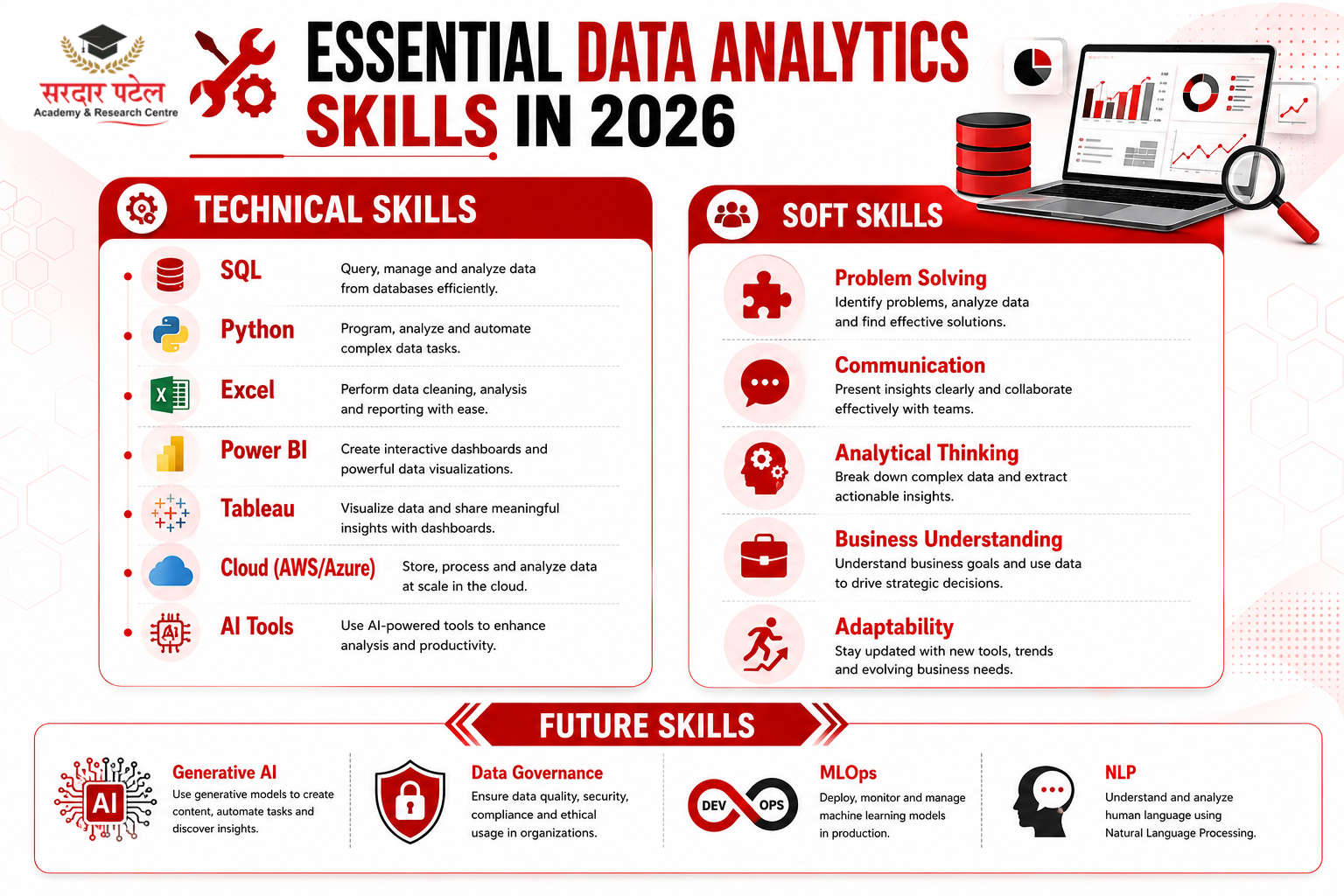
- SQL — The non-negotiable foundation of every data analytics role in India. Learn this first.
- Python — The most versatile language for data analytics, machine learning, and automation. Bridges analytics with AI.
- Power BI / Tableau — Data visualisation tools that turn complex datasets into business-ready insights. Essential for most analytics roles.
- Excel / Google Sheets — Still widely used, especially in BFSI and consulting analytics.
- R — Valued in statistical modelling and academic research roles.
- Cloud Platforms (AWS, Azure, GCP) Growing in importance as Indian enterprises shift to cloud-based data infrastructure. Data analytics tools you must know
To stay ahead in this fast-changing industry, explore the AI Tools Every Data Analyst Should Know and learn which technologies, AI tools, and skills employers are prioritizing.
Emerging Skills for the Analytics Career Future Through 2030
- Generative AI integration — Analysts who use AI tools to accelerate their workflows already command salary premiums.
- Data governance and privacy — As India's data protection laws evolve, this becomes a core analytics competency.
- MLOps — The discipline of deploying and maintaining machine learning models at scale.
- Natural Language Processing (NLP) is increasingly used in customer analytics and product development.
Soft Skills That Still Define Great Analysts
The World Economic Forum's Future of Jobs Report 2025 flagged these as the most critical workplace skills for data professionals going forward:
- Analytical thinking and structured problem-solving
- Resilience and adaptability to changing tools and methods
- Business communication — explaining data insights clearly to non-technical stakeholders
- Stakeholder management and the ability to drive decisions with data
No analytics tool — AI or otherwise — replaces the ability to walk into a boardroom and get a team to act on data. That remains entirely human.
Top Cities for Data Analytics Jobs in India
Geography still influences both salary levels and the volume of available opportunities.
Tier 1 Cities — Highest Demand and Pay:
- Bengaluru — India's undisputed analytics capital. Highest salaries, widest range of data analytics roles.
- Hyderabad — Growing fast with major tech, pharma, and BFSI analytics hiring.
- Mumbai — Strong in BFSI, media, and consulting analytics.
- Delhi NCR — Government, consulting, and IT analytics hub.
Planning to start your career in the capital region? Explore our list of Latest SQL Trends for Data Analysts to discover where freshers and experienced professionals are finding opportunities.
- Pune — Strong IT and engineering analytics base with competitive packages.
- Tier 2 Cities — Rising Fast: Cities like Jaipur, Indore, Coimbatore, and Ahmedabad are seeing a rise in analytics startups and regional training centres. Remote work has made it genuinely possible for professionals in these cities to work for Bengaluru or Mumbai-based companies without relocating — a major shift in the data analytics job market in India.
Challenges Honest Enough to Mention
No authority report covers only the upside. Here are the real challenges in India's analytics job market.
Talent-skills mismatch: Many graduates enter the market with theoretical knowledge but no practical, project-based experience. Employers consistently flag this as the biggest hiring bottleneck.
Fast-changing tools: The data analytics technology stack evolves every 18–24 months. A professional who stops learning risks becoming outdated faster than in most other fields.
Credential inflation: As more people pursue analytics certifications, a certificate alone no longer differentiates you. Employers are getting sharper at testing for actual capability rather than just credentials.
AI automation of routine tasks: Basic data cleaning and standard report generation are increasingly being automated. Analysts who stay at the routine end of the skill spectrum face the most career risk going forward.
The solution to all four challenges is consistent: practical, project-based learning that keeps pace with the market.
How to Build a Winning Data Analytics Career in India: Step-by-Step Roadmap
This roadmap works for both freshers entering the field and mid-career professionals making the switch.
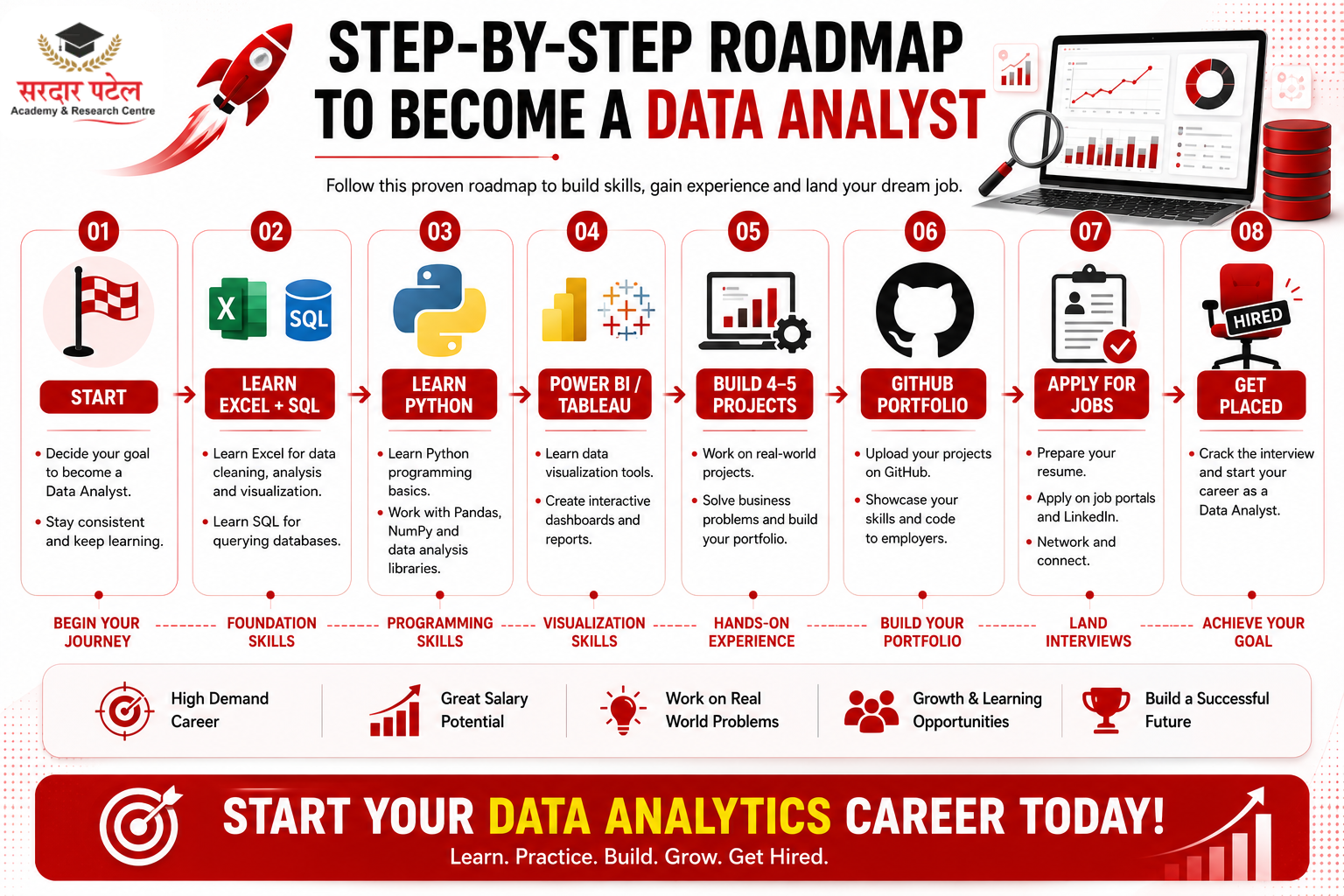
Step 1 — Build the foundation (0–3 months). Start with SQL and Excel. These two skills alone open the door to entry-level interviews for most data analytics roles in India. Use free resources — SQLZoo, W3Schools, and HackerRank SQL are good starting points.
Step 2 — Add Python (3–6 months). Learn Pandas, NumPy, and Matplotlib. Complete at least two real projects using public datasets from Kaggle or the Government of India open data portal. Python is the skill that most directly elevates your data analytics salary in India.
Step 3 — Learn a visualisation tool (parallel track). Pick Power BI or Tableau. Build three dashboards and add them to a portfolio. The Microsoft PL-300 (Power BI) and Tableau Desktop Specialist certifications are recognised across most Indian analytics hiring teams.
Step 4 — Build a portfolio (6–9 months). Create 4–5 end-to-end analytics projects. Host them on GitHub with clear documentation. This is the single most important differentiator for freshers and career switchers in India's analytics job market
Step 5 — Apply strategically to target product-based companies and mid-sized startups where you'll get broader exposure across the analytics stack. Avoid limiting yourself to IT service roles where the work can be narrow.
Step 6 — Keep learning continuously. Once employed, deepen your Python skills, explore the basics of machine learning, and stay current with generative AI tools. The professionals who will lead data analytics teams in India in 2030 are the ones who never stopped learning in 2025 and 2026. Data analytics course eligibility and career opportunities
At Sardar Patel Academy & Research Centre (SPARC) in GTB Nagar, Delhi, our data analytics program is specifically designed to prepare students for the roles and skills described in this guide — from SQL and Power BI to Python and real-world projects.
📞 +91 93129-66129 | 📍 GTB Nagar, North Delhi
Start Your Analytics Career Path
You don't need a perfect background. You need the right skills, a strong portfolio, and a clear plan.
Your first move:
- Learn SQL this week — it's free, and it's the foundation of every data analytics role in India.
- Enrol in our Data Analytics Course, which includes hands-on projects, Excel, SQL, Power BI, Tableau, Python, and placement support to help you become job-ready.
- Build one complete project using a public dataset and publish it on GitHub.
- Start applying — even before you feel fully ready.
The best time to build your data analytics career in India was five years ago. The second-best time is today.
Ready to build a successful career in data analytics? Visit SPARC to explore our industry-focused training programs, upcoming batches, and placement support that can help you become job-ready
References:
[1] Grand View Research — India Data Analytics Market Size & Outlook, 2025–2030 (January 2026)
[2] NASSCOM — Analytics Sector Report: Jobs & Talent Demand India 2025
[3] Coursera — 7 In-Demand Data Analyst Skills to Get You Hired (December 2025)
[4] World Economic Forum — Future of Jobs Report 2025
[5] Indeed India — Data Analyst Salary in India, Updated 2026
[6] Glassdoor India — Data Analyst Salary Benchmarks 2026
[7] Amity Online — Data Analyst Salary in India: An Updated Guide for 2026 (May 2026)
[8] SkillsetMaster — Data Analytics Salary in India 2026: Fresher to Senior (March 2026)
Conclusion
The future of data analytics jobs in India is unfolding at speed — and the window to get ahead of this curve is open right now.
India's data analytics market is scaling from USD 3.5 billion in 2024 to over USD 21 billion by 2030. More than 1.5 million data analytics jobs in India are projected by the end of 2026. A talent shortage that shows no signs of closing means salaries continue to rise year on year. And an analytics career future that runs through AI, governance, predictive modelling, and real-time business intelligence offers professionals decades of relevance — not just a few good years.
But opportunity doesn't wait. The professionals building skills today — SQL, Python, Power BI, and the business judgment to use them well — are the ones who will lead analytics teams in 2030.
India has a genuine window right now. The data economy is growing faster than talent can keep up. That gap is your opening.
FAQs
Yes — it's one of the strongest career choices available in 2026. Demand significantly outpaces supply across every major sector. NASSCOM projects a shortage of over 200,000 data analytics professionals, which means the Indian job market strongly favours skilled, trained candidates. Entry-level salaries are competitive, and the growth trajectory is consistent through at least 2030.
No. Professionals from commerce, arts, business, and non-CS engineering backgrounds transition into data analytics roles in India every day. What matters is your demonstrated skill with tools like SQL, Python, and Power BI — along with practical project experience. Background matters far less than capability.
Most freshers earn between ₹3.5 LPA and ₹6 LPA. With strong Python and SQL skills and a well-built project portfolio, starting at ₹6–8 LPA at product-based companies in Bengaluru or Hyderabad is realistic. The fresher salary range in India's analytics job market has improved noticeably over the past three years.
Not the skilled ones — and here's why. AI is automating routine, repetitive tasks like basic report generation, simple data cleaning, and templated dashboards. But AI cannot frame the right business problem, interpret ambiguous or conflicting data in context, or walk into a leadership meeting and persuade a team to change strategy based on findings. For example, when Zomato or PhonePe make a major product call, they're not relying on an automated report — they need an analyst who understands the business deeply enough to ask the right questions of the data. Analysts who learn to work with AI tools will actually become more valuable, not less. The risk is only for those who stay at the most routine end of the skill spectrum and don't adapt.
BFSI, e-commerce, and product-based tech companies pay the most. Senior analytics roles at companies like PhonePe, Razorpay, Meesho, and top BFSI firms regularly command ₹20–40 LPA. Healthcare and pharma analytics are also seeing strong salary growth as the sector digitises rapidly.
With structured learning and consistent project-based practice, most people become job-ready in 4–8 months. A practical approach — where you build real projects alongside learning — accelerates timelines far more than theory-only classroom programmes.
Very strong. India's data analytics market is projected to reach USD 21 billion by 2030 at a CAGR of 35.8%. New roles in AI governance, MLOps, and data ethics will emerge alongside traditional analyst positions. Companies across BFSI, healthcare, e-commerce, and government are all increasing their analytics headcount. Professionals who upskill continuously will find that a data analytics career in India offers genuine long-term stability and growth.