+91 9312966129
 sparc.enquiry01@gmail.com


Can I Get a Job After Data Analytics Course?
Wondering if you can get a job after a data analytics course? Learn required skills, salary expectations, interview tips, and placement support for 2026.

Table of Contents
- In This Guide
- Is It Possible to Get a Job After a Data Analytics Course?
- Why Data Analytics Professionals Are in Demand
- Industries Hiring Data Analysts
- What Skills Are Required to Get a Job After a Data Analytics Course?
- What Kind of Jobs Can You Get After a Data Analytics Course?
- Data Analyst
- Business Analyst
- Reporting Analyst / MIS Executive
- Data Visualization Specialist
- Junior Analytics Associate
- Average Salary After a Data Analytics Course
- Analytics Placement After Training: What Does It Really Mean?
- Why Practical Training Improves Placement Chances
- What Recruiters Look for During Analytics Interviews
- Technical Skills
- Project Experience
- Communication Skills
- Analytical Thinking
- Is Placement Guaranteed After an Analytics Course?
- Placement Assistance vs. Guaranteed Placement — Know the Difference
- Common Mistakes That Prevent Students from Getting Jobs
- 1. Focusing Only on Certificates
- 2. Not Working on Real Projects
- 3. Weak SQL Skills
- 4. Poor Dashboard Portfolio
- 5. Ignoring Interview Preparation
- 6. Incomplete LinkedIn Profile
- 7. Applying Without Customizing the Resume
- 8. Lack of Consistency After Course Completion
- How SPARC Supports Students for Analytics Placements
- Career Support Includes:
- What Should You Do After Completing a Data Analytics Course?
- Build a Strong Portfolio
- Practice Interview Questions Regularly
- Optimize Your LinkedIn Profile
- Continue Learning
- Apply Consistently
- Why Choose SPARC?
- Conclusion
One of the most common questions students ask before joining a training program is:
"Can I get a job after a Data Analytics course?"
The short answer is yes — but your success depends on the skills you develop, the projects you complete, and how well you prepare for interviews.
Data Analytics continues to be one of the fastest-growing career fields in India. Organizations across industries are investing heavily in data-driven decision-making, creating strong demand for professionals who can collect, analyse, and interpret business data. Before enrolling, many students also want to know — What Tools Will I Learn in a Data Analytics Course?— a question we answer in full detail.
Whether you are a student, graduate, working professional, or career switcher, a structured Data Analytics course can help you build job-ready skills and enter the analytics industry. If you are looking for the right program, explore the Best Data Analytics Course in Delhi with Placement to find a training program that matches your career goals.
Is It Possible to Get a Job After a Data Analytics Course?
Absolutely.
Thousands of professionals successfully transition into analytics careers every year after completing practical training programs.
However, employers rarely hire candidates based on certificates alone. Recruiters generally evaluate:
✔ Practical Skills
✔ Project Experience
✔ Problem-Solving Ability
✔ Communication Skills
✔ Knowledge of Analytics Tools
✔ Interview Performance
This is why practical learning and industry projects are often more valuable than theoretical knowledge alone. If you want structured guidance on clearing the hiring process, read our detailed guide on SQL Interview Questions for Freshers — it covers technical rounds, HR rounds, and common questions in detail
Why Data Analytics Professionals Are in Demand
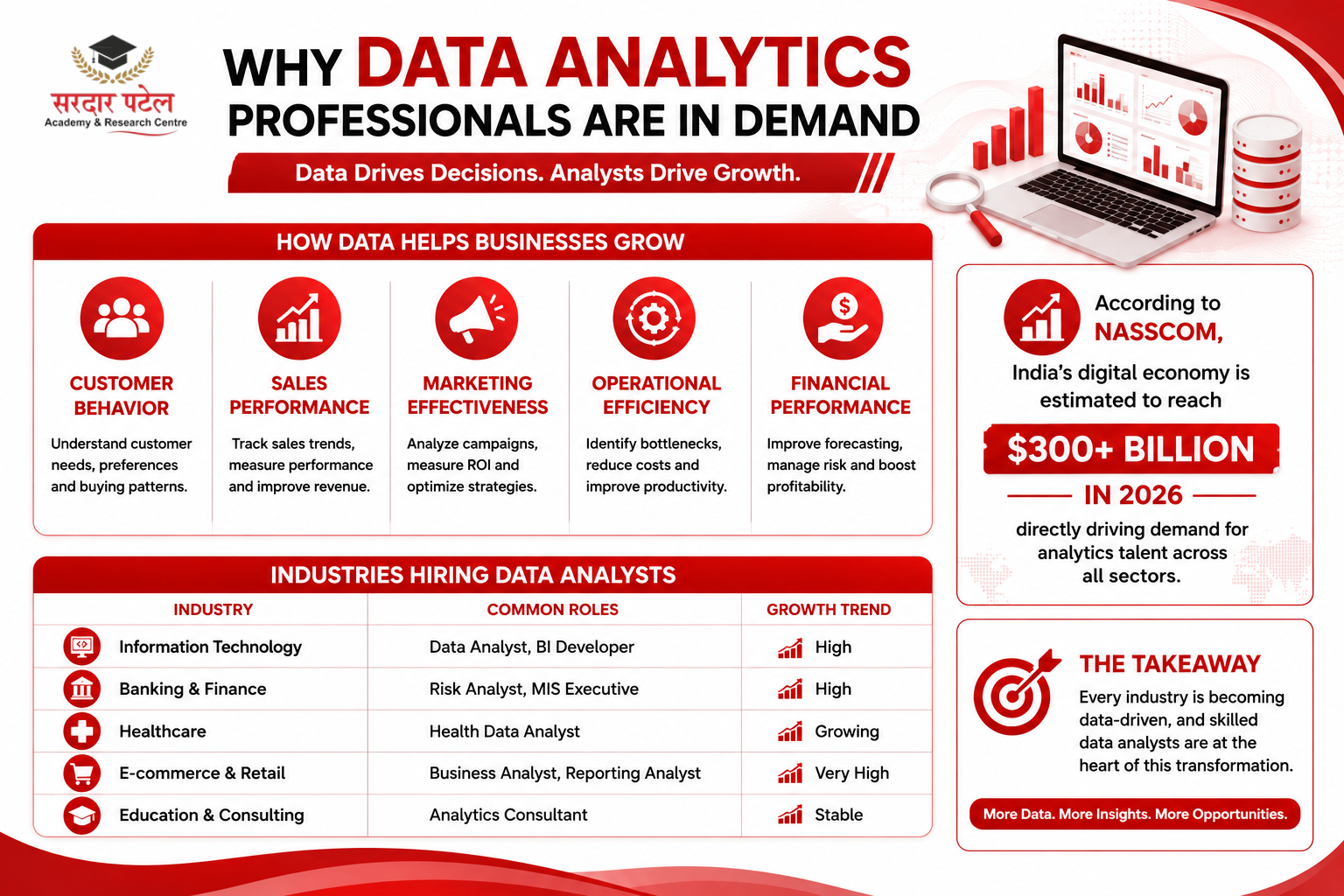
Businesses generate massive amounts of data every day. This data helps companies understand:
• Customer behavior
• Sales performance
• Marketing effectiveness
• Operational efficiency
• Financial performance
To make sense of this information, organizations need skilled analysts. According to NASSCOM, India's digital economy is estimated to reach $300+ billion in 2026, directly driving demand for analytics talent across all sectors.
Industries Hiring Data Analysts
| Industry | Common Roles | Growth Trend |
| Information Technology | Data Analyst, BI Developer | High |
| Banking & Finance | Risk Analyst, MIS Executive | High |
| Healthcare | Health Data Analyst | Growing |
| E-commerce & Retail | Business Analyst, Reporting Analyst | Very High |
| Education & Consulting | Analytics Consultant | Stable |
What Skills Are Required to Get a Job After a Data Analytics Course?
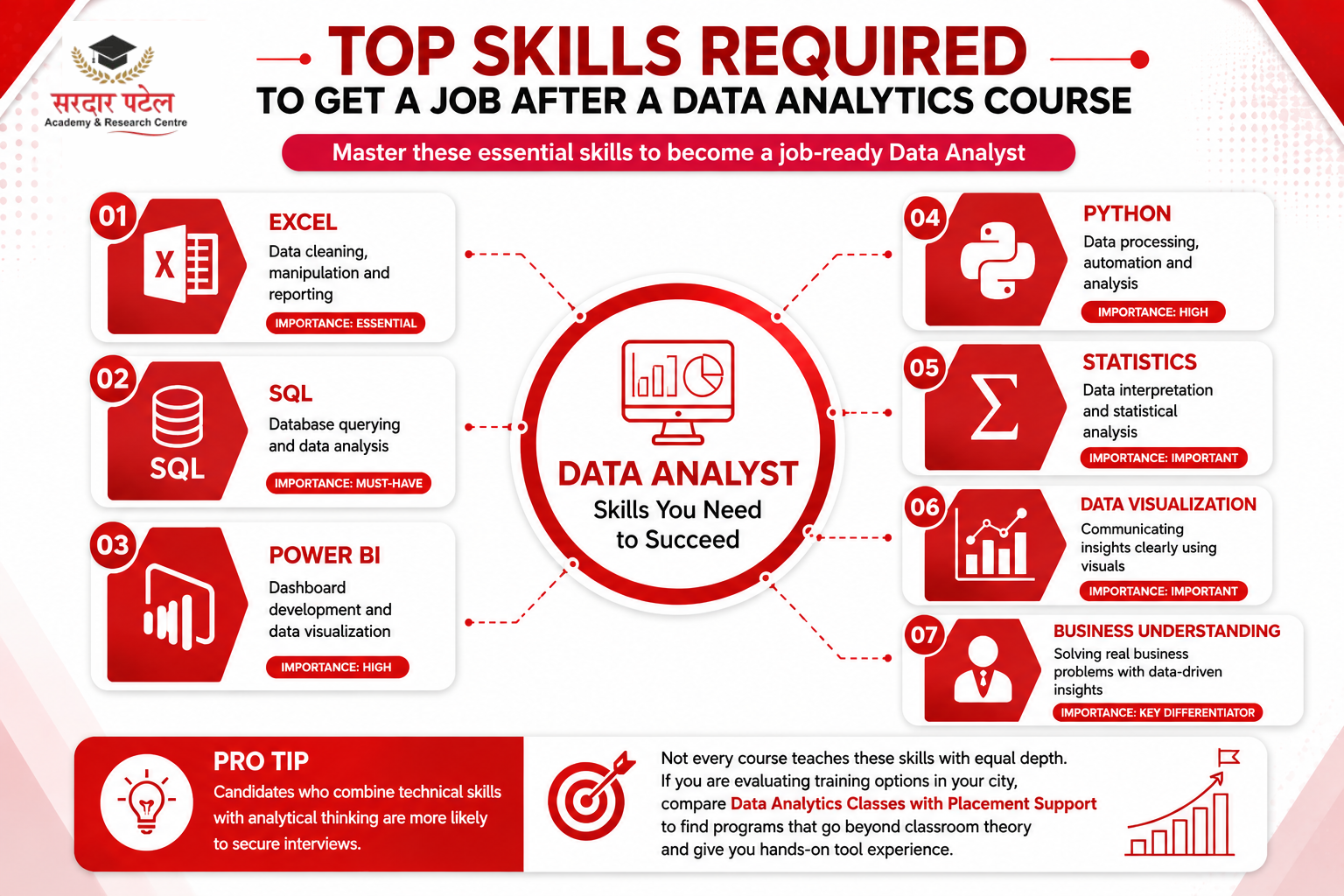
Completing a course is only the first step. Students should focus on building practical proficiency in the following areas:
| Skill | What It Covers | Importance |
| Excel | Data cleaning and reporting | Essential |
| SQL | Database querying and analysis | Must-Have |
| Power BI | Dashboard development | High |
| Python | Data processing and automation | High |
| Statistics | Data interpretation | Important |
| Data Visualization | Communicating insights clearly | Important |
| Business Understanding | Solving real business problems | Key Differentiator |
Pro Tip: Candidates who combine technical skills with analytical thinking are more likely to secure interviews.
Not every course teaches these skills with equal depth. If you are evaluating training options in your city, compare Data Analytics Classes with Placement Support to find programs that go beyond classroom theory and give you hands-on tool experience.
What Kind of Jobs Can You Get After a Data Analytics Course?
A Data Analytics course can open doors to multiple entry-level opportunities:
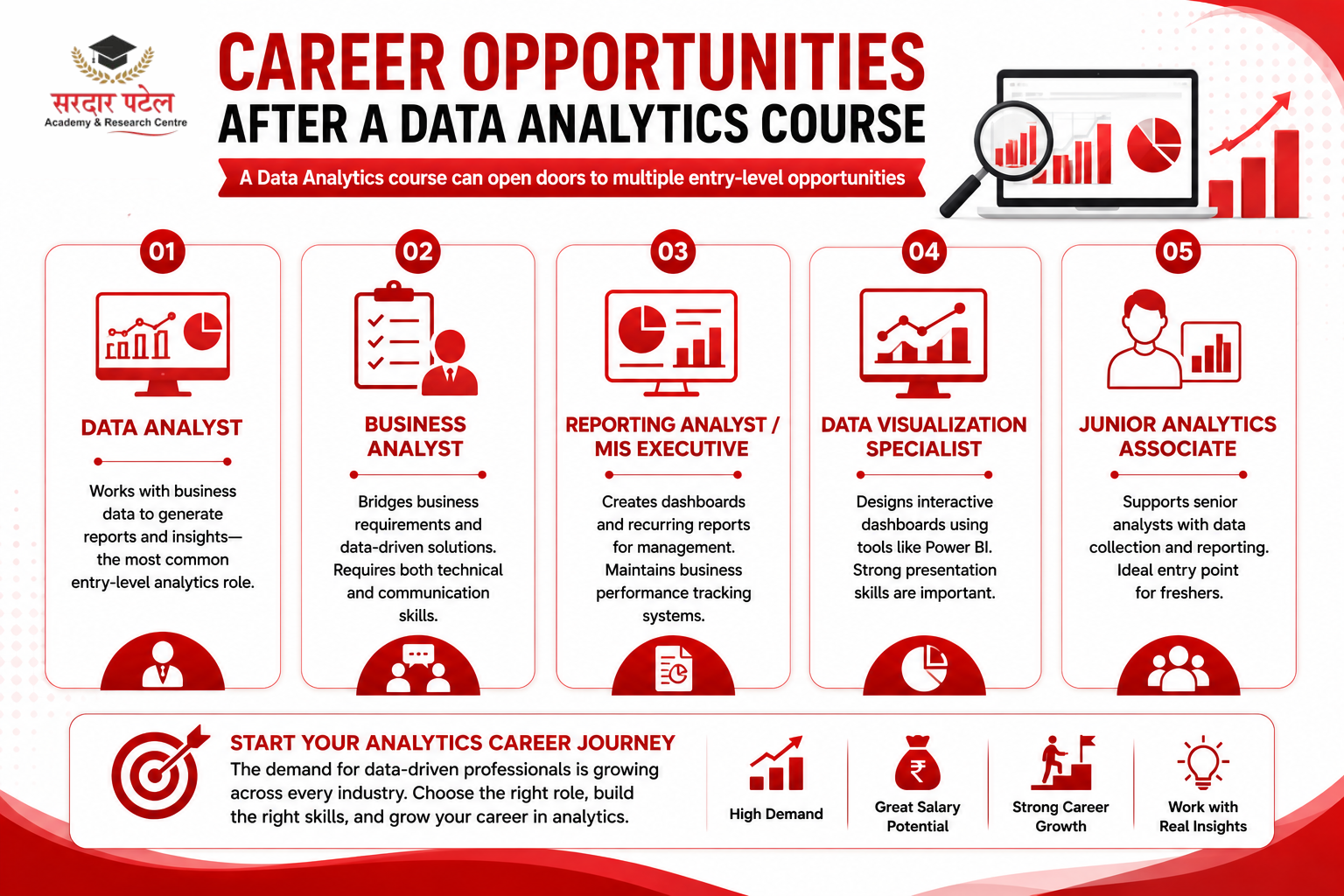
Data Analyst
Works with business data to generate reports and insights—the most common entry-level analytics role.
Business Analyst
Bridges business requirements and data-driven solutions. Requires both technical and communication skills.
Reporting Analyst / MIS Executive
Creates dashboards and recurring reports for management. Maintains business performance tracking systems.
Data Visualization Specialist
Designs interactive dashboards using tools like Power BI. Strong presentation skills are important.
Junior Analytics Associate
Supports senior analysts with data collection and reporting. Ideal entry point for freshers.
Average Salary After a Data Analytics Course
Salary depends on multiple factors, including skills, projects, certifications, company size, location, and interview performance.
| Experience Level | Average Annual Salary | Key Growth Factors |
| Fresher (0–1 Year) | Rs. 3.5 – Rs. 6 LPA | Skills + Portfolio |
| Junior Analyst (1–3 Years) | Rs. 5 – Rs. 8 LPA | Domain Knowledge |
| Mid-Level Analyst (3–5 Years) | Rs. 8 – Rs. 15 LPA | Leadership + Tools |
| Senior Analyst (5+ Years) | Rs. 15 LPA+ | Strategy + Mentoring |
Note: These figures are approximate and may vary depending on market conditions and employer requirements. Source: Indeed India Salary Data, 2025-26.
Analytics Placement After Training: What Does It Really Mean?
Many students misunderstand placement support. Placement assistance does not mean automatic employment.
Instead, placement-oriented institutes help students through:
✔ Resume Building — Creating ATS-friendly resumes that highlight skills and projects
✔ LinkedIn Profile Optimization — Enhancing professional visibility to recruiters
✔ Mock Interviews — Practicing technical and HR rounds in a simulated environment
✔ Aptitude Preparation — Preparing for company aptitude and reasoning tests
✔ Portfolio Development — Building real projects to showcase during interviews
✔ Employer Referrals — Introductions through industry connections
The goal is to improve employability and help students perform better during hiring processes.
Why Practical Training Improves Placement Chances
Employers prefer candidates who can demonstrate real-world skills. Key benefits of practical training include:
✔ Hands-on experience with real datasets
✔ Industry project exposure
✔ Stronger problem-solving ability
✔ A compelling portfolio to show recruiters
✔ Greater interview confidence
✔ Deeper technical understanding
Students who work on live projects can explain business scenarios more effectively during interviews.
What Recruiters Look for During Analytics Interviews
Recruiters typically evaluate much more than technical knowledge alone:
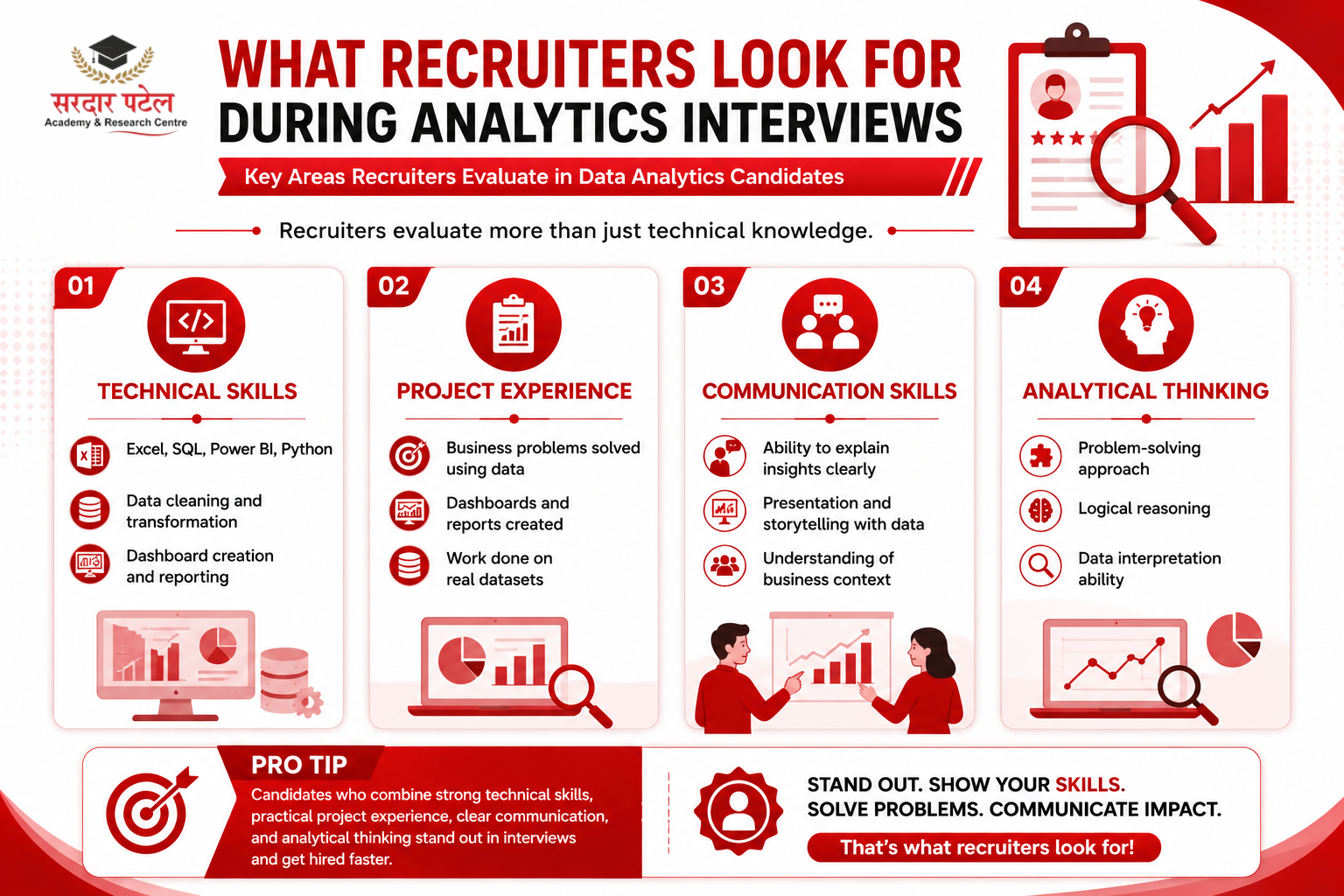
Technical Skills
• Excel, SQL, Power BI, Python
• Data cleaning and transformation
• Dashboard creation and reporting
Project Experience
• Business problems solved using data
• Dashboards and reports created
• Work done on real datasets
Communication Skills
• Ability to explain insights clearly
• Presentation and storytelling with data
• Understanding of business context
Analytical Thinking
• Problem-solving approach
• Logical reasoning
• Data interpretation ability
Is Placement Guaranteed After an Analytics Course?
One of the most frequently asked questions by students is:
Before choosing any institute, it is important to understand Is Placement Guaranteed After Analytics Course and how placement assistance differs from actual job guarantees.
"Will I definitely get a job after completing a Data Analytics course?"
The honest answer is that no training institute can legally guarantee a job. Hiring decisions are ultimately made by employers based on a candidate's skills, project experience, interview performance, and overall suitability for a role.
However, a quality institute can significantly improve your chances of getting hired by providing practical training, live project experience, industry-relevant skills, resume support, mock interviews, and employer connections.
Placement Assistance vs. Guaranteed Placement — Know the Difference
| Feature | Placement Assistance | Guaranteed Placement |
| Resume Support | Yes | Yes |
| Mock Interviews | Yes | Yes |
| Career Guidance | Yes | Yes |
| Job Referrals | Yes | Yes |
| Direct Job Guarantee | No | Claimed by Some Institutes |
| Final Hiring Decision | Made by Employer | Made by Employer |
| Student Skill Requirement | Essential | Essential |
Reality Check: Placement support can improve your opportunities, but your skills and interview performance ultimately determine the outcome.
Common Mistakes That Prevent Students from Getting Jobs
Many students complete a Data Analytics course but still struggle to secure interviews or job offers. In most cases, the issue is not a lack of opportunities but avoidable mistakes:
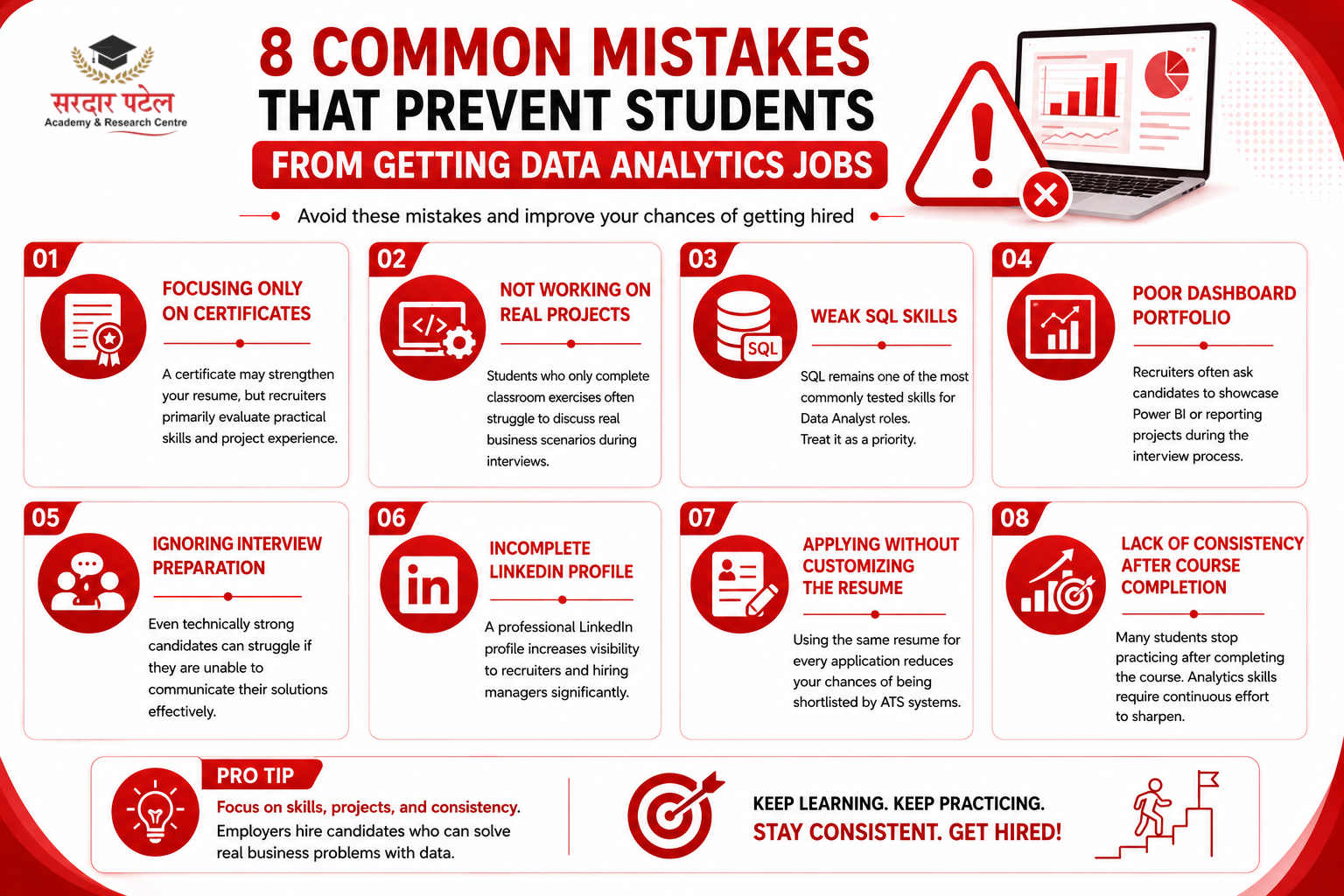
1. Focusing Only on Certificates
A certificate may strengthen your resume, but recruiters primarily evaluate practical skills and project experience.
2. Not Working on Real Projects
Students who only complete classroom exercises often struggle to discuss real business scenarios during interviews.
3. Weak SQL Skills
SQL remains one of the most commonly tested skills for Data Analyst roles. Treat it as a priority.
4. Poor Dashboard Portfolio
Recruiters often ask candidates to showcase Power BI or reporting projects during the interview process.
5. Ignoring Interview Preparation
Even technically strong candidates can struggle if they are unable to communicate their solutions effectively.
6. Incomplete LinkedIn Profile
A professional LinkedIn profile increases visibility to recruiters and hiring managers significantly.
7. Applying Without Customizing the Resume
Using the same resume for every application reduces your chances of being shortlisted by ATS systems.
8. Lack of Consistency After Course Completion
Many students stop practicing after completing the course. Analytics skills require continuous effort to sharpen.
How SPARC Supports Students for Analytics Placements
At SPARC (Sardar Patel Academy & Research Center), the focus goes beyond classroom learning. The goal is to help students become job-ready through practical training and structured career preparation.
Career Support Includes:
✔ Resume Building Assistance — ATS-friendly resumes that highlight skills and project work
✔ LinkedIn Profile Optimization — Professional profile enhancement for better recruiter visibility
✔ Mock Interviews — Technical and HR interview practice in a simulated environment
✔ Project Portfolio Development — Industry-relevant projects to showcase during interviews
✔ Career Guidance — Individual counseling sessions to identify suitable career paths
✔ Placement Assistance — Interview opportunities and support through industry connections
What Should You Do After Completing a Data Analytics Course?
To maximize your chances of getting hired:
Build a Strong Portfolio
Include dashboards, SQL projects, and analytics case studies. Aim to complete at least 3–5 practical projects before applying.
Practice Interview Questions Regularly
Revise technical concepts and be ready to walk through your project explanations step by step.
Optimize Your LinkedIn Profile
Showcase certifications, projects, and achievements. Recruiters actively search LinkedIn for analytics candidates.
Continue Learning
Stay updated with new analytics tools and industry trends. Follow analytics communities and blogs.
Apply Consistently
Job searching is a process. Consistency and follow-through often lead to better results over time.
Start Job-Ready Training Today
Want to build practical skills that employers actually look for?
At Sardar Patel Academy & Research Center (SPARC), students learn through hands-on training, real-world projects, and career-focused guidance designed to improve employability.
Why Choose SPARC?
✔ Excel, SQL, Power BI & Python Training
✔ Live Industry Projects
✔ Practical Assignments
✔ Resume Building Support
✔ LinkedIn Profile Optimization
✔ Mock Interview Preparation
✔ Placement Assistance
✔ Expert Mentorship
✔ Flexible Weekday & Weekend Batches
Phone: +91 93129-66129
Email: admissions@sparc.org.in
Website: https://sparc.org.in
Conclusion
So, can you get a job after a Data Analytics course?
The answer is yes — provided you focus on developing practical skills, completing real-world projects, building a strong portfolio, and preparing effectively for interviews.
While no institute can guarantee employment, quality training combined with consistent effort can significantly improve your chances of launching a successful analytics career.
A structured program that includes practical learning, live projects, interview preparation, and placement assistance can help bridge the gap between learning and employment.
If your goal is to become a confident, job-ready Data Analyst, investing in practical training is one of the smartest career decisions you can make.
FAQs
Yes. Students with practical skills, project experience, and interview preparation can qualify for entry-level analytics roles.
No institute can guarantee employment because hiring decisions are made by employers. However, placement assistance can significantly improve your chances.
It refers to career support services such as resume building, interview preparation, referrals, and job assistance provided by the institute.
Excel, SQL, Power BI, Python, statistics, data visualization, and communication skills are highly valued by employers.
Most recruiters prefer candidates who can demonstrate 3–5 practical projects with real-world business context.
Yes. Many organizations hire freshers for entry-level analytics positions, especially those with a strong portfolio.
SQL is one of the most commonly required skills for Data Analyst roles and is highly recommended for every candidate.
Certifications help, but practical skills and project experience often carry more weight during the hiring process.
Most students become job-ready within 4–8 months, depending on the quality of training and consistent practice.
Yes. Students from commerce, arts, management, and science backgrounds can successfully transition into analytics careers.
Freshers typically earn between Rs. 3.5 LPA and Rs. 6 LPA depending on skills, portfolio, and company requirements.
IT, Banking, Finance, Healthcare, Retail, E-commerce, Logistics, Manufacturing, and Consulting firms actively hire analytics professionals.
Yes. Live projects help students build portfolios and discuss practical business scenarios confidently during interviews.
Yes. SPARC provides resume support, mock interviews, career guidance, and placement assistance for eligible students.
Dashboards, SQL projects, Excel reports, business case studies, and Power BI visualizations are valuable portfolio additions.
Yes. The demand for analytics professionals continues to grow across multiple industries, with strong salary growth.
Yes. Many professionals transition successfully into analytics roles through structured training programs.
Data Analytics focuses on extracting insights from data, while Business Analytics focuses on applying those insights to business decision-making.