+91 9312966129
 sparc.enquiry01@gmail.com


Best Data Analytics Course in Delhi with Placement: A Complete Career Guide
Looking for the best data analytics course in Delhi with placement? Sardar Patel Academy & Research Centre, GTB Nagar offers hands-on training in Excel, SQL, Python, and Power BI with live projects, top certifications, and dedicated job placement support.
Table of Contents
- Why Data Analytics Is One of the Fastest-Growing Career Fields in 2026
- What Is Data Analytics?
- 1. Data Collection
- 2. Data Cleaning
- 3. Data Analysis
- 4. Data Visualisation
- 5. Business Recommendations
- Is Data Analytics the Right Career Choice for You?
- Fresh Graduates
- Working Professionals
- Entrepreneurs
- Career Switchers
- Skills You Learn in the Best Data Analytics Course in Delhi
- Microsoft Excel
- SQL (Structured Query Language)
- Python for Data Analytics
- Power BI
- Statistics and Analytical Thinking
- Data Visualisation and Storytelling
- Top Data Analytics Certifications to Strengthen Your Resume
- 1. Google Data Analytics Professional Certificate
- 2. Microsoft Power BI Data Analyst Associate (PL-300)
- 3. Tableau Desktop Specialist
- 4. IBM Data Analyst Professional Certificate
- 5. Microsoft Azure Data Fundamentals (DP-900)
- Data Analytics vs Data Science: Which Career Is Better in 2026?
- Career Opportunities After Completing Data Analytics Training
- Data Analyst
- Business Analyst
- Reporting Analyst
- MIS Executive (Management Information Systems)
- Data Visualisation Specialist
- Junior Data Scientist
- Data Analytics Salary in Delhi NCR: What to Expect in 2026
- Why Delhi Is an Ideal City for Data Analytics Training and Career Growth
- One of India's Strongest Job Markets
- Thriving Startup Ecosystem
- Networking and Industry Events
- Internship Availability
- How to Choose the Right Data Analytics Institute in Delhi
- 1. Industry-Relevant, Updated Curriculum
- 2. Experienced, Active Industry Trainers
- 3. Live Projects on Real Businesses
- 4. Small, Manageable Batch Sizes
- 5. Genuine Placement Assistance
- 6. Recognised Certifications
- 7. Verifiable Alumni Reviews
- Why Sardar Patel Academy & Research Centre Is Delhi's Preferred Analytics Training Institute
- Related Courses and Resources at Sardar Patel Academy & Research Centre
- Benefits of Learning Data Analytics in 2026
- Ready to Take the Next Step in Data Analytics?
Best Data Analytics Course in Delhi with Placement: A Complete Career Guide for 2026
Priya had just completed her B.Com degree from Delhi University. She spent three months sending job applications every single day — to banking, finance, and accounting firms. The replies were either rejections or complete silence. Most companies wanted candidates who could work with data, build reports, and extract insights. A degree alone was no longer enough.
That's when a friend suggested she look into data analytics. Within five months of structured training at Sardar Patel Academy & Research Centre in GTB Nagar, Priya had learned Excel, SQL, Python, and Power BI. She built three portfolio projects, earned two certifications, and landed a Junior Data Analyst role at a Delhi-based e-commerce firm with a starting package of ₹4.2 LPA.
Her story is not unusual. Across Delhi NCR, students and working professionals are discovering that data analytics skills are among the most practical and in-demand qualifications in today's job market — and that the right training institute can make all the difference.
For a deeper comparison of training providers, facilities, certifications, and placement support, check our guide on How to Choose the Right Data Analytics Institute in Delhi.
Why Data Analytics Is One of the Fastest-Growing Career Fields in 2026
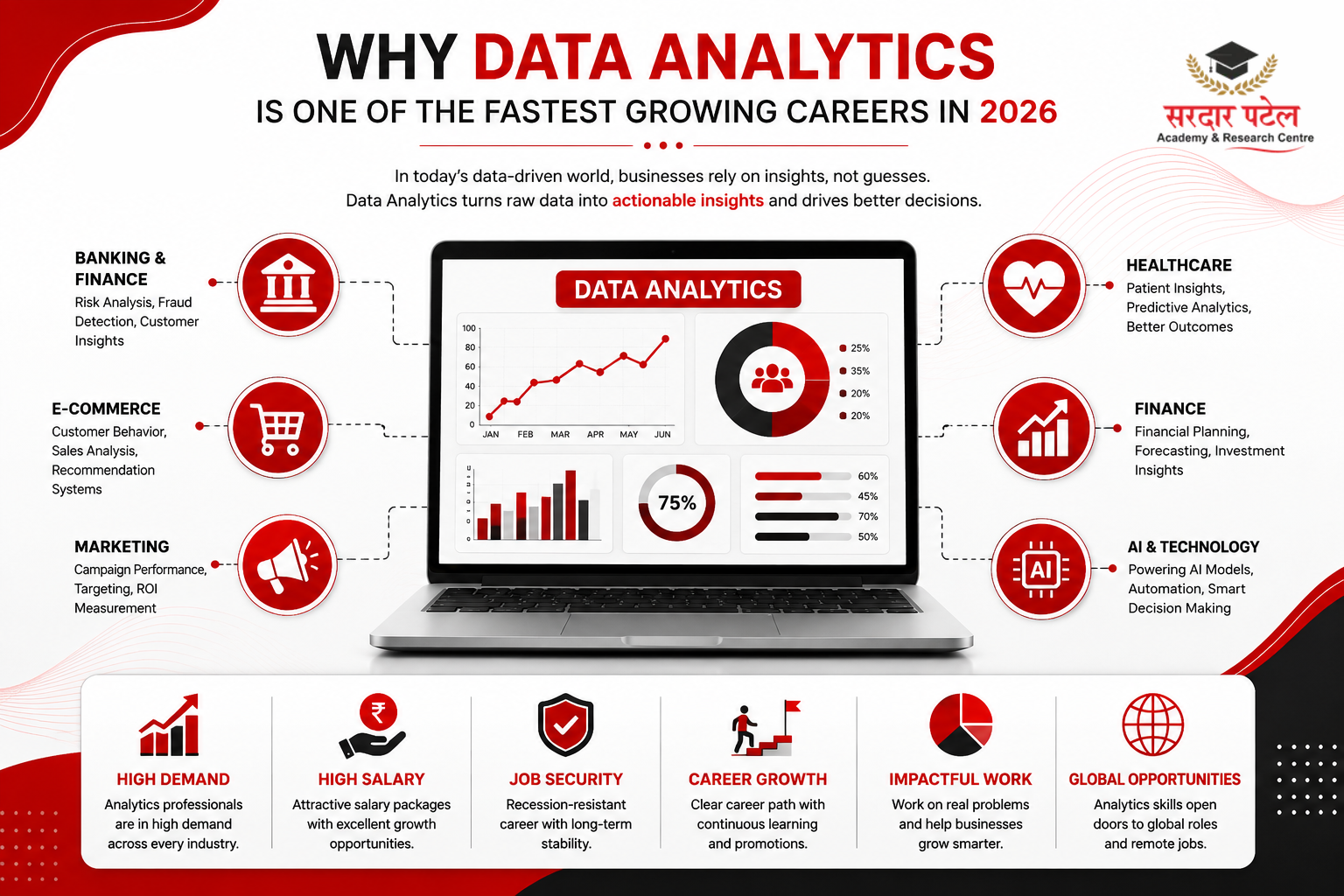
Imagine running a business without understanding your customers, tracking your sales trends, or measuring your marketing performance. Without access to meaningful insights, businesses make guesses instead of decisions — and that is an expensive habit in a competitive market.
Data analytics solves this challenge. It helps organisations turn raw numbers into clear, actionable information. This is why companies across every industry are actively hiring professionals who can collect, clean, analyse, and visualise data.
Across India, the demand for trained analytics professionals is growing rapidly — driven by digital transformation in banking, healthcare, e-commerce, and government sectors. Industry projections from NASSCOM and IDC suggest that India's analytics and data science market will continue expanding significantly through 2027, creating hundreds of thousands of new roles for skilled candidates.
The specific benefits data analytics brings to organisations include:
- Understanding customer behaviour and purchase patterns
- Improving overall business performance through data-driven decisions
- Identifying new growth opportunities before competitors do
- Reducing operational costs through process analysis
- Predicting future trends and preparing for market changes
- Measuring the effectiveness of marketing campaigns and sales strategies
What Is Data Analytics?
Data analytics is the process of collecting, organising, analysing, and interpreting data to uncover useful insights that guide better business decisions.
New to the field? Start with our What Is Data Analytics? Beginner's Guide to understanding the fundamentals before exploring advanced career opportunities.
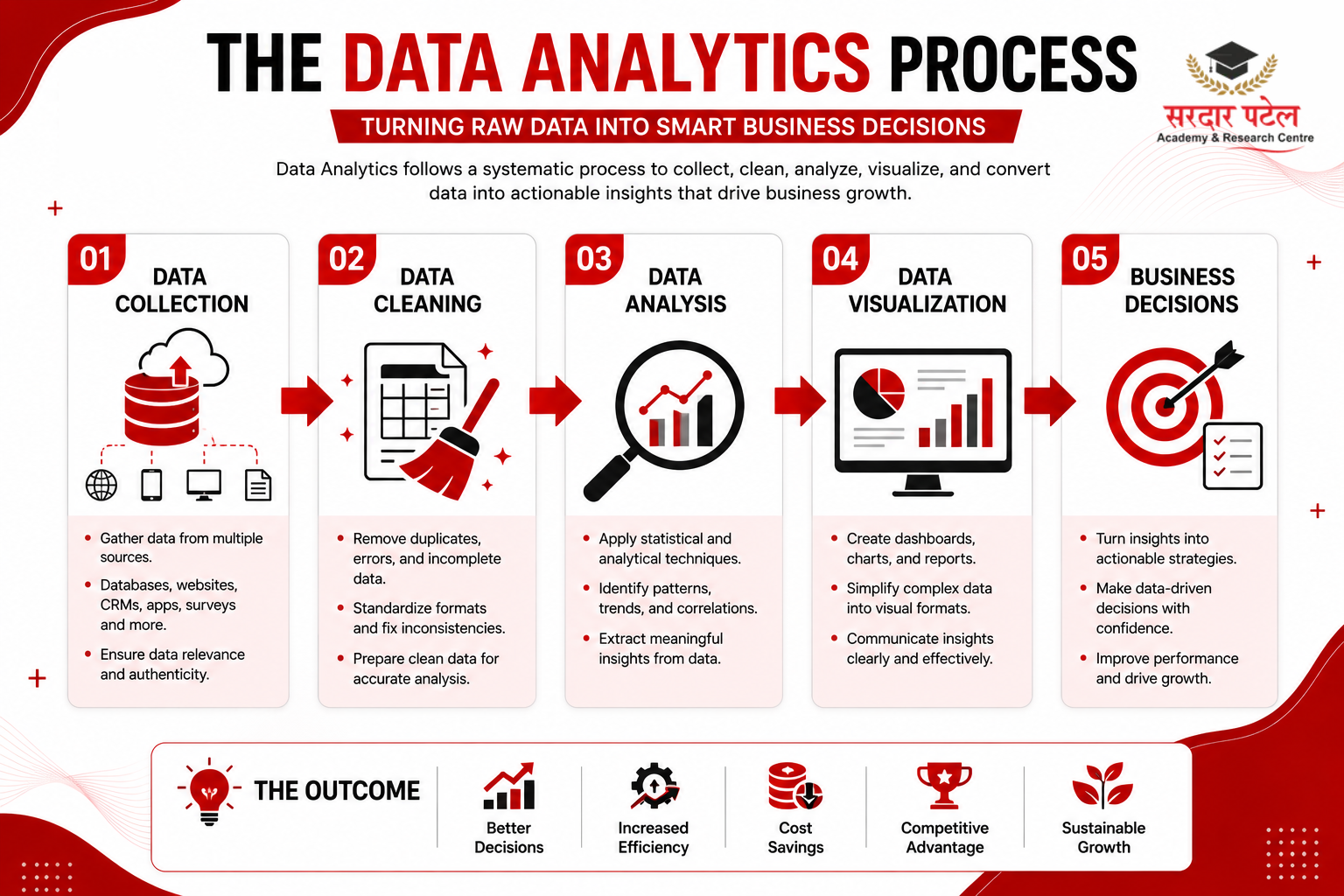
A data analyst takes raw, unstructured information and transforms it into clear findings that non-technical stakeholders can understand and act upon. The process follows a consistent workflow:
1. Data Collection
Gathering information from multiple sources, including websites, databases, CRM systems, mobile applications, and customer surveys.
2. Data Cleaning
Identifying and removing duplicate, incomplete, or incorrect entries to ensure the dataset is reliable and ready for analysis.
3. Data Analysis
Applying statistical and analytical techniques to identify trends, patterns, and correlations within the cleaned data.
4. Data Visualisation
Presenting findings through dashboards, charts, graphs, and reports that communicate insights in a clear and visually accessible format.
5. Business Recommendations
Translating data findings into specific, actionable recommendations that help stakeholders make confident, informed decisions.
Is Data Analytics the Right Career Choice for You?
One of the biggest advantages of data analytics as a career is its accessibility. If you're still evaluating the future scope of this field, read our detailed guide on Is Data Analytics a Good Career in 2026?
Fresh Graduates
Students who have completed B.Com, BBA, BCA, B.Sc, B.Tech, or BA degrees can build strong, rewarding careers in analytics. The field values logical thinking and business understanding as much as technical ability.
Working Professionals
Professionals currently working in marketing, finance, operations, human resources, or sales can upskill into data-focused roles without starting their careers from scratch. Analytics skills complement and enhance almost every existing professional background.
Entrepreneurs
For business owners, analytics serves as a powerful competitive tool — helping them understand market trends, customer preferences, and operational performance so they can make well-informed decisions with confidence rather than relying on gut feeling.
Career Switchers
Individuals looking to transition into a high-growth, technology-driven career will find data analytics to be one of the most accessible entry points. The learning curve is manageable, the time to employment is relatively short, and the long-term career ceiling is high.
Skills You Learn in the Best Data Analytics Course in Delhi
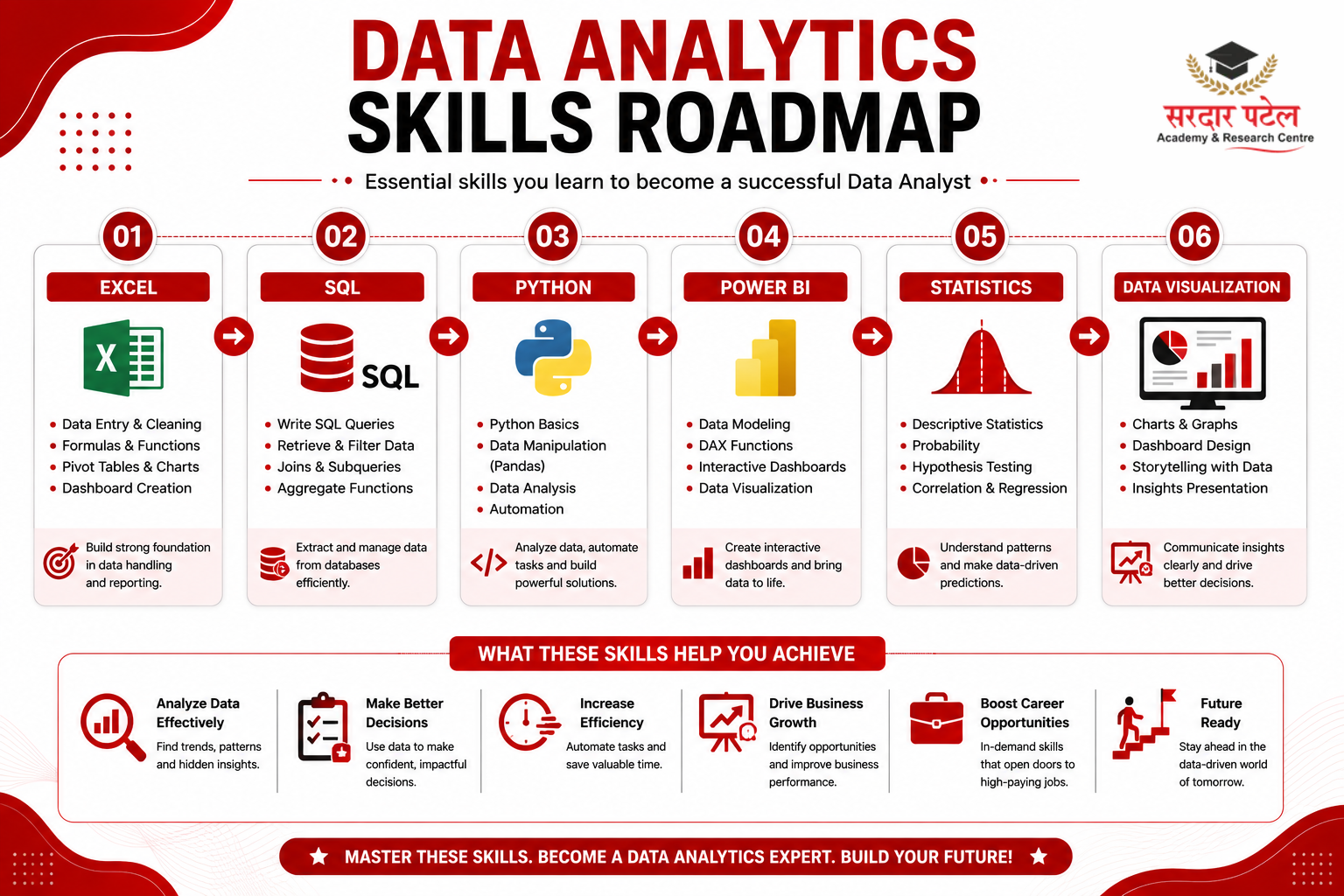
A quality training program at Sardar Patel Academy & Research Centre focuses on the practical tools and techniques that employers in Delhi NCR actively look for when hiring analytics professionals.
Microsoft Excel
Excel remains one of the most widely used tools for data analysis across every industry and company size. The curriculum covers Pivot Tables, VLOOKUP and VLOOKUP functions, data cleaning techniques, advanced formulas, and dashboard creation — giving students a strong foundation that applies immediately in the workplace.
SQL (Structured Query Language)
SQL is the standard language for working with databases and is listed as a required skill in the majority of analytics job descriptions in India. Students learn database management, writing queries, filtering and sorting data, performing joins across multiple tables, aggregations, and efficient data extraction from large datasets.
Python for Data Analytics
Python has become the preferred programming language for data professionals worldwide. Students learn the core libraries used in analytics work: Pandas for data manipulation and cleaning, NumPy for numerical analysis, Matplotlib and Seaborn for data visualisation, and the basics of exploratory data analysis (EDA) — the process of understanding a dataset before formal analysis begins.
Power BI
Power BI is Microsoft's leading business intelligence platform and is extensively used across Indian corporations and MNCs. Students learn data modelling, creating interactive dashboards, designing KPI tracking reports, and building visualisations that make complex data immediately understandable to business stakeholders.
Statistics and Analytical Thinking
Understanding statistics is what separates analysts who can describe data from those who can truly interpret it. Key concepts covered include mean, median, mode, probability, standard deviation, correlation, and hypothesis testing — the statistical foundation that ensures analysts draw accurate, reliable conclusions from data.
Data Visualisation and Storytelling
Communicating insights effectively is one of the most valued — and most underrated — skills in analytics. Students learn how to transform complex datasets into clear, compelling visual reports and presentations that non-technical decision-makers can understand and act upon confidently.
Top Data Analytics Certifications to Strengthen Your Resume
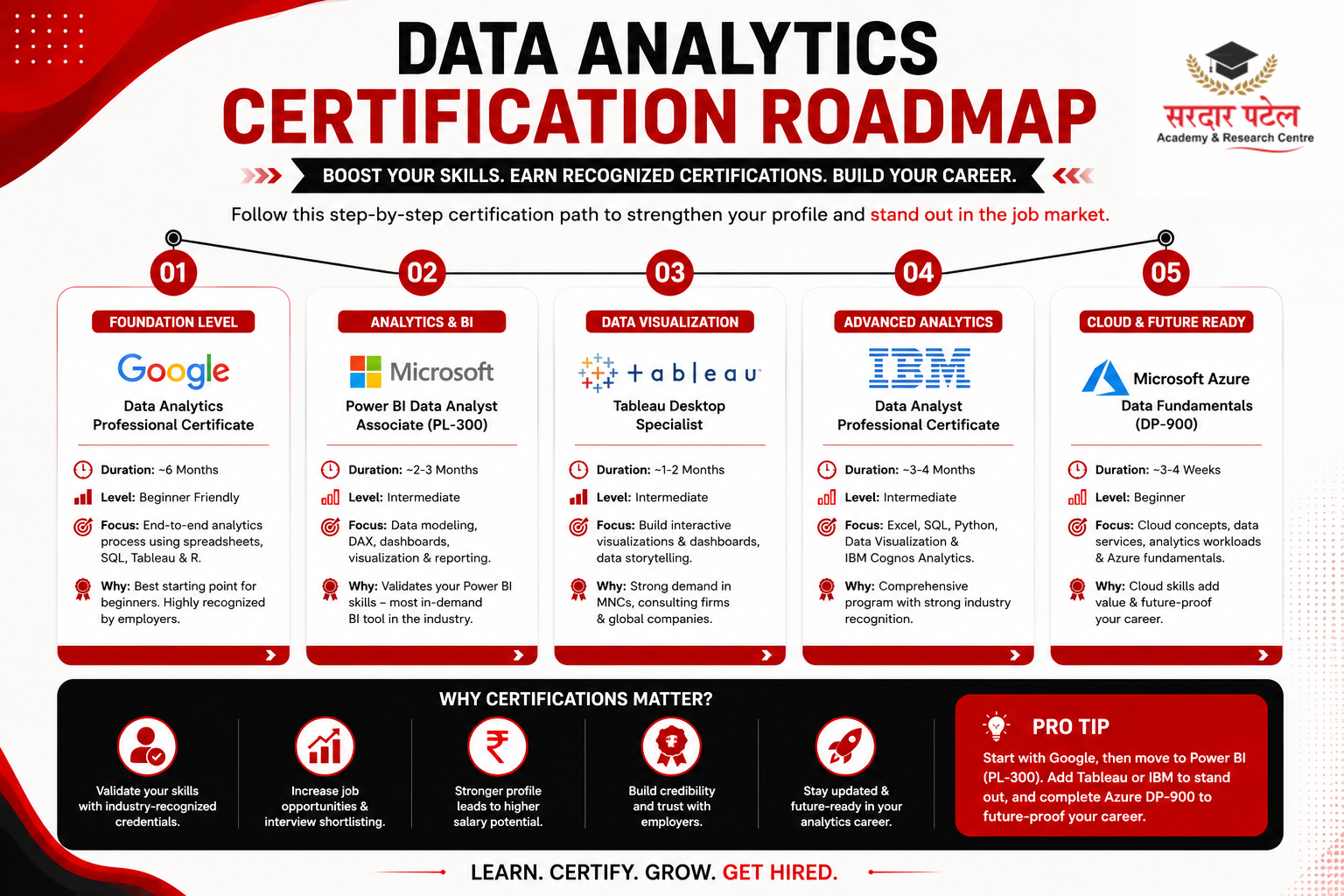
Certifications validate your skills to employers and significantly improve your chances of being shortlisted — especially as a fresher without work experience. Sardar Patel Academy & Research Centre prepares students for the following industry-recognised credentials:
1. Google Data Analytics Professional Certificate
Offered through Coursera, this is the most beginner-friendly and widely recognised analytics certification available today. It covers the complete analytics workflow using Spreadsheets, SQL, Tableau, and R. Completion time is approximately 6 months at a part-time pace, and the Google brand carries strong recognition among Indian employers.
2. Microsoft Power BI Data Analyst Associate (PL-300)
Microsoft's official certification for Power BI proficiency. It validates your ability to connect data sources, build reports, model data, and create interactive dashboards. Highly recommended for anyone targeting IT companies, financial institutions, or MNCs in Delhi NCR — Power BI skills appear in the majority of analytics job postings in India.
3. Tableau Desktop Specialist
Tableau's entry-level certification demonstrates your ability to build interactive data visualisations and dashboards. Tableau is widely used in consulting firms and global companies. It complements Power BI well and makes your profile stand out for roles requiring strong visualisation expertise.
4. IBM Data Analyst Professional Certificate
Available on Coursera, this IBM-certified program covers Excel, SQL, Python, data visualisation, and IBM Cognos Analytics. It is comprehensive, structured for beginners, and carries strong recognition in the Indian technology sector.
5. Microsoft Azure Data Fundamentals (DP-900)
As Indian companies increasingly move their data infrastructure to cloud platforms, understanding cloud data concepts is becoming a valuable differentiator even for junior analysts. The DP-900 certification covers relational and non-relational data, analytics workloads, and Azure data services — and it is beginner-accessible with no prior cloud experience required.
Recommended starting point: Begin with the Google Data Analytics Certificate to build your foundation, then add the Microsoft Power BI certification to target the majority of analytics roles available in Delhi NCR. This combination covers what most Indian employers actually look for in entry-level candidates.
Data Analytics vs Data Science: Which Career Is Better in 2026?
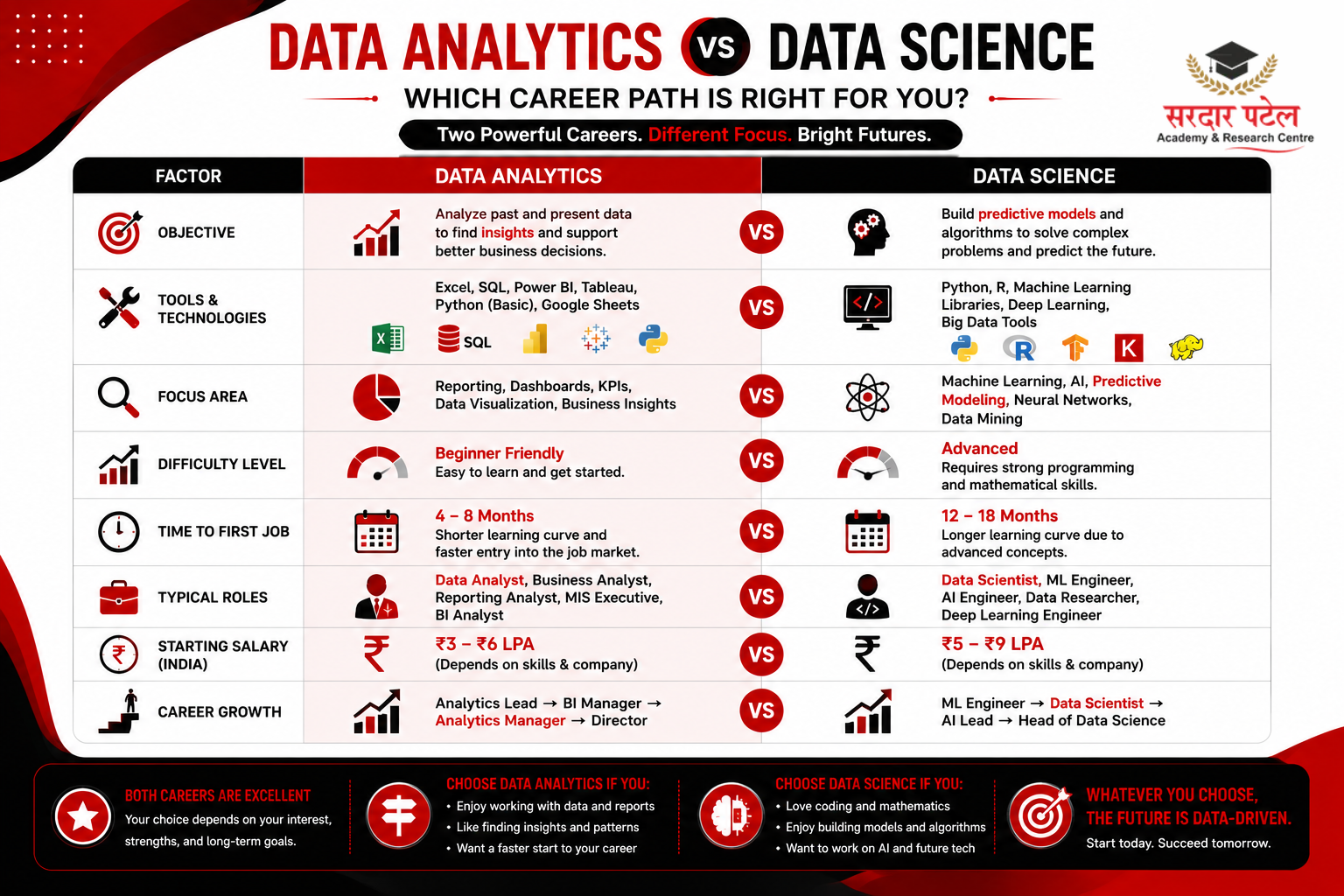
This is one of the most frequently searched questions among students choosing between these two closely related fields. Here is a clear, honest comparison:
| Factor | Data Analytics | Data Science | Verdict |
| Entry Difficulty | Lower | Higher | Analytics is better for beginners |
| Coding Required | Medium — SQL, Python basics | High — Python, R, ML | Analytics more accessible |
| Starting Salary | ₹3 – ₹6 LPA | ₹5 – ₹9 LPA | Data Science slightly higher |
| Beginner Friendly | Yes | Moderate | Analytics recommended first |
| Time to First Job | 4–8 months | 12–18 months | Analytics faster ROI |
| Career Ceiling | Analytics Manager, BI Lead | ML Engineer, AI Researcher | Both strong long-term |
Source: Based on job posting analysis from Naukri.com and LinkedIn India, Q1 2026.
Bottom line: Data Analytics is the smarter entry point for most beginners. It has a shorter learning curve, faster time to employment, and strong salary growth. Many successful data scientists started their careers as data analysts and gradually moved toward machine learning and AI work as their skills deepened.
If you want to start working sooner and build real industry experience — begin with Data Analytics. If you are comfortable with a longer, more technical learning journey — Data Science is the higher-ceiling path.
Career Opportunities After Completing Data Analytics Training
Completing a structured data analytics course opens doors to multiple job roles across industries. Candidates looking for practical learning, live projects, and placement support can explore our Job-Oriented Data Analytics Course in Delhi guide.
Data Analyst
The most direct and common entry-level role after training. Data Analysts work with business data, identify trends and patterns, and present findings to help management make better decisions. This role exists in virtually every mid-size and large company.
Business Analyst
Business Analysts bridge the gap between data insights and business strategy. They work closely with both technical and non-technical teams, translating data findings into specific operational improvements and growth recommendations.
Reporting Analyst
Reporting Analysts specialise in building and maintaining dashboards, automated reports, and performance tracking systems for management teams. Strong Excel, SQL, and Power BI skills are the core requirements for this role.
MIS Executive (Management Information Systems)
MIS Executives manage information systems and produce regular reports that help leadership track business performance across departments. This is a stable, widely available entry-level role in banking, insurance, and corporate organisations across Delhi.
Data Visualisation Specialist
Data Visualisation Specialists present data visually through interactive dashboards and compelling reports. Power BI and Tableau expertise are the primary requirements. This role is growing rapidly as companies invest in making their data accessible to non-technical decision-makers.
Junior Data Scientist
An advanced entry-level role for analytics graduates who have also learned Python and basic machine learning concepts. This serves as a natural progression path for Data Analysts who want to move toward predictive analytics and AI-related work over time.
With 2 to 4 years of experience, professionals can progress into senior roles such as Senior Data Analyst, Analytics Manager, Performance Marketing Analyst, Business Intelligence Lead, or Data Science Specialist — each carrying significantly higher compensation.
Data Analytics Salary in Delhi NCR: What to Expect in 2026
Salary in data analytics varies based on your specialisation, the tools you know, the strength of your portfolio, and the type of organisation you join. Here is a realistic breakdown for the Delhi NCR market:
| Experience Level | Typical Role | Average Annual Salary | High-Value Skills |
| 0–1 Year (Fresher) | Junior Data Analyst / MIS Executive | ₹3 – ₹6 LPA | Excel, SQL, Power BI |
| 1–3 Years | Data Analyst | ₹6 – ₹12 LPA | Python, Tableau, Statistics |
| 3–6 Years | Senior Analyst / BI Lead | ₹12 – ₹20 LPA | Advanced Python, Cloud, AI Tools |
| 6+ Years | Analytics Manager / Consultant | ₹20+ LPA | Strategy, Leadership, ML |
Professionals who combine SQL and Python expertise with Power BI or Tableau dashboard skills consistently land at the higher end of the fresher salary range and see faster growth in their second and third year of employment. Adding cloud certifications (Azure DP-900) or machine learning knowledge further accelerates compensation.
Why Delhi Is an Ideal City for Data Analytics Training and Career Growth
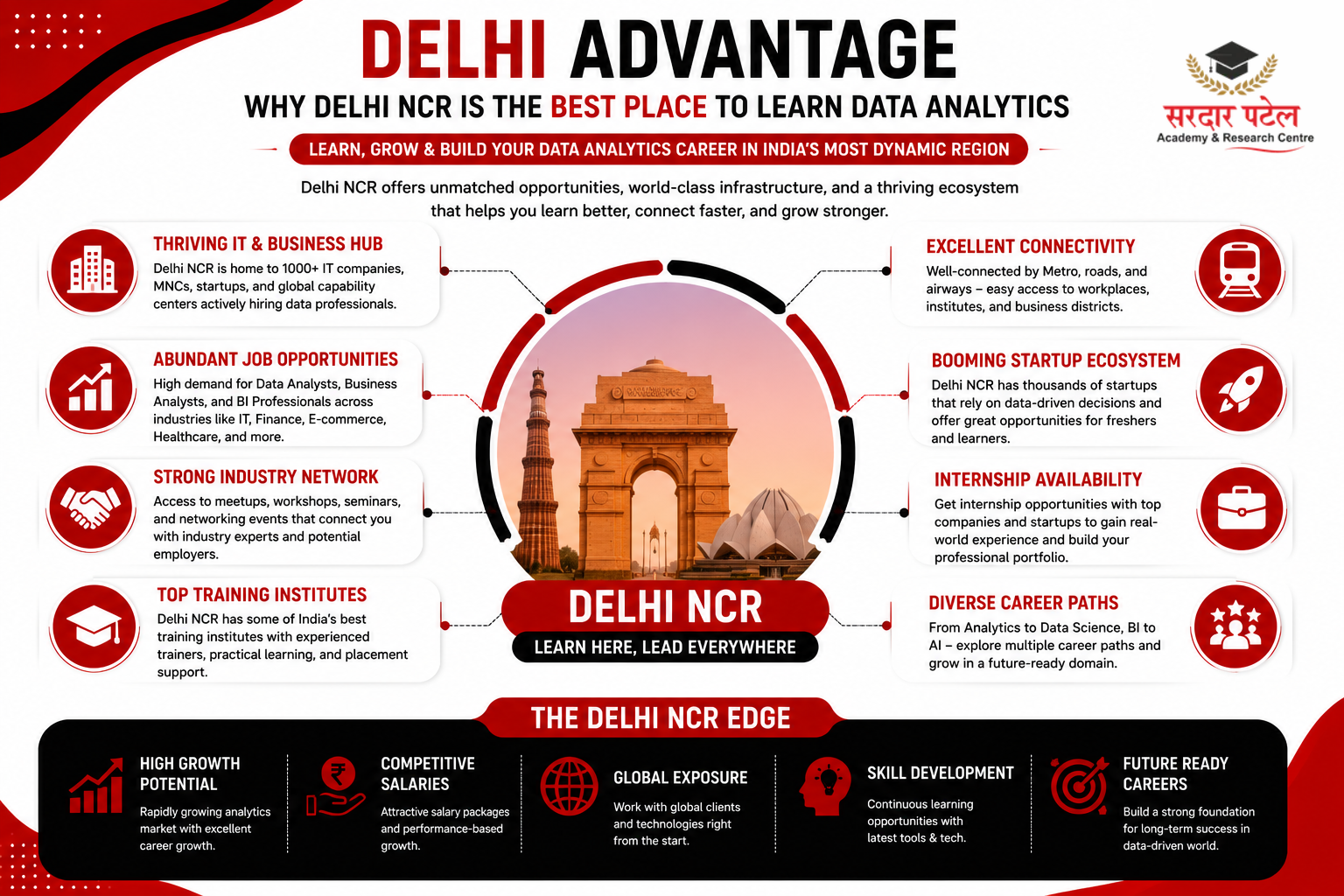
Delhi NCR — including Gurugram and Noida — has established itself as one of India's most active hubs for technology, business services, and analytics careers. Training here gives you advantages that are difficult to replicate through online learning alone:
One of India's Strongest Job Markets
Delhi NCR is home to thousands of technology companies, digital agencies, financial institutions, healthcare organisations, and e-commerce businesses — all of which actively hire analytics professionals. The concentration of employers creates consistent job opportunities year-round for trained graduates.
Thriving Startup Ecosystem
Areas like Gurugram, Noida, and South Delhi host hundreds of fast-growing startups that rely heavily on data analytics for growth decisions. These companies often hire freshers with good practical skills, making them excellent first employers for analytics graduates.
Networking and Industry Events
Delhi's density and professional culture mean there are regular analytics meetups, data science workshops, and technology conferences where students can connect with industry professionals, potential employers, and peers. These connections often lead to referrals and job opportunities that are never publicly advertised.
Internship Availability
The volume of companies in Delhi NCR creates strong internship opportunities that allow students to gain supervised real-world experience before their first full-time role. Many organisations convert strong interns into full-time employees — making internships one of the most reliable pathways into a first analytics job.
How to Choose the Right Data Analytics Institute in Delhi
With dozens of training institutes competing for your attention, knowing what genuinely separates good programs from average ones can save you both time and money. Here are the factors that actually matter:
1. Industry-Relevant, Updated Curriculum
The course should cover the tools employers currently use — Excel, SQL, Python, Power BI, and Tableau — alongside modern topics like AI-assisted analytics and cloud data fundamentals. If a curriculum hasn't been updated in two years, it may already be teaching outdated practices.
2. Experienced, Active Industry Trainers
The best mentors are professionals who are currently working in analytics — not just academic instructors. Trainers with real campaign and project experience can share practical insights, industry shortcuts, and the kind of judgment that only comes from working on real business problems.
3. Live Projects on Real Businesses
Practical exposure to actual business datasets is the single biggest differentiator between an average training program and an exceptional one. You should leave the course with completed projects you can show employers — not just theory you can describe.
4. Small, Manageable Batch Sizes
Smaller batches — ideally 15 to 20 students — ensure you receive individual attention, get your doubts resolved quickly, and have meaningful interaction with your trainer. Large batches of 40 or 50 students make personalised feedback nearly impossible.
5. Genuine Placement Assistance
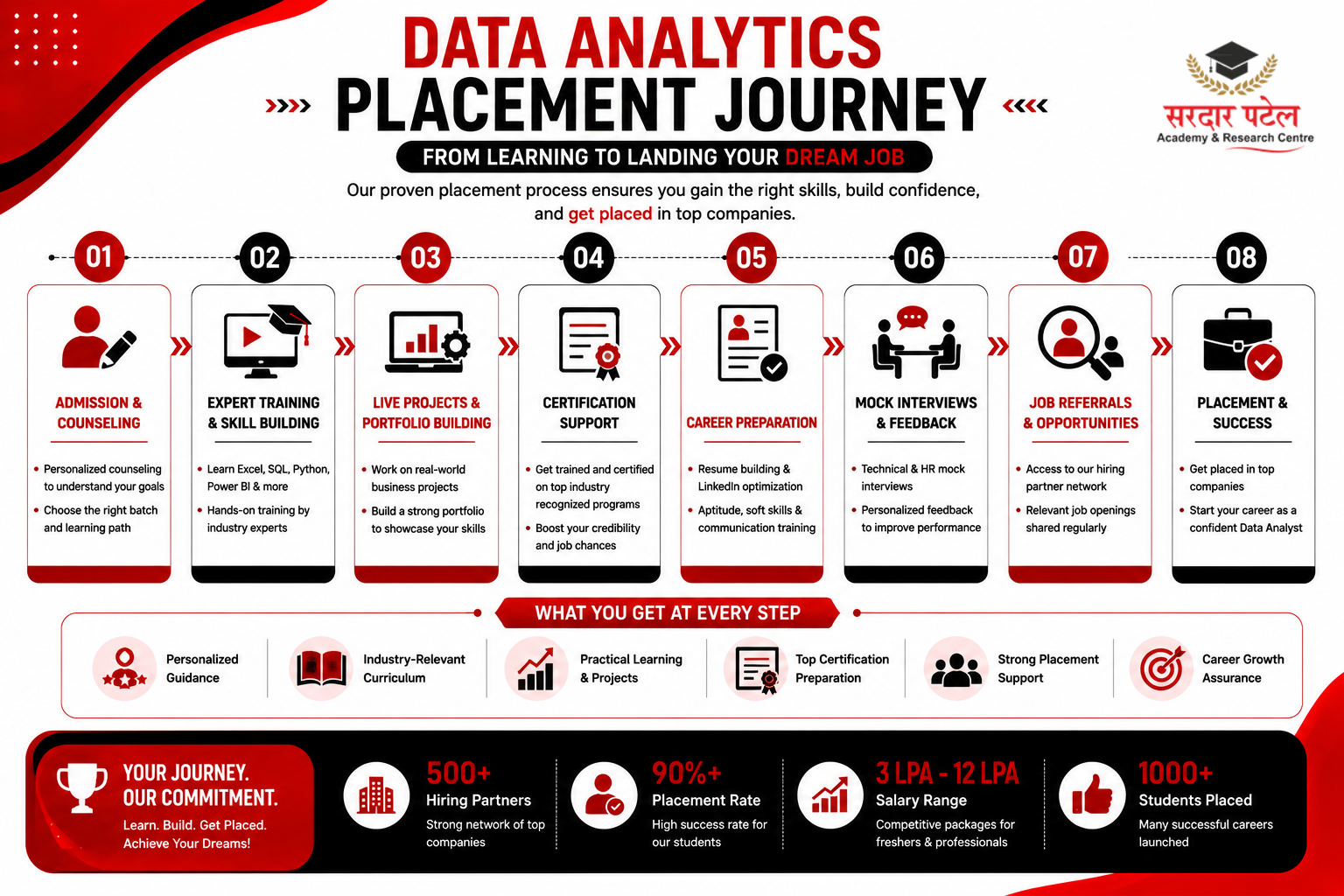
True placement support goes far beyond simply sharing job listings. It should include resume building tailored to analytics roles, LinkedIn profile optimisation, mock interview sessions with realistic feedback, aptitude and communication preparation, and direct referrals to hiring companies and agencies.
6. Recognised Certifications
The program should prepare you for credentials that employers actually recognise — Google, Microsoft, Tableau, IBM, and HubSpot certifications strengthen your profile and signal competence to hiring managers who may not have time to review portfolios in detail.
Before enrolling, it's also important to understand the complete cost structure. Read Data Analytics Course Fees in Delhi Explained to compare training investments and course inclusions.
7. Verifiable Alumni Reviews
Look for genuine Google reviews, LinkedIn recommendations from former students, and alumni you can contact directly. Be cautious of institutes that only display curated success stories without verifiable evidence of actual student outcomes.
Why Sardar Patel Academy & Research Centre Is Delhi's Preferred Analytics Training Institute
At Sardar Patel Academy & Research Centre, we have built our curriculum specifically around what Delhi NCR employers actually look for — not what sounds impressive in a brochure. Here is what sets our Data Analytics program apart:
- Hands-on training on Excel, SQL, Python, and Power BI from the very first week — no lengthy theory-only phases
- Live projects using real business datasets so your portfolio reflects genuine analytical work
- Small batch sizes ensuring every student receives individual attention and personalized feedback
- Trainers who are active analytics professionals with verifiable industry experience
- Dedicated placement support including resume building, LinkedIn optimization, mock interviews, and direct employer referrals
- Preparation for Google, Microsoft Power BI, IBM, and Tableau certifications as part of the program
- Internship opportunities with partner companies for students who want supervised real-world experience before their first full-time role
- Flexible learning options to accommodate both full-time students and working professionals
The demand for analytics professionals continues to grow across Delhi NCR. Starting your learning journey sooner gives you more time to build practical skills, work on projects, and prepare for future opportunities in the field.
Related Courses and Resources at Sardar Patel Academy & Research Centre
If you are exploring career options alongside data analytics, you may also find these programs helpful:
- Digital Marketing Course with Placement — Sardar Patel Academy & Research Centre
- Data Science Course — Sardar Patel Academy & Research Centre
- Python Programming Course — Sardar Patel Academy & Research Centre
Benefits of Learning Data Analytics in 2026
For students and professionals evaluating their next career move, here is why data analytics consistently ranks as one of the smartest investments you can make in yourself right now:
- High and growing demand across virtually every industry in India
- Competitive salaries with clear, predictable growth as experience increases
- Diverse job roles — from analyst and visualizer to scientist and consultant
- Industry versatility — your skills transfer across technology, finance, healthcare, marketing, and more
- Global relevance — analytics skills are valued by companies around the world
- Continuous growth potential as AI and machine learning create new adjacent opportunities
- Accessible entry point for candidates from non-technical backgrounds
- Relatively short training period before employability (4 to 8 months for most beginners)
Ready to Take the Next Step in Data Analytics?
If you're considering a career in data analytics, choosing a program that combines practical training, industry-relevant tools, and career support can help you build a stronger foundation for long-term growth.
Our program combines practical training on industry tools, real-world project work, recognised certifications, and dedicated career support — everything you need to compete confidently in Delhi NCR's analytics job market.
- Industry-Relevant Curriculum — Excel, SQL, Python, Power BI, Statistics
- Live Projects and Real Business Case Studies
- Recognised Certification Preparation — Google, Microsoft, IBM, Tableau
- Dedicated Placement Assistance — Resume, LinkedIn, Mock Interviews, Job Referrals
- Internship Opportunities with Partner Companies
- Small Batch Sizes for Personalised Learning
- Experienced Industry Trainers — Not Just Academic Instructors
FAQs
The best program is one that combines practical training on industry tools (Excel, SQL, Python, Power BI), live projects on real business data, recognized certifications, and dedicated placement assistance including resume building, mock interviews, and direct employer connections. Sardar Patel Academy & Research Centre in GTB Nagar offers all of these within a structured, job-oriented curriculum.
Yes. Data analytics courses are designed to take students from zero prior experience to a job-ready skill level. Basic computer knowledge is sufficient to begin. Most beginners reach employable proficiency within 4 to 8 months of consistent, structured training.
Most reputed institutes, including Sardar Patel Academy & Research Centre, accept graduates and undergraduates from any discipline — B.Com, BBA, BCA, B.Sc, B.Tech, BA, and others. Working professionals are equally welcome. No specific prior technical background is required.
Yes. Sardar Patel Academy & Research Centre provides dedicated placement support, including resume creation tailored to analytics roles, LinkedIn profile optimization, mock interview sessions, aptitude preparation, soft skills training, and direct referrals to hiring companies and partner agencies in Delhi NCR.
Most professional data analytics programs range from 3 to 6 months for foundational training. Advanced or specialization-focused programs can extend to 9 to 12 months. The Sardar Patel Academy & Research Centre curriculum is structured to ensure students have enough time for both skill development and live project completion before entering the job market.
Basic coding knowledge is helpful but not required before you start. Python and SQL are taught from scratch as part of the curriculum. Entry-level analytics roles often require only SQL and Excel, while learning Python significantly expands your opportunities and earning potential over time.
Freshers in Delhi NCR typically start between ₹3 LPA and ₹6 LPA depending on their skills, certifications, and portfolio strength. Candidates who complete strong practical projects and earn recognized certifications consistently land at the higher end of this range.
The curriculum covers Microsoft Excel, SQL, Python (including Pandas, NumPy, Matplotlib, and Seaborn), Power BI, Tableau, and foundational statistics. Students also receive preparation for Google, Microsoft, IBM, and Tableau certifications as part of the program.
Yes. Delhi NCR is one of India's most active markets for analytics professionals, with strong hiring activity across technology, banking, e-commerce, healthcare, and marketing sectors. Demand for trained analysts continues to outpace supply in most specializations, making this an excellent time to enter the field.
Absolutely. Professionals from marketing, finance, operations, HR, and sales regularly and successfully transition into data analytics roles after gaining the required practical skills. The field values business understanding and domain knowledge — which working professionals already have — alongside the new technical skills learned during training.
Sardar Patel Academy & Research Centre prepares students for the Google Data Analytics Professional Certificate, Microsoft Power BI Data Analyst (PL-300), Tableau Desktop Specialist, IBM Data Analyst Professional Certificate, and Microsoft Azure Data Fundamentals (DP-900). These credentials are recognized by employers across India and strengthen your resume significantly.
Structured classroom training provides direct access to experienced trainers who can answer questions in real time, personalized feedback on your projects, accountability that keeps your learning on schedule, live project experience on real business data, and placement support that connects you directly with employers. Online self-learning offers flexibility but lacks the structure, mentorship, and career support that significantly accelerate time to employment.