+91 9312966129
 sparc.enquiry01@gmail.com



Is Tally Enough to Get an Accounting Job?
Is Tally enough for an accounting job? See which roles it covers, what GST, TDS and Excel add, and how to get job-ready. Read the full guide.

Table of Contents
- What Tally Does in a Real Accounting Job
- Is Tally Enough for an Accounting Job? The Honest Answer
- When Tally Can Be Enough
- When Tally Falls Short
- Interview Questions That Test More Than Software
- Skills Employers Expect Beyond Tally
- Tally with GST and TDS
- Tally Accountant Jobs: Roles to Aim For
- How to Read a Job Post
- A Step-by-Step Plan for Your Tally Career
- Common Mistakes Freshers Make
- Conclusion
You have finished a Tally course, and now the real question arrives: is Tally enough for an accounting job, or will recruiters expect something more?
The practical answer sits in the middle. Tally can help you land an entry-level role, especially in small and mid-sized businesses where billing, bookkeeping and GST work all run through the software. But on its own, it rarely carries you far. Employers also look for accounting understanding, tax awareness and comfort with spreadsheets.
This guide explains where Tally helps, where it stops, and which skills to add so your profile looks job-ready. It is written for commerce graduates, 12th pass students and career switchers, including learners at Sardar Patel Academy & Research Centre (SPARC) in GTB Nagar, Delhi.
What Tally Does in a Real Accounting Job
Tally is accounting and business management software. In a typical office, someone records purchase and sales vouchers, maintains ledgers, tracks stock, matches bank entries and prepares reports for the owner or the chartered accountant. TallyPrime also supports GST work, and Tally’s own GST software page lists GSTR-1, GSTR-3B and CMP-08 returns among its features.
Think of Tally as a very fast calculator for accountants. It is accurate and saves hours, but it does not decide what to enter. A person still has to judge whether an expense is a revenue or capital item, which ledger it belongs to, and whether input tax credit can be claimed. That judgement is what employers are really paying for, and it is where the real debate begins.
Is Tally Enough for an Accounting Job? The Honest Answer
For some roles, yes. For most, not by itself. Whether Tally is sufficient depends on the position, the size of the employer and the responsibility attached to the job. So when people ask, is Tally enough for an accounting job, the fair reply is “it depends on the role.”
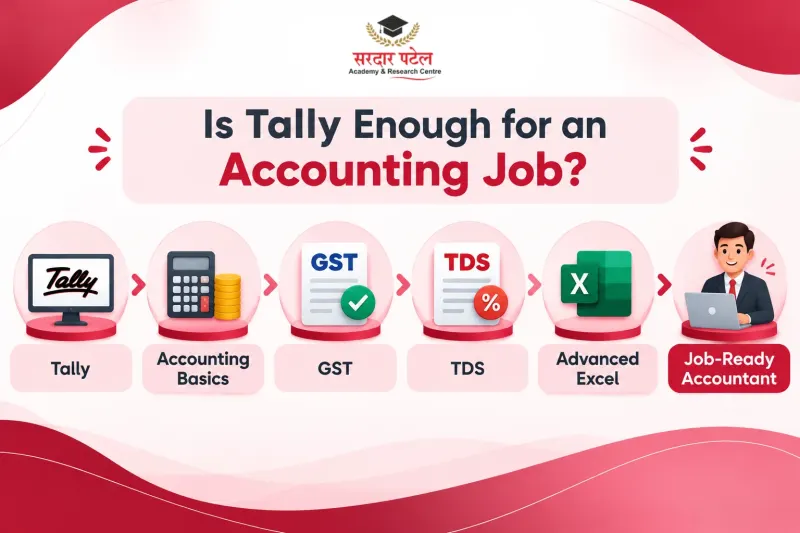
| Role type |
Is Tally alone enough? |
What usually needs to be added |
| Voucher or data entry |
Often yes |
Typing accuracy, basic accounting terms |
| Accounts assistant |
Partly |
Accounting basics, bank reconciliation, Excel |
| Accounts executive |
Rarely |
GST, TDS, Excel, ledger scrutiny |
| Senior accountant or finance role |
No |
Degree or professional qualification, reporting and analysis |
Treat this table as a guide, not a hiring rule; every company sets its own requirements.
When Tally Can Be Enough
Small trading firms, local shops and some CA offices may need someone who can post vouchers, raise bills and keep ledgers tidy. Here, strong Tally practice combined with basic accounting knowledge can be sufficient to start. Even then, you should understand why each entry is made, not just where to click.
When Tally Falls Short
Interviewers often ask questions that software cannot answer. Why is the trial balance not matching? How do you treat an advance received from a customer? What is the difference between accrual and cash accounting? If you have only memorised keystrokes, these questions expose the gap quickly. That is why this debate is really about whether you understand accounting itself.
Interview Questions That Test More Than Software
Expect questions like these, and prepare answers in your own words:
- A customer pays an advance. How do you record it? As a liability, advance from the customer, until the goods or services are supplied. Then adjust it against the sale.
- The trial balance does not match. What do you check first? One-sided entries, wrong amounts and missing opening balances, before touching any final figure.
- Why does the bank book differ from the bank statement? Common reasons are cheques not yet cleared and charges or credits not yet recorded. A reconciliation statement explains the gap.
Skills Employers Expect Beyond Tally
Strong Tally job skills sit on top of a wider base. Tally job skills are easier to judge when you list them out. Check how many of these you already have:
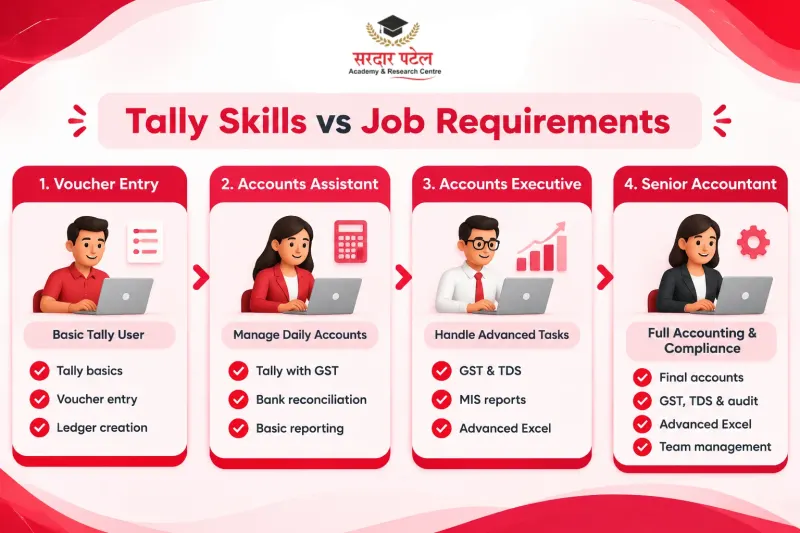
- Accounting fundamentals: double entry, journal and ledger posting, trial balance and final accounts.
- GST knowledge: tax invoices, input tax credit, return types and reconciliation.
- TDS basics: when tax must be deducted, who deposits it and how statements are filed.
- Excel: formulas, lookups, pivot tables and clean formatting for reports.
- Bank reconciliation: spotting unmatched entries and explaining differences.
- Communication: explaining numbers to a manager or client in plain language.
Software skills extend beyond one tool. If you want to see what else is worth learning, this overview of Top Software Skills Every Accountant Should Know is a useful next read.
So, is Tally enough for an accounting job if your Excel is weak? In most office roles, probably not. Accounts teams can export Tally data into spreadsheets to analyse, sort and present it.
Tally with GST and TDS
Tally with GST is the pairing that makes the biggest practical difference. Nearly every registered business deals with tax invoices, returns and input credit, so someone who can handle them inside the software is immediately more useful.
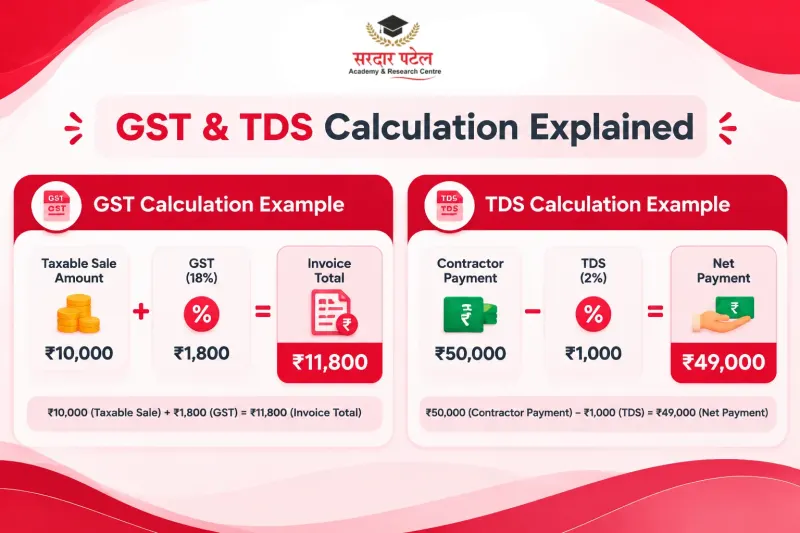
Here is a simple example. A business sells goods worth ₹10,000 to a customer in the same state at 18% GST. The tax is ₹1,800, split as ₹900 CGST and ₹900 SGST, and the invoice total is ₹11,800. If the accountant picks the wrong tax ledger or rate, the books look fine on screen, but the return later shows a mismatch. Knowing the logic prevents that.
E-invoicing adds another layer. Under this system, specified businesses report B2B invoice details to the Invoice Registration Portal and receive an Invoice Reference Number and QR code. Tally explains how this works inside the software on its e-invoicing help page, and the official e-invoice portal FAQs cover the rules. Thresholds have changed over time, so check the latest notification before advising anyone.
TDS matters just as much. Under the Income Tax framework, a person making a specified payment deducts tax and deposits it with the government, and the receiver gets credit for it. The Income Tax Department explains the basics on its TDS overview page. Employers value accountants who can record TDS entries correctly and support timely compliance.
Here is a quick illustration with an assumed rate, so the arithmetic is easy to follow. A business pays a contractor ₹50,000 and TDS at 2% applies. The deduction is ₹1,000, so the contractor receives ₹49,000 and ₹1,000 sits as TDS payable until it is deposited. Always confirm the applicable section and rate before posting real entries.
If you want to see how the three skills fit together, read Tally + GST + TDS: The Best Skill Combination for Accounting Jobs? Adding both taxes improves your chances noticeably, yet is Tally enough for an accounting job once GST and TDS are added? It is closer, but analysis, accuracy and accounting logic still count.
Tally Accountant Jobs: Roles to Aim For
Job titles vary between companies, but freshers commonly look at roles such as:
- Accounts assistant
- Accounts executive
- Billing or invoicing executive
- GST or compliance assistant
- Junior accountant in a CA or tax consultancy office
- Inventory or stores accounts executive
How to Read a Job Post
The quickest way to check whether you qualify is to decode the listing. This sample is illustrative, not a real posting.
| Line in the job post |
What it usually means |
How to prepare |
| “Proficiency in Tally” |
Daily voucher entry, ledgers, reports |
Practise a full month on a mock company |
| “GST filing knowledge” |
Tax entries, return data, reconciliation |
Learn GST ledgers and return reports |
| “Good Excel skills” |
Lookups, pivots, tidy reports |
Build two or three practice sheets |
Read each listing this way and ask: is Tally enough for an accounting job like this one? If the post lists more than software, your preparation should too.
Many Tally accountant jobs work as starting points rather than final destinations. With experience, people can move toward GST filing, audit support, MIS reporting or further professional study. If you want a closer look at duties and growth, How to Become a Tally Accountant? Skills, Jobs and Career Path walks through the path in more detail.
Students from non-commerce backgrounds are not shut out either. If you completed arts after school, Accounting Career Options After 12th Arts explains which routes are realistic.
A Step-by-Step Plan for Your Tally Career
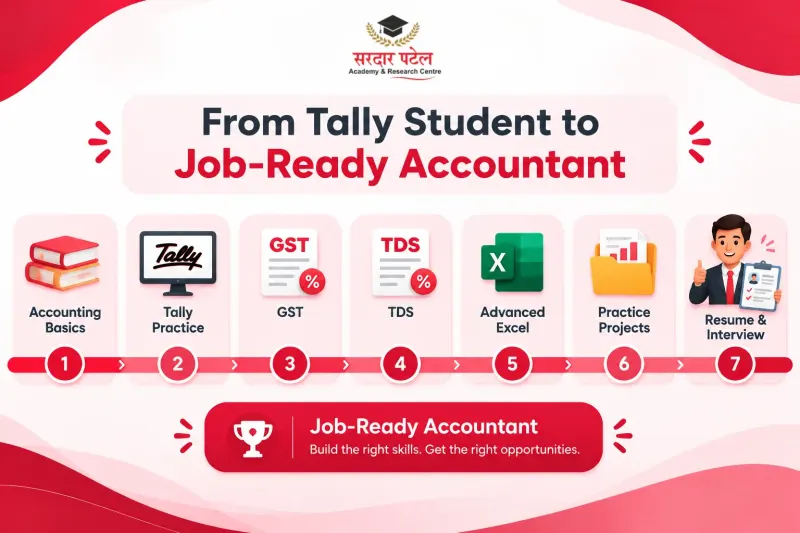
The best answer is a plan that builds layers instead of chasing the software alone. A sensible Tally career follows the steps below.
- Learn accounting basics first. Understand debit and credit, ledgers and financial statements before opening the software.
- Practice at a mock company. Create masters, post a month of transactions and generate reports. Tally Prime Skills Every Fresher Should Learn Before Applying for Jobs lists what to practise.
- Add GST. Set up tax ledgers, record sales and purchases with tax, and read the return reports.
- Add TDS. Learn common deductions, deposit timelines and how entries flow into statements.
- Strengthen Excel. Practise lookups, pivot tables and basic dashboards.
- Consider certification. Tally Education offers certification programmes, and according to this overview of Tally Education certifications, certified learners can access Tally’s job portal.
- Prepare proof of work. Keep sample reports from your practice company ready to discuss in interviews.
- Tailor your resume. Match skills to each job description rather than sending one generic version.
Still wondering, is Tally enough for an accounting job in your case? If you prefer one structured path over piecing it together yourself, the Advanced Diploma in Financial Accounting (E-DAFA) at SPARC is worth exploring. According to the course page, this 12-month programme starts from computer basics and moves through accounting, Tally Prime, Busy, Advanced Excel, payroll, TDS, GST and income tax e-filing. Learners who want to Build Complete Accounting Skills rather than only software skills may prefer this guided route.
- Beginner-friendly: no technical or coding background is needed.
- Software practice: Tally Prime, Busy, Webtel software, the GST portal and income tax e-filing, with practical assignments.
- Certificates: a SPARC course completion certificate and a certificate from Webtel Academy, plus the CCC certificate from the National Institute of Electronics & Information Technology (NIELIT) after you qualify the CCC exam.
- Placement support: resume guidance, mock interviews.
- Flexible timing: batch options for working professionals.
Fees and batch details change, so confirm the current ones with SPARC’s counselling team.
Prefer to start with the software itself? SPARC also offers a Tally Prime & Busy course alongside its longer accounting programmes.
Common Mistakes Freshers Make
- Treating “Is Tally enough for an accounting job?” as a yes-or-no question. The real answer changes with the role, so research before applying.
- Learning shortcuts without concepts. Keystrokes are easy to forget; logic stays with you.
- Ignoring GST until after the course. Check the listings you are targeting for GST requirements.
- Skipping Excel. It is a daily companion to Tally in most offices.
- Calling yourself an expert too early. Be honest about your level and show practical examples.
- Never practise a full cycle. Work through entries, reconciliation, reports and a month-end close at least once.
Conclusion
So, is Tally enough for an accounting job? It is a strong starting tool, but not a complete profile. Whenever you feel unsure, ask again: is Tally enough for an accounting job in the role you want? Go back to the actual job requirements. Your next three moves are simple: master the accounting basics, add GST and TDS, then practise on realistic data.
If you would like guided support, explore Sardar Patel Academy & Research Centre (SPARC) and see how a structured programme can help you Build Complete Accounting Skills for the roles you want.
FAQs
For basic entry-level roles, it can be a good start, especially in small businesses. For most accounts executive positions, employers also expect accounting knowledge, GST, TDS and Excel. So is Tally enough for an accounting job? Only if the job requirements are limited to data entry and billing.
Sometimes. For a fresher asking, is Tally enough for an accounting job, the answer can be yes for simple voucher entry or billing roles. Your chances improve with accounting basics and a few practice projects that show what you can actually do.
Learn accounting basics first, then Tally, then Excel. Most office accounting roles use both, so plan to learn both.
Is Tally enough for an accounting job once GST is included? The answer is still “partly”. Tally with GST makes your profile stronger than Tally alone, because GST affects daily invoicing and returns. Add TDS and Excel for a more complete profile.
A recognised certificate can show that you completed structured training, but employers still test practical knowledge. Use it to support your skills, not replace them.
Yes, many people enter accounting from other streams, and the same logic applies to them: whether Tally is enough depends on the role, not your stream. Start with accounting fundamentals, build software practice and show your work. Some employers may prefer a commerce background, so be ready to explain your learning path.
List only what you can demonstrate: voucher entry, ledger and inventory handling, GST entries, bank reconciliation and report generation. Name the TallyPrime tasks you practised, because specific Tally job skills read as more credible than a generic “Tally expert” label.