+91 9312966129
 sparc.enquiry01@gmail.com



AI Digital Marketing Curriculum report
Explore what an AI digital marketing curriculum should teach, from prompting and analytics to automation and ethics. By Sardar Patel Academy, Delhi.

Table of Contents
- Executive Summary
- Why Older Syllabi Are Falling Behind
- What Is an AI Digital Marketing Curriculum?
- The Five-Layer Framework for a Future-Ready Syllabus
- Layer 1: Marketing Foundations
- Layer 2: AI-Assisted Execution
- Layer 3: Data and Analytics
- Layer 4: Automation and Workflows
- Layer 5: Judgment, Ethics and Brand Safety
- Traditional vs AI-Integrated Syllabus
- A Sample Learning Path
- How to Evaluate Any Syllabus Before Joining
- The Delhi NCR Context
- From our classroom:
- Common Mistakes When Learning AI for Marketing
- Practical Tips for Learners
- Conclusion
Syllabi for AI in digital marketing vary widely from one institute to another. Some add a single “ChatGPT session” at the end of the course. Others rename old modules and call them AI-powered.
This whitepaper is for students, working professionals and business owners who want a clearer picture. It explains what a serious AI digital marketing curriculum should contain, how the modules fit together, and how to judge any syllabus before you pay for it.
Executive Summary
Marketing work has split into two kinds of tasks. The first kind is repetitive and rule-based: drafting first versions, resizing creatives, clustering keywords, summarising reports. AI handles much of this quickly. The second kind needs judgment: choosing a positioning, reading a customer’s mood, deciding what not to publish.
A syllabus built for today has to train both. Students need hands-on fluency with AI tools, and they need the thinking skills that tell them when the tool’s output is wrong, bland or risky.
Why Older Syllabi Are Falling Behind
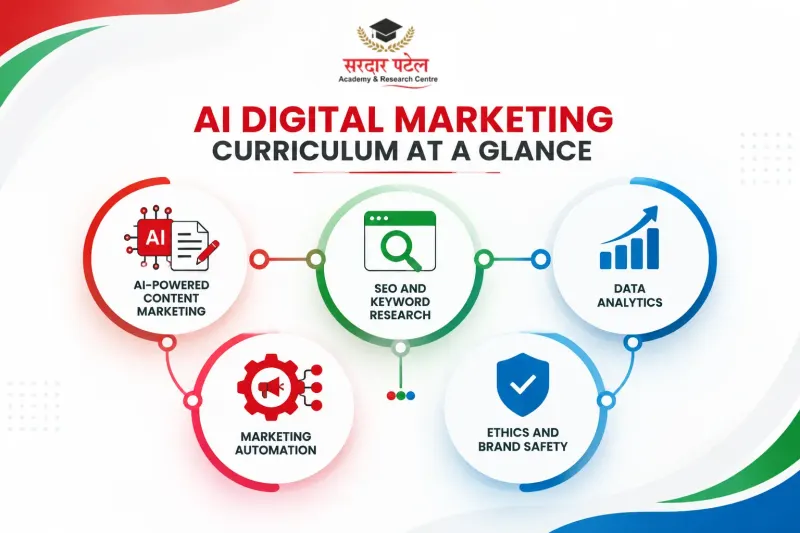
A few years ago, a standard course covered SEO, social media, Google Ads, email and analytics, each taught as a separate silo. That structure still makes sense. What has changed is the way work happens inside each silo.
A content writer now briefs an AI assistant, edits the draft, and fact-checks it before it goes anywhere near a client. A paid media executive tests ad variations at a pace that used to need a whole team. An SEO analyst gets cluster suggestions in minutes and spends the saved time on search intent.
Hiring expectations are shifting too. Our piece on [why AI-skilled digital marketers are in demand] looks at how hiring conversations have changed. When a syllabus ignores this shift, graduates end up learning on the job what they should have practised in class.
What Is an AI Digital Marketing Curriculum?
Definition: An AI digital marketing curriculum is a structured learning plan that teaches marketing fundamentals together with the practical use of AI across research, content, SEO, advertising, analytics and automation.
The word “together” matters. A course that teaches AI tools without marketing grounding produces people who can operate software but cannot explain why a campaign failed. A course that teaches marketing and treats AI as a footnote produces people who will struggle in their first interview.
The Five-Layer Framework for a Future-Ready Syllabus
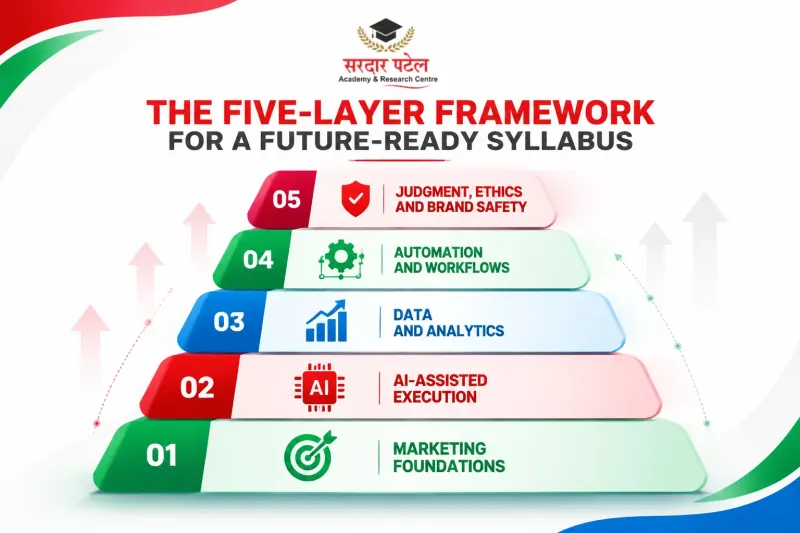
We find it useful to think of a future-ready digital marketing syllabus as five layers stacked on top of each other. Each layer supports the next.
Layer 1: Marketing Foundations
No AI tool can rescue a student who does not understand the basics. This layer covers the marketing funnel, audience research, positioning, the difference between a brand message and a sales message, and how search engines and social platforms actually work.
Example exercise: before anyone can generate a single ad headline, the student writes a one-page audience profile for a local coaching centre. The profile later becomes the brief they give to the AI tool.
Layer 2: AI-Assisted Execution
This is the layer most people think of first. It covers prompt writing, using AI for ideation and first drafts, image and design assistance, and repurposing one idea across formats.
The skill being trained is direction, not typing. Students learn to give clear context, set constraints, compare outputs and push back when the first answer is weak. Our guides on [AI tools every digital marketing student should know] and on [Canva and ChatGPT for marketers] show what this looks like with everyday tools.
Example exercise: a student takes one product page and produces a blog outline, five social captions, an email subject line test and a short video script. Google's guidance on AI-generated content. Then they mark which parts of the AI output they rewrote and why.
Layer 3: Data and Analytics
Marketing runs on numbers, and AI is increasingly the first thing that reads those numbers. Students should learn to set up tracking, read dashboards, ask an AI assistant to summarise a report, and then check that summary against the raw figures.
The last step is where many beginners slip. AI summaries sound confident even when they are wrong, so verification has to be taught as a habit. Google Analytics reporting documentation
Example exercise: given a month of ad data with a few deliberate errors planted in it, students find the errors before presenting their conclusions.
Layer 4: Automation and Workflows
Once students understand the individual tasks, they learn to connect them. This layer covers email sequences, lead routing, content calendars, reporting automation, and simple chatbot flows.
The aim is not to turn marketers into engineers. It is to help them spot repetitive work and decide what is worth automating, and what should stay human because the customer would feel the difference.
Example exercise: a student designs a three-email welcome sequence for a new subscriber, then writes down which steps are automated and which still need a person.
Layer 5: Judgment, Ethics and Brand Safety
This layer is often overlooked in syllabi, and in our view it is among the most valuable. Students discuss disclosure of AI-generated content, copyright questions, bias in outputs, customer data privacy, and the risk of publishing something that sounds fine but is factually wrong.
Example exercise: the class reviews a set of AI-written product claims and flags every statement that a brand could not legally or honestly stand behind.Copyright Act, 1957
Official references for this layer: [ADD links: ASCI (Advertising Standards Council of India) guidelines on misleading and influencer advertising; Digital Personal Data Protection Act, 2023; Copyright Act, 1957].
Traditional vs AI-Integrated Syllabus
| Area |
Traditional syllabus |
AI-integrated syllabus |
| Content |
Writing from a blank page |
Briefing, editing and fact-checking AI drafts |
| SEO |
Manual keyword lists |
Intent mapping with AI-assisted clustering and human review |
| Paid ads |
Writing a few ad variants |
Structured testing across many variants with clear learning goals |
| Analytics |
Reading standard reports |
Questioning AI summaries and validating against raw data |
| Social media |
Posting calendar |
Trend reading, repurposing and community judgment |
| Assessment |
Theory test |
Portfolio of reviewed, real-world work |
| Ethics |
Often not a core focus |
Dedicated discussion on disclosure, privacy and accuracy |
Social platforms change quickly, so the social media row above works best when it is paired with current reading. Our overview of [the newest social media trends] is the kind of material a live syllabus should keep refreshing.
A Sample Learning Path
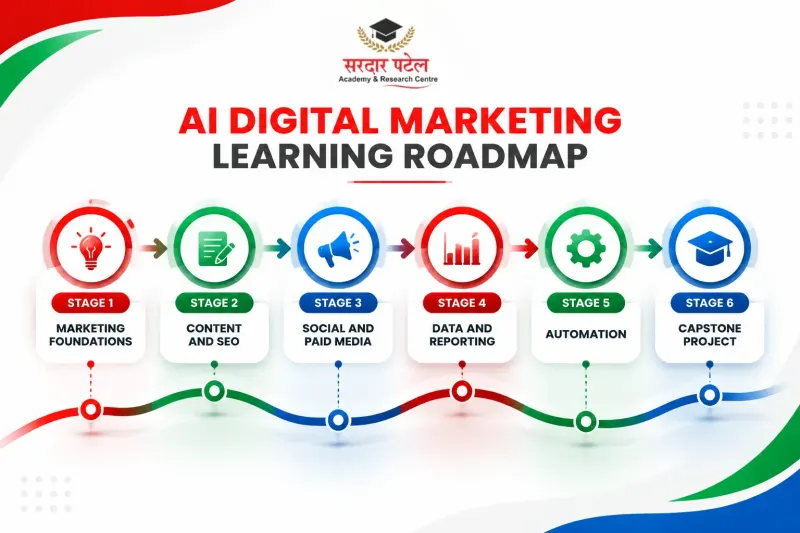
Here is one way a programme could be sequenced. The exact length depends on batch size and student background.
- Orientation and foundations. Marketing basics, audience research and a first look at AI tools.
- Content and search. SEO fundamentals, content briefs, AI-assisted drafting and editing.
- Social and paid media. Platform mechanics, creative testing and budget thinking.
- Data and reporting. Tracking setup, dashboards and AI-assisted analysis with verification.
- Automation. Email flows, lead handling and workflow design.
- Capstone. A full campaign for a real or simulated business, reviewed by a mentor.
Notice that AI appears in every step. That is the practical meaning of a future-ready syllabus: AI is a thread through the whole course, not a separate subject.
How to Evaluate Any Syllabus Before Joining
Use this short checklist when you compare institutes:
- Does AI appear inside the SEO, ads, social and analytics modules, or only in one standalone chapter?
- Is the syllabus tool-first or workflow-first? A list of fifteen tool names tells you very little.
- Will you build work you can show in an interview?
- Is there a clear review process where a mentor marks your work and explains what to fix?
- Does the course say anything about ethics, accuracy and data privacy?
- How often is the syllabus updated, and who updates it?
Ask these questions in person. A specific answer backed by an example is a good sign, and a vague answer tells you something too.
The Delhi NCR Context
Delhi NCR has a dense mix of agencies, startups, e-commerce teams, coaching businesses and in-house marketing departments. That mix shapes what learners need.
A student in North Delhi, whether coming from GTB Nagar, Kamla Nagar, Mukherjee Nagar or further out, will often find entry roles in small teams where one person handles several jobs. In those teams, AI fluency saves hours, but only if the person also knows enough marketing to judge the result.
Local businesses add another angle. Many want content in both English and Hindi, and AI output in mixed or regional languages often needs heavy human correction. A syllabus that practises this gives learners a real edge. For a view of what local employers are asking for, see our note on [Delhi companies hiring AI-smart digital marketers].
From our classroom:
Sonam Rajput
*****
My experience at SPARC Institute, Hudson Lane, has been really good so far! I’m currently pursuing the DM (Digital Marketing) course, and right now I’m learning Excel, which is helping me build useful practical skills. What I like is that I get to explore new things and improve my knowledge step by step. Learning here feels interesting, and I’m excited to learn more as I continue my course. If you’re looking to learn Digital Marketing and develop new skills, SPARC Institute is definitely worth checking out!
Common Mistakes When Learning AI for Marketing
- Treating the tool as the skill. Interfaces change. The ability to write a clear brief and judge the output does not.
- Publishing without checking. AI can invent facts, names and numbers. Every claim needs a human check. Google's guidance on helpful, reliable content.
- Skipping the basics. Students who jump straight to AI often cannot explain why a campaign works.
- Copying prompts from the internet. A prompt that works for someone else’s brand rarely fits yours.
- Ignoring the audience. AI content tends toward a generic tone. Readers can feel it.
- Never building a portfolio. Certificates matter less than visible, reviewed work.
Practical Tips for Learners
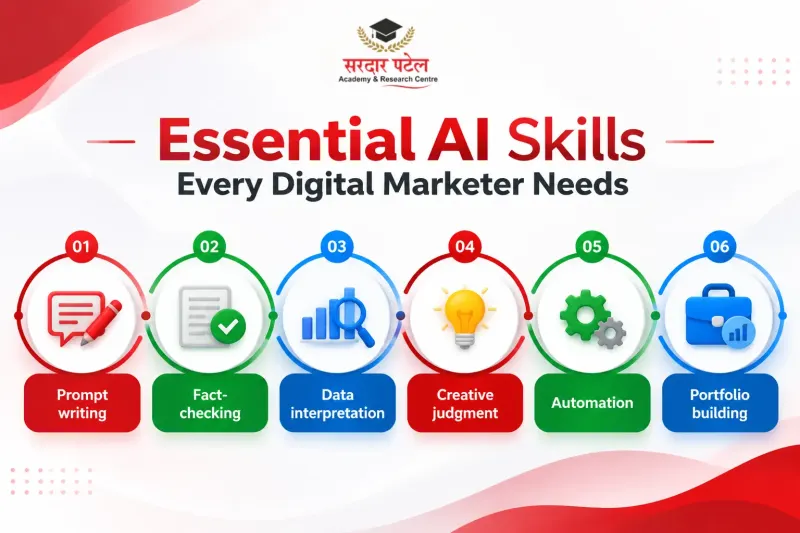
- Keep a log of your prompts and note which versions produced better results.
- Rewrite at least one paragraph of every AI draft in your own voice.
- Practise explaining a campaign decision out loud, without the tool open.
- Build one small project for a real local business, even if unpaid.
- Revisit your own work every month and ask what you would do differently now.
Conclusion
The point of a modern AI digital marketing curriculum is not to turn students into tool operators. It is to produce marketers who understand the fundamentals, use AI to move faster, and still catch the mistakes a machine will make.
When you compare programmes, look for AI woven into every module, assessment based on real work, and honest teaching about the limits of the tools. A future-ready digital marketing syllabus should feel less like a list of software and more like a way of working.
If you want to see how Sardar Patel Academy teaches digital marketing, explore our digital marketing course and ask how its AI modules map to these five layers. You can also contact the Sardar Patel Academy team in GTB Nagar to talk through your goals and ask about the syllabus in detail.
Explore AI Modules at Sardar Patel Academy & Research Centre, GTB Nagar, Delhi | +91 93129-66129 | sparc.org.in
FAQs
It is a learning plan that combines core marketing skills with the practical use of AI in content, SEO, ads, analytics and automation. The best versions also teach judgment, ethics and verification so students do not depend blindly on tools.
No. Most modules rely on clear thinking and good communication, not coding. If you can write a clear instruction and judge whether the result makes sense, you can start. Technical depth can be added later if your role needs it.
Routine tasks are getting faster, but strategy, brand judgment, client communication and quality control still need people. The more realistic shift is that marketers who use AI well are likely to be more productive than those who do not. This is an opinion rather than a guarantee, so treat it as a direction, not a prediction.
In a regular course, AI is an add-on. In an integrated course, it appears in every module, from keyword research to reporting, alongside lessons on checking and correcting its output.
Start with one general AI assistant, one design tool and your analytics platform. Depth in a few tools beats shallow knowledge of many, and workflow thinking carries over when tools change.
It varies with your starting point and practice time. Many learners feel confident with basic workflows after a few weeks of regular, guided practice, but real fluency comes from working on actual projects over several months.
Yes. Professionals can focus on the layers closest to their role, and business owners can learn enough to brief teams or agencies properly and review the output with confidence.
Ask to see module-level details, sample student work, the update history of the syllabus, and how mentors review assignments. Specific answers are a good sign.