+91 9312966129
 sparc.enquiry01@gmail.com


Digital Marketing Internship vs Full Time Job
Confused between a digital marketing internship and a job? Compare benefits, responsibilities, pay, and career growth to choose your next step.
Table of Contents
- What Does a Digital Marketing Internship Actually Involve?
- What Does a Full-Time Digital Marketing Job Look Like?
- Internship Benefits After a Digital Marketing Course
- Pros and Cons of Starting With an Internship
- Pros and Cons of Jumping Straight Into a Full-Time Job
- Common Mistakes Freshers Make When Choosing
- How to Decide: Internship or Job?
- Internship vs Job: What About Career Growth Long-Term?
- Final Thought
If you've just wrapped up a digital marketing course, there's a good chance you're stuck at the same crossroads most fresh learners reach: should you take up an internship first, or try to land a full-time job straight away? It's a fair question, and honestly, there's no one-size-fits-all answer.
The debate around digital marketing internship vs job comes up constantly among students in Delhi NCR, and for good reason — the two paths look similar on paper but feel very different once you're actually in them. In this article, we'll break down what each option really involves, where they differ, what an internship can genuinely do for your career, and how to figure out which route makes more sense for where you currently stand.
What Does a Digital Marketing Internship Actually Involve?
An internship is essentially a structured learning period inside a real work environment. You're not expected to know everything — you're expected to learn fast, ask questions, and apply what you studied in your course to actual client work or in-house projects.
Typical internship responsibilities include:
- Running and monitoring small-scale ad campaigns
- Writing content for blogs, social media, or email newsletters
- Doing keyword research and basic on-page SEO
- Pulling reports from tools like Google Analytics or Search Console
- Assisting senior marketers with client presentations or strategy decks
Internships usually last anywhere from six weeks to six months, and the pay — if any — tends to be modest. That's not a flaw in the system; it reflects the fact that you're being trained, not just employed.
What Does a Full-Time Digital Marketing Job Look Like?
A full-time role, on the other hand, comes with ownership. You're hired to deliver results, not just learn how things work. Employers expect you to manage campaigns, hit targets, and contribute to strategy with far less hand-holding than an intern would get.
Common expectations in a full-time digital marketing job include:
- Owning specific channels (SEO, paid ads, social media, or email)
- Meeting KPIs tied to leads, traffic, or conversions
- Coordinating with designers, writers, and developers
- Reporting directly to a manager or client on performance
- Handling budgets, even if small ones initiall
The learning curve doesn't disappear once you're full-time — it just shifts. Instead of being taught step by step, you're expected to figure things out while still delivering on deadlines.
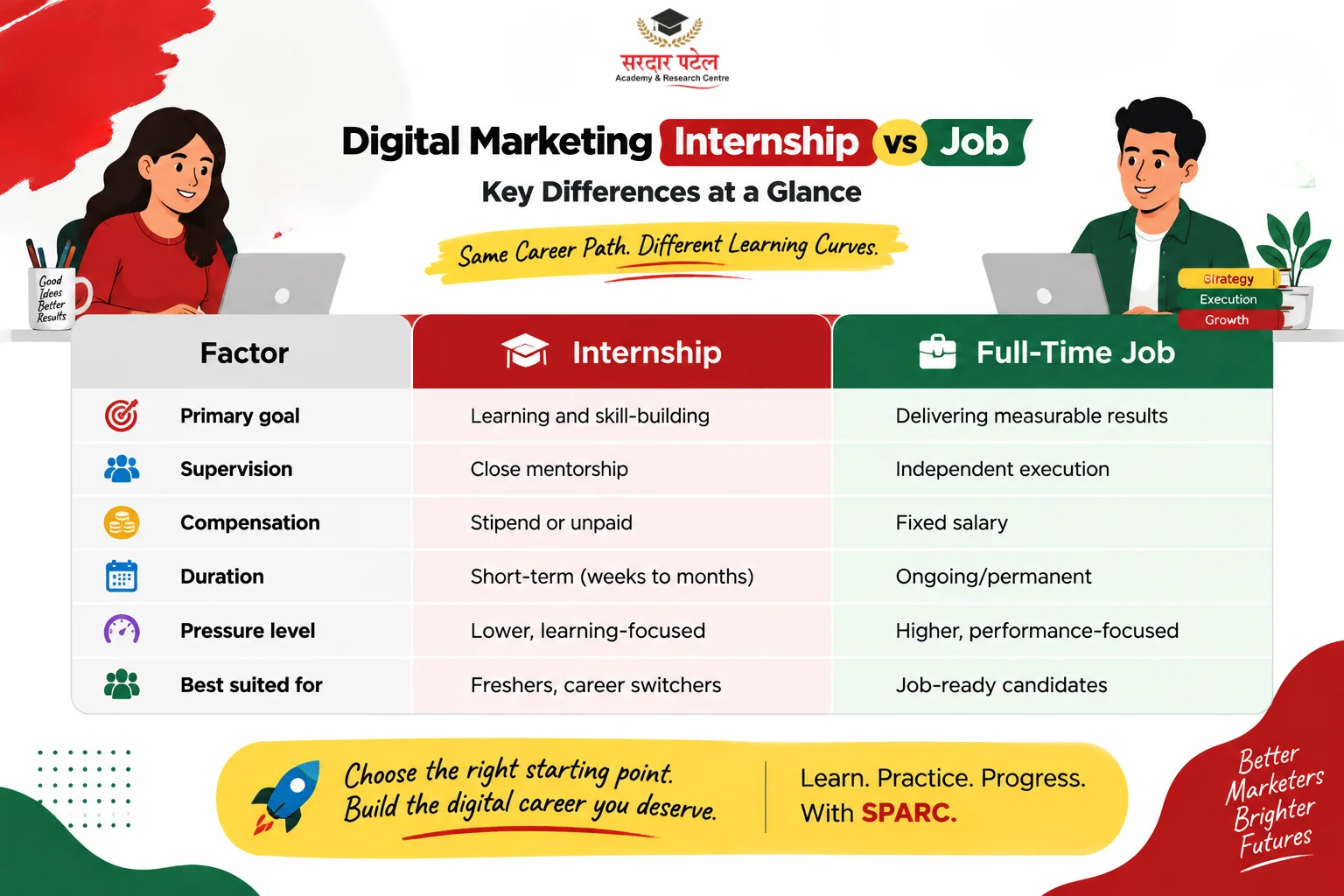
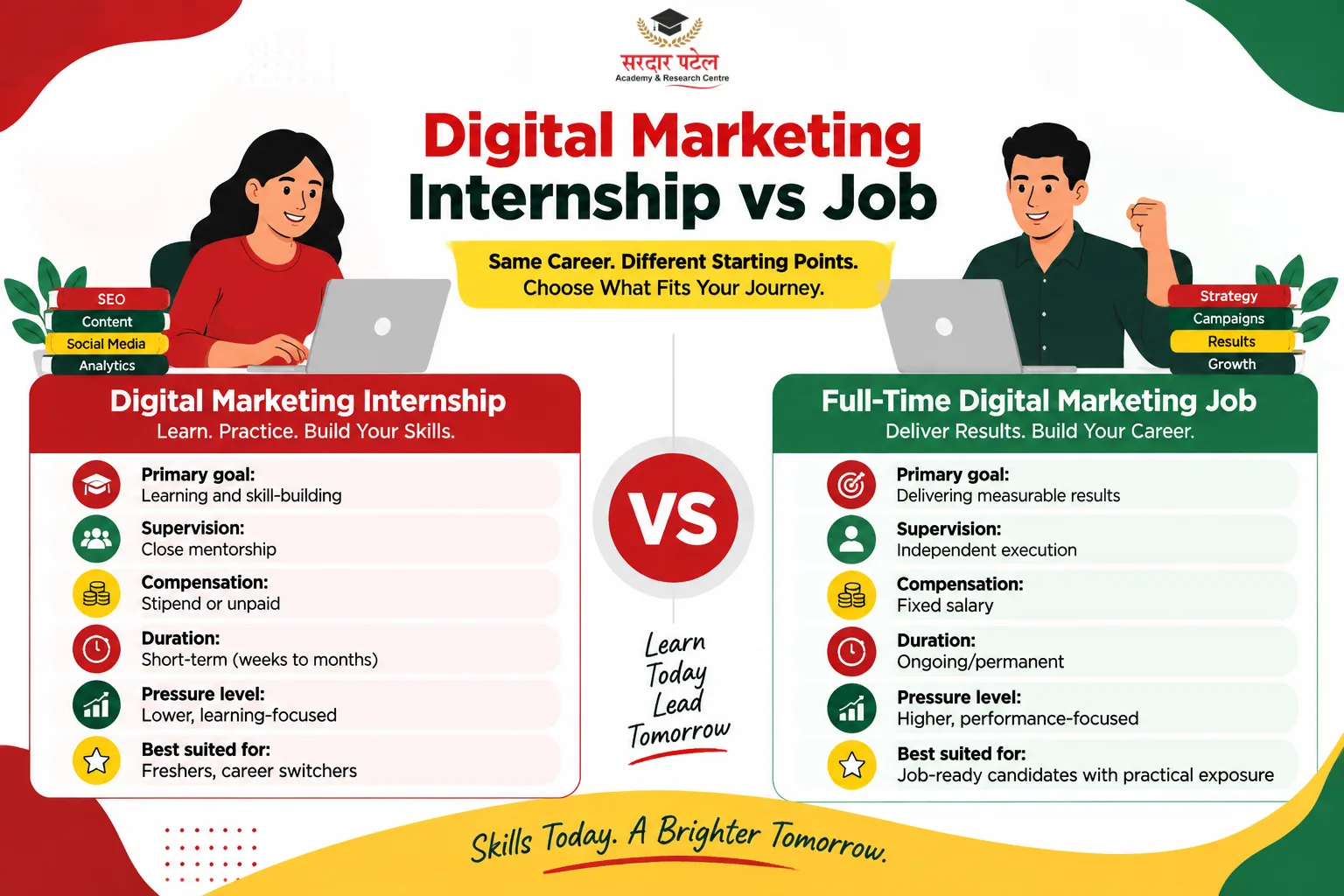
| Factor |
Internship |
Full-Time Job |
| Primary goal |
Learning and skill-building |
Delivering measurable results |
| Supervision |
Close mentorship |
Independent execution |
| Compensation |
Stipend or unpaid |
Fixed salary |
| Duration |
Short-term (weeks to months) |
Ongoing/permanent |
| Pressure level |
Lower, learning-focused |
Higher, performance-focused |
| Responsibility |
Assist and support tasks |
Own outcomes and decisions |
| Best suited for |
Freshers, career switchers |
Job-ready candidates with practical exposure |
This table sums up why the digital marketing internship vs job decision isn't really about which one is "better" — it's about which one matches your current stage.
Internship Benefits After a Digital Marketing Course
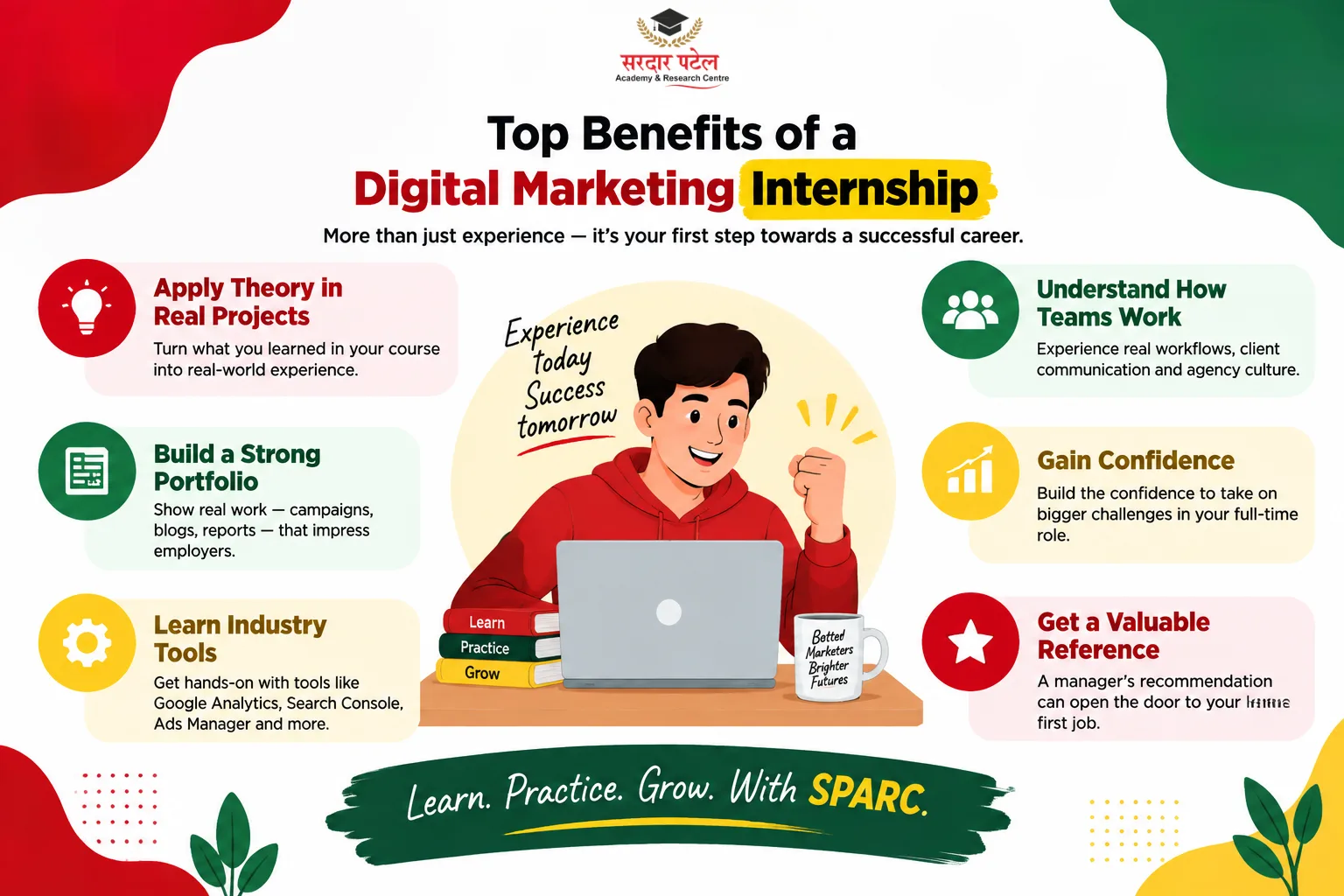
This is where things get interesting, because the internship benefits after a digital marketing course go beyond just adding a line to your resume.
- You get to apply theory in a live setting. Courses teach concepts. Internships show you how those concepts behave when a client changes their mind mid-campaign or when an ad account suddenly underperforms.
- You build a portfolio you can actually show. Employers care less about certificates and more about proof of work. Screenshots of a campaign you optimized, a blog you wrote that ranked, or a report you built carry real weight in interviews.
- You understand tools the way professionals use them. Reading about Google Search Console in a course is one thing. Using it daily to track indexing issues or click-through rates is another. If you want a deeper walkthrough of how this works in practice, our Google Search Console tutorial for students is a useful next read.
- 4. You learn how agencies and in-house teams actually operate. Deadlines, client feedback loops, internal approvals — none of this shows up in a syllabus, but all of it shapes how you'll work once you're full-time.
- It often becomes your first real reference point. A manager who's seen your work first-hand can vouch for you in a way that a course certificate simply can't. We've seen this play out directly with Arjun, one of our students who turned an internship into their first SEO role. Read the full story: How Arjun Got His First SEO Internship.
Pros and Cons of Starting With an Internship
Pros:
- Lower pressure while you're still learning the ropes
- Room to make mistakes without major consequences
- Easier entry point if you have zero prior work experience
- Builds real examples for your portfolio
Cons:
- Stipend is often low or non-existent
- Some internships offer more busywork than genuine learning
- Duration is temporary, so job security isn't guaranteed
Pros and Cons of Jumping Straight Into a Full-Time Job
Pros:
- Stable income from day one
- Faster career progression if you perform well
- More ownership, which can accelerate learning under pressure
Cons:
- Steeper learning curve with less guidance
- Higher expectations even in your first few weeks
- Mistakes carry more visible consequences
Common Mistakes Freshers Make When Choosing
A few patterns show up again and again among students trying to decide between an internship and a job:
- Chasing a job title over actual skill-building. A "Digital Marketing Executive" title means little if you're not learning anything new after three months.
- Assuming internships are only for people with no experience. Even working professionals switching into digital marketing benefit from a short internship to rebuild practical skills.
- Picking based on stipend alone. A slightly lower-paying internship with hands-on live projects often beats a better-paid one where you're mostly observing. If you're weighing this trade-off, our comparison on live projects vs certificates in a digital marketing course breaks this down further.
- Ignoring the mentorship factor. Working under someone who actually reviews your work and gives feedback matters more than the company's brand name.
How to Decide: Internship or Job?
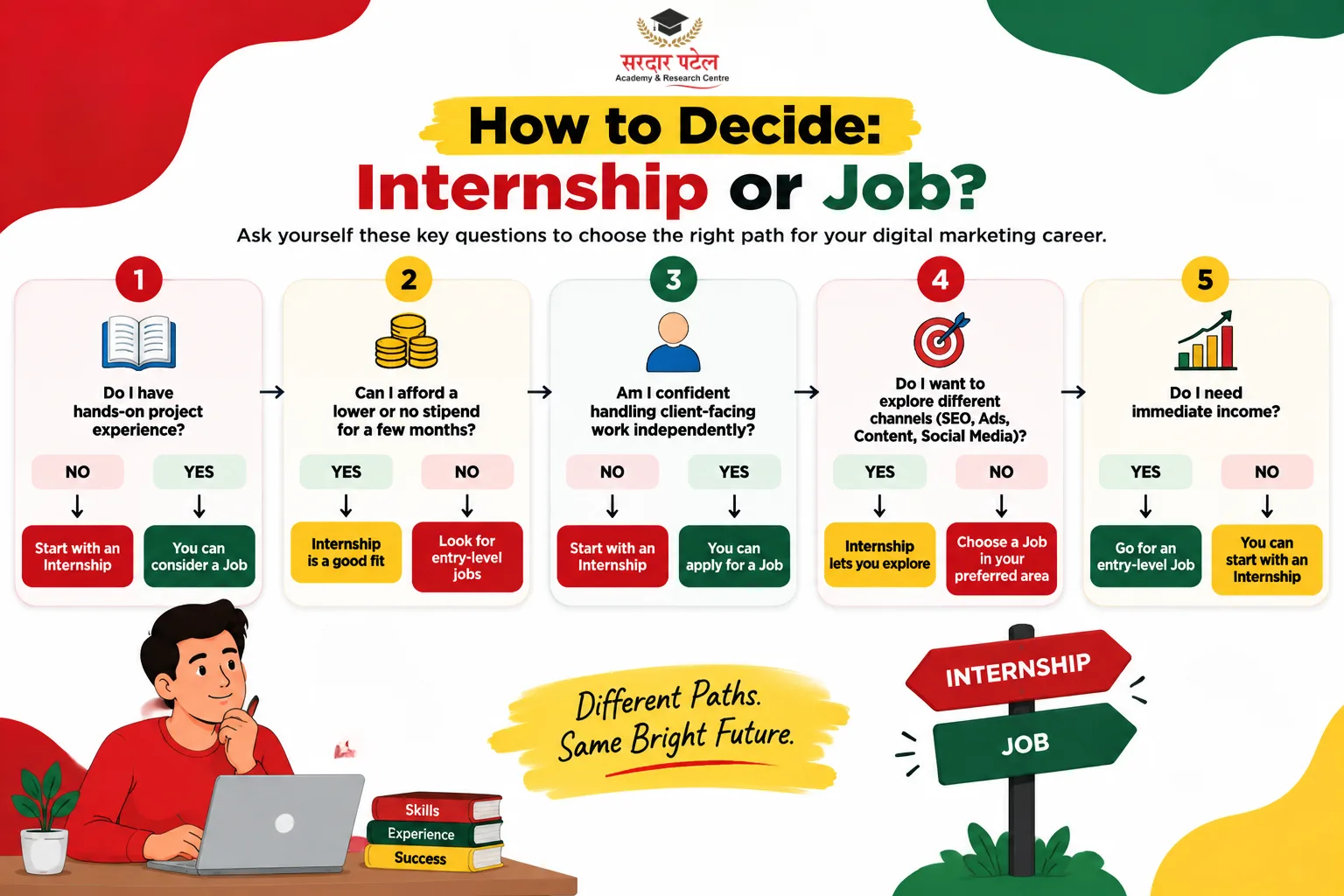
Ask yourself these questions before deciding:
- Do I have hands-on project experience, or only theoretical knowledge?
If it's mostly theory, an internship will close that gap faster than a job will. - Can I currently afford a lower or no stipend for a few months?
If not, you may need to prioritize paid roles, even entry-level ones. - Am I confident handling client-facing work without supervision?
If not, the mentorship structure of an internship will serve you better. - Is there a specific channel (SEO, ads, content) I want to specialize in?
Internships let you explore before committing; jobs often expect you to pick a lane early.
There's also a middle path worth mentioning: many students in Delhi NCR complete a short internship first and use it as a stepping stone into a full-time role at the same company or a related one. This is fairly common in the local job market, where agencies and startups frequently convert strong interns into full-time hires once they've seen consistent output.
Internship vs Job: What About Career Growth Long-Term?
Neither path guarantees faster growth on its own. What matters more is how quickly you build measurable skills — whether that's through an internship's structured learning or a job's real-world pressure. Many professionals who started with an internship end up growing just as fast, sometimes faster, because they entered their first full-time role already comfortable with tools, workflows, and client expectations.
Final Thought
There's no universally "correct" side to the digital marketing internship vs job debate. If you're still building confidence with tools, campaigns, and client communication, an internship gives you room to learn without the full weight of expectations. If you already have practical exposure and want to start earning while growing on the job, a full-time role might suit you better.
What matters most is choosing a path that actually builds your skills, not just your resume. If you're currently deciding what comes next after your digital marketing course, Sardar Patel Academy & Research Centre (SPARC), GTB Nagar, Delhi, can help you understand your internship options.
Explore our Digital Marketing Course to learn more about practical training and internship opportunities. You can also contact our team at +91 93129-66129 / +91 93129-77129 to understand the available batches and application process.
FAQs
freshers, yes. An internship gives you practical exposure and portfolio work, both of which make job applications significantly stronger.
Stipends vary widely depending on the company, city, and your existing skill level. Some are unpaid, others offer a modest monthly stipend — it's rarely comparable to a full-time salary.
Yes, especially if you already have practical project experience from your course or personal work. However, expect a steeper learning curve without mentorship support.
Most internships run between two and six months. Anything shorter rarely gives enough time to work across a full campaign cycle.
No, it's not guaranteed, but many companies do prefer converting strong-performing interns into full-time employees rather than hiring externally.
Prioritize SEO fundamentals, running small ad campaigns, content writing, and getting comfortable with analytics tools — these form the backbone of most entry-level roles.
It depends on the quality of work you'll actually be doing. An unpaid internship with genuine live project exposure can be worth more long-term than a paid one that's mostly repetitive tasks.