+91 9312966129
 sparc.enquiry01@gmail.com


Why AI + Analytics Professionals Are in Demand
AI analytics jobs are growing fast in India. See why AI + analytics skills are in demand, what roles are opening up, and how to get started.

Table of Contents
- What Do We Actually Mean by "AI + Analytics" Roles
- Why AI Analytics Jobs Are Growing So Fast in India
- The Skills Gap Behind the Demand
- What Kind of Roles Fall Under AI Analytics Jobs
- AI Tools in Analytics Career: What's Actually Changing
- Why This Matters More in Delhi NCR Right Now
- Skills That Make You Employable in This Space
- Benefits and Limitations of Moving Into AI + Analytics
- Benefits:
- Limitations:
- How to Actually Get Started
- Final Thoughts
Every second job posting in analytics today seems to mention AI in some form — AI-assisted reporting, AI-driven forecasting, GenAI dashboards. If you're a student, working professional, or business owner trying to figure out whether this is a real shift or just buzzwords, the honest answer is: it's real, and the demand for AI analytics jobs in India is growing faster than the supply of people qualified to fill them.
This article looks at why that gap exists, what roles are opening up, which skills matter, and what this means if you're based in Delhi NCR.
What Do We Actually Mean by "AI + Analytics" Roles
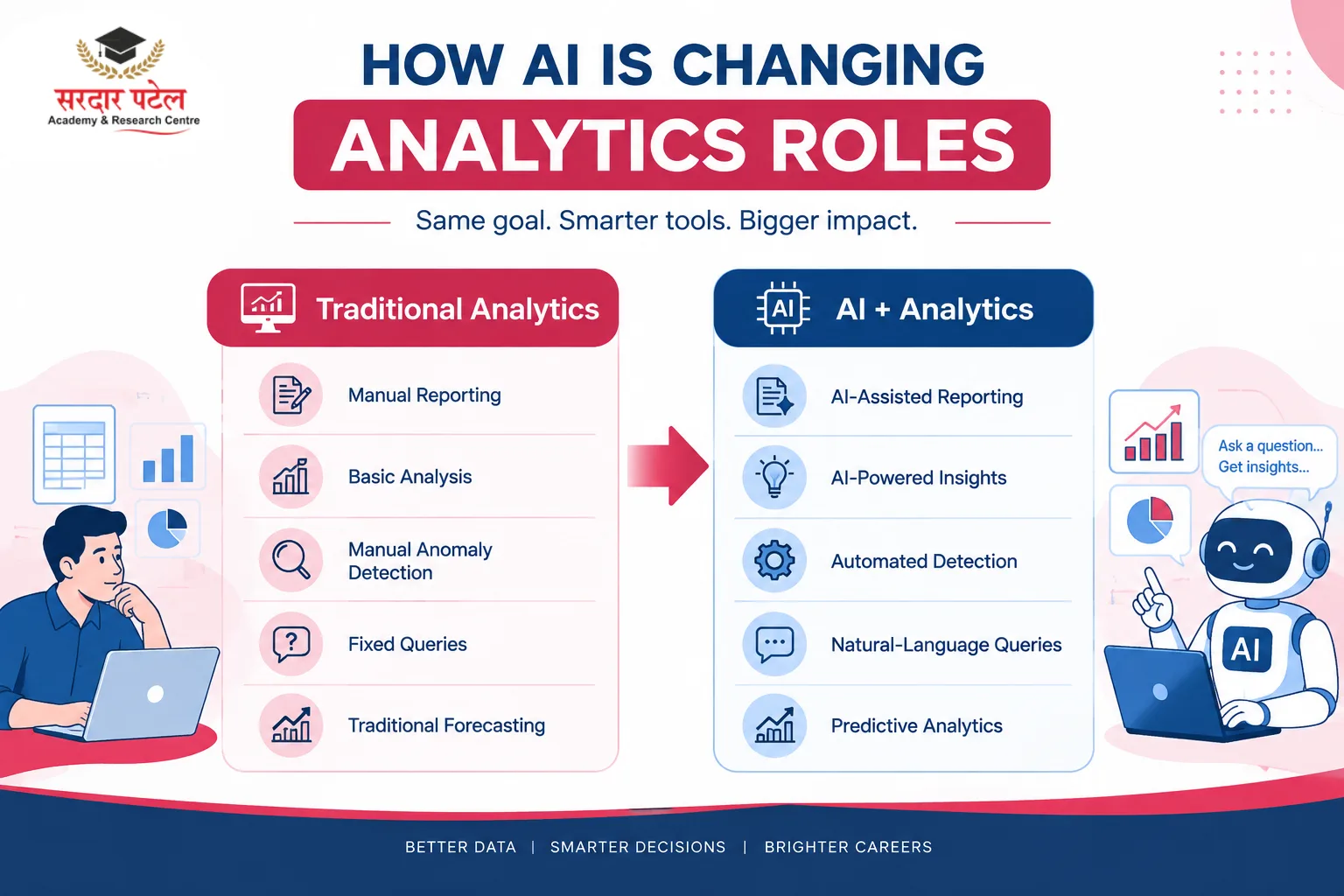
"AI + analytics" isn't a single job title — it describes how traditional analytics work is changing. A few years ago, an analyst's job was mostly pulling data, cleaning it, and building reports manually. Today, more of that work is AI-assisted: automated anomaly detection, AI-generated trend summaries, natural-language queries against a dataset, and predictive models that used to need a dedicated data scientist.
This doesn't mean analytics roles are being replaced by AI — it means expectations attached to the role are shifting. Companies increasingly want people who can use AI tools to work faster and more accurately, not just people who know Excel or SQL in isolation.
Why AI Analytics Jobs Are Growing So Fast in India
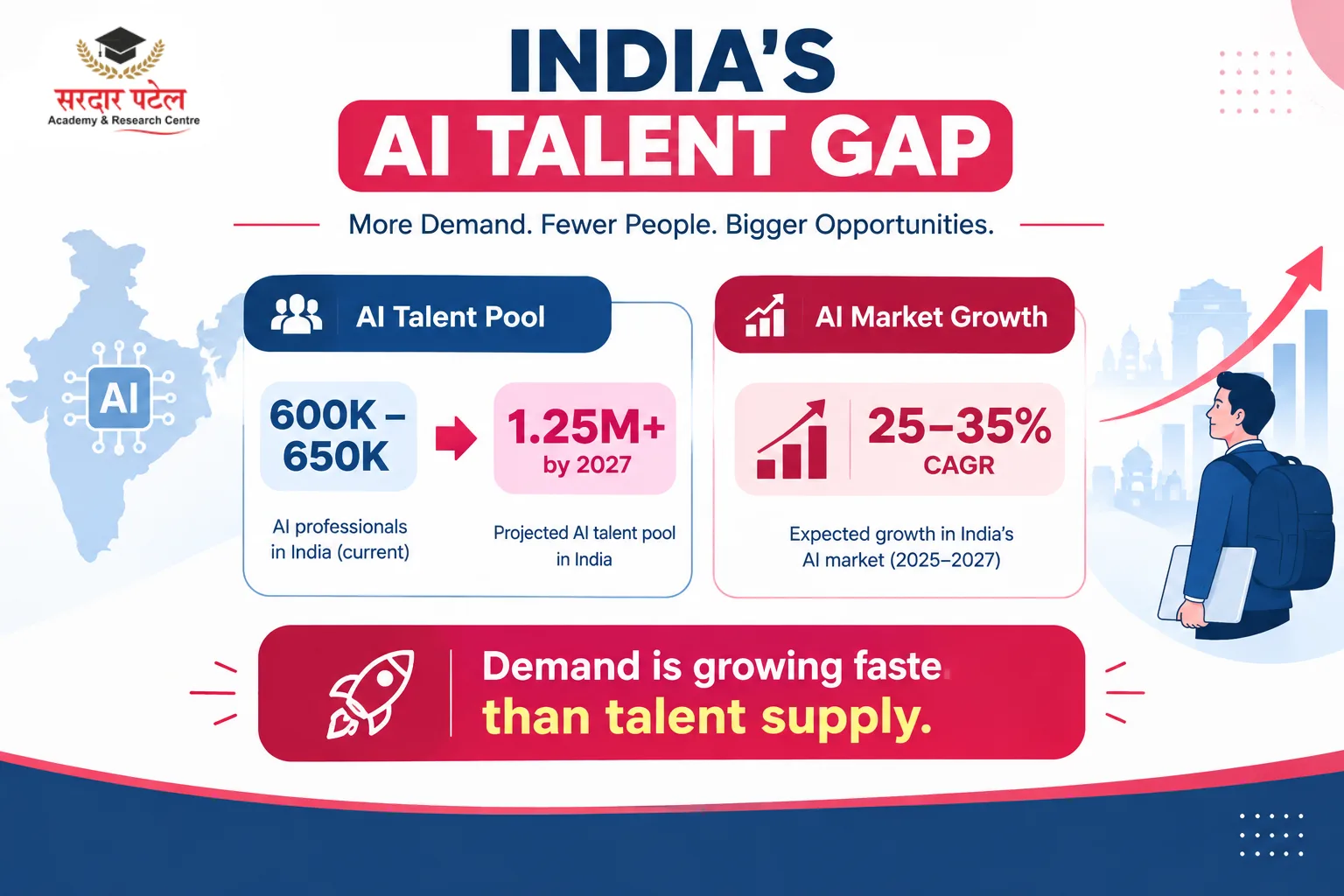
A joint report by Deloitte India and NASSCOM, "Advancing India's AI Skills: Interventions and Programmes Needed," gives a useful sense of scale. India's AI talent pool is projected to grow from around 600,000–650,000 professionals to more than 1.25 million by 2027. Over the same period, India's AI market is expected to grow at 25–35% CAGR — meaning demand is expanding faster than the talent pool feeding it, pointing to a real, ongoing skills gap rather than a temporary hiring spike.
A few forces are driving this beyond the numbers:
- Businesses are sitting on more data than they can manually process. Every customer interaction, transaction, and campaign now generates data. AI tools help companies actually use that data instead of letting it pile up unanalysed.
- AI adoption needs people who understand both the tool and the business problem. A model or dashboard is only useful if someone can interpret it correctly and apply it to a real decision — exactly where trained analytics professionals fit in. Recent Microsoft and LinkedIn research also highlights the growing importance of AI skills in India's workplace, with 92% of Indian knowledge workers reporting AI use at work.
- Companies are automating the repetitive parts of analytics work. This frees analysts to spend more time on interpretation and strategy, raising the bar for what "being good at analytics" means, rather than reducing the need for analysts. This growing use of data also highlights the importance of data analytics in business, particularly when companies need to turn large volumes of information into actionable decisions.
- India's IT and services sector is investing heavily in AI skilling. Several large IT companies have run internal AI training programmes for hundreds of thousands of employees in the past two years, per the same Deloitte-NASSCOM report — reflecting how central this skill set has become industry-wide, not just in specialised AI teams.
→ Ready to build these skills yourself? Explore SPARC's Data Analytics Course with AI
The Skills Gap Behind the Demand
It's worth being precise about what "skills gap" actually means here, because it's often misread as "there aren't enough coders." That's not quite it.
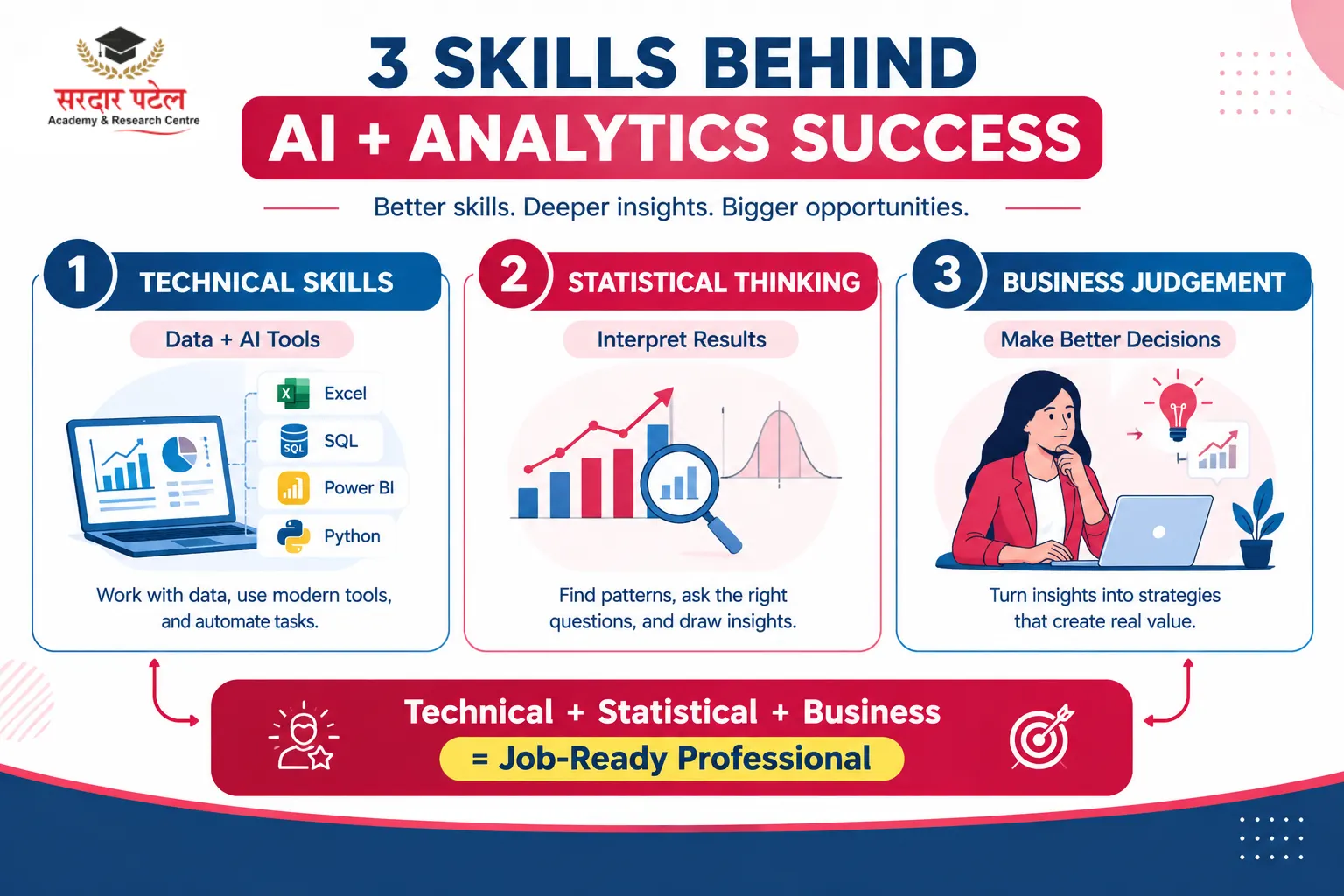
The gap is largely about people who combine three things at once: technical comfort with data and AI-assisted tools, enough statistical understanding to interpret results correctly, and business judgement to know what question is worth asking. Plenty of people have one or two of these. Fewer have all three — and that combination is exactly what most AI analytics job postings are looking for.
This is good news if you're starting, because the entry point isn't "become a machine learning researcher." It's closer to "get genuinely good at analytics, and learn to use AI tools as part of that work" — a far more achievable goal for most students and career switchers.
What Kind of Roles Fall Under AI Analytics Jobs
The demand doesn't sit in one narrow job title — it spreads across several roles that all touch AI and analytics differently.
| Role |
What It Typically Involves |
| Data Analyst (AI-assisted) |
Traditional reporting and dashboards, increasingly using AI for faster cleaning and pattern detection |
| Business Intelligence Analyst |
Building dashboards and reports, often with AI-generated insights layered on top |
| AI/Analytics Associate |
Supporting model outputs, validating predictions, translating results for business teams |
| Marketing/Growth Analyst |
Using AI tools to analyse campaign performance and customer behaviour at scale |
| Junior Data Scientist |
Building and testing models, usually requiring stronger statistics and programming skills |
| MIS/Reporting Analyst with AI tools |
Automating recurring reports using AI-assisted spreadsheet and BI tools |
AI Tools in Analytics Career: What's Actually Changing
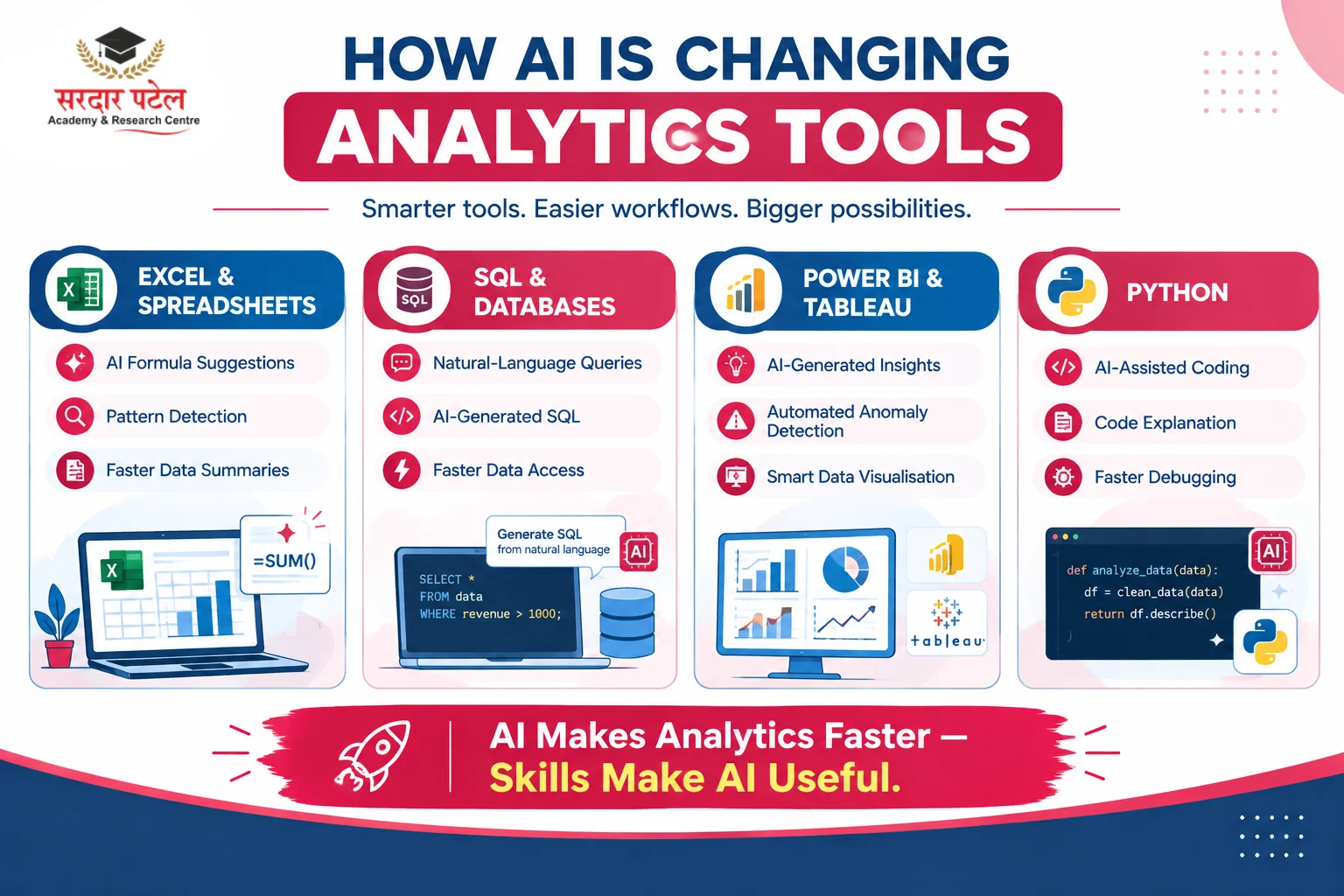
If you're mapping out AI tools in analytics career paths, the shift is less about replacing core skills and more about adding a layer on top of them.
- Excel and spreadsheets now often include AI-assisted formula suggestions and pattern detection, but structuring and cleaning data still matters — AI tools work better on well-organised data, not despite it.
- SQL and databases remain central, though natural-language-to-SQL tools make it easier to query data without writing every line manually. Understanding SQL logic is still valuable even when a tool generates some of the syntax.
- BI tools like Power BI and Tableau increasingly include AI-generated insights and automated anomaly flags, but someone still needs to decide which insight actually matters for the business.
- Python and statistical tools remain relevant for advanced roles, and AI coding assistants have made it faster to write and debug scripts — though understanding what the code does is still essential; you can't fully outsource judgement to a tool. To understand the core data analytics tools you must know, beginners can also explore our guide covering the essential tools used across analytics workflows.
AI tools are changing how analytics professionals work, from faster reporting to AI-assisted coding. How ChatGPT is Changing Analytics Careers explains how this shift is affecting analytics roles and career expectations.
The common thread: AI tools change how fast you work, not what you fundamentally need to understand.
Why This Matters More in Delhi NCR Right Now
Delhi NCR has one of the densest concentrations of IT services companies, consulting firms, fintech startups, and D2C brands in the country — all sectors actively investing in AI-driven analytics. A fintech startup in Gurugram might need someone to interpret AI-flagged transaction anomalies; a consulting firm in Delhi might need analysts who use AI tools to speed up client reporting.
For students and working professionals in Delhi NCR, the opportunity isn't limited to one industry — finance, retail, marketing, and operations are all looking for the same underlying combination: solid analytics fundamentals plus comfort with AI-assisted tools. For a closer look at the local job market, check our Delhi Analytics Hiring Report 2026 to understand current hiring trends, in-demand roles, and opportunities in the Delhi NCR region.
Skills That Make You Employable in This Space
You don't need to become an AI researcher to be considered for these roles. What consistently shows up in job requirements is more grounded:
- Core analytics skills — Excel, SQL, and a visualisation tool like Power BI or Tableau, the daily-use foundation
- Basic statistics — enough to interpret trends, correlations, and model outputs correctly, rather than take them at face value
- Comfort using AI-assisted tools — using AI features inside your existing tools (spreadsheet AI functions, BI copilots, coding assistants) rather than treating them as unfamiliar
- Business context — understanding what a metric means for a company's decisions, not just how to calculate it
- Clear communication — explaining what an AI-generated insight actually means to someone non-technical
Python and deeper machine learning knowledge matter more as you move into specialised or senior roles, but they're rarely a strict requirement to enter the field. For a broader understanding of data analytics career scope, skills, and salaries, you can explore our detailed career guide.
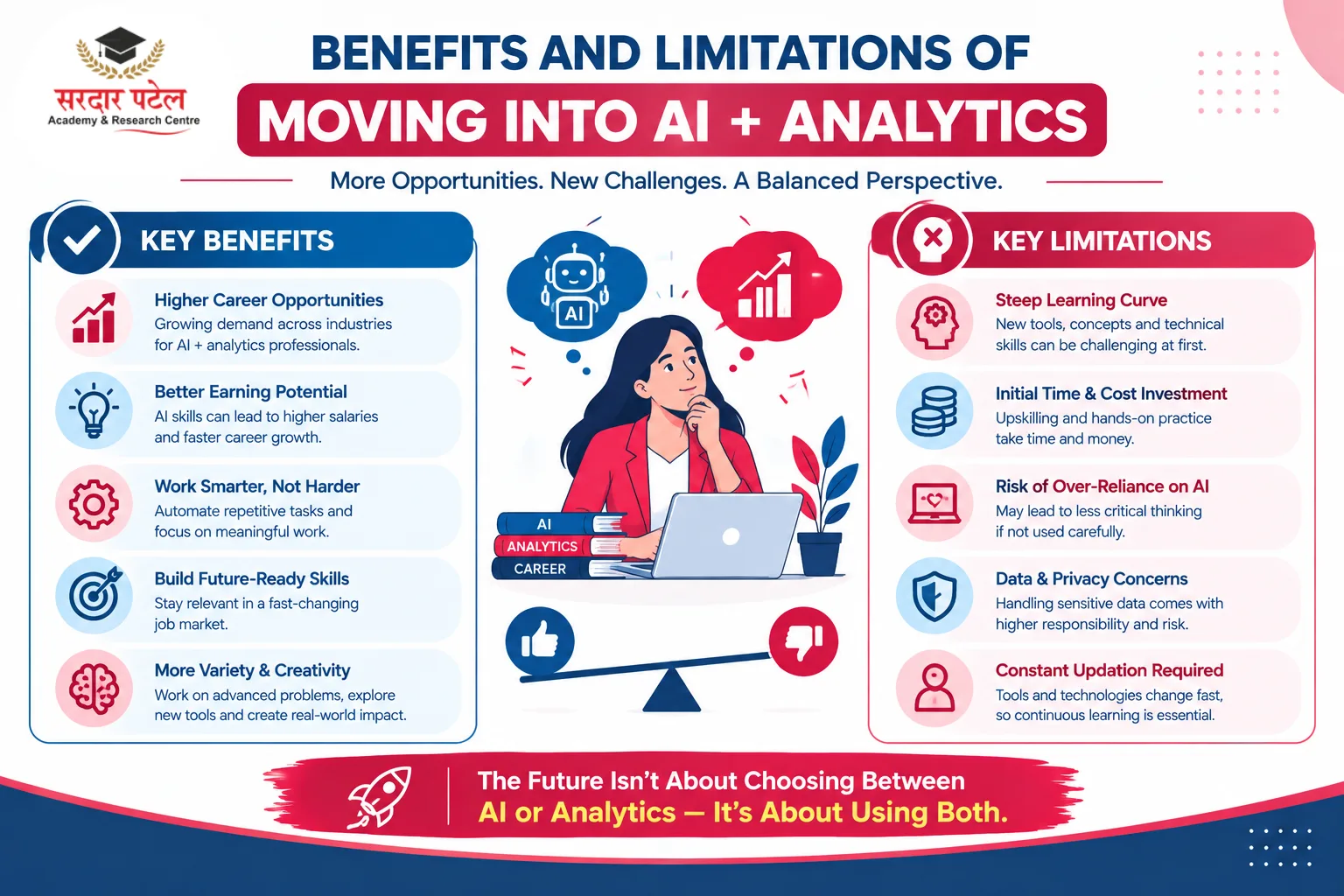
Benefits and Limitations of Moving Into AI + Analytics
Benefits:
- Strong, sustained hiring demand backed by a genuine skills gap, not short-term hype
- Roles spread across almost every industry, not limited to one sector
- Clear progression from entry-level analytics into more AI-focused positions over time
- Skills that stay useful even as specific tools change, since the logic of good analysis doesn't shift as fast as the tools do
Limitations:
- The field moves quickly, so ongoing learning is part of the job, not a one-time course
- Entry-level roles still expect solid analytics fundamentals — AI tools don't replace understanding your data
- Not every "AI analyst" job is equally well-defined; ask specific questions about actual tools and responsibilities in interviews rather than assuming from the title
How to Actually Get Started
- Build the analytics foundation first — Excel, SQL, and one visualisation tool. This remains the base everything else sits on.
- Get comfortable using AI features inside tools you already use — spreadsheet AI functions, BI copilots, or AI coding assistants — rather than treating them as separate from your core work.
- Work on real or realistic datasets, not just tutorials, so you build the judgement to spot when an AI-generated insight looks off.
- Learn basic statistics properly so you can evaluate AI outputs critically instead of accepting them automatically.
- Build two to three portfolio projects that go from raw data to a clear business recommendation, ideally with an AI-assisted step included.
If you're based in Delhi NCR and prefer structured, guided learning, Sardar Patel Academy & Research Centre (SPARC) runs practical analytics training built around exactly this kind of project-based, tool-focused learning.
Final Thoughts
The rise in AI analytics jobs isn't a passing trend — it reflects a genuine, measurable gap between how fast India's AI-driven analytics market is growing and how many people are equipped to work in it. For students, freshers, and working professionals, that gap is an opportunity, provided you focus on fundamentals first and treat AI tools as something you learn to use well, not something you wait to be forced into.
Ready to Learn AI Analytics Skills?
→ Explore SPARC's Data Analytics Course with AI
FAQs
Not for most entry-level roles. A solid grip on Excel, SQL, statistics, and business context matters more at the start. Machine learning becomes more relevant in specialised data science roles.
Not in the way often feared. AI is automating repetitive tasks like data cleaning and basic reporting, but interpreting results and applying them to real decisions still needs a human who understands the business.
There isn't always a strict line — many analyst roles now expect comfort using AI-assisted tools as part of the job, rather than being a separate title altogether.
Start with AI features inside tools you already use — spreadsheet AI functions and BI copilots — before moving to more advanced tools like Python-based AI libraries.
Both. Many entry-level roles now expect basic AI-tool familiarity, but strong fundamentals still matter more than AI exposure alone at the fresher level.
It's spreading. While hubs like Delhi NCR see especially dense demand, sectors like retail, finance, and healthcare across the country are adopting AI-driven analytics at a growing pace.
It depends on your starting point and consistency, but a focused few months of building core analytics skills alongside AI-tool familiarity is a realistic target for most beginners.