+91 9312966129
 sparc.enquiry01@gmail.com


How to Get Your First Job as an Accountant? Practical Guide
Learn how to get your first job as an accountant with essential Tally, GST, and Excel skills, resume tips, interview preparation, and job search advice for freshers.
Table of Contents
- What Does an Entry-Level Accountant Do?
- Common Entry-Level Roles to Search For
- Skills Employers Look for in a Fresher Accountant
- Technical skills
- Soft skills
- 7 Steps to Get Your First Job as an Accountant
- Step 2 in more detail: practise like it's a real job
- Where to Look for Fresher Accountant Jobs in Delhi NCR
- How to Build a Resume for a Fresher Accountant Job
- Accountant Interview Preparation: What to Expect
- Commonly asked questions
- A sample answer
- Interview day tips
- Common Mistakes Freshers Make
- Do You Need a Course to Get Your First Job as an Accountant?
- Practical Tips to Stand Out
- Conclusion
You've finished your degree, or you're close to it. You know the basics of debit and credit. But when you open a job portal and see "1–2 years of experience required" on almost every accounting post, it's hard not to wonder where to begin.
This is a common problem, and it can be solved. Most employers hiring a fresher don't expect deep experience. They want to see that you can do the daily work: enter vouchers, reconcile a bank statement, handle GST basics, and use Excel without panic. If you're starting from zero, here's a practical guide on how to get an accounting job without experience and demonstrate your skills to employers.
In this guide, you'll learn what entry-level accountants actually do, which skills matter, and a step-by-step plan to land your first job as an accountant. You'll also get interview preparation tips and local pointers for job hunting in Delhi NCR.
What Does an Entry-Level Accountant Do?
An entry-level accountant records, checks, and organises a business's financial transactions so that its books are accurate and ready for tax filing and reporting. Explore the different accounting jobs for freshers, including roles, skills, and career opportunities, to understand which position best matches your qualifications.
On a normal day, a fresher usually does some mix of the following:
- Enter purchase, sales, receipt, and payment vouchers in accounting software
- Match bank statements with the company's books (bank reconciliation)
- Prepare GST invoices and help with return data
- Maintain ledgers for customers and suppliers
- Follow up on pending payments or bills
- Prepare simple reports in Excel for a senior or the owner
You will not be preparing audit reports or advising on tax strategy in your first year. Your job is to be accurate, careful, and dependable. That is what gets you promoted.
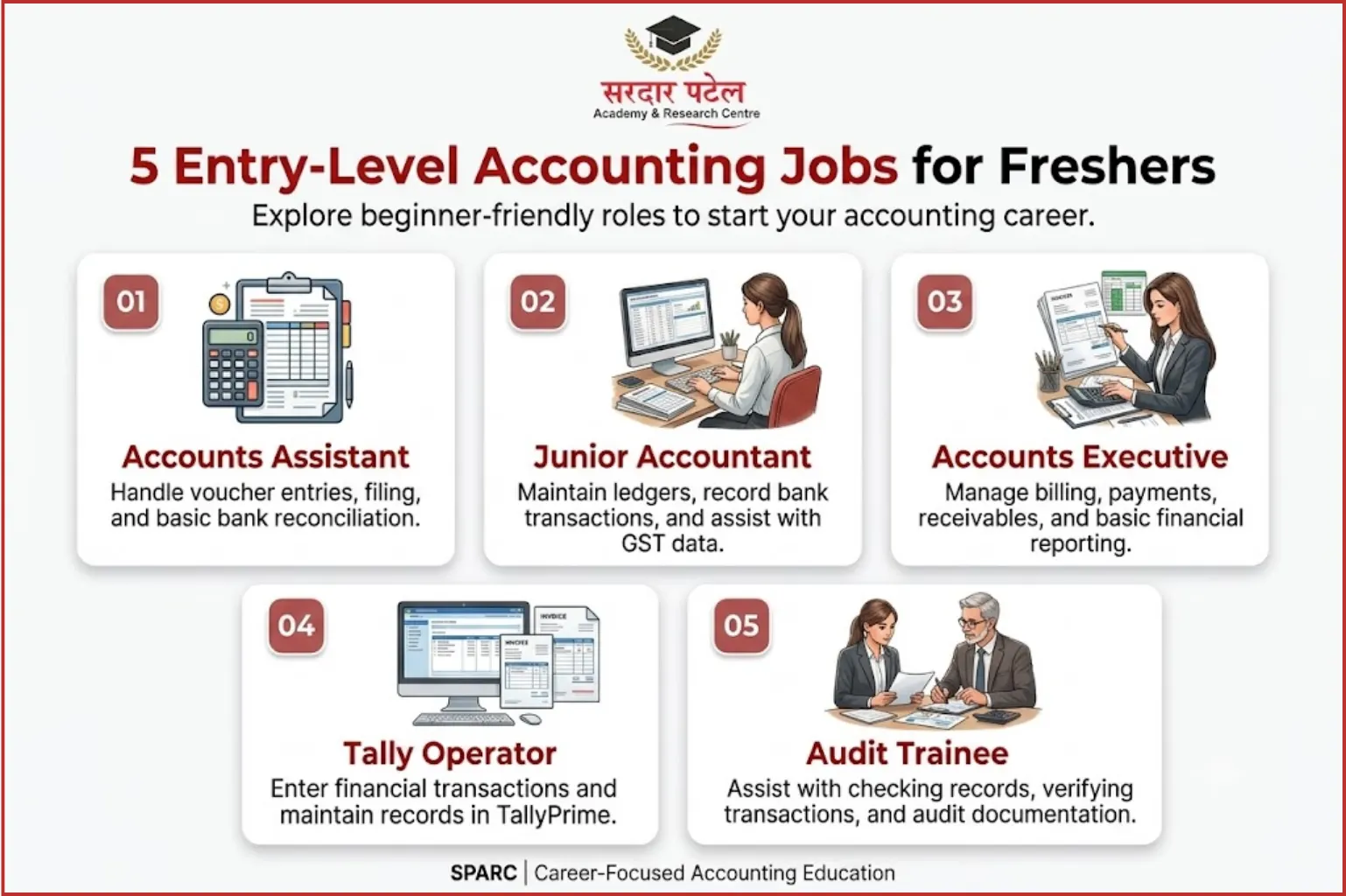
Common Entry-Level Roles to Search For
Job titles vary from company to company. Searching only for "accountant" can make you miss good openings.
| Job title |
What it usually involves |
Good for |
| Accounts Assistant |
Voucher entry, filing, basic reconciliation |
Absolute beginners |
| Junior Accountant |
Ledgers, GST data, bank entries |
Commerce graduates with Tally skills |
| Accounts Executive |
Billing, payments, receivables, reporting |
Freshers with Excel and GST knowledge |
| Tally Operator / Data Entry (Accounts) |
Entering data in Tally |
Students starting out |
| Audit or Articleship Trainee |
Working under a CA firm |
CA/CMA aspirants |
Treat the first role as a learning platform. It may not be your dream title, but it gives you the experience that every later employer will ask for.
Skills Employers Look for in a Fresher Accountant
Hiring managers know freshers lack experience. What they test is whether you are trainable and practically ready. For a more detailed breakdown, read about the accounting skills employers look for in freshers, from technical knowledge to workplace habits.
Technical skills
- Accounting fundamentals: journal entries, ledgers, trial balance, depreciation, basic final accounts
- Tally (TallyPrime): by far the most requested accounting software in small and mid-sized Indian businesses Before applying, review the TallyPrime skills every fresher should learn before applying for jobs so you can practise the tasks employers commonly expect.
- GST basics: invoices, input tax credit, returns, and how they connect to your books. Refer to the official GST Portal for GST-related services and information.
- Microsoft Excel: VLOOKUP/XLOOKUP, pivot tables, sorting, filters, and basic formatting. Beginners can practise these skills using Microsoft's official Excel help and learning resources.
- TDS basics: what it is and when it applies. Refer to the Income Tax Department's TDS guidance to understand tax deduction requirements.
Soft skills
- Attention to detail (one wrong digit can throw off a whole ledger)
- Clear communication, especially in emails and when asking questions
- Time management during month-end and return-filing weeks
- Honesty and confidentiality, since you will see sensitive financial data
If you have to pick one thing to strengthen first, pick Tally with GST. For many fresher accountant jobs, it's the skill that separates a shortlisted resume from a rejected one.
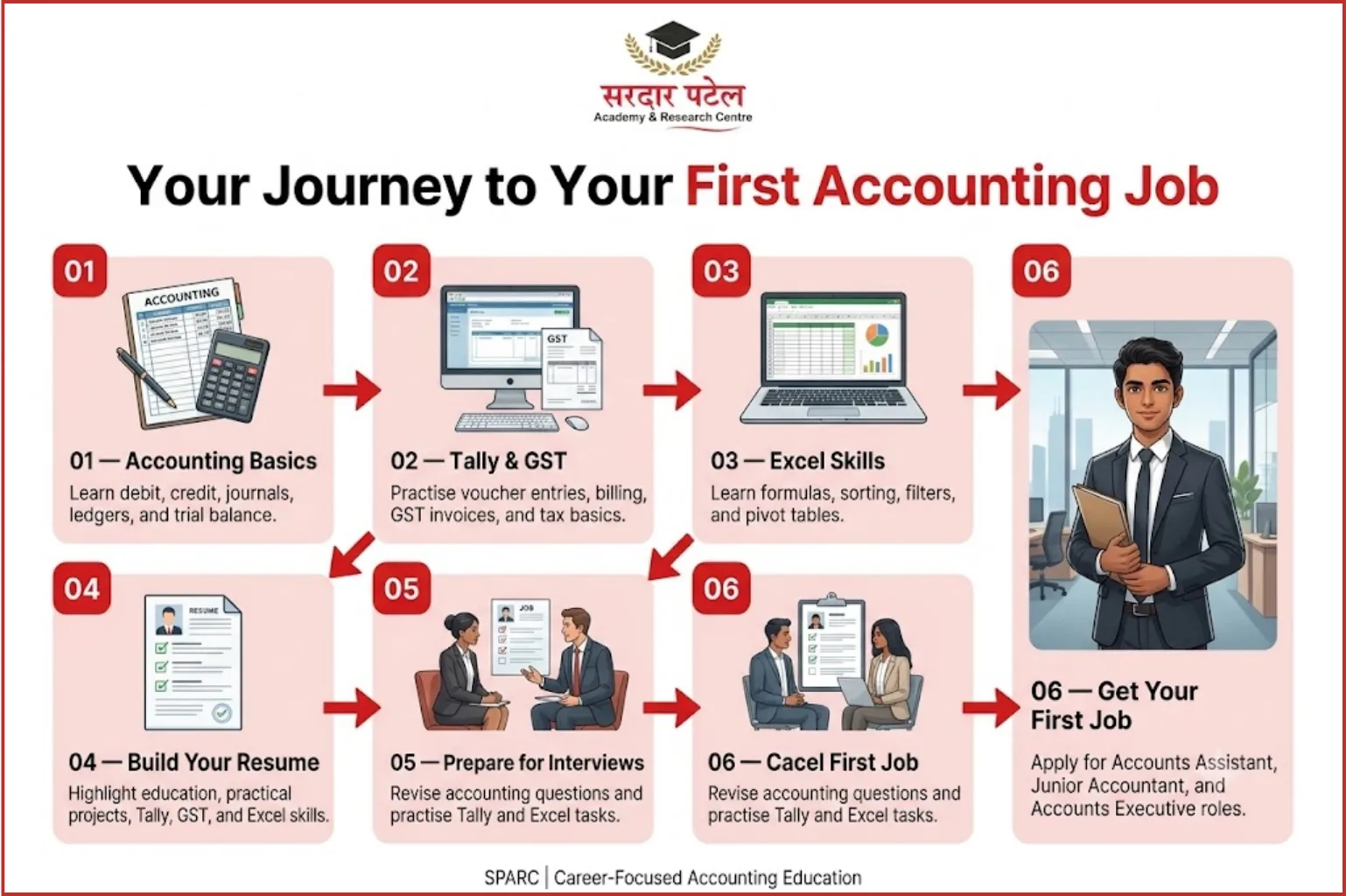
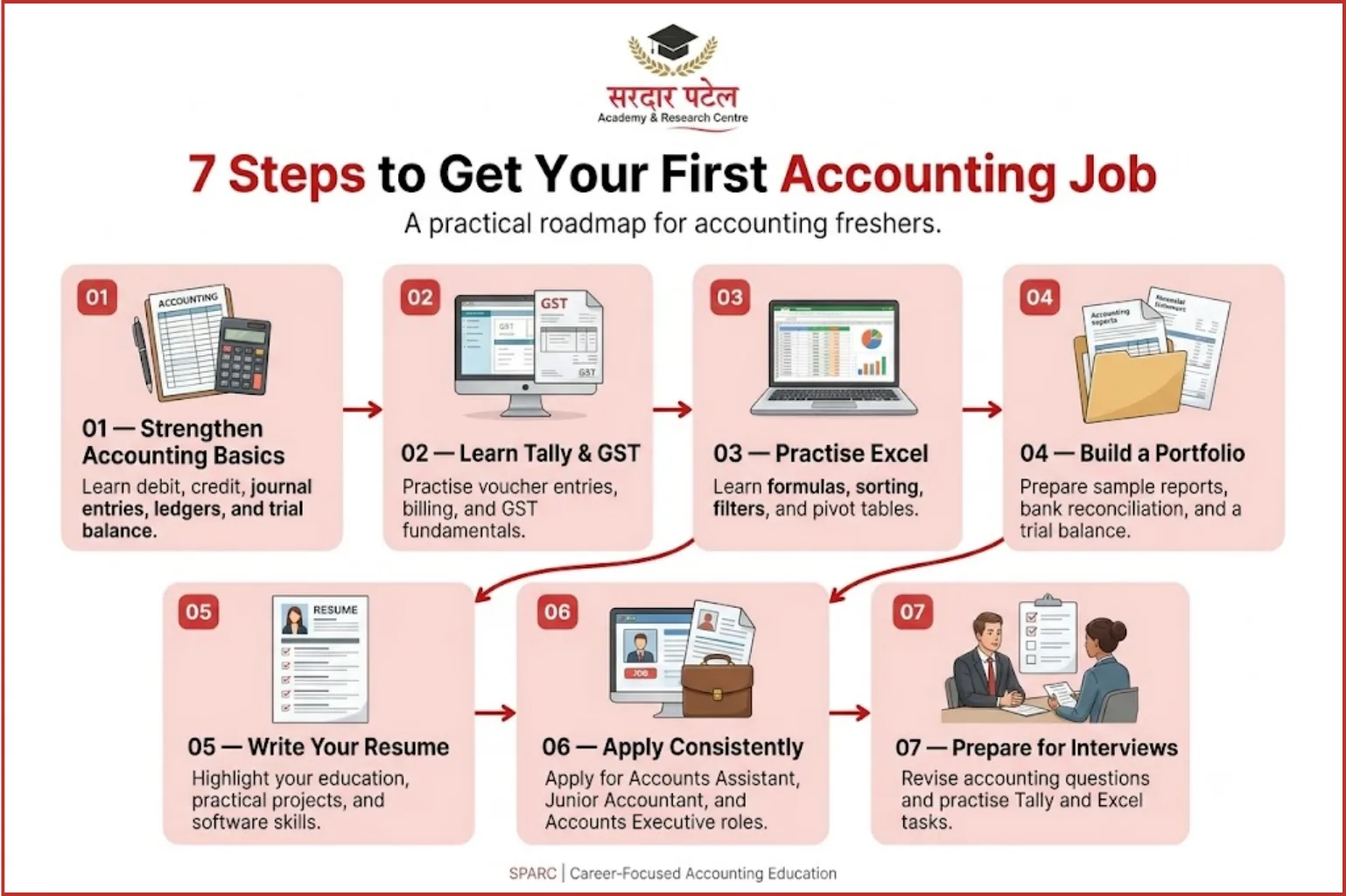
7 Steps to Get Your First Job as an Accountant
Here is a practical sequence you can follow, starting today.
- Strengthen your basics – revise accounting entries and the logic behind them. If you can't explain why an entry is passed, you will struggle in interviews.
- Learn Tally and GST by doing – watching videos isn't enough. Create a practice company and enter at least a few months of sample transactions.
- Get comfortable with Excel – practise on real-looking data, such as a sales register or expense sheet.
- Build a small portfolio of practice work – a bank reconciliation, a GST-ready sales register, and a trial balance you prepared yourself prove more than a line saying "knows Tally".Write a focused resume – keep it on one page. More on this below.
- Apply widely and consistently – aim for a steady number of applications weekly instead of a burst followed by silence.
- Prepare for the interview – practise answering out loud, not just reading answers.
Step 2 in more detail: practise like it's a real job
Many beginners finish a course but have never handled messy data. Try this exercise:
- Create a fictional trading company.
- Enter 30 sales invoices, 20 purchase bills, a few expenses, and bank receipts. Add GST at different rates.
- Then generate the trial balance, GST reports, and a bank reconciliation. For a practical walkthrough, refer to TallyPrime's bank reconciliation guide to understand how businesses review and reconcile banking transactions.
When you hit errors- and you will- solving them teaches you more than any tutorial. This is exactly the experience an employer wants to hear about in an interview.
Where to Look for Fresher Accountant Jobs in Delhi NCR
Delhi NCR has a large and varied market for accounts staff. Many openings are not on big job portals at all.
Where openings typically come from:
- Online job portals: Naukri and other job platforms are useful starting points. Search for terms like "fresher accountant", "accounts executive fresher," and "Tally operator" to find relevant openings.
- CA and CS firms: Many small and mid-sized practices around Connaught Place, Karol Bagh, Nehru Place and North Delhi hire trainees regularly.
- Trading and wholesale businesses: Areas like Azadpur, Sadar Bazar, Chandni Chowk and Kamla Nagar have many traders who need someone to maintain Tally books.
- Manufacturing and logistics firms: Industrial areas across Delhi, Noida, Ghaziabad and Gurugram often need accounts assistants.
- Walk-ins and referrals: Ask your trainers, seniors, and classmates. A referral often gets your resume read when a cold application wouldn't.
A practical local tip: if you live in or near GTB Nagar, Mukherjee Nagar, Kamla Nagar or Civil Lines, you have good Metro access to many of these job clusters. When you apply, mention that you are available locally and can join quickly. Employers like that, especially for roles that need on-site presence.
How to Build a Resume for a Fresher Accountant Job
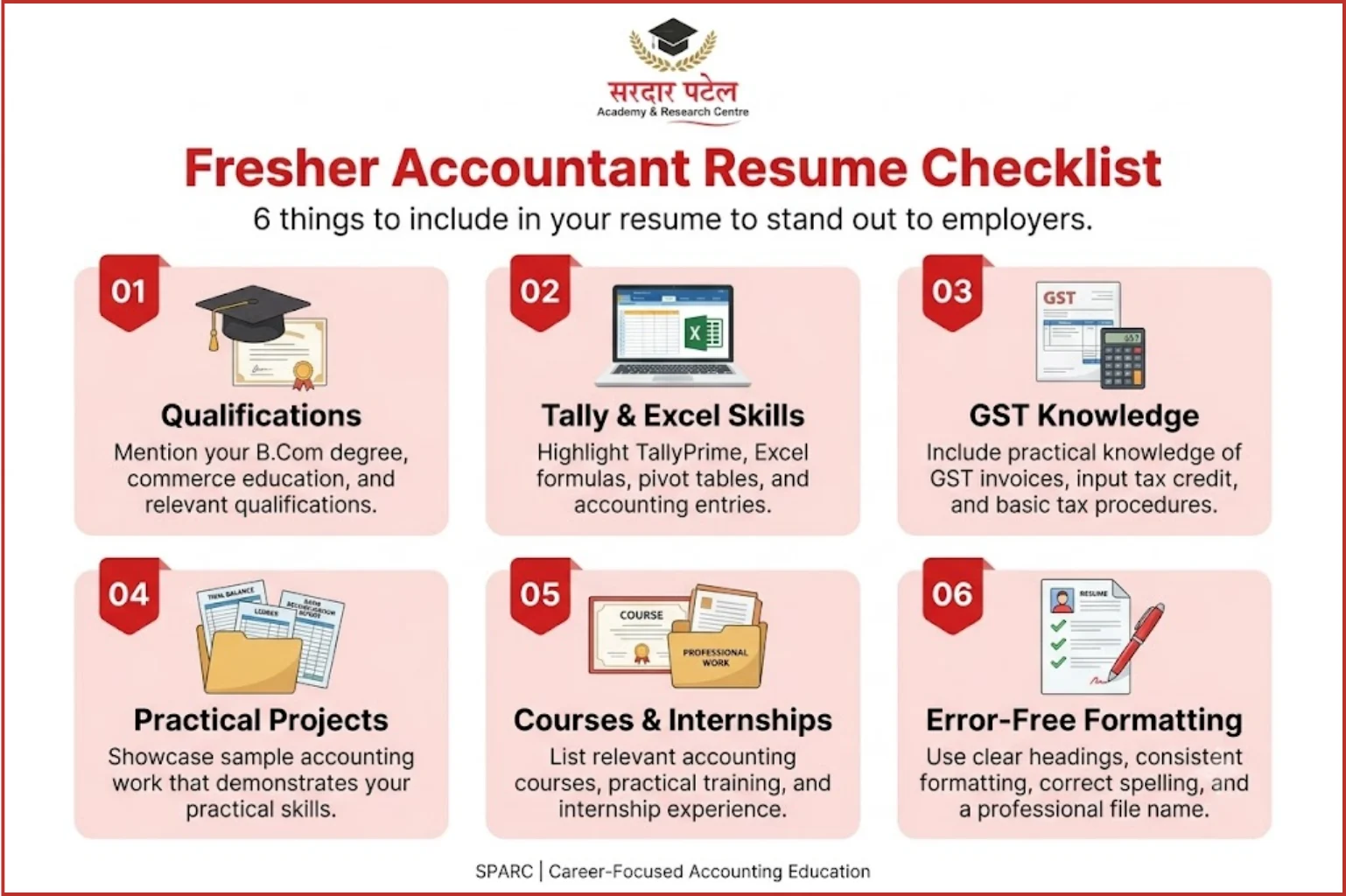
You don't have work experience, so your resume needs to show readiness in other ways.
What to include:
- A two-line summary stating your qualifications and core skills
- Software skills: Tally, Excel, GST knowledge
- Projects or practical work you completed
- Education and any short-term courses
- Internships, even unpaid or short ones
Sample summary:
Commerce graduate with hands-on practice in Tally, GST invoicing, and bank reconciliation. Comfortable with Excel and eager to start in an accounts executive role.
What to avoid:
- Fancy designs and photos that make the resume hard to read
- Vague claims like "good communication skills" without any example
- Listing skills you cannot actually demonstrate
- Typos (for an accountant, they raise a red flag)
Keep the file name simple, like Firstname_Lastname_Accounts_Fresher.pdf.
Accountant Interview Preparation: What to Expect
Good accountant interview preparation comes down to two things: knowing your fundamentals and speaking about them clearly.
Commonly asked questions
| Question |
What the interviewer wants to see |
| What is the difference between a journal and a ledger? |
Clear fundamentals |
| How do you do a bank reconciliation? |
Process thinking and accuracy |
| What is input tax credit in GST? |
Practical GST understanding |
| What have you done in Tally so far? |
Real, hands-on exposure |
| How do you handle a mismatch in books? |
Problem-solving approach |
| Why do you want to work in accounts? |
Motivation and seriousness |
A sample answer
- Question: What do you do if your trial balance doesn't tally?
"I first check whether the debit and credit totals differ by a round number, which often points to a transposition error. Then I recheck recent entries, look at opening balances, and verify any entries that were edited late. I'd also ask a senior if I'm stuck instead of guessing."
Notice the last line. Being honest about asking for help is a strength, not a weakness.
Interview day tips
- Carry printed copies of your resume and certificates
- Be ready for a short practical test in Tally or Excel
- Dress simply and neatly
- Reach out early and stay calm if asked something you don't know. Say what you would do to find the answer.
Common Mistakes Freshers Make
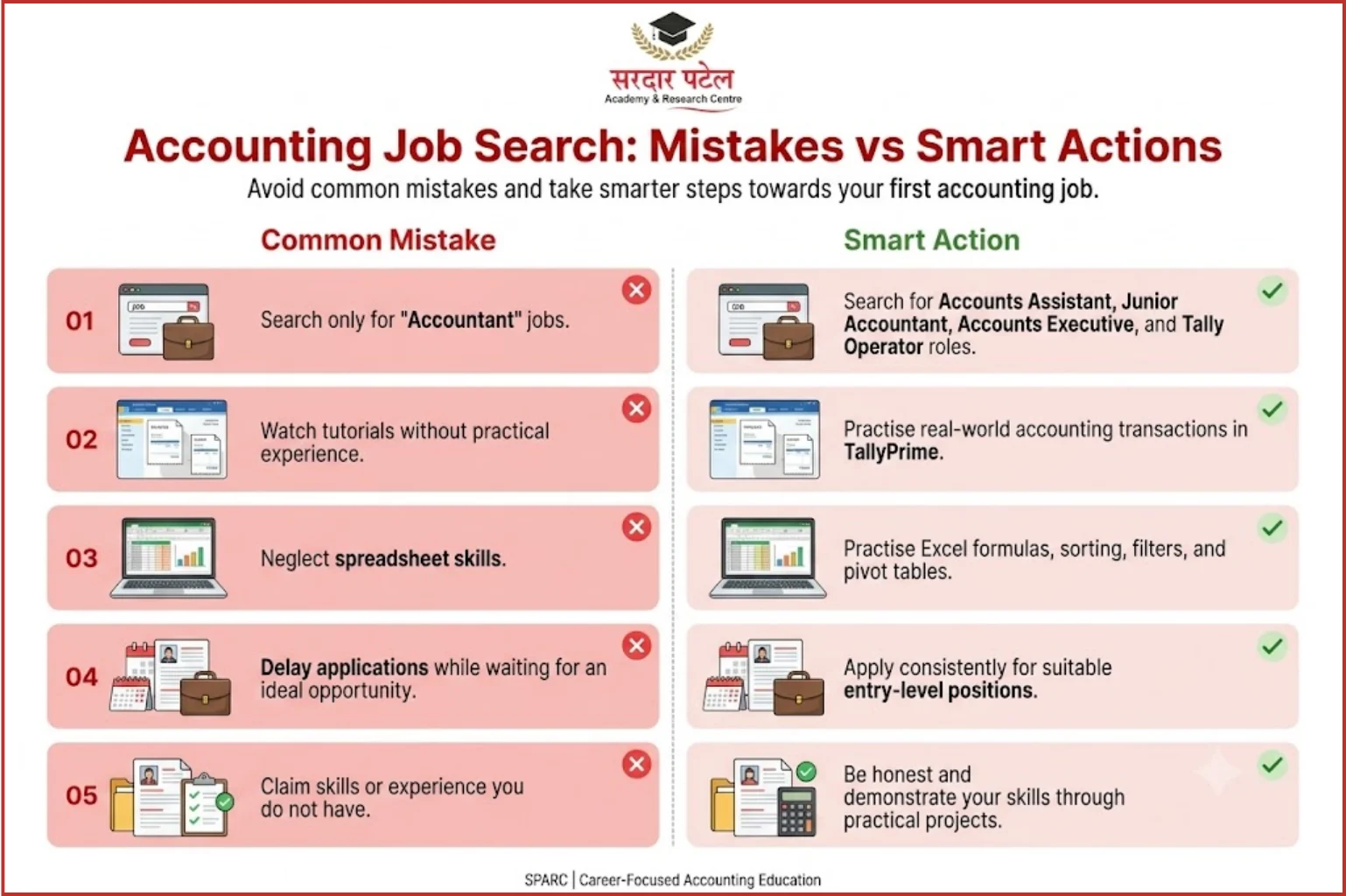
- Applying only for "Accountant" titles – search for assistant, executive, and operator roles too.
- Learning theory only – employers value what you can do on screen.
- Ignoring Excel – even basic Excel gaps can cost you an offer.
- Waiting for the perfect job – a modest first role with good learning is better than months of waiting.
- Not following up – a polite message after an interview shows interest.
- Lying about experience – it is easy to get caught in a practical test.
Do You Need a Course to Get Your First Job as an Accountant?
A degree like B.Com gives you a base, but it doesn't always cover day-to-day software work. Many students find a gap between what college teaches and what employers expect in week one. If you want a structured learning plan, follow this guide on how to become job-ready for an accounting career in 6 months, with a focus on practical skills and workplace readiness.
Here is an honest comparison:
| Approach |
Pros |
Cons |
| Self-study only |
Low cost, flexible |
No feedback, easy to learn wrongly, no practice structure |
| Online videos |
Good for concepts |
Hard to test real-world practice |
| Classroom practical training [SPARC accounting course page] |
Guided practice, doubts cleared, discipline |
Costs time and money; quality varies by institute |
Practical Tips to Stand Out
- Learn one thing deeply before spreading it across many tools
- Keep a simple notebook of errors you made and fixed
- Stay updated on GST changes and rule updates from official government sources
- Connect with accounting professionals on LinkedIn and ask sensible questions
- Treat your first six months as paid training
Conclusion
Landing your first job as an accountant isn't about luck. It's about showing a hiring manager that you can do the work from day one.
To recap: learn Tally and GST by practising, get comfortable in Excel, build a clean one-page resume, search under multiple job titles, and rehearse your interview answers. Be open to a modest starting role, because that experience becomes your strongest asset.
If you're in or around GTB Nagar and want guided, hands-on practice instead of figuring it all out alone, SPARC's practical accounting training is built around exactly these skills. Talk to the team and become job-ready for accounting, or call +91 93129-66129.
FAQs
Yes. Many companies hire freshers for assistant and junior roles. Practical Tally, GST, and Excel skills improve your chances a lot.
Accounting basics, Tally, GST fundamentals, and Excel. Accuracy and honesty matter just as much.
It varies. Your skills, how consistently you apply, and the job market all play a role.
It helps, and many employers prefer it, but practical skills often decide who gets hired for entry-level roles. Check each job listing's requirements.
Tally is widely used in small and mid-sized Indian businesses, so it's a safe starting point. Learn other tools as your job demands.
Learn the company's process, ask how entries are classified, take notes, and double-check your work before sending it.
Revise basics, practise Tally tasks, and rehearse short, clear answers aloud. Mock interviews with a friend or trainer help.
It depends on the city, company and your skills. Check current listings on job portals and note the ranges instead of relying on a fixed figure.