+91 9312966129
 sparc.enquiry01@gmail.com



Future of Data Analytics Jobs in India: A Career Report for 2030
Global data, India lens: explore the future of data analytics jobs in India — key roles, skills, AI’s impact and a practical roadmap to 2030.
Table of Contents
- Why the Analytics Job Market Keeps Evolving
- Forces Shaping the Future of Data Analytics Jobs in India
- Digital adoption beyond the metros
- Business teams asking sharper questions
- Data protection rules
- Automation of routine work
- What the Data Says
- Roles You Will See More Often
- Skills That Will Matter Most
- Technical foundations
- Human skills that employers keep asking for
- How AI Changes the Daily Work of an Analyst
- Industries to Watch
- How Hiring Is Changing
- The Analytics Career Future 2030: What to Expect
- Step-by-Step Roadmap for Freshers and Career Switchers
- Quick readiness checklist
- Common Mistakes to Avoid
- Conclusion
Ask ten hiring managers in Bengaluru, Pune or Gurugram what they want from an analyst today, and you will hear ten slightly different answers. That gap is the real story behind the future of data analytics jobs in India. The title "data analyst" has not disappeared, but the work behind it is changing quickly. Spreadsheets still matter. SQL still matters. Yet the people who get shortlisted are increasingly the ones who can connect numbers to a business decision and explain it in plain language.
This report is written by the team at Sardar Patel Academy & Research Centre (SPARC) for students, graduates and working professionals who are trying to judge where analytics careers are heading. It avoids invented salary tables and made-up growth percentages. Instead, it explains the forces shaping demand, the skills that are gaining weight, and a practical route you can follow if you want to build an analytics career future 2030 can still reward.
Why the Analytics Job Market Keeps Evolving
Every company now produces data, whether it sells insurance, groceries, software or school admissions. The harder part is turning that data into decisions. Analysts sit exactly at that point, which is why the future of data analytics jobs in India looks tied to how seriously Indian organisations treat evidence-based decision-making.
Three shifts explain most of what is happening in the future of data analytics jobs in India:
- Data is easier to collect than to understand. Dashboards are cheap to build; insight is not.
- Tools are becoming friendlier. Self-service platforms let non-technical teams explore numbers, so analysts are expected to add judgement rather than just pull reports.
- Regulation and trust are catching up. Companies must now think about how personal data is stored and used.
The World Economic Forum's Future of Jobs Report 2025 points to data and AI-related skills [Why AI + Analytics Professionals Are in Demand] among those employers expect to grow in importance globally. India is part of that picture, but local hiring depends on sector, city and company size, so treat any single national figure with caution.
Forces Shaping the Future of Data Analytics Jobs in India
Digital adoption beyond the metros
Many retail, logistics, banking and healthcare firms in tier-2 cities are digitising billing, inventory and customer records. Once records are digital, someone has to clean, interpret and report on them. This quietly widens the future of data analytics jobs in India beyond a handful of technology hubs.
Business teams asking sharper questions
A few years ago, a manager might have asked for "a sales report." Now the request is closer to "which customers are likely to stop buying next quarter, and why?" Answering that needs statistics, domain knowledge and communication, not only dashboard skills.
Data protection rules
India's Digital Personal Data Protection Act, 2023 is administered through the Ministry of Electronics and Information Technology, and its official framework page is the right place to read the primary documents. For analysts, the practical lesson is simple: knowing how to handle personal data responsibly is turning into a hiring advantage, not a legal footnote.
Automation of routine work
Repetitive tasks such as formatting reports, writing boilerplate queries or tidying columns are the first to be automated. That does not remove the profession. It shifts the value toward problem framing, validation and storytelling.
What the Data Says
The strongest public evidence comes from the World Economic Forum's employer survey, which covered more than 1,000 companies across 22 industry clusters and over 14 million workers. It is a global study, not an India-only one, so use it for direction rather than precise local forecasts.
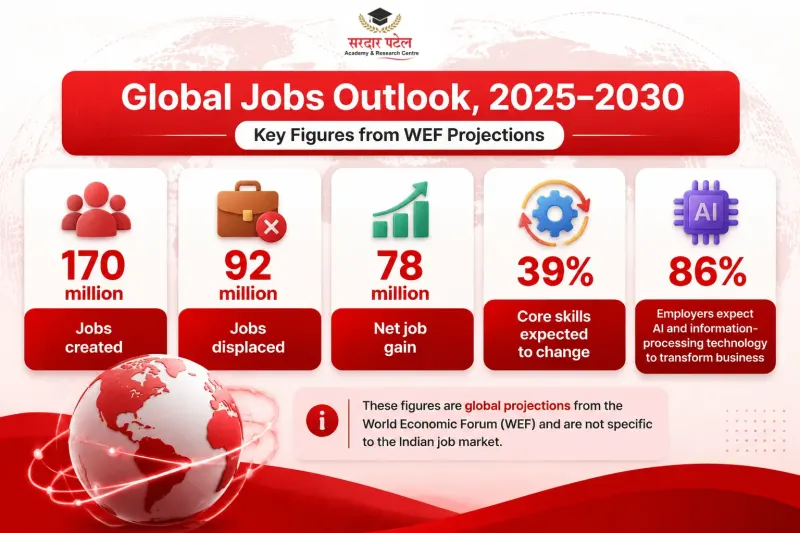
| Finding (2025–2030) |
Figure |
| New jobs created globally |
170 million |
| Jobs displaced globally |
92 million |
| Net job gain |
78 million |
| Workers' core skills expected to change |
39% |
| Employers expecting AI and information-processing technology to transform their business |
86% |
| Projected growth, Big Data Specialists (fastest-growing role) |
roughly 110% |
| Projected growth, Data Analysts and Scientists |
roughly 40% |
Sources: the WEF's own analysis of fastest-growing and declining jobs and the role-growth chart compiled by Visual Capitalist. Different write-ups round the growth percentages slightly differently, which is why they are shown as approximate.
Two lessons stand out. First, data roles are expanding even as other jobs shrink, which supports the broad direction of the future of data analytics jobs in India. Second, the same report treats analytical thinking and AI and big data literacy as top skills, which matches the judgement-first theme of this article.
Roles You Will See More Often
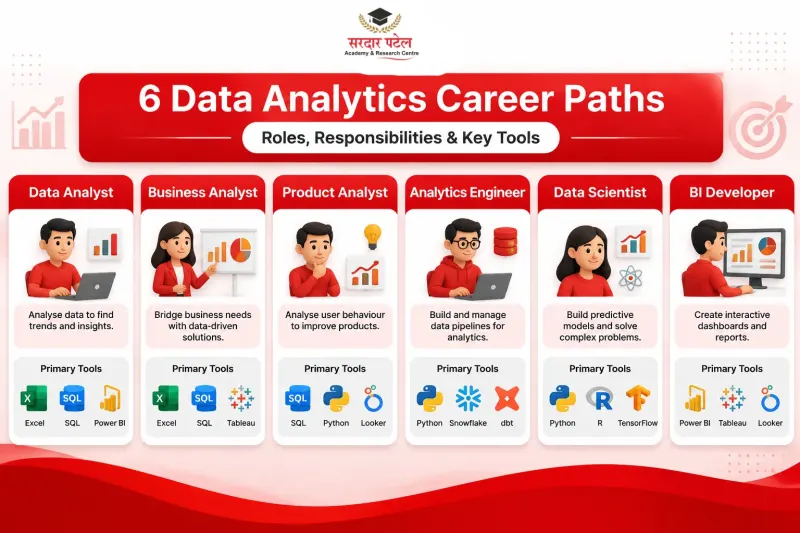
Titles vary between companies, so read job descriptions rather than names. The table below groups common roles by what they actually do.
| Role |
Core focus |
Typical tools |
| Data Analyst |
Reporting, trend analysis, stakeholder questions |
SQL, Excel, Power BI or Tableau |
| Business Analyst |
Linking data to processes and requirements |
Excel, SQL, documentation tools |
| Product Analyst |
User behaviour, funnels, experiments |
SQL, Python, product analytics platforms |
| Analytics Engineer |
Clean, reusable data models for analysts |
SQL, version control, transformation tools |
| Data Scientist |
Predictive modelling and experimentation |
Python, statistics, machine learning libraries |
| BI Developer |
Dashboards and semantic models |
Power BI, Tableau, data warehouses |
Readers who want a deeper look at one technical layer can explore the latest SQL trends for data analysts, since query skills remain the common thread across almost every row above.
Skills That Will Matter Most
Technical foundations
- SQL: Among the most commonly requested skills in analyst job posts. Window functions, joins across multiple tables and query optimisation separate average candidates from strong ones. The PostgreSQL window function tutorial is a clear, free place to practise.
- Excel: Not outdated. Pivot tables, lookups and quick modelling remain daily tools in finance, operations and sales teams.
- Python: Useful for cleaning data, automation and basic modelling. The official pandas user guide covers the data-wrangling skills most analysts need first.
- Visualisation: Microsoft's Power BI documentation is a reliable starting point for learning how reports and models fit together.
- Statistics: Understanding distributions, sampling, correlation and basic hypothesis testing prevents embarrassing conclusions.
Human skills that employers keep asking for
- Business understanding. Knowing why a metric moves is more valuable than knowing how to plot it.
- Clear communication. A good analyst can explain a finding to a non-technical manager in three sentences.
- Curiosity. The best analysts question odd numbers before anyone else notices them.
- Ethical judgement. Handling sensitive data with care builds trust with employers and customers.
This blend is a major reason the future of data analytics jobs in India favours people who keep learning rather than people who master one tool and stop.
How AI Changes the Daily Work of an Analyst
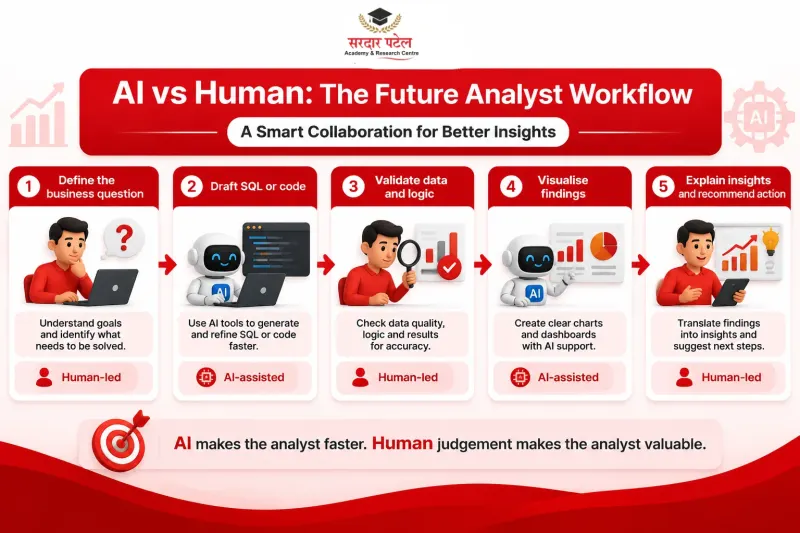
AI assistants can draft queries, suggest chart types, summarise tables and speed up code. That is useful, and it is also risky when the output is accepted without checking. A generated query may run without errors and still answer the wrong question.
Here is a realistic example. An analyst at an e-commerce company asks an AI tool for monthly repeat-purchase rates. The tool returns a tidy chart. A careful analyst notices that returned orders were counted as purchases, which inflates the rate. The tool saved time; the human protected accuracy.
That division of labour is likely to define the next several years. Analysts who use AI as a fast assistant, while still verifying logic and context, will be better placed than those who either ignore it or trust it blindly. If you want a practical starting list, the guide on AI tools every data analyst should know walks through options worth testing.
Industries to Watch
Rather than guess at numbers, it is more honest to describe where data work is visibly expanding in day-to-day business:
- Banking, fintech and insurance: Risk, fraud detection, customer segmentation and regulatory reporting all depend on analysts.
- E-commerce and retail: Pricing, inventory planning, delivery performance and customer retention.
- Healthcare and pharma: Operations, patient flow, claims and clinical research support.
- Logistics and manufacturing: Demand forecasting, quality tracking and supply-chain visibility.
- Education and public services: Enrolment trends, outcome tracking and programme evaluation.
- Marketing and media: Campaign attribution, audience behaviour and content performance.
Each sector rewards domain knowledge. An analyst who understands insurance claims, for example, will often outperform a technically stronger candidate who does not.
How Hiring Is Changing
Many recruiters in analytics [ Delhi Analytics Hiring Report] appear to be rewriting their checklists. A degree and a tool list are no longer enough to stand out. Interviewers often hand over a messy dataset and ask the candidate to find something useful in around thirty minutes. They are watching how you ask questions, how you check your assumptions and how you explain what you found.
This matters for anyone studying the future of data analytics jobs in India, because it shows where the bar is moving. Candidates who can show a small project with a clear business question tend to be remembered. Those who recite definitions rarely are. A realistic view of the future of data analytics jobs in India therefore starts with your own evidence: portfolio work, case solutions and the ability to talk through a decision.
Hiring teams also value people who can work across functions. An analyst who can sit with a marketing lead, understand the campaign goal and return with a clean answer saves everyone time. That habit, more than any single tool, shapes how the future of data analytics jobs in India will reward early-career professionals over the next few years.
The Analytics Career Future 2030: What to Expect
Nobody can forecast exact openings, and anyone quoting precise figures for 2030 without a source deserves scepticism. What can be said with reasonable confidence is directional:
- Entry-level work will lean more on judgement because routine tasks are increasingly automated.
- Hybrid profiles, such as "analyst who understands product" or "analyst who understands finance," will stand out.
- Data literacy will spread to non-analyst roles, so specialists must offer depth, not just basic reporting.
- Governance, privacy and data quality will become more visible parts of the job.
In other words, the analytics career future 2030 offers is less about holding a job title and more about being the person a team trusts to interpret evidence. That is the central theme of the future of data analytics jobs in India for anyone planning a long career, and it is why this report keeps returning to judgement over tools.
Step-by-Step Roadmap for Freshers and Career Switchers
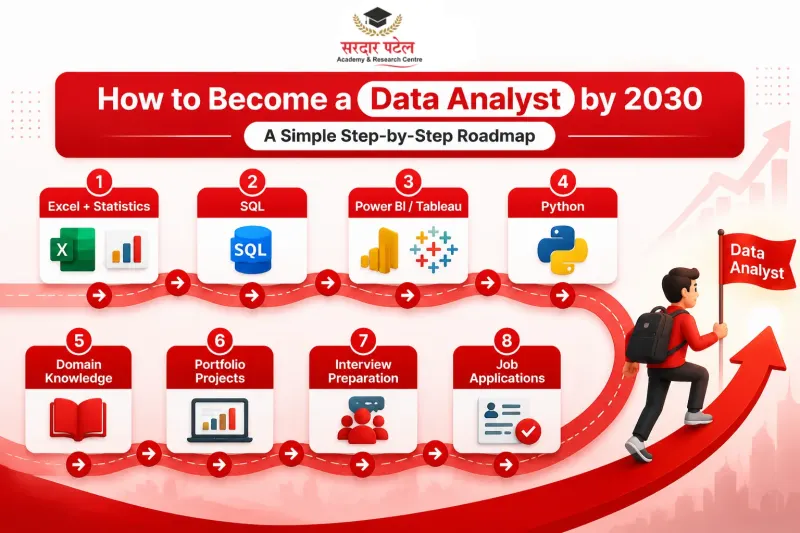
- Start with Excel and basic statistics. Build comfort with tables, averages, percentages and simple charts.
- Learn SQL properly. Practise on realistic datasets until joins and aggregations feel routine.
- Add one visualisation tool. Choose Power BI or Tableau and build three dashboards around real questions.
- Pick up Python gradually. Focus on data cleaning and exploratory analysis before moving to modelling.
- Choose a domain. Finance, marketing, operations, healthcare or HR; depth in one area builds credibility.
- Build a portfolio. Three well-explained projects beat ten unfinished ones. Describe the question, method, findings, and limitations of each.
- Practise explaining results. Present a project to a friend who knows nothing about data.
- Apply with focus. Tailor your resume to each role rather than sending one generic version.
Anyone serious about the future of data analytics jobs in India should treat this roadmap Data Analytics Career Guide as a loop rather than a straight line, since each step reveals gaps worth revisiting. A structured programme can shorten this path by providing sequence, mentoring and practice problems. Learners comparing options can review the data analytics course at SPARC to see how a guided pathway is organised. You can also learn more about the institute through the Sardar Patel Academy & Research Centre website.
Quick readiness checklist
Tick what you can already do without help:
- Write a SQL query with a join and a grouped aggregate
- Build a pivot table and explain what it shows
- Clean a messy CSV and document what you changed
- Build a dashboard that answers one real business question
- Explain a finding to a non-technical person in three sentences
- Verify an AI-generated query or chart before trusting it
- Describe one portfolio project: question, method, result, limitation
Common Mistakes to Avoid
These errors show up repeatedly among learners preparing for the future of data analytics jobs in India.
- Collecting certificates instead of skills. Employers test whether you can solve a problem, not how many badges you hold.
- Jumping into machine learning too early. Weak SQL and statistics make advanced models unreliable.
- Ignoring communication. A correct analysis that nobody understands has little impact.
- Copying tutorial projects unchanged. Interviewers recognise popular datasets quickly; add your own question or angle.
- Trusting AI output blindly. Always check definitions, filters and edge cases.
- Ignoring data privacy. Learn the basics of responsible handling early.
Conclusion
The future of data analytics jobs in India is neither a guaranteed boom nor a looming collapse. It is a steady reshaping of the profession, where routine tasks fade and judgement, domain knowledge and communication grow in value. Learners who build solid foundations in SQL, Excel, statistics and visualisation, then add AI literacy and a chosen industry focus, will be well prepared for whatever job titles emerge.
If you are ready to turn this outlook into a plan, you can Start Analytics Career Path with a structured programme and build your first portfolio projects with guidance.
FAQs
For people who enjoy problem-solving and keep their skills current, it is a strong option, and the future of data analytics jobs in India supports that view when you look at how many sectors now rely on analysts. Outcomes depend on skills, domain and location, so judge opportunities by job descriptions rather than headlines.
AI will automate parts of the work, particularly routine querying and reporting. Roles that combine business context, validation and communication are harder to replace, which is why the future of data analytics jobs in India still looks active for adaptable professionals.
Start with Excel, basic statistics and SQL. Then add a visualisation tool and Python. Whatever the future of data analytics jobs in India brings, these foundations rarely lose value.
Not always. When assessing the future of data analytics jobs in India, note that many employers focus on demonstrated skills and projects, though some roles, especially in data science, prefer stronger mathematical backgrounds.
It varies with your starting point and study time. Consistent practice and portfolio projects matter more than a fixed number of months.
Yes, and the future of data analytics jobs in India is open to such moves. Commerce, arts, management and science graduates often bring domain knowledge that technical candidates lack. Pair that with SQL, Excel and visualisation skills.
Expect more AI-assisted workflows, closer collaboration with business teams and greater attention to data governance. Preparing for the analytics career future in 2030 means building judgement alongside tools.