+91 9312966129
 sparc.enquiry01@gmail.com


How to Crack a Digital Marketing Interview
Master digital marketing interview preparation with this complete guide, covering SEO, PPC, analytics, AI tools, and interview-day tips for freshers.
Table of Contents
- Why Most Digital Marketing Freshers Fail Interviews
- What Recruiters Actually Look For
- Technical Understanding
- Practical Knowledge
- Problem-Solving Skills
- Communication Skills
- Learning Attitude
- Tool Familiarity
- Digital Marketing Interview Preparation: Step-by-Step Guide
- Research the Company
- Understand the Job Description
- Revise Digital Marketing Fundamentals
- Prepare Concrete Project Examples
- Build a Simple Portfolio
- Practice Interview Questions
- Improve Communication
- Stay Updated with Industry Trends
- SEO Interview Tips for Freshers
- Basic SEO Questions You Should Know Cold
- Practical SEO Questions
- Common Mistakes in SEO Interviews
- How to Answer Confidently
- PPC Interview Questions Every Fresher Should Prepare
- Google Ads Basics
- Campaign Structure
- Bidding
- Quality Score
- Ad Extensions
- Conversion Tracking
- Social Media Interview Questions
- Content Marketing Interview Questions
- Google Analytics & GA4 Questions
- Interview Questions About AI in Digital Marketing
- Top 25 Digital Marketing Interview Questions with Answers Direction
- SEO
- PPC
- Social Media
- Analytics
- Content Marketing
- AI Tools
- Interview Day Preparation Checklist
- Common Interview Mistakes That Cost Candidates Jobs
- How We Help Students Build Interview Confidence
- Final Thoughts
Picture this. You've just finished a digital marketing course. You know SEO. You know Google Ads. You have the certifications to prove it. Then the interviewer leans forward and asks: “Tell me about a campaign you've worked on.”
Silence.
This happens to more students than you'd think. Not because they don't know digital marketing, but because knowing concepts and performing in an interview are two completely different skills. Digital marketing interview preparation isn't about memorising definitions. It's about being able to talk about what you've done, what you'd do next, and why it matters. That's what this guide is for. Whether you're a fresher, a recent graduate, or someone switching careers, let's walk through exactly how to prepare
Why Most Digital Marketing Freshers Fail Interviews
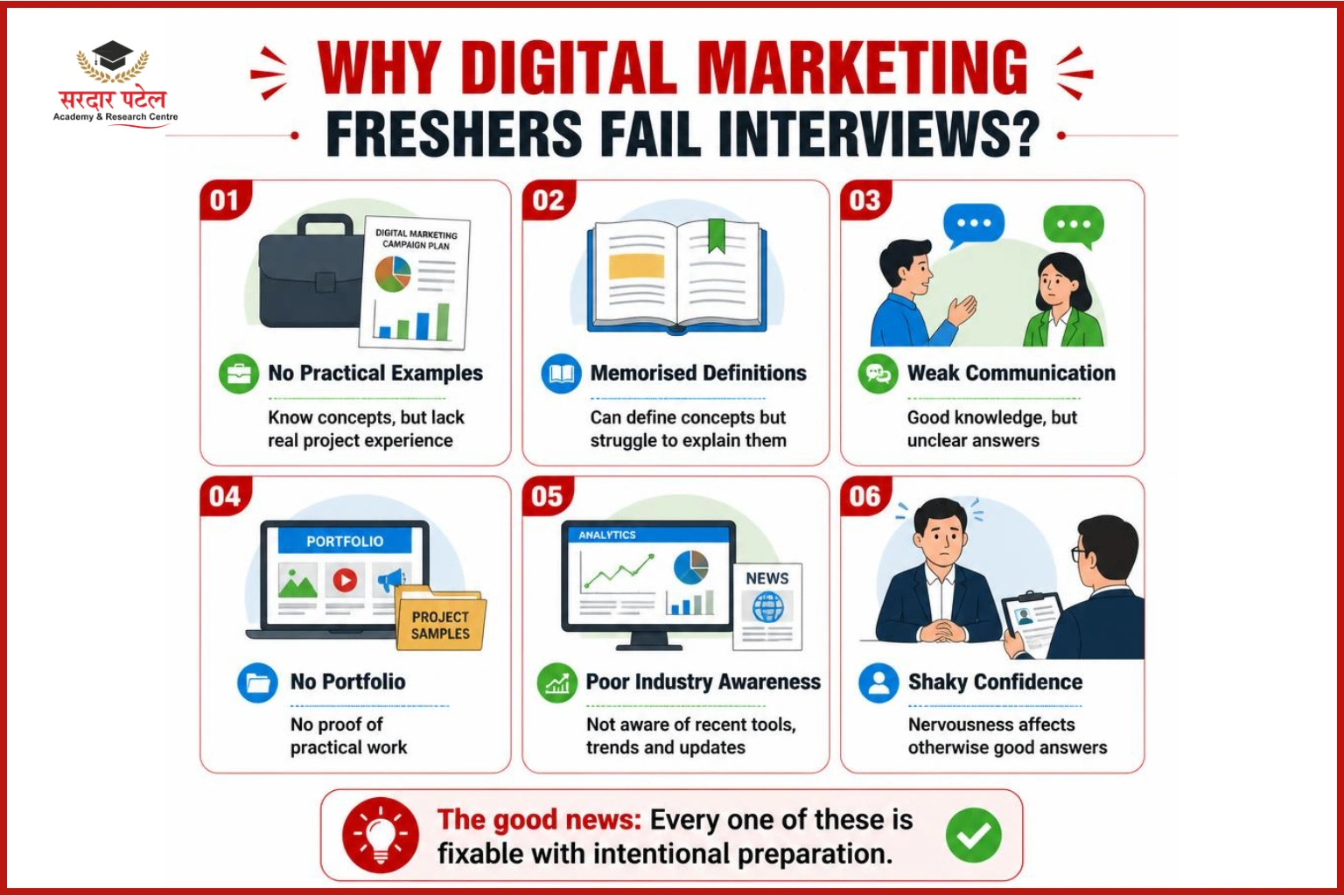
It's not always a knowledge gap. Often, it's a preparation gap. Here are the most common reasons freshers struggle.
- No practical examples: they've watched tutorials, not run campaigns. Interviewers ask what you've done, not what you've watched.
- Memorised definitions: reciting the textbook definition of SEO won't impress anyone. Recruiters want to see if you can think.
- Weak communication: strong answers delivered poorly still lose to average answers delivered confidently. How you say it matters.
- No portfolio: without proof of work, every claim feels theoretical. Even a simple case study helps.
- Poor industry awareness: not knowing what's changed in digital marketing in the last six months signals a lack of genuine interest.
- Shaky confidence: nervousness is expected, but when panic replaces preparation, it shows.
The good news? Every single one of these is fixable. It just takes intentional preparatio
What Recruiters Actually Look For
Recruiters aren't trying to catch you out. They're trying to figure out one thing: can this person do the work
Technical Understanding
Do you know how SEO, PPC, social media, and analytics actually work? Not just definitions, but do you understand the logic behind each channe
Practical Knowledge
Have you used Google Ads? Have you read a GA4 report? Have you published SEO content? Hands-on exposure, even on small personal projects, counts.
Problem-Solving Skills
“If your client's website traffic dropped 30% overnight, what would you check?” This kind of question is designed to see how you think, not what you've memorised.
Communication Skills
Can you explain a complex concept? Can you present data in a way that makes sense? Client-facing roles especially need this.
Learning Attitude
Digital marketing changes constantly. Recruiters want people who stay curious. Mentioning something you recently learned, a new Google update or a new tool, says a lot about your mindset.
Tool Familiarity
Google Analytics, Search Console, Meta Ads Manager, SEMrush: knowing these tools by name isn't enough. Being able to describe how you've used them is what separates candidates.
Digital Marketing Interview Preparation: Step-by-Step Guide
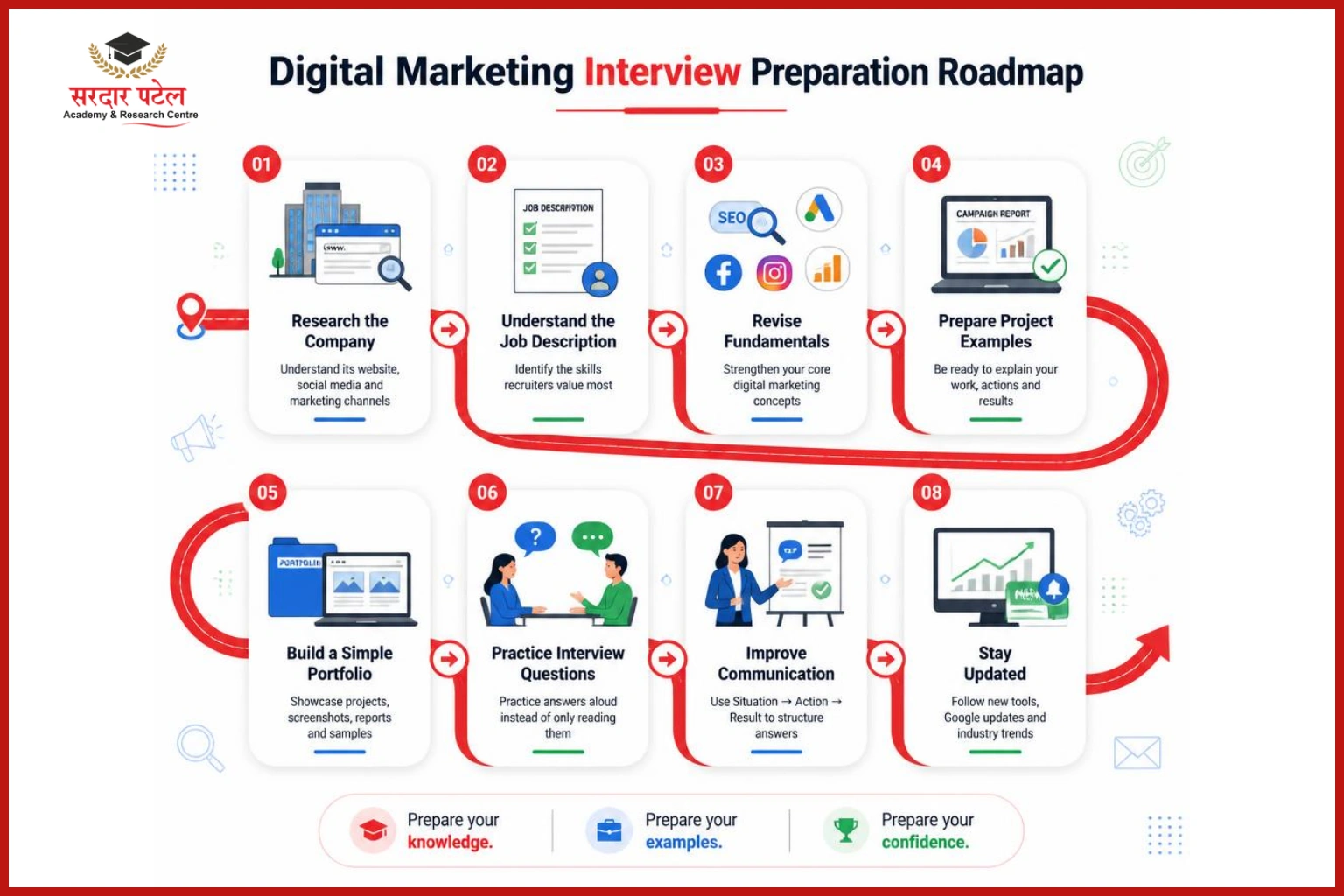
Research the Company
Before any interview, spend time understanding what the company does. What channels do they use? What does their social media look like? Do they run Google Ads? Check their website for obvious SEO gaps. Show up with observations, not just questions.
Understand the Job Description
Read it carefully. Which skills appear more than once? If they mention “SEO” three times and “Meta Ads” once, you know where to focus your preparation.
Revise Digital Marketing Fundamentals
Go back to basics: SEO, SEM, social media strategy, content marketing, email marketing, and analytics. Don't go deep on everything. Go solid on the core concepts.
Prepare Concrete Project Examples
Even if your only experience is a college project or a personal blog, prepare to talk about it with specifics. What was the goal? What did you do? What happened? Numbers help, even approximate ones. “I grew organic traffic by about 40% in two months” is much stronger than “I improved the website's SEO.”
Build a Simple Portfolio
A Google Drive folder or a basic website with screenshots, reports, and samples of your work is enough. It gives interviewers something concrete to look at.
Practice Interview Questions
Don't just read them. Say the answers out loud. Record yourself if you can. You'll catch things you'd never notice otherwise.
Improve Communication
Use the simple framework: Situation, Action, Result. It structures your answers and keeps you from rambling.
Stay Updated with Industry Trends
Read Search Engine Journal, the Moz Blog, or Neil Patel's newsletter. Even fifteen minutes a week keeps you current and gives you things to mention in interviews.
SEO Interview Tips for Freshers
SEO questions tend to come in two flavours: conceptual and situational. Here's how to handle both
Basic SEO Questions You Should Know
- What is SEO? Optimising a website to appear in search results organically, through content relevance, technical health, and backlinks.
- On-page vs off-page SEO? On-page is everything you control on the site itself. Off-page is external signals: backlinks, brand mentions, and authority.
- What is keyword research? Finding the search terms your target audience actually uses, balancing search volume, competition, and intent.
- What is technical SEO? Site speed, crawlability, mobile-friendliness, HTTPS, structured data: the infrastructure that lets content perform.
- What is search intent? The reason behind a search query: informational, navigational, transactional, or commercial investigation
Practical SEO Questions
1. How would you improve a website's Google rankings?
Talk about auditing existing content, fixing technical issues, building topical authority, improving Core Web Vitals, and earning relevant backlinks.
2. What would you do if organic traffic suddenly dropped?
Mention checking Google Search Console for manual penalties, algorithm update dates, page indexing issues, and any recent site change
Common Mistakes in SEO Interviews
- Saying “I would build more backlinks” as the answer to every problem
- Using outdated tactics like keyword density or meta keyword tags
- Forgetting to mention user experience as a ranking factor
How to Answer Confidently
Use this framework: Define, Context, Example. Define the concept, add context for why it matters, then give a brief example from your experience or a hypothetical.
Tip: before any SEO interview, spend time actually looking at the company's website. Please open Search Console and estimate what their issues might be. Walk in with an observation; it signals genuine interest.
For freshers who want to understand why live projects beat certificates in SEO roles, read our Why Live Projects Matter More Than Certificates
PPC Interview Questions Every Fresher Should Prepare
PPC questions test both your conceptual understanding and your ability to make decisions under pressure. Here's what to be ready for
Google Ads Basics
- What is pay-per-click advertising?
- What is the Google Ads auction system?
- What are the different types of Google Ads campaigns?
Campaign Structure
Understand the Account → Campaign → Ad Group → Ad hierarchy. Interviewers often ask you to walk through how you'd set up a campaign from scratch.
Bidding
Know the difference between manual CPC, enhanced CPC, Target CPA, and Target ROAS. Be ready to explain when you'd use each one.
Quality Score
Quality Score = Expected CTR + Ad Relevance + Landing Page Experience. A higher Quality Score means lower CPCs. Know this well; it comes up constantly.
Ad Extensions
Sitelinks, callouts, structured snippets, call extensions. Know what they are and how they affect ad visibility and CTR.
Conversion Tracking
Being able to explain how to set up Google Ads conversion tracking and why it matters puts you ahead of most freshers. Bonus points if you can mention Google Tag Manager.
PPC Topic |
What the Recruiter Wants to Know |
What the Recruiter Wants to Know |
| Quality Score |
Do you understand the levers that affect ad cost? |
CTR, ad relevance, landing page experience |
| Bidding Strategy |
Can you match bidding to campaign goals? |
Manual for control; smart bidding for scale |
| Negative Keywords |
Do you know how to prevent wasted spend? |
Block irrelevant traffic; lower CPC |
| Conversion Tracking |
Can you measure what actually matters? |
Tag setup, goals, attribution models |
| A/B Testing Ads |
Do you test before scaling? |
Test one variable at a time |
If you want to strengthen your understanding of modern advertising tools, including AI-assisted PPC, start with our AI Tools Every Digital Marketing Student Should Know
Social Media Interview Questions
- Instagram marketing: know the difference between organic content strategy and paid campaigns. Be familiar with Reels, Stories, and shopping features.
- Facebook Ads basics: understand campaign objectives, audience targeting, and the difference between Reach, Traffic, and Conversion campaigns.
- LinkedIn marketing is especially relevant for B2B roles. Know the basics of Company Pages, thought-leadership content, and LinkedIn Ads if possible.
- Engagement metrics: reach, impressions, engagement rate, follower growth, and click-through rate are the basics. Know what each one tells you.
- Content planning: be ready to talk about how you'd build a 30-day content calendar, including the mix of content types, posting frequency, and goals.
Content Marketing Interview Questions
- Blog writing: understand how to write for both readers and search engines: headline frameworks, paragraph structure, and calls to action.
- SEO content: know the basics of target keyword placement, semantic keywords, internal linking, and readability optimisation.
- Content strategy: be ready to explain how you'd plan content for a new brand, starting with audience research, then topics, then formats.
- Audience research: talk about using tools like AnswerThePublic, Google's People Also Ask, or Reddit to understand what questions your audience actually has.
- Content performance: pageviews, average time on page, scroll depth, conversions, and social shares are the metrics that matter most.
Google Analytics & GA4 Questions
GA4 is the default now. If you're still talking about Universal Analytics, catch up quickly.
| Metric / Feature |
What It Means |
Why It Matters |
| Users |
Total unique visitors in a given period |
Measures audience size |
| Sessions |
Group of interactions during a site visit |
Measures visit volume |
| Bounce Rate (UA) vs Engagement Rate (GA4) |
UA counted sessions with no engagement; GA4 counts sessions lasting 10+ seconds, with a conversion, or 2+ pageviews |
Measures content quality |
| Conversions |
Completed goals: purchase, signup, form fill |
Measures business outcomes |
| Event Tracking |
Custom actions tracked on the site |
Measures specific user behaviour |
Be ready to explain the difference between bounce rate in Universal Analytics and engagement rate in GA4. This trips up a lot of candidates.
Interview Questions About AI in Digital Marketing
AI in marketing is no longer a futuristic topic. It's a present-day expectation
- ChatGPT and AI writing tools: know how to use them for content ideation, first drafts, and headline testing, but be clear that human editing is essential.
- AI-assisted SEO: tools like Surfer SEO, Clearscope, and RankMath use AI to help optimise content. Knowing one of these is a clear advantage.
- AI-assisted PPC: Google's Performance Max campaigns use AI for bidding, placement, and creative optimisation. Understand what that means for campaign management.
- Ethical use of AI: recruiters increasingly ask about this. Be ready to explain that AI should augment human judgment, not replace strategy.
The right answer isn't “I use AI for everything.” It's “I know when to use AI, and I know when not to.
If you're just getting started with Meta Ads alongside AI tools, this resource is useful, our: Meta Ads Beginner Training Guide
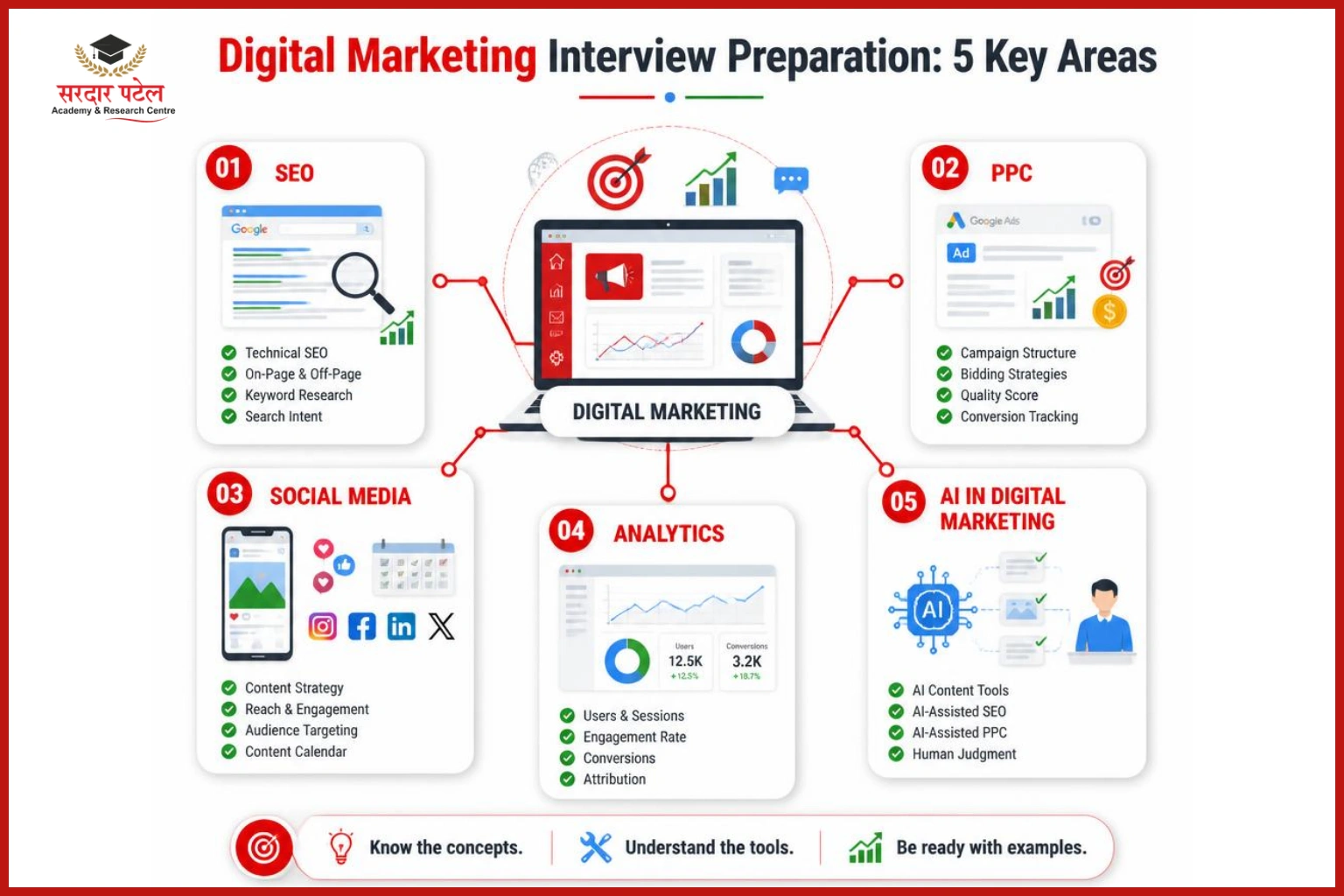
Top 5 Digital Marketing Interview Questions with Answers Direction
SEO
- What is SEO and how does it work?
Define organic search and explain the three pillars: technical, on-page, and off-page. - What is the difference between a do-follow and a no-follow link?
Do-follow passes link equity. No-follow signals to Google not to pass authority. - What is a Core Web Vital?
Explain LCP, INP (which replaced FID), and CLS, and why Google uses them as ranking factors. - How do you approach keyword research for a new website?
Start with seed keywords, check competitor gaps, then filter by intent and volume. - What would cause a sudden drop in organic traffic?
An algorithm update, a manual penalty, a technical issue, de-indexed content, or keyword cannibalisation.
If you're new to search engine optimization, start by understanding the SEO basics for beginners before preparing for interview questions
PPC
- What is Quality Score and how do you improve it?
CTR, ad relevance, and landing page experience. Improve it by aligning ad copy with search intent and optimising landing pages. - What's the difference between search and display campaigns?
Search is intent-based. Display is for awareness and retargeting. - How would you reduce cost per click without losing traffic?
Improve Quality Score, add negative keywords, and refine match types. - What is smart bidding?
Automated bid strategies using machine learning, such as Target CPA, Target ROAS, and Maximise Conversions. - How do you track conversions in Google Ads?
Through the Google Ads conversion tag, or by importing goals from GA4.
If you want hands-on experience before attending interviews, explore our practical Google Ads training in Delhi to learn campaign setup, bidding strategies, conversion tracking, and optimization techniques.
Social Media
- How do you measure success on Instagram?
Reach, engagement rate, story views, link clicks, and profile visits, depending on the goal. - What is the difference between reach and impressions?
Reach is unique people. Impressions are the total number of times content was seen. - How would you grow a brand's LinkedIn presence from scratch?
Optimise the Company Page, post consistently with value-driven content, engage in comments, and use employee advocacy. - What is a social media content calendar and why does it matter?
A planned schedule of posts, formats, and goals. It brings consistency, which algorithms reward.
Analytics
- What is the difference between a session and a user in GA4?
A user is a unique visitor. A session is one visit. One user can have multiple sessions. - What is attribution modelling?
How do you assign credit for a conversion across multiple touchpoints: last click, first click, or data-driven? - What is the engagement rate in GA4?
Sessions that lasted over 10 seconds, had a conversion event, or viewed 2 or more pages are a more meaningful metric than bounce rate
Content Marketing
- What makes a piece of content rank on Google?
Search intent alignment, topical authority, content quality, backlinks, and technical correctness. - How do you write a blog post that gets organic traffic?
Start with keyword research, match search intent, structure for readability, optimise on-page elements, and build internal links. - What is the difference between evergreen content and trending content?
Evergreen content stays relevant indefinitely. Trending content peaks and fades. Both have a role in a content strat
AI Tools
- How do you use AI in your content process?
For ideation, outlining, and first drafts, always followed by human review for accuracy and tone. - What is Google's stance on AI-generated content?
Google doesn't penalise AI content; it penalises low-quality, unhelpful content. Quality is the standard, not origin. - Have you used any AI tools for SEO or PPC?
Mention tools like Surfer SEO, Jasper, Google's Smart Bidding, or Performance Max, and explain what each one helps with. - Can AI replace a digital marketer's job?
No: AI speeds up execution and optimisation, but strategy, creativity, and judgment still need a human marketer. - How would you use AI to speed up keyword research or content creation?
Use AI tools to generate initial keyword clusters or content outlines, then validate and refine them using search intent and genuine audience research.
If you're still building these skills, review this digital marketing course checklist AI Tools Every Digital Marketing Student Should Know to make sure your training includes practical projects, analytics, SEO, PPC, social media, content marketing, and AI tools.
Interview Day Preparation Checklist
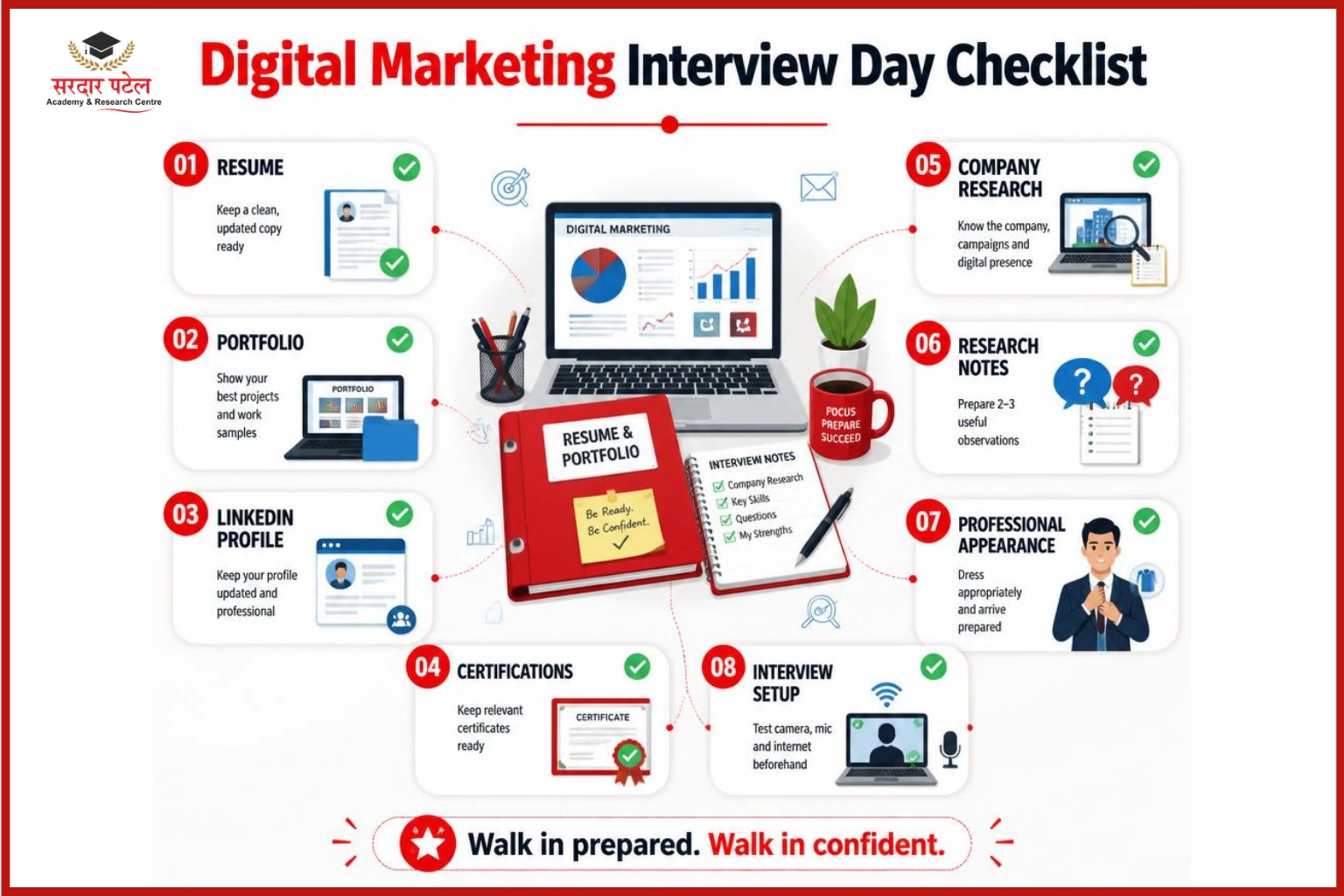
- Resume: a printed copy (for in-person) and a PDF ready. One page if fresher, max two pages if experienced.
- Portfolio: link ready to share, whether on Google Drive, a website, or a PDF deck with your best work.
- LinkedIn profile: up to date with accurate roles, skills, and a professional photo.Certifications: Google Ads, Google Analytics, HubSpot, or Meta Blueprint; have digital copies ready.
- Research notes: two to three observations about the company's digital presence that you can mention naturally.
- Company information: website, social media, recent campaigns, and any news from the last few months.
- Professional appearance: dress appropriately. First impressions still count.
- Internet setup (for virtual interviews): test your connection, camera, and mic at least 30 minutes before, and use a clean, neutral background.
Along with this checklist, it's equally important to build confidence for digital marketing interviews through mock interviews, practical projects, and regular practice. then you will be able to understand Why Live Projects Matter More Than Certificates.
Common Interview Mistakes That Cost Candidates Jobs
- Talking too much: long, unfocused answers signal poor communication skills. Learn to answer concisely and invite follow-ups.
- Talking too little: one-word answers make interviews feel like interrogations. Give context without rambling.
- Faking knowledge: if you don't know something, say so, then explain how you'd find out. Honesty beats bluffing every single time.
- Ignoring recent trends: saying “I haven't really followed that” when asked about GA4 or AI tools is a red flag.
- No examples: abstract answers with no supporting evidence feel untrustworthy. Always connect claims to specific situations.
- Poor attitude: confidence is attractive, arrogance isn't. Being dismissive about past employers, teammates, or projects reflects badly.
Final Thoughts
Interviews are nerve-wracking. That's just true.
But the candidates who struggle most aren't the ones who are nervous; they're the ones who aren't prepared.
Digital marketing interview preparation isn't about memorising answers. It's about walking into that room knowing your work, knowing your tools, and knowing what you'd do when things get complicated.
Research the company. Build your portfolio. Practice out loud. Stay current.
And most importantly, be honest about what you know and curious about what you don't. Recruiters hire people, not performances.
You've put in the effort to learn digital marketing. Now put in the same effort to show it. Good luck.
| Want hands-on interview preparation built into your course? Talk to our career counsellor about mock interviews, portfolio reviews, and placement grooming included with our digital marketing training in Delhi. visit Sardar patel academy & Research centre. or contact us |
If you want to strengthen your practical skills before your next interview, explore our job-oriented digital marketing course with live projects, interview preparation, and placement support
FAQs
For a fresher, 2 to 4 weeks of focused preparation is usually enough. That means revising fundamentals, preparing examples, building or organising your portfolio, and practising answers out loud.
Focus on demonstrating your understanding of how SEO works, your ability to use relevant tools, and any personal or academic projects where you've applied SEO principles. These SEO interview tips apply just as well even if your examples are small and personal: discuss them with specifics.
Recruiters typically ask about Quality Score, campaign structure, bidding strategies, and conversion tracking. These core PPC interview questions appear across almost every Google Ads role, so prepare clear, specific answers for each one.
Certifications help, especially Google Ads and GA4. But recruiters care more about whether you can explain what the certification taught you than the certificate itself.
Google Analytics 4, Google Search Console, Google Ads, Meta Ads Manager, and at least one SEO tool like SEMrush or Ubersuggest. Being familiar with Canva and a scheduling tool is a bonus.
Be honest and specific. Mention what drew you to it, whether it was a project, the creative-plus-data combination, or the career opportunities. Avoid generic answers like “it's the future.”
Not mandatory, but it significantly strengthens your application. Even a simple Google Drive folder with campaign screenshots, blog samples, or a small case study gives you a genuine edge.
Use the Situation, Action, Result framework. Describe the context, explain what you did, and share the outcome. Keep it concise and lead with the result if it was strong.
Yes. A brief, professional follow-up email within 24 hours reinforces your interest and keeps your name in front of the interviewer. Keep it short: thank them, reiterate your interest, that's it.
Yes, but you'll need to work harder to show proof of ability. Personal projects, freelance work, or even a well-documented internship can compensate for a lack of formal employment history.