+91 9312966129
 sparc.enquiry01@gmail.com


Inside Our Practical Digital Marketing Classroom
See what practical digital marketing classes in Delhi look like, from hands-on tools and campaigns to guided exercises, feedback, and real classroom learning.

Table of Contents
- Why "Practical" Has Become a Confusing Word in Digital Marketing Education
- What a Typical Session Looks Like in Our Classroom
- The Tools Students Actually Get Their Hands On
- Why Tool Access Matters More Than Most People Realize
- Classroom Training vs. Self-Paced Online Learning: An Honest Comparison
- Common Mistakes Beginners Make (And How Classroom Feedback Fixes Them)
- Who Actually Benefits From This Kind of Classroom Setup
- How to Evaluate Whether a Digital Marketing Institute Is Genuinely Practical
- What a Real Student Journey Looks Like
- Final Thoughts and Next Steps
If you've spent even ten minutes researching digital marketing courses in Delhi, you've probably noticed that almost every institute claims to be "practical" and "industry-oriented." The words get repeated so often that they stop meaning much. So instead of telling you that our classroom is different, we're going to show you exactly what happens inside it — the tools, the exercises, the mistakes students make in week two, and why this approach matters if you're serious about a career in the field.
This article walks through what practical digital marketing classes in Delhi actually look like on a day-to-day basis, why classroom training still has a place in a world full of self-paced video courses, and how to judge whether a program is genuinely hands-on or just says it is.
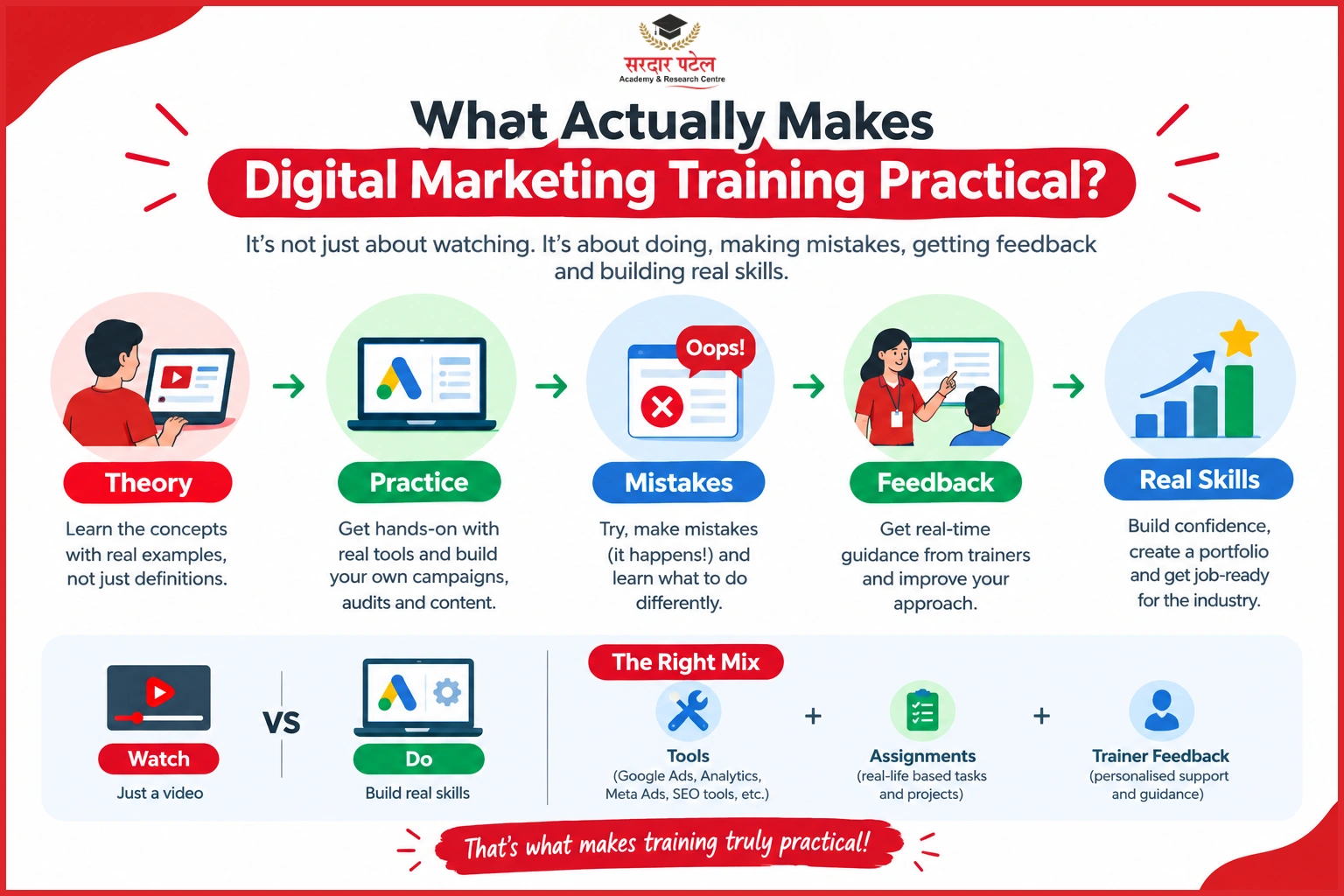
Why "Practical" Has Become a Confusing Word in Digital Marketing Education
Search for any digital marketing course in Delhi NCR and you'll see the word "practical" attached to nearly every listing. That's partly because employers value practical skills — familiarity with industry tools and hands-on campaign experience can help beginners demonstrate that they are ready to apply what they've learned in real-world situations.
But "practical" can mean very different things:
- Watching a recorded tutorial of someone else running a Google Ads campaign
- Reading case studies about campaigns other companies ran
- Actually logging into an ad account, setting a real budget, and watching your own numbers move
Only the third one builds the muscle memory that recruiters are actually testing for during interviews. That distinction is the entire reason our classroom is structured the way it is.
What a Typical Session Looks Like in Our Classroom
Our digital marketing classes are held at our GTB Nagar centre in Delhi, and each session is built around a "learn, then do" rhythm rather than a long lecture followed by a quiz.
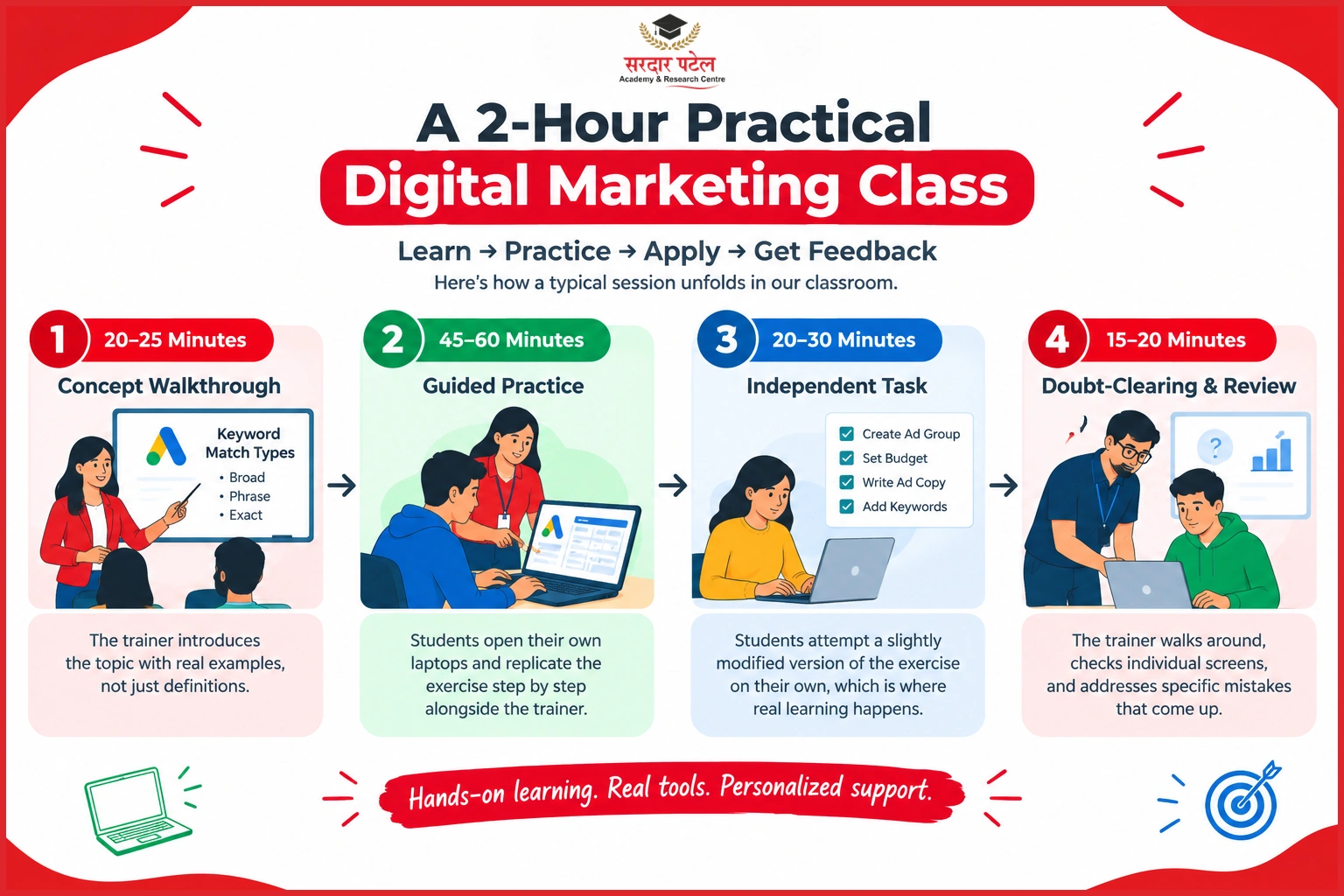
A typical two-hour session breaks down roughly like this:
- Concept walkthrough (20–25 minutes) — the trainer introduces the topic (say, keyword match types in Google Ads) with real examples, not just definitions.
- Guided practice (45–60 minutes) — students open their own laptops and replicate the exercise step by step alongside the trainer, pausing wherever something doesn't work as expected.
- Independent task (20–30 minutes) — students attempt a slightly modified version of the exercise on their own, which is where most of the actual learning happens.
- Doubt-clearing and review (15–20 minutes) — the trainer walks around, checks individual screens, and addresses the specific mistakes that came up, since these tend to differ from student to student.
This is a meaningful part of what makes practical digital marketing classes in Delhi worth attending in person rather than purely online — a trainer can spot that you've set the wrong campaign objective before you waste a week's practice budget on it.
The Tools Students Actually Get Their Hands On
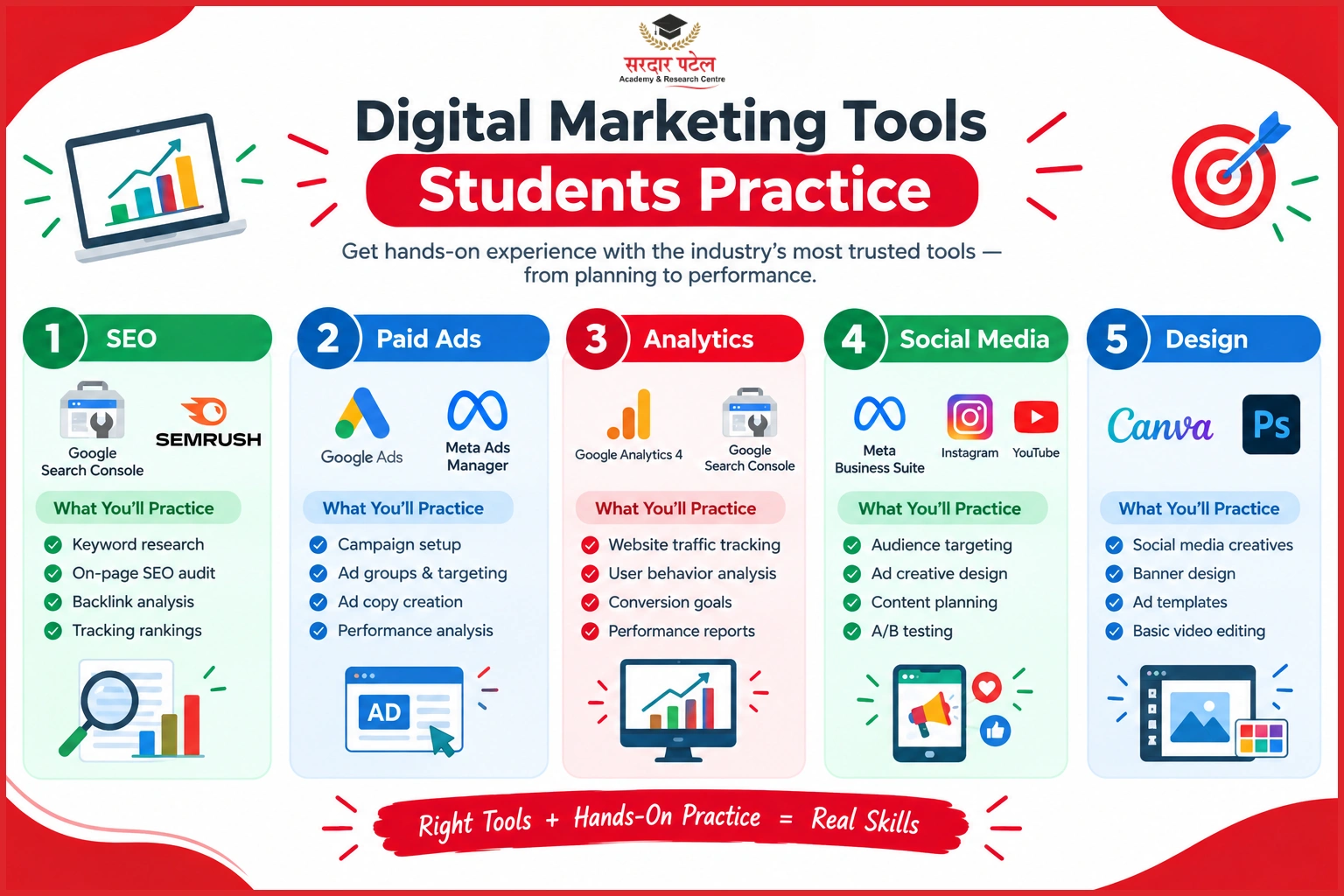
Talking about tools is easy; using them under supervision is where the learning sticks. In our classroom training, digital marketing students work directly inside the platforms professionals use daily, including:
- Google Ads — setting up Search and Display campaigns, structuring ad groups, and reading the metrics that matter (CTR, Quality Score, CPC)
- Google Analytics and Search Console — tracking real traffic behavior and diagnosing why a page isn't ranking or converting
- Meta Ads Manager — building audience segments and comparing creative performanceSEO tools for keyword research, on-page audits, and backlink analysis
- Canva and basic design tools for creating ad creatives and social posts without needing a design background
Why Tool Access Matters More Than Most People Realize
A student who has only read about UTM parameters will freeze the first time a manager asks them to build a tracking link on the job. A student who has built dozens of them during classroom exercises — including the ones that broke because of a typo — handles it without thinking twice. That gap is exactly what practical training is meant to close.
Classroom Training vs. Self-Paced Online Learning: An Honest Comparison
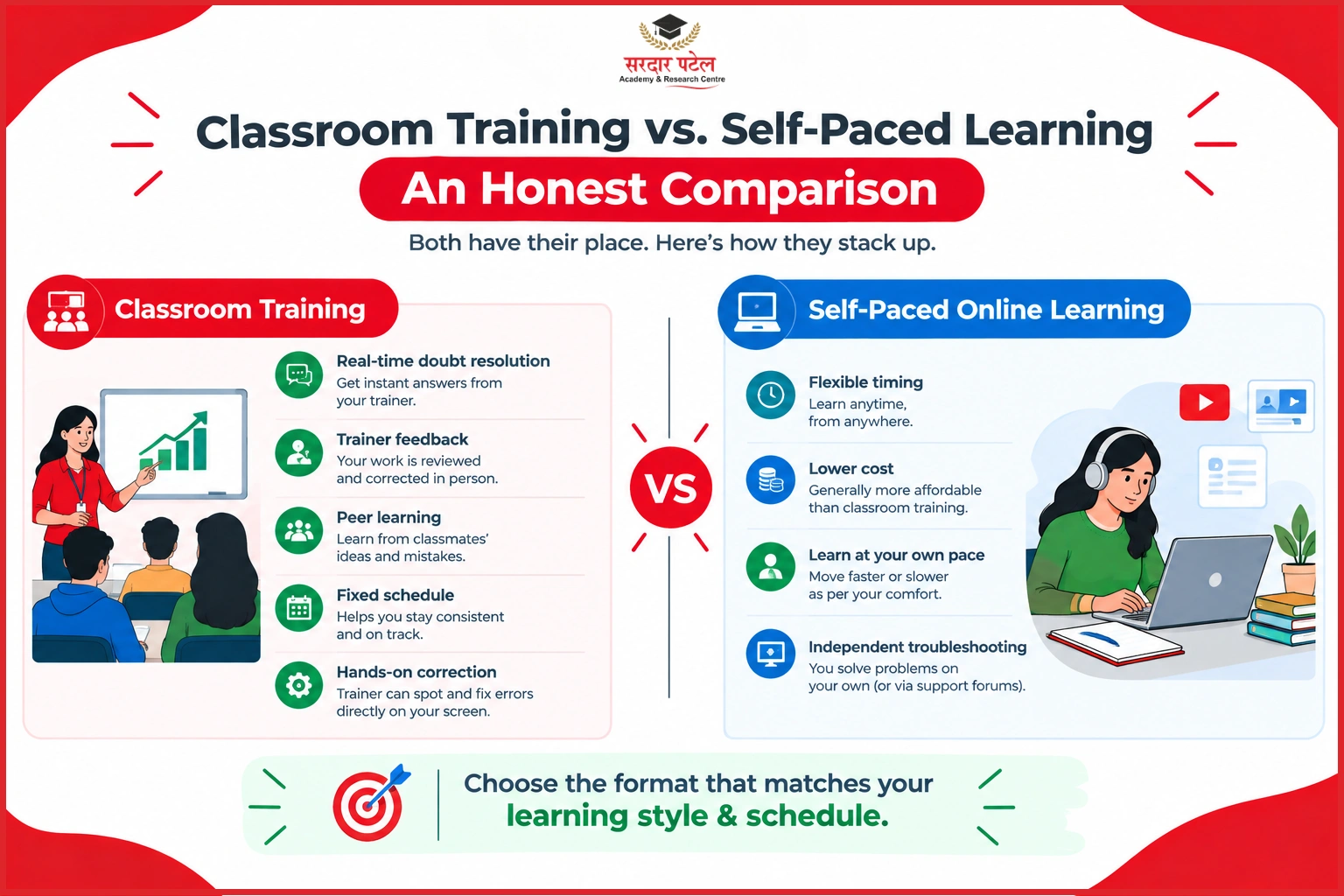
Neither format is universally "better" — they solve different problems. Here's how they compare for someone trying to build real job-ready skills:
| Factor |
Classroom Training |
Self-Paced Online Courses |
| Real-time doubt resolution |
Immediate, in-person |
Delayed, often via forums or email |
| Accountability |
Fixed schedule keeps you consistent |
Easy to postpone or abandon |
| Peer learning |
High — group discussions, shared mistakes |
Minimal or none |
| Hands-on correction |
Trainer can review your screen directly |
You troubleshoot alone |
| Flexibility |
Fixed batch timings |
Learn anytime |
| Cost |
Generally higher |
Generally lower |
If you're the kind of learner who finishes what you start on your own, self-paced content can work well as a supplement. If you've tried that route before and lost momentum by week three, structured classroom training — with a trainer and a room full of peers — tends to hold people accountable in a way videos rarely do.
Common Mistakes Beginners Make (And How Classroom Feedback Fixes Them)
Trainers who've spent years teaching digital marketing classes see the same handful of mistakes repeat across nearly every new batch:
- Setting campaign budgets too aggressively during practice, before understanding how bidding actually works.
- Writing ad copy focused on features rather than what the customer actually searches for
- Ignoring mobile page speed while auditing a website, even though most traffic today is mobile
- Treating SEO and paid ads as separate silos instead of understanding how they support each other
None of these mistakes are unusual — they're a normal part of learning. What matters is whether someone catches them early. In a classroom setting, a trainer can flag a poorly targeted ad group before a student submits an assignment built entirely on that mistake, saving weeks of practicing the wrong habit.
Who Actually Benefits From This Kind of Classroom Setup
Practical digital marketing classes in Delhi tend to work well for a fairly wide range of people, though for different reasons:
- College students and freshers get a head start on skills that aren't taught in most degree programs, along with a portfolio of real campaigns to show in interviews.
- Working professionals looking to shift into marketing roles benefit from structured evening or weekend batches that don't require quitting their current job.
- Business owners and freelancers often want just enough hands-on understanding to run their own campaigns or supervise a marketing hire competently.
- Career changers frequently value the classroom environment because it rebuilds confidence through small, guided wins rather than overwhelming self-study.
If any of these describe your situation, it's worth reading why students at our institute often prefer practical learning over pure theory — the reasoning holds up regardless of your starting point.
How to Evaluate Whether a Digital Marketing Institute Is Genuinely Practical
Before enrolling anywhere in Delhi NCR, it's worth asking a few direct questions during a demo class or counseling session:
- Do students get individual tool access, or is it a trainer-only demo on a projector?
- Are live or near-live campaigns used, or only screenshots and slides?
- How much of the syllabus is graded through actual assignments versus theory-based tests?
- Can you speak to a current or former student about their day-to-day classroom experience?
An institute confident in its training approach will usually be happy to let you sit in on a session before committing. That's also the easiest way to judge classroom energy, batch size, and trainer availability firsthand rather than relying on a brochure.
What a Real Student Journey Looks Like
Reading about a classroom is useful, but seeing how the experience translates into a real opportunity is more convincing. One example worth reading is how a student moved from classroom exercises to landing an SEO internship — it walks through the specific skills that came up during the interview process, most of which were things practiced repeatedly in class rather than read about once.
If you're curious about the people leading these sessions, our interview with a lead faculty member on student career growth also covers how trainers structure feedback around real career outcomes rather than just completing a syllabus.
Final Thoughts and Next Steps
Practical digital marketing classes in Delhi are only as good as the hands-on experience they actually deliver — not the number of times the word "practical" appears in their marketing material. What matters is whether you leave a session having built something yourself, made a few mistakes, and understood exactly why they happened.
If you want to see this classroom approach firsthand rather than just read about it, the easiest next step is to sit in on a live session. You can book a free demo class with Sardar Patel Academy & Research Centre (SPARC) in GTB Nagar, Delhi, and judge the training style for yourself before making any commitment.
FAQs
Practical classes involve hands-on work inside real tools — Google Ads, Analytics, SEO platforms — under a trainer's guidance, rather than only watching demonstrations or reading concepts.
No. Most practical digital marketing classes in Delhi are designed for absolute beginners, with concepts introduced step by step before any tool-based exercises begin.
Duration varies by institute and course depth, typically ranging from a few weeks for a foundational program to several months for an advanced, project-heavy course.
It depends on your learning style. Classroom training generally offers more real-time feedback and accountability, while online courses offer flexibility. Many learners benefit from combining both.
Genuinely practical programs include exercises using live or simulated campaigns inside actual ad platforms, not just recorded walkthroughs. Ask specifically about this before enrolling anywhere.
Yes — many institutes, including ours, run weekend or evening batches specifically for professionals who want to reskill without leaving their current job.
At minimum, expect direct practice with Google Ads, Google Analytics, Meta Ads Manager, SEO auditing tools, and basic content or design tools like Canva.
YouTube tutorials are useful for concepts, but they can't correct your specific mistakes in real time or hold you accountable to a schedule the way in-person classroom training does.