+91 9312966129
 sparc.enquiry01@gmail.com


How Long Does It Take to Become Data Analyst?
Wondering how long to learn data analytics? See realistic timelines for students, working professionals, and beginners, plus what actually speeds up progress.

Table of Contents
- Why There's No Single Answer
- Quick Answer: The Typical Timeline
- Breaking It Down: What You're Actually Learning
- Excel and Spreadsheet Fundamentals (2–4 weeks)
- SQL for Querying Data (3–5 weeks)
- Data Visualization — Power BI or Tableau (3–4 weeks)
- Statistics and Analytical Thinking (ongoing, 3–6 weeks focused)
- Python for Analytics (4–6 weeks, optional but valuable)
- Real Projects and Portfolio Building (4–8 weeks, often overlapping)
- What Actually Slows People Down
- Self-Study vs. Structured Course: Which Is Faster?
- Does Your Educational Background Matter?
- For Working Professionals in Delhi NCR
- For Business Owners: Do You Need to Learn It Yourself?
- Skills You'll Need Along the Way
- Final Thoughts
If you've searched for how long to learn data analytics, you've probably already read three different articles giving you three different answers — "3 months," "6 months," "a year or more." The honest answer is: it depends on where you're starting from and how much time you can actually give it each week.
This guide explains how long to learn data analytics for different types of learners — students, working professionals, and business owners — so you can set a timeline that's realistic instead of guessing based on a course ad you saw on Instagram.
Why There's No Single Answer
Data analytics isn't one skill — it's a bundle of skills: Excel, SQL, a visualization tool like Power BI, some statistics, and increasingly, basic Python. How long it takes to learn data analytics depends on:
- Your starting point (complete beginner vs. someone from a commerce or engineering background)
- How many hours a week you can dedicate
- Whether you're learning through structured classes or self-study
- Whether your goal is a job-ready skill set or just conceptual familiarity
A college student with 4-5 hours a day free will move faster than a working professional squeezing in an hour after office hours — and that's completely normal.
How long to learn data analytics also depends on whether you're aiming for basic knowledge, workplace proficiency, or a job-ready skill set.
Quick Answer: The Typical Timeline
For most beginners following a structured, guided course, how long to learn data analytics to a job-ready level generally falls in this range:
| Learner Type |
Typical Duration |
Weekly Time Commitment |
| Full-time student (dedicated learning) |
3–4 months |
15–20 hours/week |
| Working professional (part-time) |
5–7 months |
6–8 hours/week |
| Complete beginner, self-taught |
8–12 months |
Varies, often inconsistent |
| Fast-track structured course |
2–3 months |
20+ hours/week |
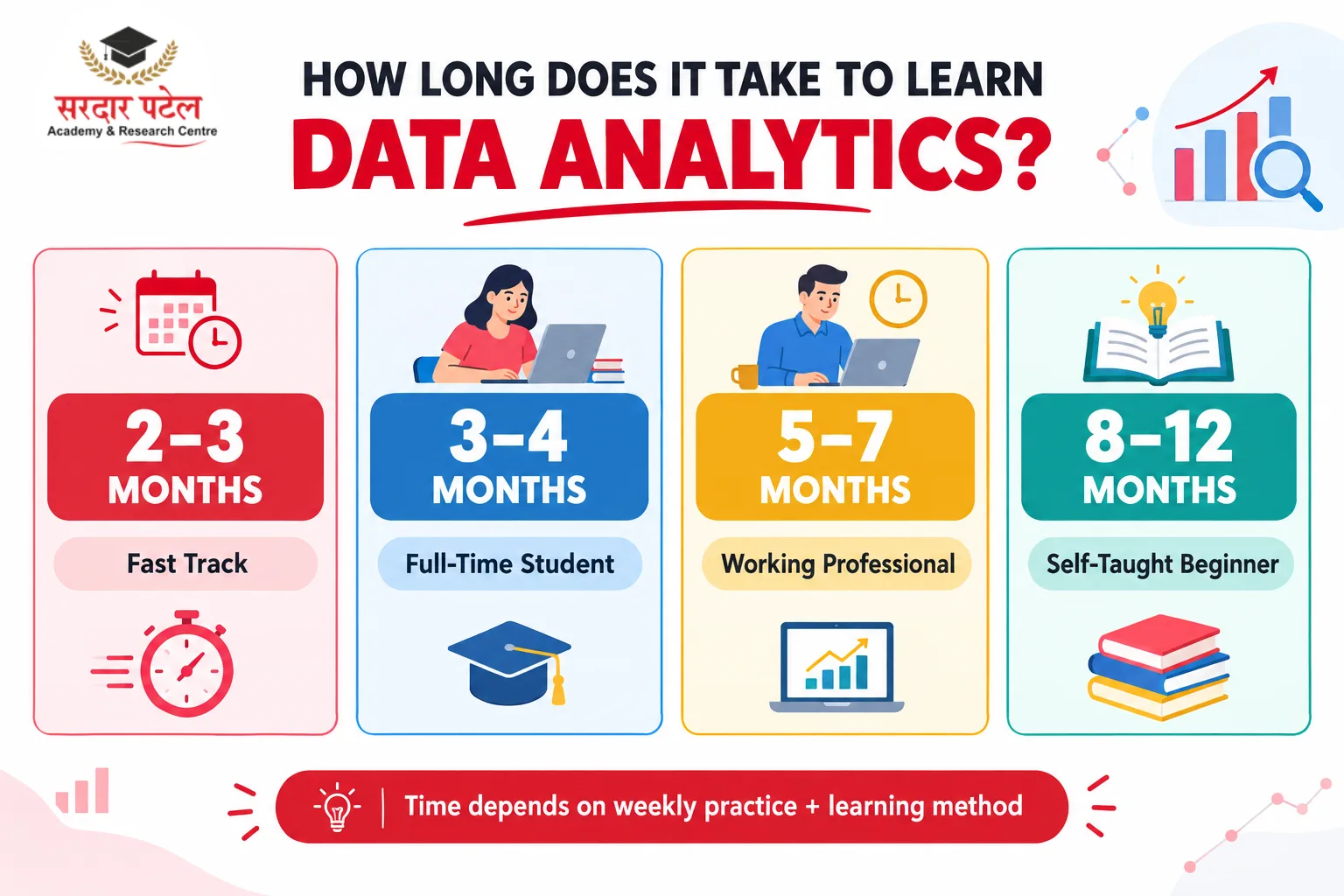
These are general ranges based on typical course structures, not guarantees — your actual pace will vary depending on how much time you can put in each week.
Breaking It Down: What You're Actually Learning
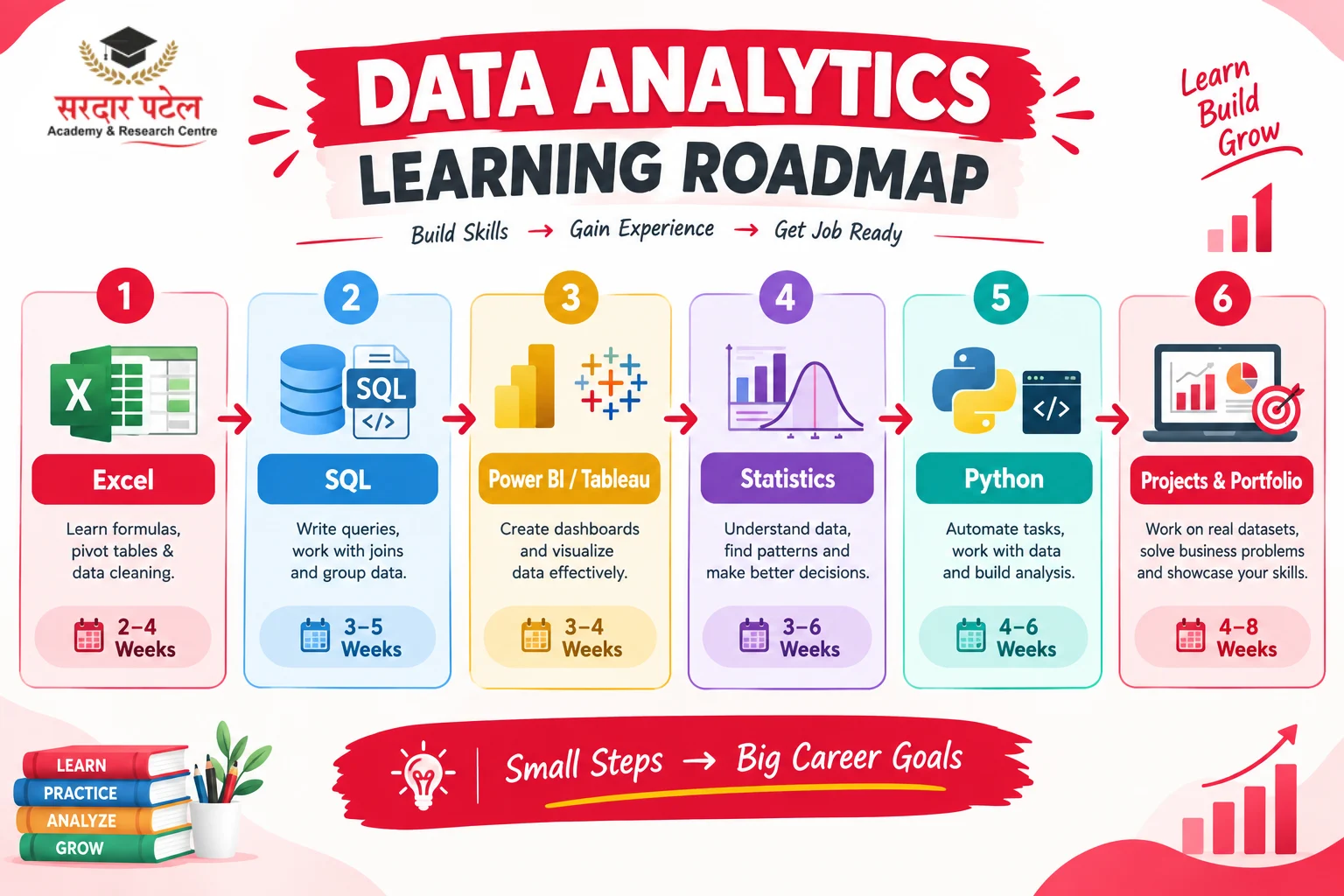
It helps to stop thinking of "data analytics" as one giant mountain and instead as a set of smaller hills. Here's roughly how the skill-building usually stacks up. Understanding how long to learn data analytics becomes easier when you break the learning process into individual skills instead of treating analytics as one subject.
Excel and Spreadsheet Fundamentals (2–4 weeks)
This is usually the starting point, even for people who think they "already know Excel." Formulas, pivot tables, and data cleaning in Excel form the base that everything else builds on.
SQL for Querying Data (3–5 weeks)
SQL is where a lot of learners either click with the logic quickly or need extra practice with joins and grouping. Most beginners can write functional queries within a month of consistent practice.
Data Visualization — Power BI or Tableau (3–4 weeks)
Turning raw numbers into dashboards is often the most enjoyable part for beginners because progress is visible immediately. You go from a blank canvas to a working dashboard fairly quickly.
Statistics and Analytical Thinking (ongoing, 3–6 weeks focused)
This is less about memorizing formulas and more about learning to ask the right questions of your data — what's actually meaningful versus what's just noise.
Python for Analytics (4–6 weeks, optional but valuable)
Not every analyst role requires Python on day one, but it's increasingly expected for mid-level roles and gives you a real edge over candidates who stopped at Excel and SQL. To understand how Excel, SQL, Power BI, Python, and other tools fit into an analytics workflow, explore this guide to data analytics tools.
Real Projects and Portfolio Building (4–8 weeks, often overlapping)
This is the step people skip and regret. Employers want to see that you've applied these tools to messy, real-world-style data — not just completed quizzes. You can practise with real-world datasets available through Kaggle datasets while building your portfolio.
Put together, that's roughly 3 to 6 months for someone learning consistently. So, how long to learn data analytics ultimately depends on how these skill areas overlap and how consistently you practise them.
For learners interested in digital or website analytics, Google Analytics Academy also provides free training and practical learning resources.
What Actually Slows People Down
A few patterns show up again and again with learners who take much longer than expected:
- Inconsistent practice. Learning analytics in two-hour bursts once a week takes far longer than daily 45-minute sessions, even though the total hours may look similar on paper.
- Skipping projects. Watching tutorials feels like progress, but tools like SQL and Power BI only really stick once you've used them on an actual dataset with actual problems.
- No structured order. Jumping between YouTube videos on unrelated topics without a sequence usually means gaps show up later, often during interviews. Following a structured data analytics learning guide can help you build these skills in the right order without missing important fundamentals.
- Trying to master everything before applying. Many learners delay job applications waiting to feel "100% ready," which rarely happens — most working analysts are still learning on the job. Once you have the core skills and a few projects ready, you can explore Data Analyst job opportunities and compare the skills employers are currently requesting.
Self-Study vs. Structured Course: Which Is Faster?
Both paths can work, but they solve for different things — and they can significantly affect how long to learn data analytics takes in practice.
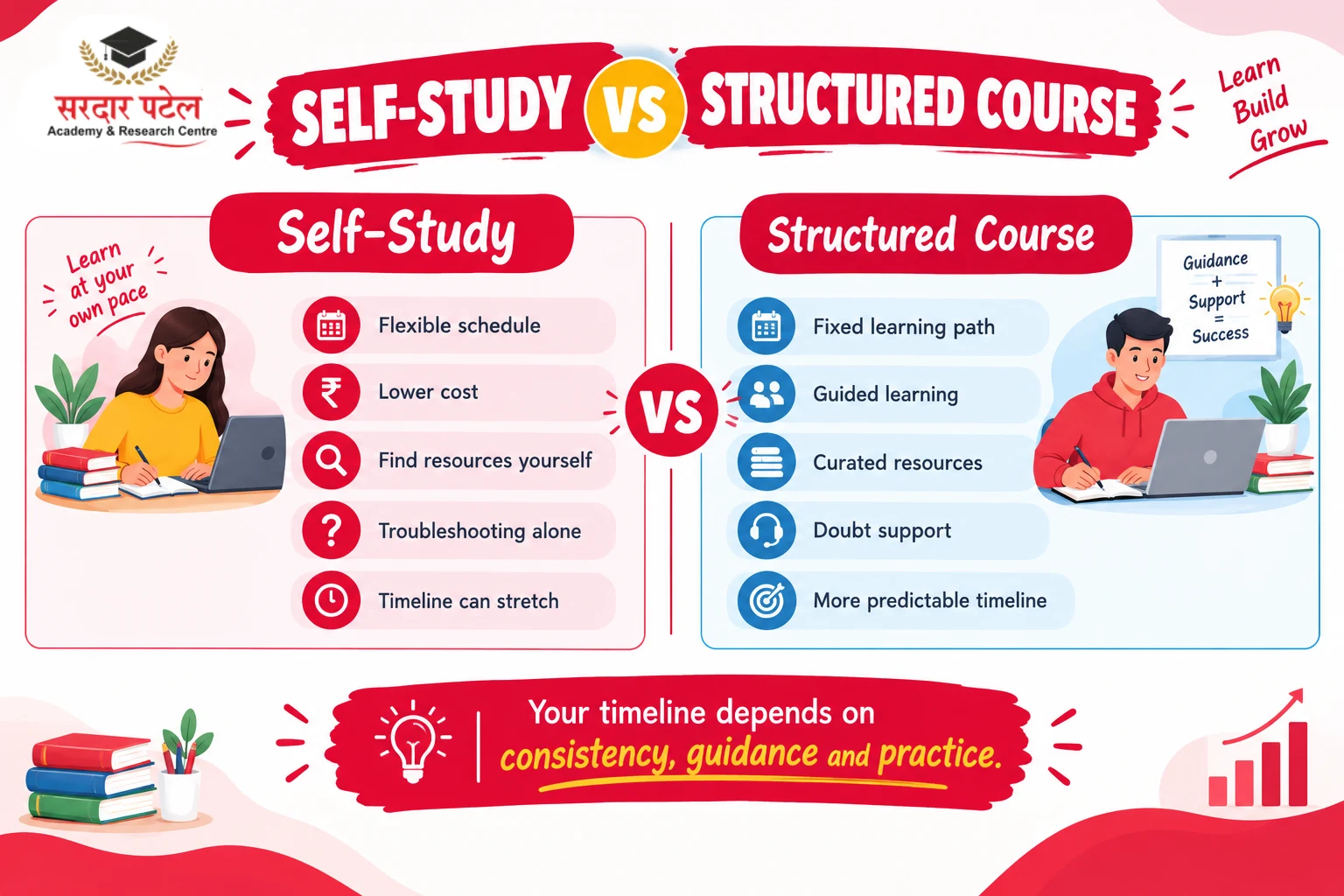
Self-study tends to be cheaper and flexible, but the learning curve stretches out because you're also spending time figuring out what to learn next, sourcing datasets, and troubleshooting without guided feedback.
A structured course compresses the timeline mainly by removing that guesswork — the sequence, the practice datasets, and the doubt-clearing are already built in. This is usually where the difference between a 10-month self-taught journey and a 3-month guided one comes from.
If you're weighing the two, our detailed breakdown of course duration options [ "What is Analytics Course Duration?"] covers how different course formats (weekday, weekend, and fast-track) affect the total time commitment.
Does Your Educational Background Matter?
Not as much as people assume. Data analytics draws from commerce, engineering, statistics, and even arts backgrounds. If you're wondering whether a 12th-pass student can realistically start this path, the short answer is yes — see our guide on whether 12th pass students can learn analytics [ "Can 12th Pass Students Learn Analytics?"] for a more detailed look at prerequisites.
What matters more than your degree is comfort with basic logical thinking and a willingness to sit with a problem until it clicks — which is true whether you're 19 or 39. If you're also comparing eligibility requirements and possible career paths, this data analytics course eligibility and career opportunities guide provides a useful overview.
For Working Professionals in Delhi NCR
If you're currently employed and considering a shift into analytics, timing is often the real constraint, not ability. Evening and weekend batches are common across Delhi NCR because so many learners balance this with a 9-to-6 job.
If you're wondering how long to learn data analytics while working full-time, a realistic approach is to treat the first 8–10 weeks as foundation-building (Excel and SQL) and the following weeks as visualization and project work, rather than trying to learn everything in parallel. It's slower on paper but far more sustainable, and sustainability is usually what determines whether someone actually finishes the course.
For Business Owners: Do You Need to Learn It Yourself?
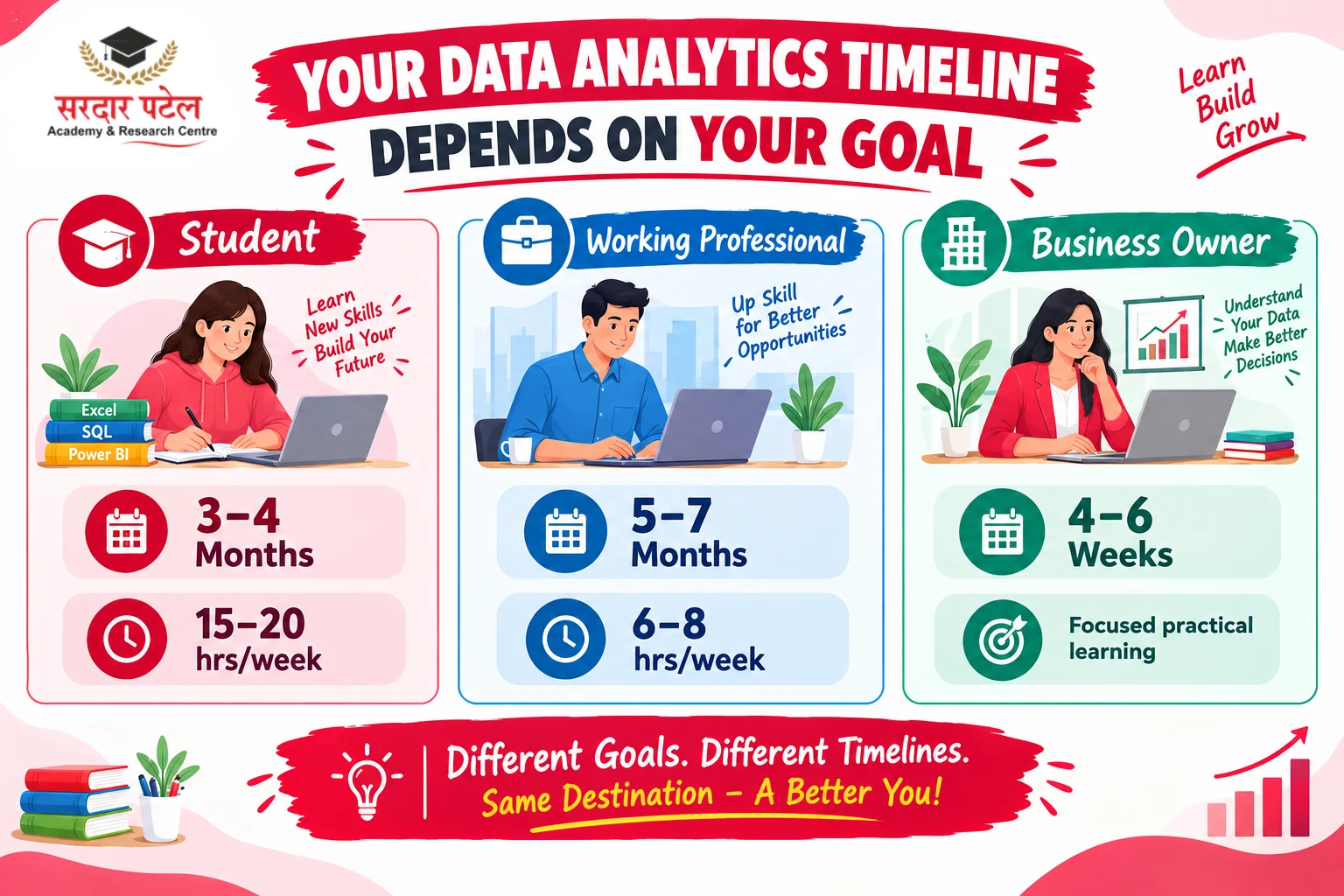
If you're a business owner rather than someone planning to work as an analyst, the timeline question looks a little different. You probably don't need the full 3–7 month, job-ready skill path — what you need is enough working knowledge to read a dashboard, ask your team the right questions, and evaluate the analytics hires you're making.
For business owners, how long to learn data analytics is less about becoming an analyst and more about learning the specific skills needed to understand and use business data.
For that level of fluency, 4–6 weeks of focused learning covering Excel, basic SQL, and how to interpret a Power BI dashboard is usually enough. It won't make you an analyst, but it will stop you from being dependent on someone else to explain what your own numbers mean — which is often the real goal for business owners exploring this.
Skills You'll Need Along the Way
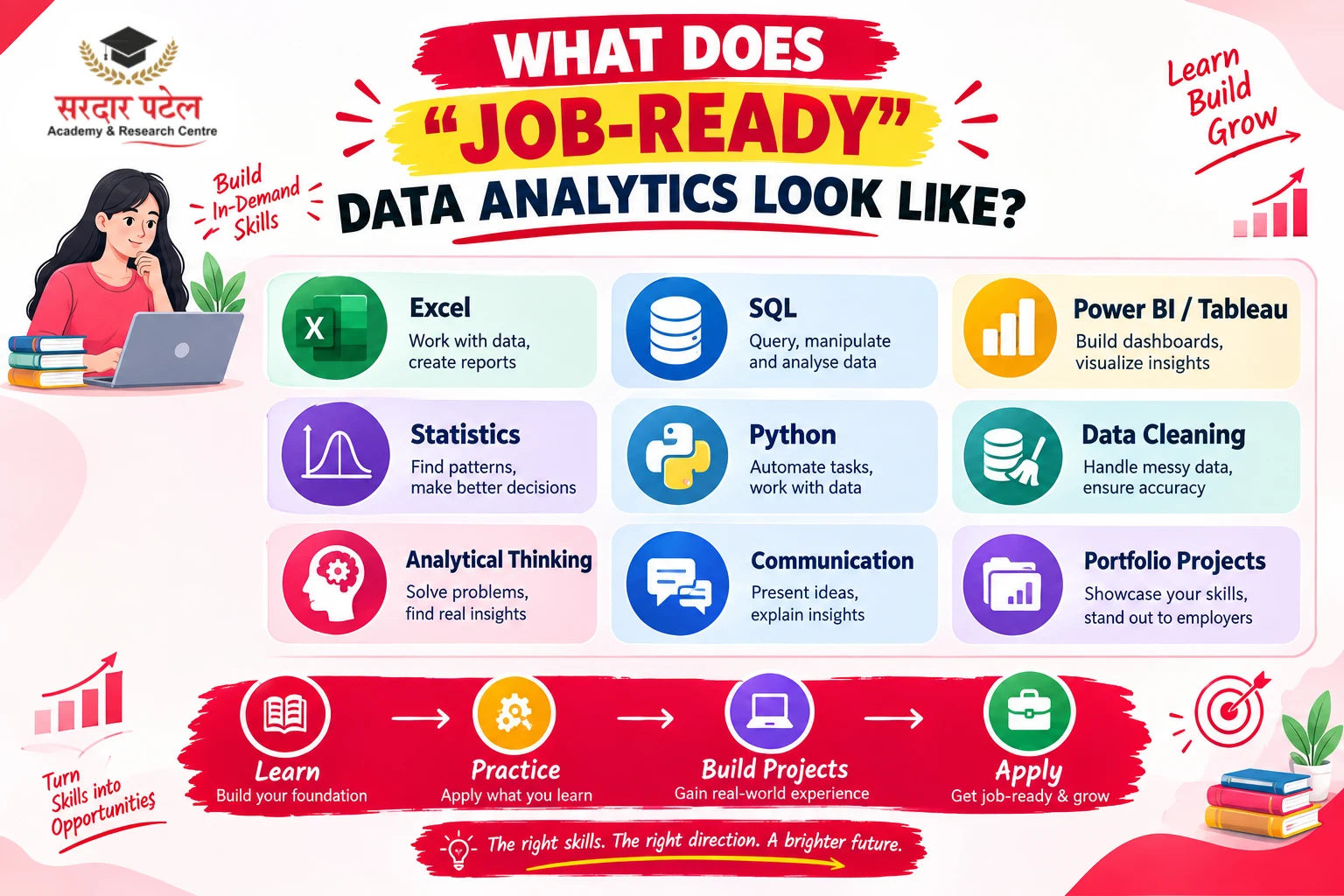
Before deciding how long to learn data analytics, it's worth knowing what the finish line actually looks like.
For a broader view of the work involved in data-focused roles, you can also explore the O*NET occupation database. Once you understand the required skills and become job-ready, you can also compare current data analyst salary trends in India to understand how compensation varies by experience and role.
Our article on skills required to become a data analyst [ "Skills Required to Become Data Analyst"] lays out the technical and non-technical skills employers in the Delhi job market typically screen for.
Final Thoughts
There's no single correct answer to how long to learn data analytics, but for most learners following a structured path, somewhere between 3 and 7 months is a realistic range, depending on your starting point and available time. What matters most isn't rushing the calendar; it's building a genuine, demonstrable skill set you can walk into an interview with.
If you'd rather not piece this timeline together on your own, SPARC's Fast Track Analytics Course is built specifically to compress this learning curve with structured, project-based training. You can also browse more career guidance on our blog before deciding what timeline fits you best.
FAQs
Most beginners with no prior background need around 4–6 months to reach a job-ready level through a structured course, assuming consistent weekly practice.
It's possible if you're able to dedicate close to full-time hours through an intensive, fast-track format, but 2 months is tight for building a portfolio alongside the core skills.
No. Most courses start with no-code or low-code tools like Excel and Power BI before introducing SQL and Python later in the sequence.
Generally, no. Data analytics focuses more on interpreting and visualizing existing data, while data science adds deeper statistics, machine learning, and programming — data science typically takes longer to learn.
Not necessarily. What matters more to employers is whether you can demonstrate applied skills through real projects, not just the number of weeks listed on a certificate.
Yes — this is one of the most common learner profiles, and evening/weekend formats are specifically designed around that schedule, though the timeline usually stretches to 5–7 months.
Not meaningfully. Pace depends far more on prior exposure to logical/numerical work and consistency of practice than on age.