+91 9312966129
 sparc.enquiry01@gmail.com


Real SEO Ranking Case Study: How a SPARC Student Improved a Live Website's Search Visibility
See how a SPARC student improved a live website’s SEO ranking from position 47 to 12 using practical SEO strategies and tracking.
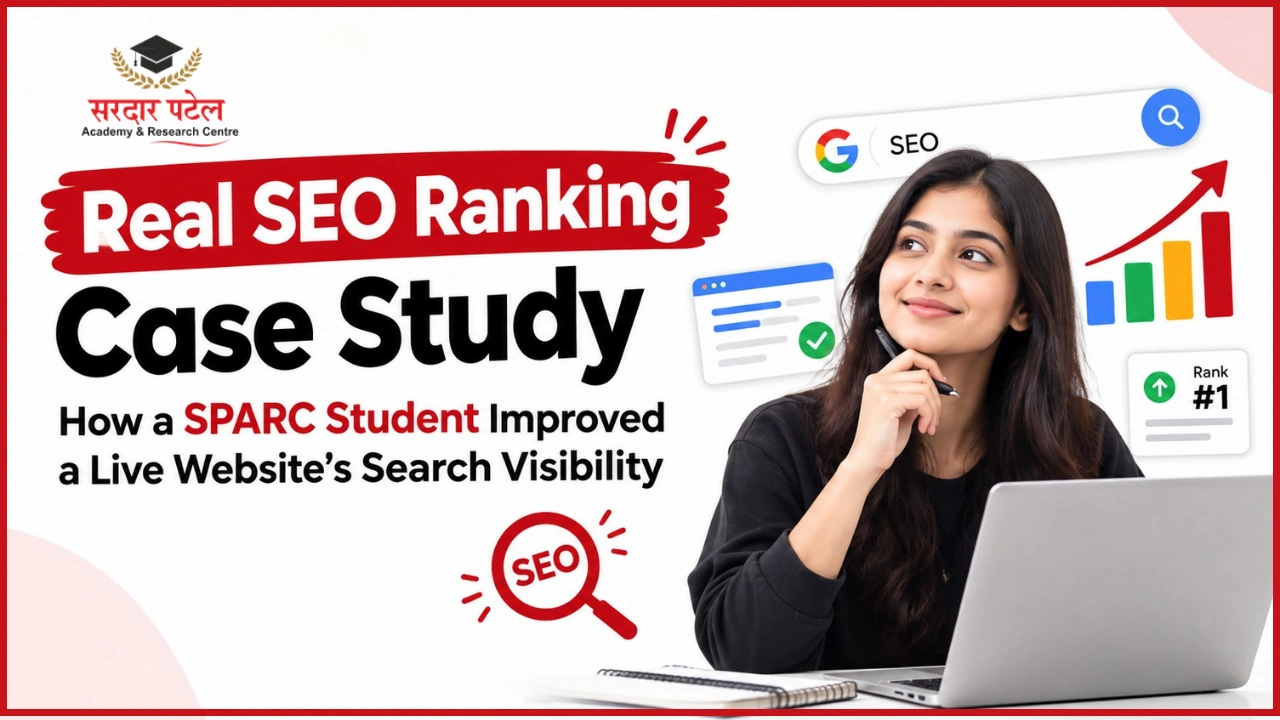
Table of Contents
- The Project: What the Student Was Given
- Step-by-Step: How the Ranking Work Was Done
- Step 1: Keyword and Search Intent Research
- Step 2: On-Page Optimization
- Step 3: Technical SEO Fixes
- Step 4: Content Depth and Internal Linking
- Step 5: Ethical Off-Page Signals
- Step 6: Tracking and Reporting
- What Changed (Honestly Reported)
- Common Mistakes Students Make on Their First SEO Project
- Practical Tips for Students Starting Their Own Case Study
- Final Thoughts and Next Step
If you're researching a digital marketing course in Delhi NCR, you've probably read a dozen pages that say things like "our students get amazing results." Almost none of them show you how. That's the gap this article is trying to close.
This is a real SEO ranking case study student walkthrough — not a marketing slide, but an honest look at how one SPARC learner worked on a live website, made specific changes, and tracked what happened over time. If you want live website ranking proof instead of vague promises, this is the kind of breakdown to look for before picking a digital marketing institute.
By the end of this article, you'll understand:
The Project: What the Student Was Given
For this case study, a SPARC learner working through the digital marketing training program was assigned a real, live website — not a mock-up or a sandbox site — with an existing but underperforming presence on Google.
This case study follows Swati, a SPARC student who worked as an SEO intern on a live website during her practical training. She also shared her freelancing journey in a separate student case study, offering another perspective on her practical learning experience. Her work included keyword research, on-page optimization, content improvements, and tracking search performance under guidance.
| Project detail |
Information |
| Student name |
Swati |
| Role |
SEO Intern |
| Website |
sparc.org.in |
| worked on Target keyword |
data analytics course fees in Delhi |
| Project duration |
3 months |
The starting point looked roughly like this:
| Area |
Starting Condition |
| Target keyword |
data analytics course fees in Delhi |
| Ranking position |
Not visible in the top 50 results |
| On-page content |
Thin, generic, no clear search intent match |
| Technical health |
Missing meta tags, slow page speed, no internal linking structure |
| Backlink profile |
Minimal to none |
The brief was intentionally realistic: no shortcuts, no paid ranking tools, no black-hat tactics. Just the same process any working SEO executive would follow on a client project.
Step-by-Step: How the Ranking Work Was Done
Step 1: Keyword and Search Intent Research
Before touching the website, the student mapped out what people were actually searching for around the target topic — not just the "obvious" keyword, but the related questions and phrases real users type in.
This step matters because ranking for the wrong keyword (technically correct, but not what searchers want) rarely converts into real traffic. The student learned to check search intent first: was the searcher looking to buy, compare, or simply learn something?
Step 2: On-Page Optimization
With the target keyword and intent confirmed, the next stage was rewriting the page itself:
- A clearer, keyword-relevant title tag and meta description
- Headings restructured to match how people actually search (questions, comparisons, specifics)
- Content rewritten to directly answer the search query instead of talking around it
- Internal links added to connect the page with other relevant content on the site
This stage alone took longer than expected — the first draft of the rewritten page was still too generic, and had to be revised after feedback to include more specific, useful detail.
During her internship, Swati worked on on-page SEO improvements for the assigned website. The work included reviewing target keywords, improving page titles and headings, updating content, and adding relevant internal links.
Step 3: Technical SEO Fixes
Technical problems were quietly holding the page back even after the content improved:
- Missing alt text on images
- Slow-loading elements affecting page speed
- No clear URL structure for the page
Fixing these isn't glamorous work, but it removes friction that stops Google from crawling and indexing the page properly.
Step 4: Content Depth and Internal Linking
Rather than adding more pages, the student focused on making the existing page more complete — covering the sub-questions a real visitor would have, and linking it naturally to related content already live on the site, similar to how a well-structured student portfolio page connects related work together.
Step 5: Ethical Off-Page Signals
No paid link schemes were used. The focus stayed on legitimate, relevant off-page activity appropriate for a student project — the kind of foundational off-page work that's taught before students move on to more advanced link-building strategy.
Step 6: Tracking and Reporting
Every two weeks, the student recorded:
- Current ranking position for the target keyword
- Organic impressions and clicks (via Google Search Console)
- Any technical or content changes made in that period
This log gives the project the evidence needed to support its results — without it, a claim that “the site ranked better” is difficult to verify.
What Changed (Honestly Reported)
Ranking movement in SEO is rarely a straight line, and this project was no exception. During the three-month project, the target keyword “data analytics course fees in Delhi” improved from position 47 to position 12, based on Google Search Console data. Impressions and clicks also improved as the page gained visibility.
What's worth noting is what didn't happen: there was no sudden jump to position one, and a couple of secondary keywords barely moved at all. That's a realistic outcome, and it's a more useful lesson for students than a cherry-picked success screenshot would be.
Common Mistakes Students Make on Their First SEO Project
| Mistake |
Why It Slows Progress |
| Targeting a keyword that's too competitive for a first project |
Ranking movement becomes nearly invisible, which is demotivating and hard to learn from |
| Changing too many things at once |
Makes it impossible to tell which change actually helped |
| Skipping the tracking log |
Without a log, there's no way to build a real case study later |
| Ignoring technical SEO |
Great content on a slow, poorly structured page still struggles to rank |
| Copying competitor content instead of researching intent |
It can result in unoriginal content that provides little additional value to the reader |
Practical Tips for Students Starting Their Own Case Study
- Pick one primary keyword to track closely before adding secondary ones
- Log changes with dates — you'll need this later for your portfolio
- Check Google Search Console weekly, not just when you remember
- Compare notes with peers working on different websites; patterns become clearer
Students weighing how much runway they need to reach this stage often ask about course length — a fair question, and one covered in more depth in this comparison of shorter and longer digital marketing course formats.
Final Thoughts and Next Step
A real seo ranking case study student project is one of the clearest ways to judge whether a digital marketing course actually teaches practical skills — because it forces everything into the open: the starting point, the process, the setbacks, and the honestly reported result.
If you're comparing institutes and want to see this kind of live project work firsthand rather than take it on faith, the practical modules covered in SPARC's digital marketing training program are built around exactly this kind of hands-on, trackable work. You're welcome to get in touch to view live project training and ask any questions before enrolling.
FAQs
It's a documented project where a student works on a real website, applies SEO techniques, and tracks ranking or traffic changes over time, with evidence rather than just a final claim.
No. A genuine seo ranking case study student project uses a live, indexed website — not a mock site with no real search visibility to improve.
It varies by keyword competition and starting point, but meaningful movement typically takes several weeks to a few months of consistent, tracked work — not days.
Yes, with guidance. The goal for a first project is usually a realistic, moderately competitive keyword rather than a highly competitive one, so beginners can see clear cause-and-effect.
Commonly Google Search Console for impressions, clicks, and average position, along with basic keyword tracking to monitor movement over the reporting period.
Competition, domain authority, search intent mismatch, or insufficient content depth can all hold a keyword back — which is exactly the kind of troubleshooting a real case study is meant to teach.
Ask to see the actual website, the specific keyword targeted, the change log, and the tracking data — not just a final ranking screenshot.
No. Rankings depend on many factors including competition, domain authority, backlinks, and Google's algorithm — no ethical case study or institute can guarantee a specific ranking position.