+91 9312966129
 sparc.enquiry01@gmail.com


Internship vs Full Time Data Analytics Job
Analytics internship vs. full-time job — compare real differences, internship benefits for data analysts, and how to decide based on your career stage.

Table of Contents
- What an Analytics Internship Actually Involves
- What a Full-Time Analytics Job Actually Involves
- Key Differences at a Glance
- Internship Benefits for Data Analysts
- Benefits and Limitations of Starting Full-Time
- Benefits:
- Limitations:
- Which Path Fits Your Situation
- Students still studying:
- Fresh graduates with little to no practical exposure:
- Working professionals switching into analytics:
- Business owners evaluating who to hire:
- Common Mistakes When Choosing Between the Two
- Moving From an Internship to a Full-Time Role
- Deciding in the Delhi NCR Job Market
- Final Thoughts
If you've just finished building your data analytics skills and now have both an internship offer and a full-time opening on the table, you're facing a genuinely tricky decision. The analytics internship vs. full-time job question doesn't have a universal right answer—it depends on your career stage, how much practical experience you already have, and what you need right now.
This guide compares both paths honestly — what each looks like day-to-day, the real trade-offs, and how to decide based on your specific situation rather than a generic rule.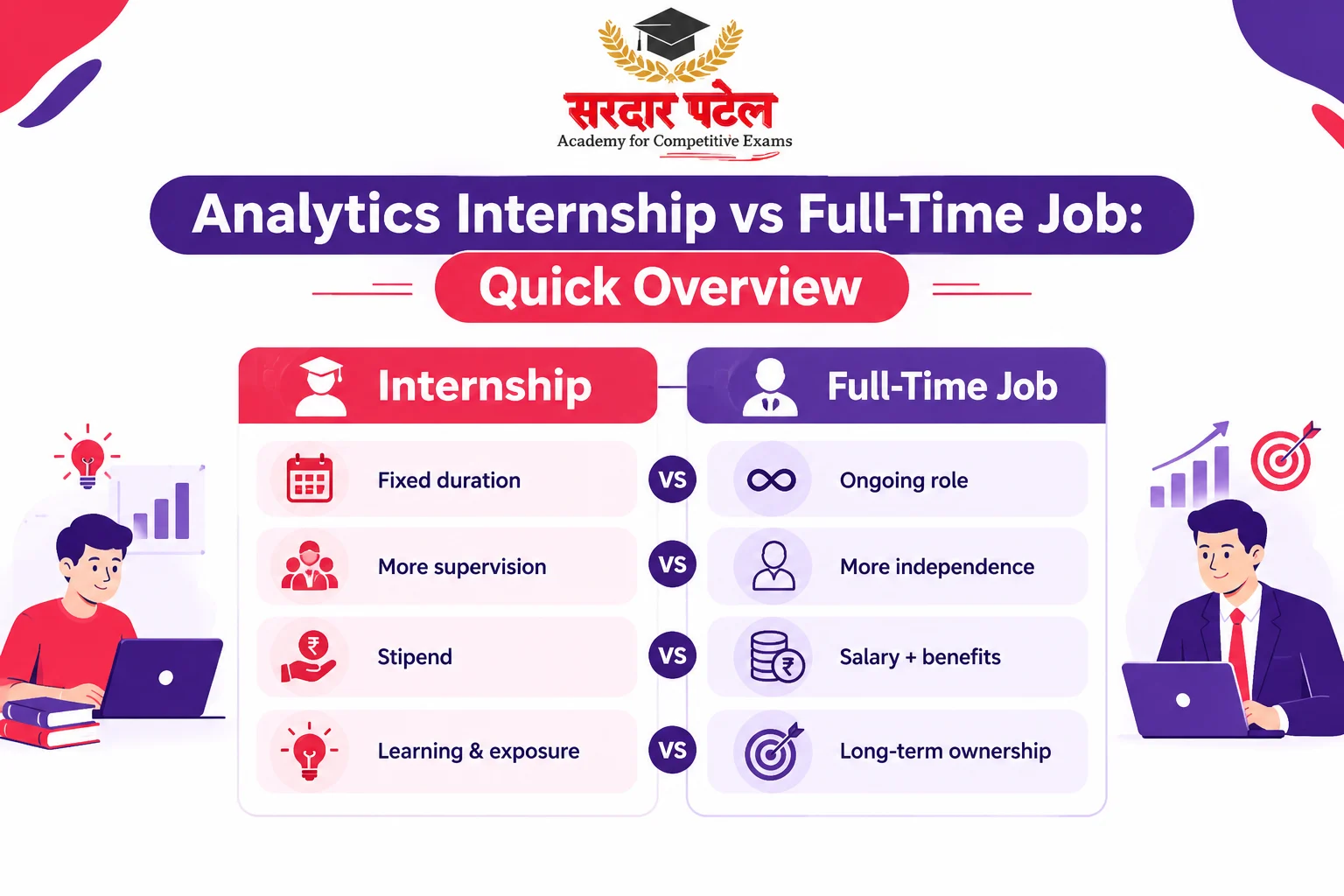
What an Analytics Internship Actually Involves
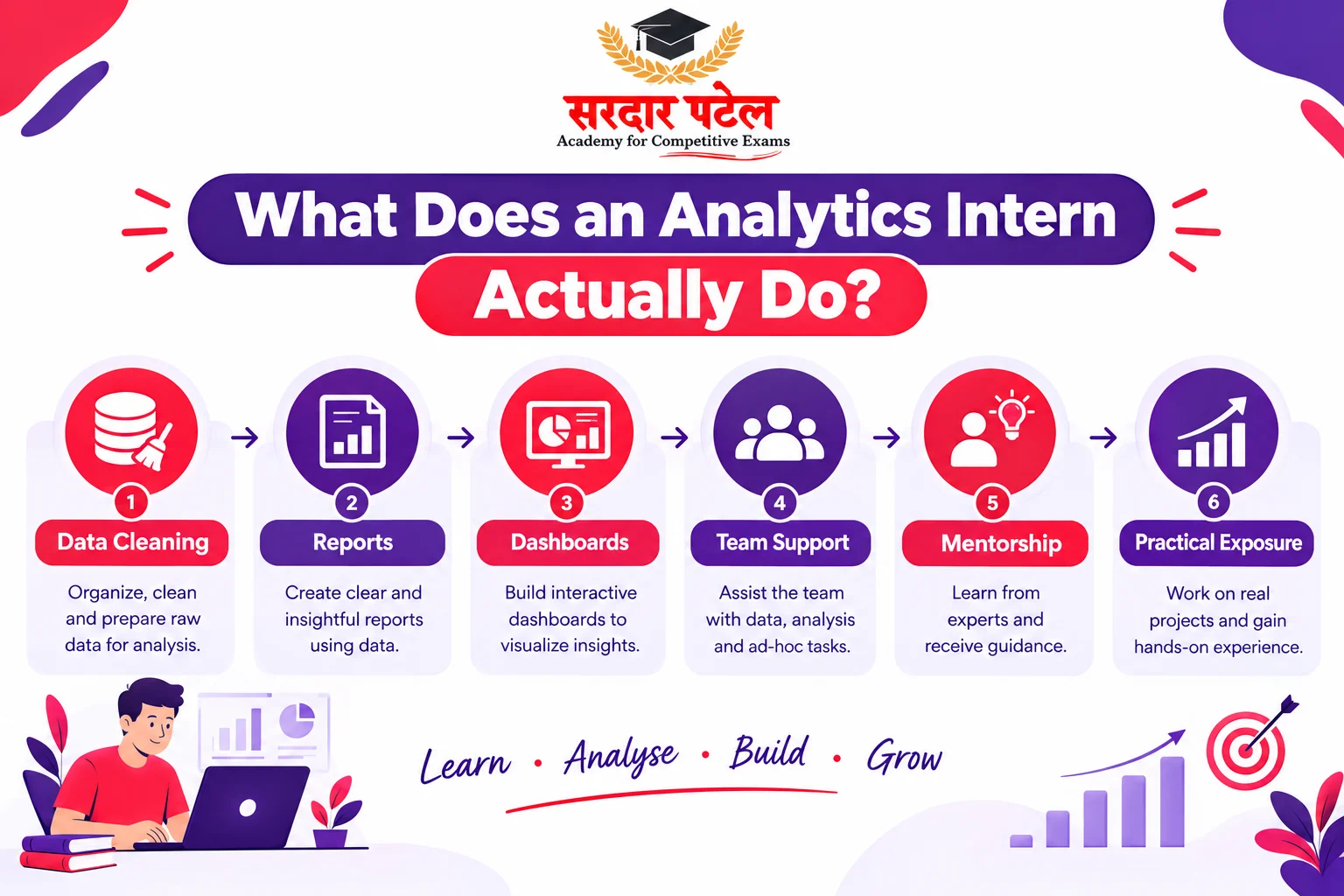
An analytics internship is usually a fixed-term position, anywhere from six weeks to six months, where you work on real (or close to real) business data under supervision. Interns typically assist with data cleaning, building or updating reports, supporting dashboard work, and helping a team with recurring analytical tasks. If you're building these skills before applying, Google's data analytics skills and career guide provides an overview of the skills used in entry-level analytics work.
The defining feature of most internships is structured mentorship — you're rarely expected to solve problems entirely on your own, and there's usually someone senior reviewing your work. Compensation varies: some internships offer a fixed stipend, some are unpaid but offer strong learning value, and some sit somewhere in between.
What a Full-Time Analytics Job Actually Involves
A full-time data analytics role comes with ongoing responsibility rather than a defined end date. You're expected to own specific tasks or projects, work with less day-to-day supervision, and contribute to decisions that actually affect the business, not just practice exercises.
Full-time roles also typically come with a fixed salary, statutory benefits like provident fund contributions, paid leave, and a clearer path toward promotions over time. The expectation of independence is usually higher from day one, even for entry-level hires.
Key Differences at a Glance
Comparing analytics internship vs full time job options side by side makes the trade-offs clearer than describing them separately.
| Factor |
Internship |
Full-Time Job |
| Duration |
Fixed term (weeks to months) |
Ongoing, no fixed end date |
| Supervision |
Close mentorship, work reviewed regularly |
More independence expected |
| Compensation |
Stipend, sometimes unpaid |
Fixed salary plus statutory benefits |
| Job security |
None beyond the internship period |
Comparatively more stable |
| Learning curve |
Structured, lower-stakes mistakes |
Steeper, higher-stakes from the start |
| Career signal |
Shows initiative and practical exposure |
Shows sustained, independent capability |
Neither column is universally "better" — the right choice depends heavily on what you're optimising for at this point in your career. The analytics internship vs full-time job decision ultimately depends on your experience, financial needs, and career goals.
Internship Benefits for Data Analysts
The internship benefits for data analysts go beyond just "getting experience," even though that's the most commonly cited reason. The internship benefits for data analysts go beyond just "getting experience," especially when you're trying to understand how internships can contribute to long-term career development.
Lower-stakes learning environment. Mistakes made during an internship are generally treated as part of the learning process, not a performance issue, which makes it easier to experiment and ask questions.
Exposure without long-term commitment. If you're not entirely sure analytics is the right fit, an internship lets you test that before committing to a full-time role.
Portfolio and reference building. Even a short internship, done well, typically produces two or three genuine project examples and a reference you can use for future applications — something a generic course project usually can't replicate.
A realistic preview of workplace dynamics. Deadlines, stakeholder communication, and working within an existing team's process are hard to simulate outside an actual work environment.
Benefits and Limitations of Starting Full-Time
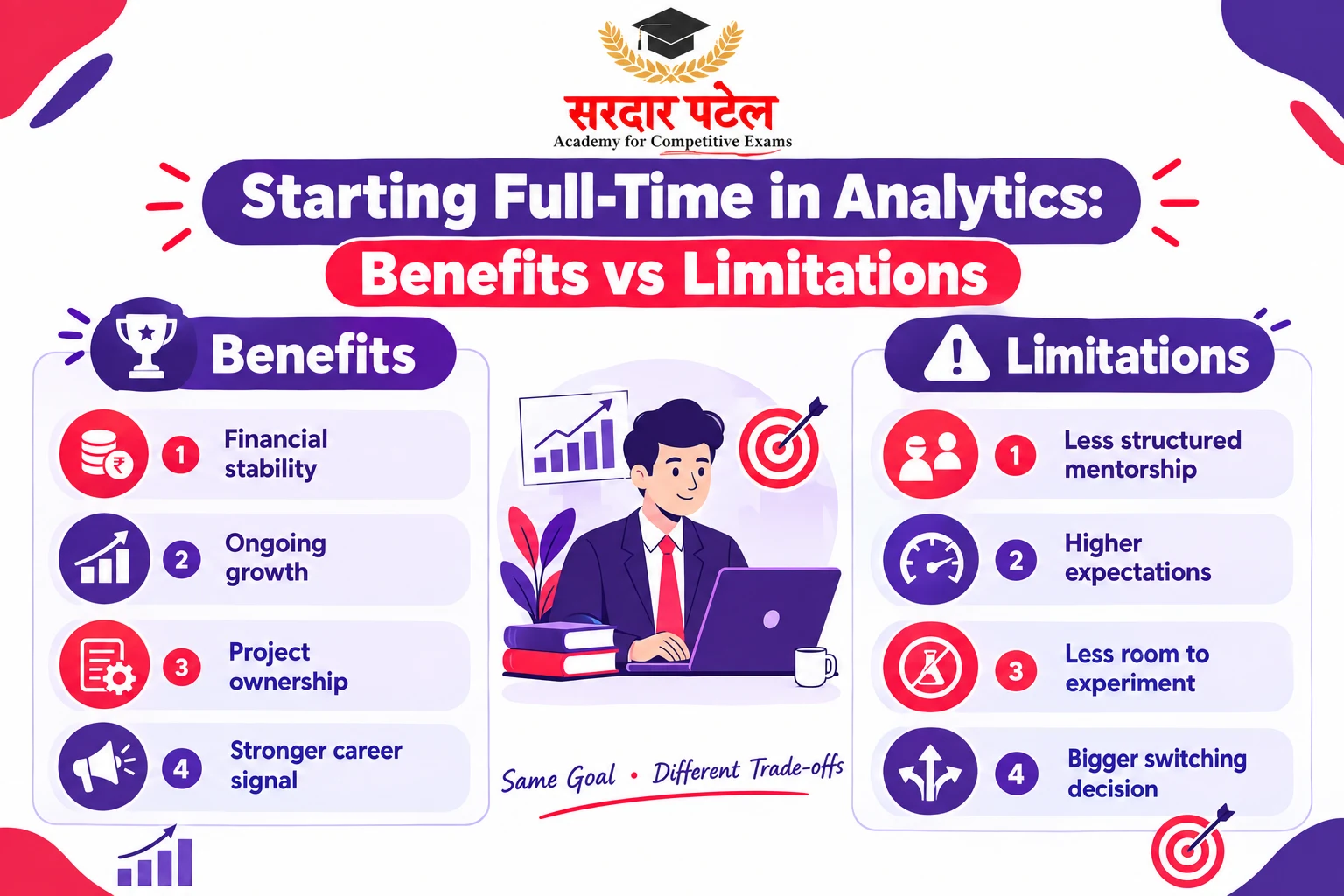
Benefits:
- Financial stability and statutory benefits from the start
- A clearer, ongoing growth path within one organisation
- Deeper ownership of projects, which can accelerate skill development faster than rotating short-term tasks. If you're comparing the longer-term career implications of each path, exploring data analytics career scope, skills, and salaries can give you a broader picture of where analytics roles can lead.
- A stronger initial signal to future employers, since full-time roles are generally read as a step above internship experience
Limitations:
- Less structured mentorship, especially at smaller companies without a formal onboarding process
- Higher expectations from day one, which can be stressful without prior practical exposure
- Less room to "try things out" without it affecting performance reviews
- Switching roles or industries later can feel like a bigger decision once you're established somewhere
Which Path Fits Your Situation
When comparing analytics internship vs. full-time job opportunities, your current experience level and career priorities matter more than choosing one path automatically.
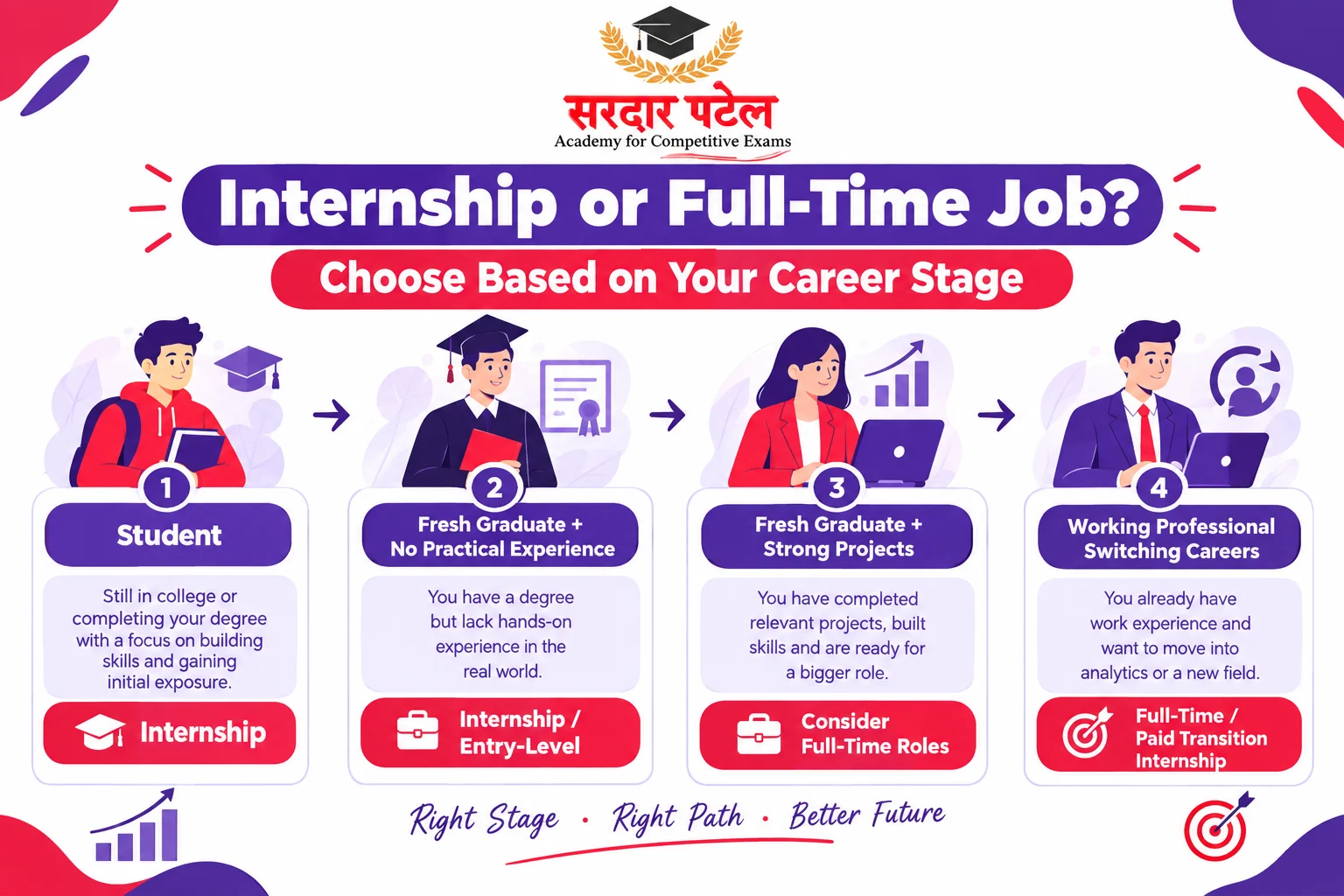
Students still studying:
An internship almost always makes more sense here, since a full-time commitment usually isn't compatible with coursework, and internships are designed around this constraint.
Fresh graduates with little to no practical exposure:
If you're still building your foundation before applying, understanding data analytics course eligibility and career opportunities can help you identify which skills and roles to target. This is where the decision gets genuinely close. If you have zero hands-on project experience, a well-structured internship can build the foundation that makes your next full-time application significantly stronger. If you already have solid portfolio projects and interview-ready skills, applying directly for full-time roles can save time. Before applying for analytics roles, beginners can also review this guide on how to become a data analyst and understand the skills involved in the field.
If you're still developing those fundamentals, this data analytics learning guide can help you understand what to learn before moving into an internship or full-time role.
Working professionals switching into analytics:
Full-time roles, or sometimes a paid transition-focused internship, tend to work better here, since you likely need income stability and already bring transferable workplace experience.
Business owners evaluating who to hire:
For a specific, well-scoped short-term need, an intern can be a cost-effective way to get support. For ongoing, business-critical reporting or analysis, a full-time hire is usually the more reliable choice.
Common Mistakes When Choosing Between the Two
The analytics internship vs. full-time job decision can become difficult when candidates focus on only one factor instead of looking at the complete opportunity.
- Choosing based only on the paycheck, without factoring in how much genuine mentorship and skill-building the internship offers.
- Assuming a full-time offer is always the "better" choice, even when it comes with little structured support for someone with no prior practical experience.
- Treating an internship as just a formality instead of using it to build a real, specific portfolio.
- Not asking about conversion possibilities — many internships lead to full-time offers, but this varies by company, and it's worth asking directly rather than assuming.
- Ignoring the reputation and structure of the specific internship program, since not all internships offer the same quality of mentorship or real project exposure.
Moving From an Internship to a Full-Time Role
If you're currently interning and considering how this connects to a future full-time role, a few things genuinely help:
- Document your work clearly — keep a running record of what you built, not just what you were told to do, so you can speak to it specifically in interviews.
- Ask for feedback proactively rather than waiting for a formal review, since informal feedback tends to be more specific and useful.
- Build relationships beyond your immediate manager, since referrals often come from people you worked with more broadly.
- Ask directly about conversion timelines if you're interested in staying on, rather than assuming it will or won't happen.
If you're preparing for interviews as this transition approaches, it's worth reviewing our guide on SQL interview questions for freshers, since SQL fundamentals come up regardless of whether you're interviewing for an internship or a full-time role. If you're currently interning and considering how this connects to a future full-time role, a few things genuinely help. You can also explore these tips for turning an internship into a full-time job.
Deciding in the Delhi NCR Job Market
Delhi NCR has a dense mix of startups, consulting firms, and established IT-services companies, which means both internship and full-time analytics openings are reasonably common across the region. Startups and smaller consulting firms often offer internships with more hands-on, varied exposure, while larger IT-services companies and established retail or fintech firms tend to have more structured, process-heavy full-time entry points.
For students and freshers based in Delhi NCR, it's worth researching how a specific company's internship program actually works — some genuinely mirror real project work, while others lean more toward observation. If you're still deciding what practical, project-based training should even look like before you apply anywhere, our piece on why live projects matter in data analytics training is a useful starting point, as is our breakdown of what tools you'll actually learn in a data analytics course
Final Thoughts
There isn't a single correct answer to the analytics internship vs full-time job question — the right choice depends on your current experience level, financial situation, and how much structured mentorship you genuinely need right now. — the right choice depends on your current experience level, financial situation, and how much structured mentorship you genuinely need right now. Students and complete beginners generally benefit more from starting with an internship, while those who already have practical exposure or need financial stability sooner often do better applying directly for full-time roles.
Ready to Apply for Internship Batch? Sardar Patel Academy & Research Centre (SPARC) runs a structured, project-based internship program designed to give you exactly the kind of practical exposure that strengthens your next application, whether that's another internship or a full-time analytics role
FAQs
It depends on what you're getting in return. If it offers genuine project exposure, mentorship, and a credible reference, it can be worthwhile early on — but it shouldn't be treated as the only viable path indefinitely.
This varies significantly by company and isn't guaranteed. It's worth asking directly during the interview process rather than assuming either way.
Not usually, unless it's specifically a paid, transition-focused program. A full-time role or a structured training path tends to fit working professionals better, given financial and time constraints.
There's no fixed rule, but internships shorter than a few weeks rarely offer enough time to complete a meaningful project. Longer internships, especially those with a defined project scope, tend to offer more genuine learning value.
This depends on your goals. Multiple internships can broaden exposure across industries, while a full-time role builds depth and a stronger single reference. Neither is universally correct.
Sometimes, though it's less common than with full-time roles. It's reasonable to ask, especially if the internship involves substantial real project work rather than purely observational tasks.