+91 9312966129
 sparc.enquiry01@gmail.com


Questions to Ask Before Joining an Data Analytics Institute
A practical checklist of questions to ask before joining a data analytics institute in Delhi — curriculum, trainers, placement support, and red flags to watch for.

Table of Contents
Most students compare analytics institutes on one variable: fee. That's the wrong starting point. Two institutes can charge the same amount and deliver completely different outcomes — one with an updated, project-based curriculum and real placement support, the other running outdated slides with a "100% placement" banner and no process behind it.
The difference is usually invisible until after you've paid. The way to catch it beforehand is to ask specific, hard-to-fake questions during admission — not "do you have placements?" but "which companies hired your last three batches, and in what roles?"
If you're still comparing institutes, you may also find our detailed guide on How to Choose the Right Data Analytics Institute in Delhi helpful. It explains the key factors you should evaluate before making your final admission decision.
This guide gives you exactly those questions, organised by what they actually reveal, plus a one-page checklist at the end you can literally take into a counselling call.
Why Taking Time to Research This Choice Matters
An analytics course is typically a 1–8 month, several-thousand-rupee commitment that directly shapes your first job. Skipping research here is a poor trade: an hour of questions can save months of sitting through an outdated curriculum with no job at the end of it.
The pattern is consistent: students who ask direct questions about curriculum currency, trainer backgrounds, live projects, and the placement process before enrolling tend to make better-informed decisions than those who enroll based on advertisements or fee comparisons alone — simply because they've forced the institute to be specific rather than vague.
A transparent institute will answer these questions directly. An institute that deflects, generalizes, or gets defensive is telling you something too.
The 15 Questions
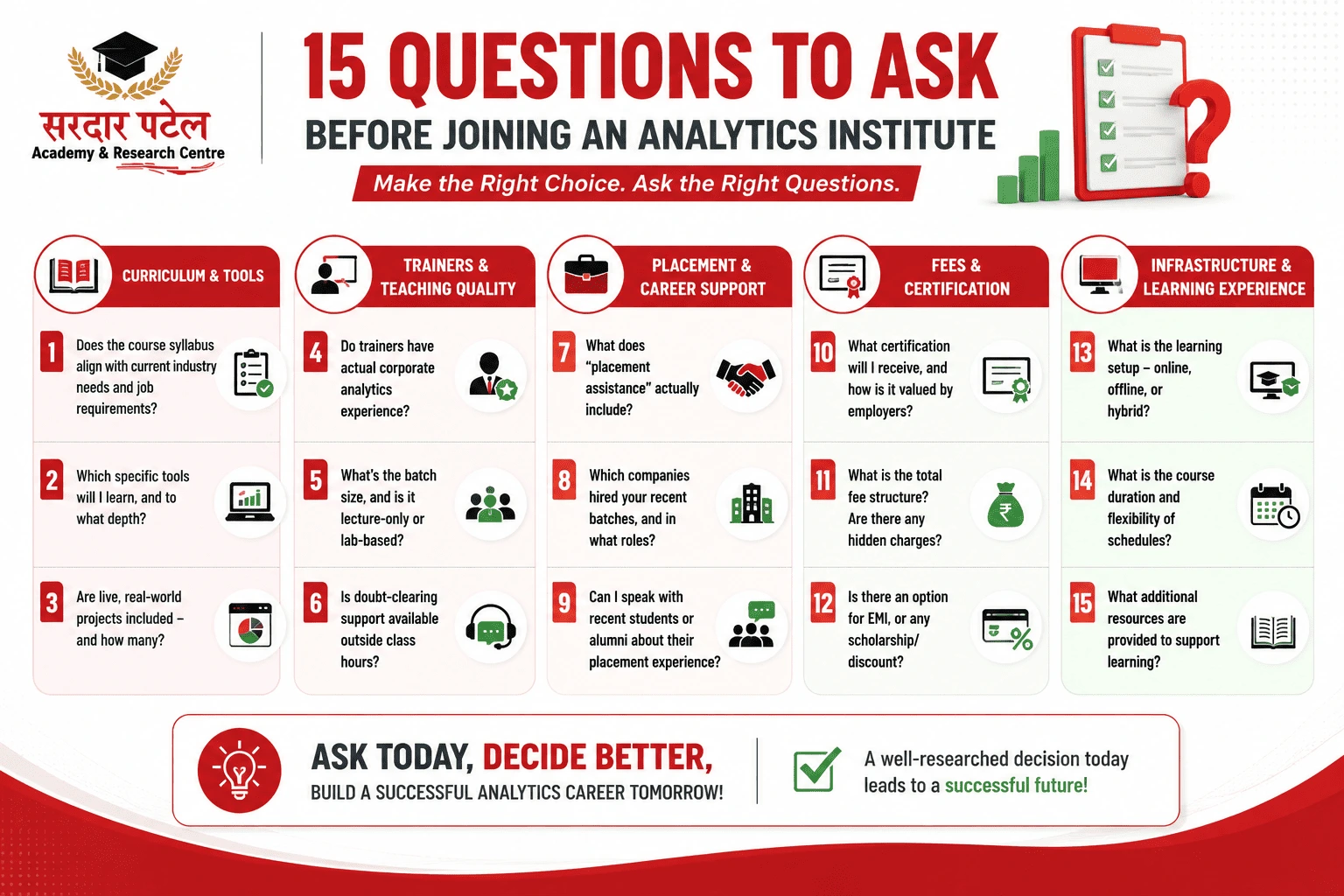
Curriculum & Tools
1. Does the course syllabus align with current industry needs and job requirements?
Analytics tools change fast. Ask when the curriculum was last revised, and whether it includes Excel, SQL, Python, Power BI, Tableau, statistics, and business intelligence — not just Excel and basic reporting
2. Which specific tools will I learn, and to what depth?
"We cover Python" can mean two weeks of syntax or a full module with Pandas, NumPy, and real automation. Ask for the module-by-module breakdown, not just a tool list.
3. Are live, real-world projects included — and how many?
Ask directly: how many projects, are they based on real business scenarios (sales dashboards, HR analytics, customer segmentation), and will you leave with something you can show in an interview?
Trainers & Teaching Quality
4. Do trainers have actual corporate analytics experience?
A trainer who has built dashboards for a real business explains trade-offs differently than one teaching purely from a textbook. Ask if you can speak with a current trainer before enrolling.
5. What's the batch size, and is it lecture-only or lab-based?
Batch size directly affects how much individual attention you get:
| Batch Size |
Typical Experience |
| 10–20 students |
Strong individual attention |
| 20–30 students |
Reasonable interaction |
| 30+ students |
Limited personal support |
Ask specifically whether sessions include hands-on lab time or are lecture-only.
6. Is doubt-clearing support available outside class hours?
One blocked concept in SQL or Python can stall progress for days without accessible support. Ask how doubts get resolved — a mentor, a forum, scheduled office hours — and how fast.
Placement & Career Support
7. What does "placement assistance" actually include?
Don't accept "yes, we provide placements" as an answer. Ask specifically: resume building? Mock interviews? Aptitude/technical rounds? How long does support continue after the course ends?
8. Which companies have hired recent batches, and for what roles?
This is the single hardest question for an institute to fake convincingly. Ask for recent, specific examples — company names and job titles, not just "our students get placed."
9. Can I speak to a recent graduate directly?
A legitimate institute should be comfortable connecting you with 1–2 recent students. Hesitation here is itself informative.
Certification & Fees
10. Is the certification recognized, and does it reflect actual skills learned?
Ask what the certificate specifically documents — course completion only, or verified project work and skills assessed.
11. What is the complete, itemized fee structure?
Ask for a written breakdown of the base fee, GST, study materials, certification, project costs, and whether placement support is included or charged separately. For a detailed comparison of tuition costs, payment options, and what is typically included in different programs, read our guide on Data Analytics Course Fees in Delhi Explained.
Infrastructure & Logistics
12. What does the physical (or virtual) learning setup actually look like?
For in-person training: modern labs, licensed software, one computer per student during practice sessions. For online: platform quality, recording access, and how technical issues get resolved. If possible, visit in person before paying.
13. What's the course duration, and how flexible is the schedule?
Ask about weekday vs. weekend batches, whether you can switch batches if needed, and whether recorded sessions are available if you miss a class.
14. What additional resources do I get access to?
Class notes, sample datasets, a learning management system, past interview questions — these matter for revision after the live sessions end.
The Meta-Question
15. Why should I choose this institute over others I'm considering?
Ask this directly and listen for specifics — updated curriculum, named trainers, named hiring companies, a clear fee breakdown — versus a generic pitch about "quality education" and "industry exposure" that could apply to literally any institute.
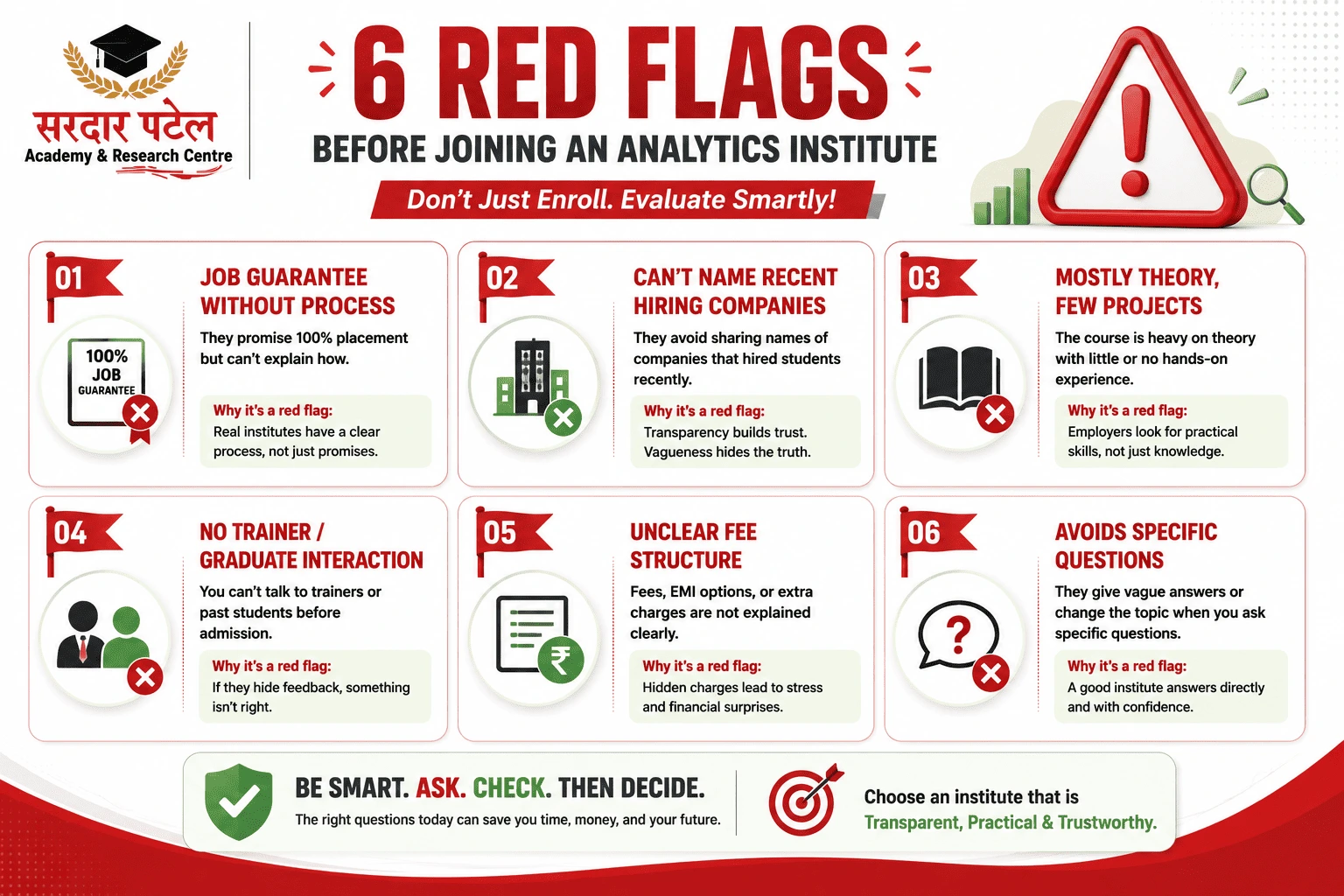
Red Flags That Should Make You Pause
Be cautious if an institute:
- Guarantees jobs without explaining the actual placement process
- Can't name specific recent hiring companies or roles when asked directly
- Focuses almost entirely on theory with minimal lab or project time
- Won't let you speak to a current trainer or recent graduate
- Has an unclear or shifting fee structure
- Gets defensive rather than specific when you ask detailed questions
None of these alone is disqualifying, but two or more together are worth taking seriously.
One Student's Real Experience
Independent reviews are one of the few genuinely hard-to-fake signals available before enrolling. Here are two recent, verified Google reviews from SPARC learners. If you want to see how analytics training can translate into a real career journey, read our Student Became Data Analyst in 7 Months success story.
"Practical & Project-Based Learning: Instead of just memorizing theory, the focus here is on hands-on practice. Classes are designed around real-time projects, which makes learning much faster. Good Lab Infrastructure: well-equipped computer labs with personal computer time to practice after or during classes. Helpful & Patient Faculty who approach topics from a beginner's level. Value for Money: quality education and professional certifications at a reasonable fee compared to high-end premium institutes in Delhi. They also provide an in-house mobile app to track daily practice, access study materials, and take tests."
— NG bhai, Google review, verified on Google Maps, posted ~1 month ago
One review is a data point, not proof. Before enrolling anywhere — SPARC included — read several independent reviews across Google Maps and other platforms, and ideally speak to a graduate directly (see Question 9).
Looking for more learner experiences before making your decision? Explore our Top Data Analytics Student Testimonials of the Year to see what students say about their learning experience.
The One-Page Checklist
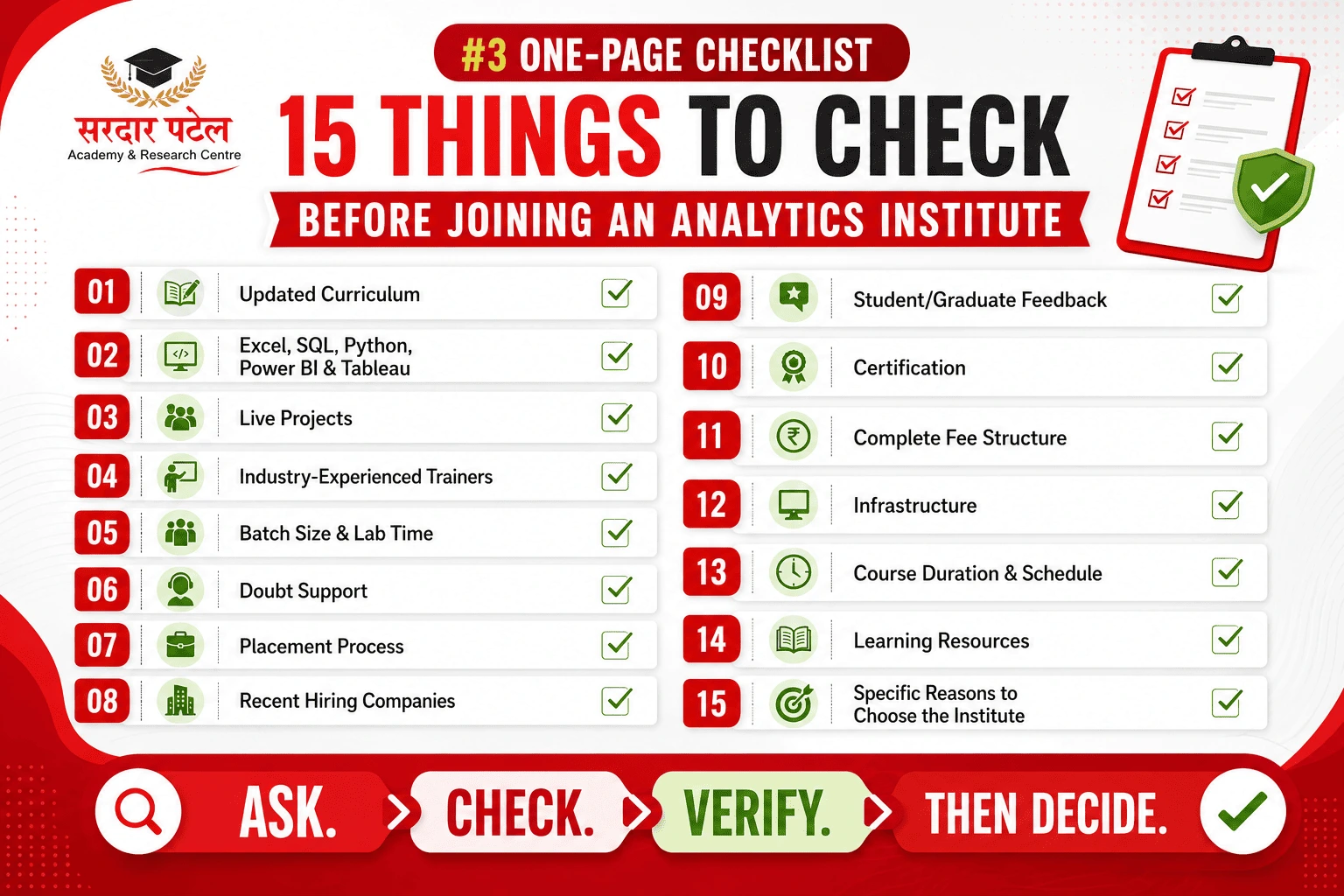
Choosing the right Data Analytics course requires more than comparing fees or course names. Use this checklist during a counselling session, institute visit, or online discussion to evaluate the program more carefully. It covers important areas such as curriculum, practical projects, trainer expertise, placement support, certification, fees, infrastructure, and student feedback.
| S.No | Check |
| 1 | Curriculum updated within the last 12 months |
| 2 | Excel, SQL, Python, Power BI, Tableau all covered in depth |
| 3 | Live, business-style projects included (not just practice sheets) |
| 4 | Trainers have real corporate analytics experience |
| 5 | Batch size and lab time confirmed |
| 6 | Doubt-support process is clear |
| 7 | Placement process specifically explained (not just promised) |
| 8 | Named recent hiring companies/roles provided |
| 9 | Spoke to a recent graduate |
| 10 | Certification value clearly explained |
| 11 | Full fee breakdown received in writing |
| 12 | Infrastructure verified (visited or seen on video call) |
| 13 | Schedule and flexibility confirmed |
| 14 | Post-class resources confirmed |
| 15 | Institute gave specific (not generic) reasons to choose them |
If an institute scores well across most of these — and can back its answers with specifics rather than slogans — it's a reasonable sign of a genuine, career-focused program.
Once you've selected the right institute and built strong technical skills, you can also explore Freelancing Opportunities in Data Analytics to discover how data analytics can help you earn through freelance projects alongside full-time career opportunities.
SPARC (Sardar Patel Academy & Research Centre) structures its analytics program around exactly this kind of transparency: an updated curriculum covering Excel, SQL, Python, Power BI, and Tableau, live business projects, and placement preparation. Ask us these same 15 questions directly — explore the program here or get in touch for specifics on trainers, recent placements, and fees.
FAQs
Because course fees look similar across institutes, but curriculum currency, trainer quality, and real placement process vary enormously — and those differences are invisible unless you ask directly.
At minimum: is the curriculum current, are live projects included, do trainers have real industry experience, what specifically does placement support include, and can you name recent hiring companies?
Yes — most structured programs start from fundamentals. The key question for beginners specifically is whether the institute has a clear path from basics to job-ready skills, not just an advanced-only curriculum.
Significantly. Interviewers can usually tell within a few questions whether a candidate actually built something or just studied it. A real project you can explain end-to-end is one of the strongest signals you can bring to an
At minimum: Excel, SQL, Python, and at least one BI tool (Power BI or Tableau), plus applied statistics.
Sardar Patel Academy & Research Centre offers an industry-updated curriculum, live business projects, and placement preparation. As with any institute, ask the 15 questions above directly and verify the answers before enrolling — that applies here too.