+91 9312966129
 sparc.enquiry01@gmail.com


How to Crack Data Analytics Interview
A complete data analytics interview preparation guide — technical rounds, SQL and case study questions, behavioural tips, and a 3-week prep plan for freshers and professionals.
Table of Contents
- What Interviewers Are Actually Evaluating
- The Typical Data Analytics Interview Structure
- Technical Round: What to Actually Prepare
- Excel
- SQL
- Statistics
- Visualisation Tools (Power BI / Tableau)
- The Case Study or Business Problem Round
- Behavioural Round: Analyst Interview Tips for Freshers
- Common Mistakes Candidates Make
- A Practical Data Analytics Interview Preparation Timeline
- Preparing for the Delhi NCR Job Market
- Final Thoughts
You've built your skills, maybe finished a course or a few portfolio projects, and now you've got an actual interview lined up. This is usually the point where data analytics interview preparation starts feeling overwhelming — should you revise SQL joins one more time, or focus on that case study format you saw online?
This guide walks through what these interviews actually test, how to prepare for each round, the mistakes candidates repeat, and a realistic prep plan — whether you're a fresher applying for your first entry-level analyst role or a working professional switching into analytics. If you're new to the field, reviewing these data analytics basics for beginners can help you build the foundation before moving into interview-focused preparation.
What Interviewers Are Actually Evaluating
Before diving into tactics, it helps to understand what a hiring panel is trying to figure out. It's rarely just "does this person know SQL?"
Most interviewers assess four things at once: whether you have the technical foundation to do the job, whether you can reason through an ambiguous business problem, whether you can explain findings to non-technical stakeholders, and whether you'll be reasonable to work with day-to-day.
That’s the frame to keep in mind throughout your interview preparation, because candidates routinely over-invest in memorising syntax and under-invest in practising how they explain their thinking.
The Typical Data Analytics Interview Structure
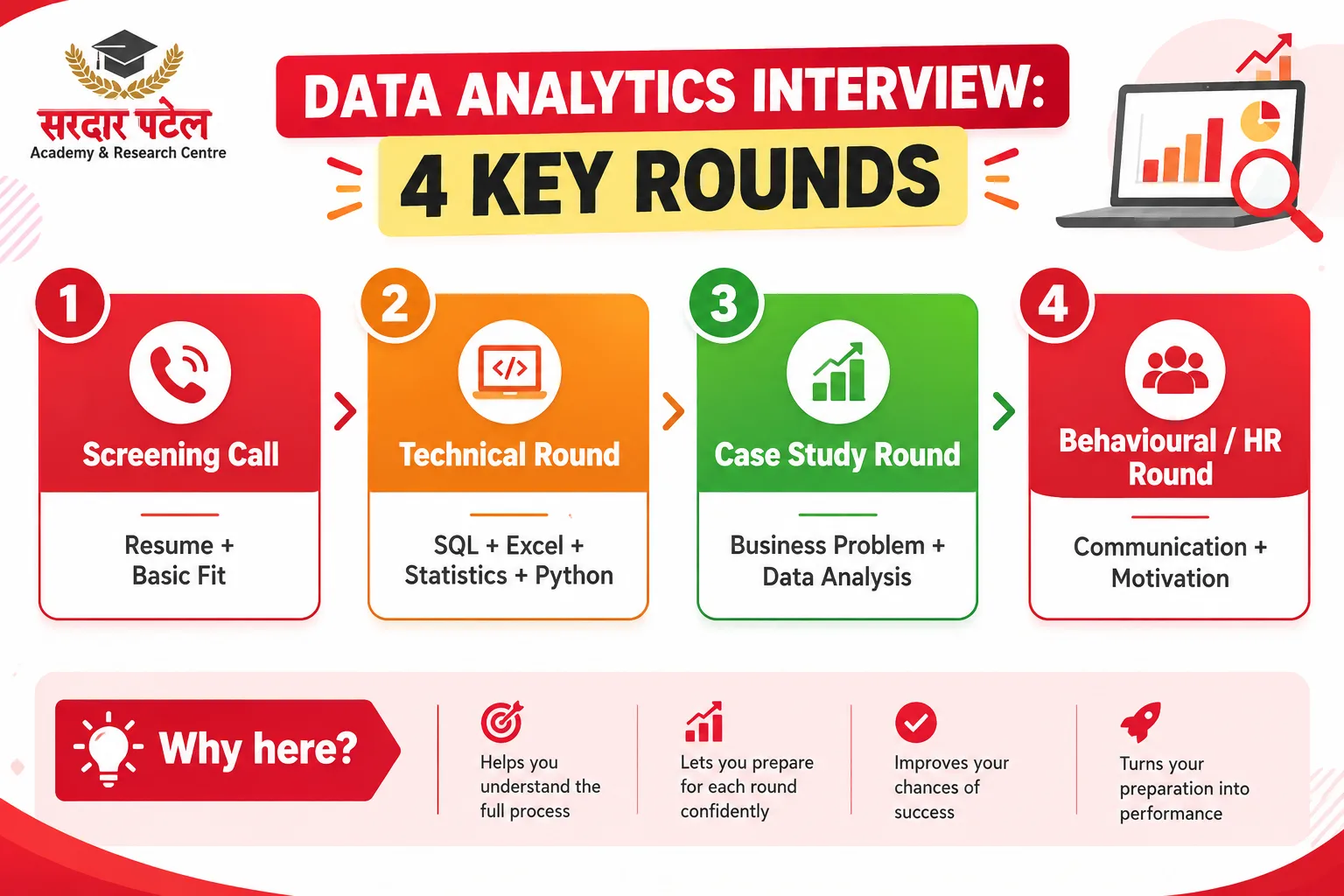
Most companies run these interviews across a few distinct rounds, though the exact order and number vary by company size and role level.
| Round |
What It Tests |
Typical Format |
| Screening call |
Basic fit, communication, resume clarity |
15–20 min call with HR or a recruiter |
| Technical round |
SQL, Excel, statistics, sometimes Python |
Live problem-solving or written test |
| Case study/business round |
Structured thinking, business judgment |
Open-ended problem, often with a dataset |
| Behavioural / HR round |
Communication, motivation, culture fit |
Communication, motivation, culture fit |
Smaller companies often merge two of these into a single round, while larger firms and consultancies may add a panel round. Ask the recruiter directly what to expect —Knowing the format upfront helps you focus your preparation on the rounds that actually decide the outcome.
Technical Round: What to Actually Prepare
This is where most candidates spend the bulk of their prep time, and for good reason — it's usually the first filter. For additional examples of data analyst interview questions, you can review this guide covering technical, statistical, SQL, and software-related topics.
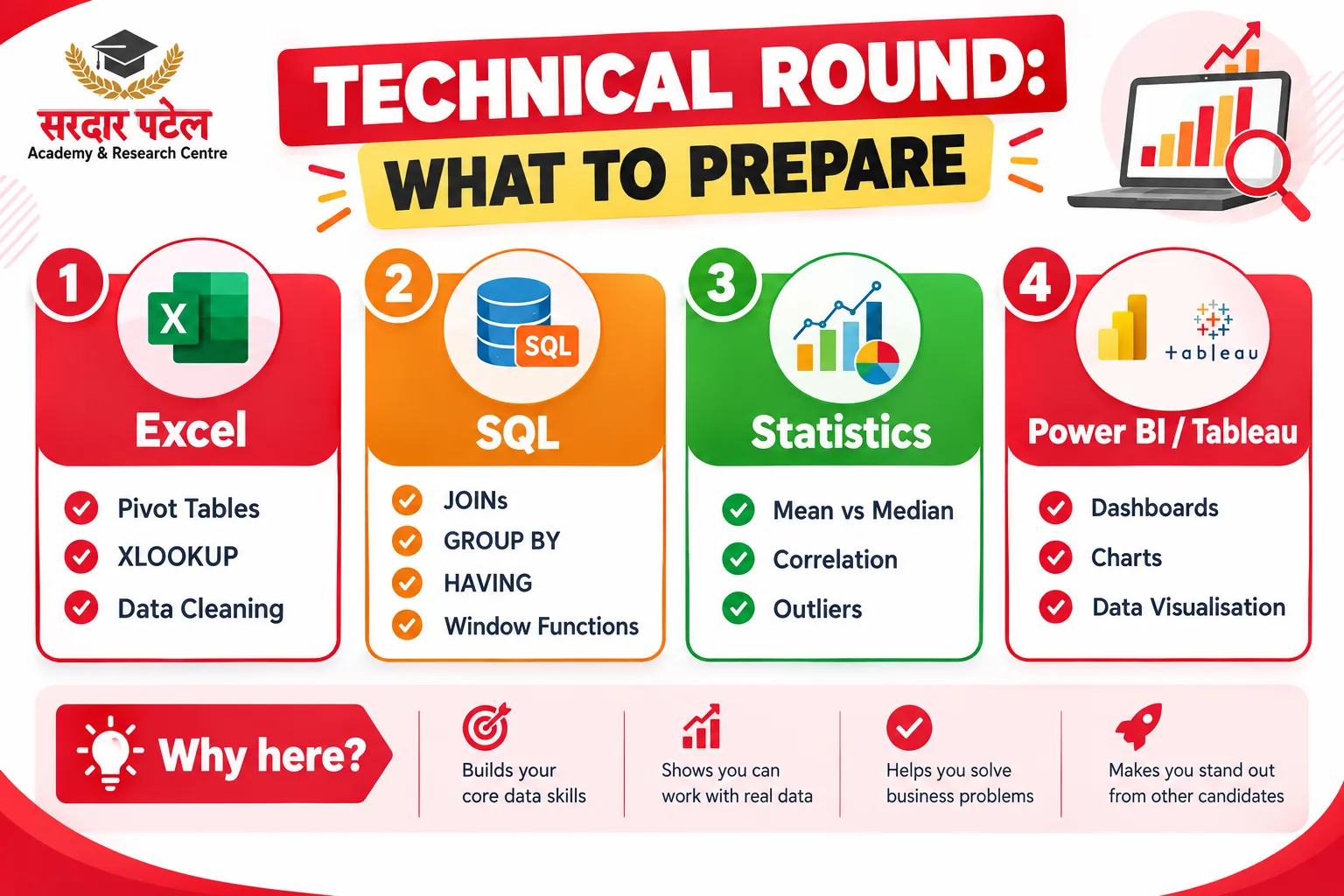
Excel
Even in companies that lean on Power BI or Tableau, Excel questions still come up, especially for entry-level and MIS-adjacent roles. Be ready to explain, not just use:
- Pivot tables, and when you'd choose one over a formula-based approach
- VLOOKUP/XLOOKUP versus INDEX-MATCH, and why one might be preferred
- Handling duplicates, blanks, and inconsistent formatting in a messy dataset
- Conditional formatting and data validation
SQL
SQL interview questions for data analysts are close to universal. Common areas interviewers probe:
- Queries using JOIN, GROUP BY, and HAVING versus WHERE
- The difference between an INNER JOIN and a LEFT JOIN, with an example
- Window functions like RANK() or ROW_NUMBER() for problems such as "find the second-highest salary";
- Writing a query to identify duplicate records in a table
If you're rusty, practise on an actual database rather than reading syntax. Plenty of candidates can recite what a JOIN does but freeze when asked to write one from scratch on a shared screen — which is exactly the gap hands-on practice is meant to close.
Statistics
You don't need a statistics degree, but you are expected to reason correctly about data:
- Mean versus median, and when each is more appropriate
- What correlation does and doesn't tell you about causation
- How you'd identify and handle outliers
- Basic probability and sampling, especially if the role touches A/B testing
Visualisation Tools (Power BI / Tableau)
If the job description names a specific BI tool, expect a few questions on it — sometimes a live task like "build a quick dashboard from this dataset." Interviewers care far less about memorised menu paths than about whether you pick the right chart type for the question being asked. For Power BI-specific preparation, Microsoft's Power BI Data Analyst study guide covers data preparation, modelling, visualisation, analysis and DAX.
If you're revising multiple platforms, this guide to data analytics tools you should know can help you understand which tools are commonly used and what they are useful for.
The Case Study or Business Problem Round
This round trips up more candidates than the technical one, because it's less about right answers and more about how you think.
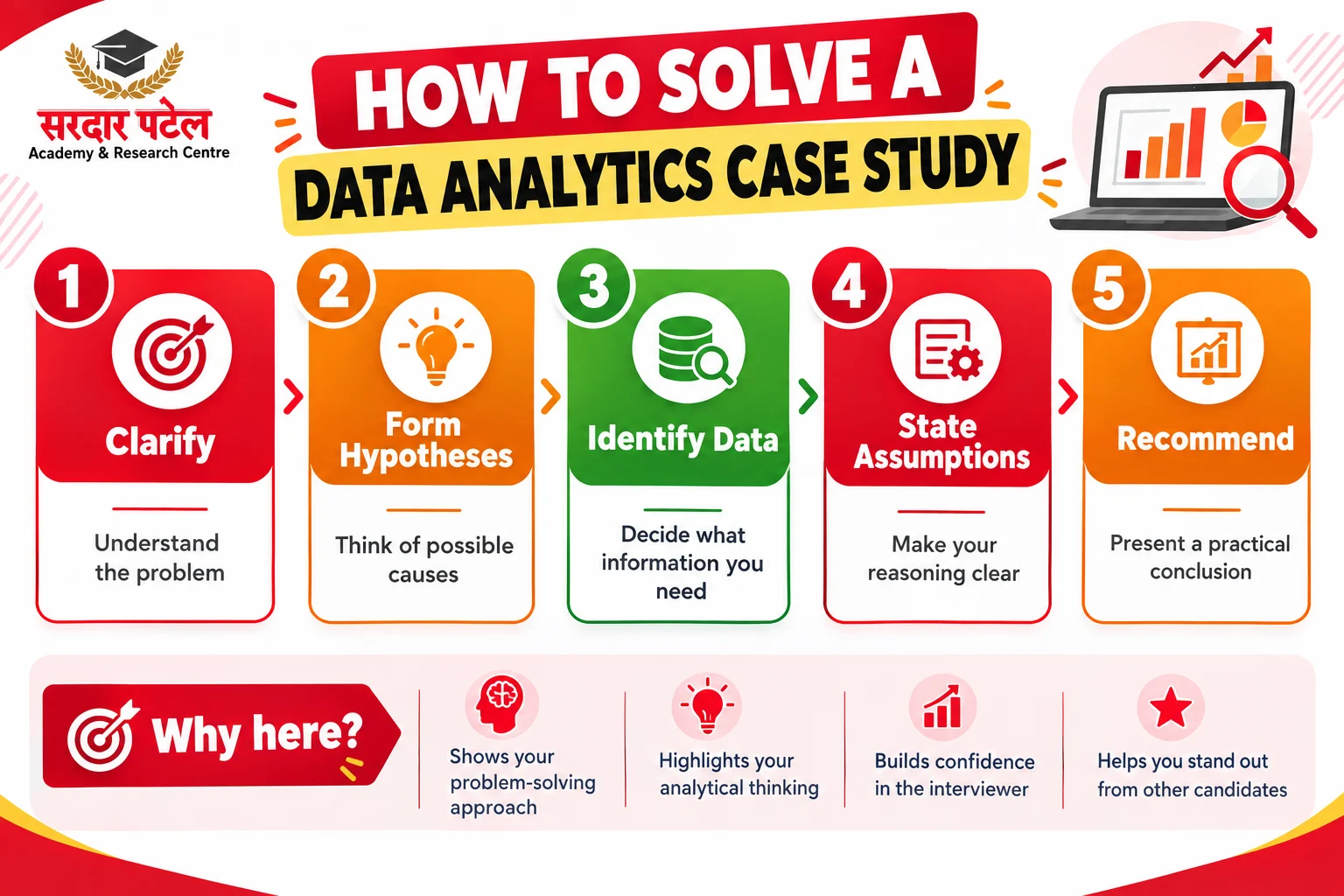
A typical prompt: "Our app's daily active users dropped 15% last month — how would you investigate this?" There's no single correct answer. What the panel wants to see is a clear method:
- Clarify the problem — ask what "dropped" means exactly, against what baseline, and whether it's company-wide or limited to one segment.
- Form hypotheses — seasonality, a product change, a tracking or data-quality issue, or a genuine drop in engagement?
- Name the data you'd pull to test each hypothesis, and in what order.
- State your assumptions rather than guessing silently.
- Close with a recommendation, even a tentative one, instead of trailing off.
Rehearsing two or three of these aloud is one of the most useful exercises in your interview prep plan, because reasoning through an ambiguous problem live is a completely different skill from solving a textbook SQL question.
Behavioural Round: Analyst Interview Tips for Freshers
The behavioural round usually gets the least attention, which is a mistake — especially for freshers without years of workplace stories to draw on.
A few analyst interview tips for freshers that consistently help:
- Use your projects as your stories. A solid college or portfolio project — including what went wrong and how you fixed it — works just as well as a workplace anecdote.
- Use the STAR method. Situation, Task, Action, Result keeps an answer tight instead of rambling into unrelated detail.
- Rehearse "walk me through a project you're proud of." It appears in some form in almost every analytics interview, so it deserves a place in your overall interview practice rather than being answered cold. Bring real questions for the interviewer. Asking about the team's tools, how success is measured, or what a typical week looks like signals genuine interest.
- Be honest about gaps. "I haven't used that tool, but here's how I'd approach learning it" lands better than a confident guess that collapses under one follow-up.
Common Mistakes Candidates Make
These patterns repeat across data analyst interviews regardless of company or seniority, and each one is easy to identify and fix before the actual interview.
- Memorising definitions without practising application — knowing what a LEFT JOIN is conceptually isn't the same as writing one under mild pressure.
- Jumping straight to an answer in case studies instead of clarifying first, then confidently solving the wrong problem.
- Avoiding clarifying questions in the belief that they look unprepared, when the opposite is usually true.
- Over-explaining technical detail in the behavioural round instead of focusing on the decision and its outcome.
- Skipping mock interviews entirely, so the real interview becomes the first time you say those answers aloud.
- Doing zero company research — not knowing what the business actually does with its data can cost you more than a shaky SQL answer.
Struggling with these on your own? SPARC's mock-interview sessions target these gaps, with feedback on case studies, SQL, and behavioural answers before you face the real panel.
A Practical Data Analytics Interview Preparation Timeline
With two to three weeks in hand, a staged plan beats cramming everything the night before.
If you need to strengthen your fundamentals before starting interview practice, this data analytics learning guide provides a structured starting point.
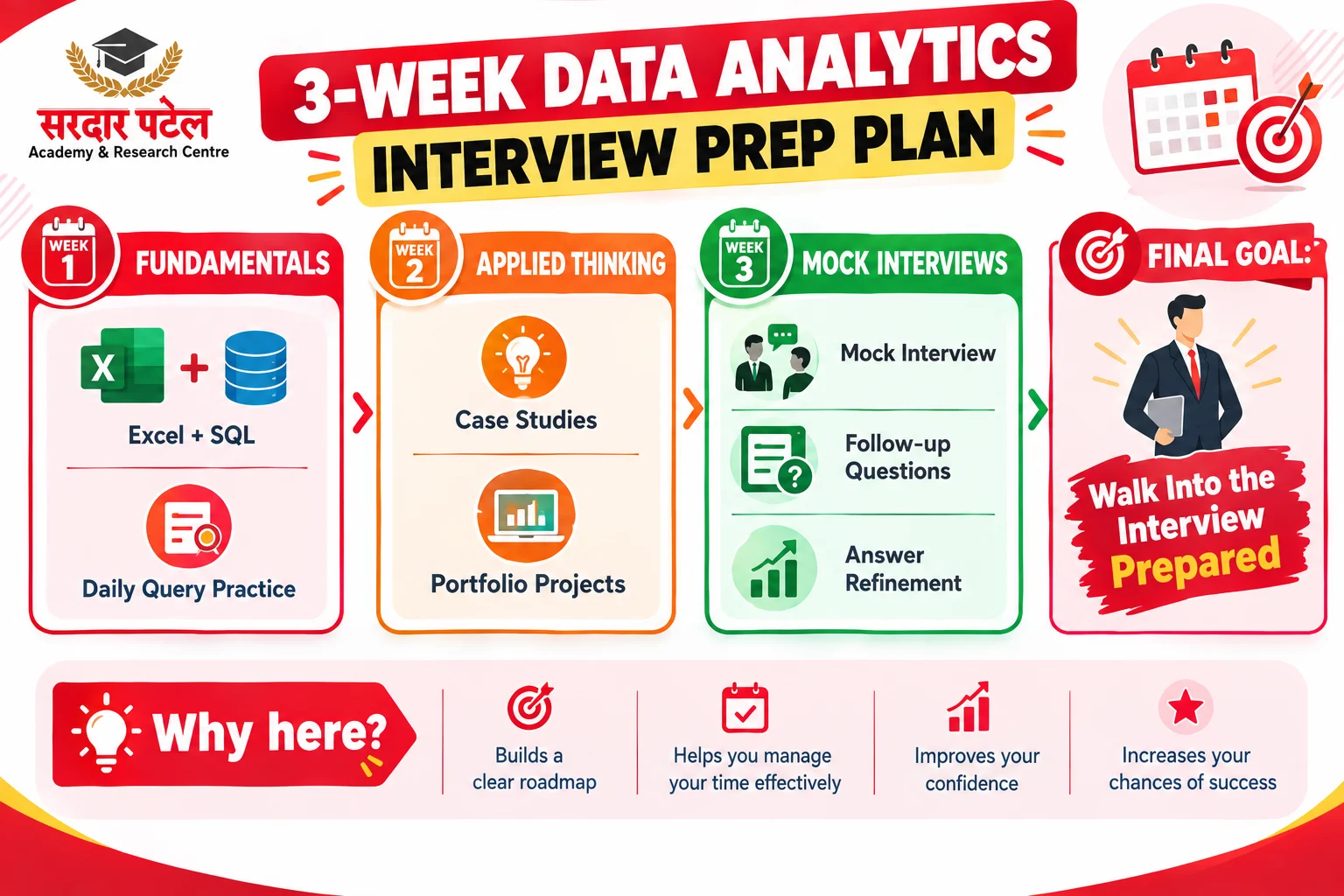
Week 1 — Rebuild the fundamentals. Revisit Excel and SQL through hands-on practice, not passive reading. Solve a handful of real query problems daily instead of skimming cheat sheets.
Week 2 — Practise applied thinking. Work through two or three case studies end to end. Revisit your own portfolio projects and prepare a clean way to talk through each one.
Week 3 — Mock interviews and refinement. Do at least one full mock with someone who will push back with follow-ups. Tighten the answers where you hesitated or rambled.
If your interview is sooner, compress the plan by prioritising Weeks 2 and 3 — applied practice moves the needle far more than re-reading definitions. The final stretch of your preparation should feel as close to the real interview as you can make it.
Preparing for the Delhi NCR Job Market
Delhi NCR has a dense mix of IT services firms, consultancies, fintech startups, and retail and e-commerce businesses, all hiring data analysts regularly. Interview style varies by sector: a consulting firm may lean heavily on case-study rounds, while a small startup might fold the technical and behavioural rounds into one informal conversation. For a broader view of the skills and technologies associated with business intelligence analyst roles, you can also refer to O*NET's Business Intelligence Analyst profile.
Before applying for different roles, it is also useful to understand the data analytics career scope and skills expected across the industry.
For freshers and career switchers here, it pays to tailor your interview strategy to the type of employer you're targeting rather than preparing generically. Rather than preparing generically. Our report on Delhi NCR's data analytics hiring landscape will help you speak knowledgeably about where the field is heading if it comes up. You can also explore the latest data analytics trends in 2026 to understand how changing tools and employer expectations are shaping analyst roles.
If you're deciding between an internship and a permanent role, our guide on internship vs full-time data analytics jobs explains the key differences between the two career paths.
Final Thoughts
Good data analytics interview preparation isn't about memorising every SQL function or statistics term — it's about applying what you know under mild pressure and explaining your reasoning clearly. Solid fundamentals, a repeatable method for case studies, and well-organised behavioural answers matter far more than any single "trick" question.
If you're also exploring your options beyond the interview stage, learning about data analytics career opportunities can help you understand the different roles you may target.
If you'd prefer guided practice to preparing alone, it's worth checking whether your learning path already covers it — our guide on getting a job after a data analytics course explains how training connects to actual interview readiness.
Ready to join an interview preparation session? Sardar Patel Academy & Research Centre (SPARC) runs practical, mock-interview-based data analytics interview preparation sessions designed to help you walk in genuinely prepared, not just familiar with the theory.
FAQs
It depends on your starting point, but two to three weeks of focused practice is realistic for most candidates who already have basic Excel and SQL familiarity.
Yes — roughly 60–90 minutes on weekdays plus one longer weekend session is enough, provided the time goes into solving problems and doing mocks rather than passive revision.
Not always. Many entry- and mid-level roles focus on Excel, SQL, and a BI tool. Python matters more for technical or data-science-adjacent roles — check the job description instead of assuming.
Joins (especially INNER versus LEFT), GROUP BY with HAVING, window functions like RANK(), and problems involving duplicate or missing records.
Point to specific projects and what you took away from them. Concrete examples beat generic claims about being a quick learner.
No. Many companies use a simplified version even for entry-level roles, specifically to test how you think rather than what you already know.
Say so, then talk through how you'd go about finding it. Honest reasoning reads better than a confident but wrong guess.
Both matter, but communication often separates two candidates with similar technical ability, since analysts explain findings to non-technical stakeholders constantly.