+91 9312966129
 sparc.enquiry01@gmail.com


Student Success Story: Graduate to Data Analyst
Discover how Krishn Raj, a Commerce graduate, transformed his career through Data Analytics training at Sardar Patel Academy & Research Centre (SPARC) and became a Data Analyst.
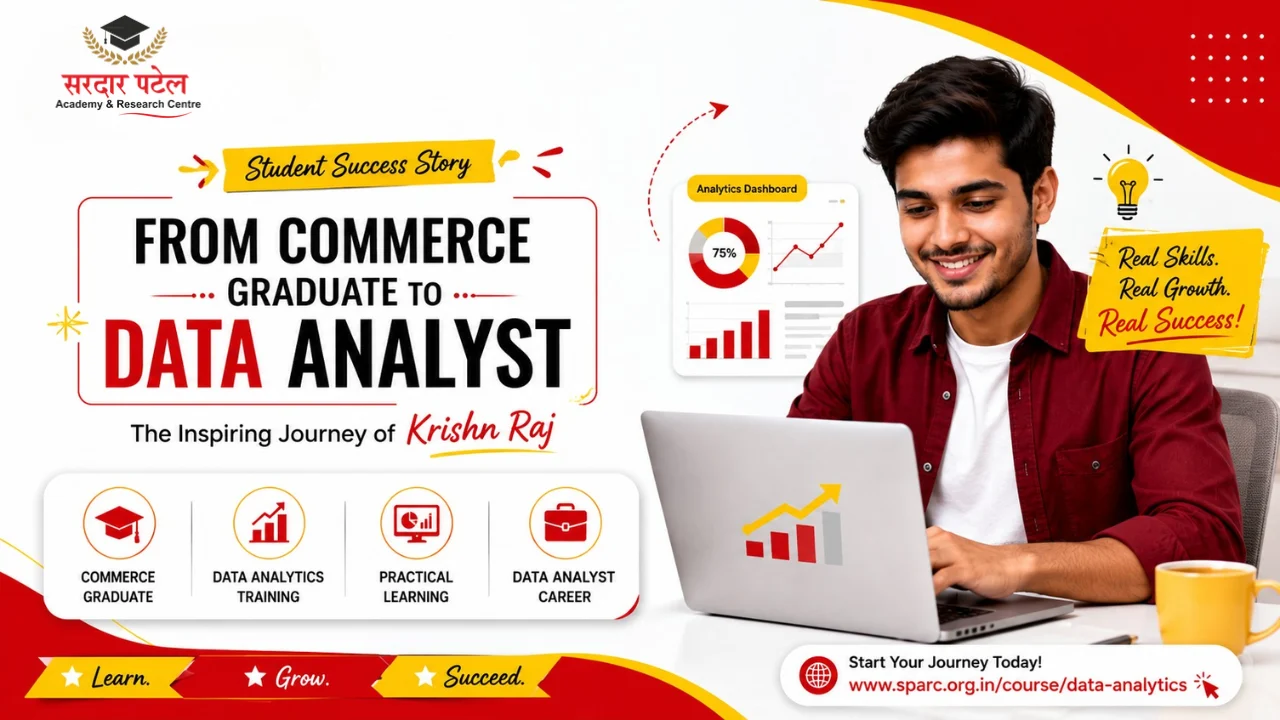
Table of Contents
- A Turning Point That Changed Everything
- From Commerce Graduate to Data Analyst
- The Learning Journey at SPARC
- Landing the Role
- In His Own Words
- Lessons for Aspiring Data Analysts
- Your degree isn't the deciding factor.
- Get the fundamentals right first.
- Practice consistently, not intensely in bursts.
- Work on real problems, not just exercises.
- Keep learning after the course ends.
- Conclusion
A Turning Point That Changed Everything
Every successful career begins with a single decision.
For Krishn Raj, that decision came after completing his Commerce degree. Like many graduates, he wanted a career with growth, stability, and exposure to modern technology. While exploring options, one field kept showing up across job portals and employer requirements: Data Analytics.
The field initially looked intimidating — programming, databases, dashboards, and machine learning were all unfamiliar territory for a Commerce student. But instead of letting uncertainty hold him back, Krishn chose to learn, adapt, and grow. With a clear goal in mind and a willingness to develop new skills, he began a journey that would eventually transform him from a Commerce graduate into a confident Data Analyst.
Today, when people ask him how a Commerce student ended up analysing data for a living, his answer is simple: he stopped waiting to feel "ready". He started learning in public, one dataset and one query at a time. That shift — from waiting for confidence to building it through practice — is the thread that runs through the rest of his story.
From Commerce Graduate to Data Analyst
Krishn's background was in Commerce, not Computer Science or Engineering — a fact that raised the usual doubts: Can a non-technical graduate really break into analytics? Is coding compulsory? Will companies hire without an engineering degree?
These are questions almost every career-switcher into analytics asks at some point, and Krishn was no exception. He spent time researching job listings, reading about what recruiters actually screened for, and speaking with people already working in the field before committing to a training program. What he found matched what industry data consistently shows: employers care more about demonstrated ability with tools like SQL, Python, and Excel than about which degree is printed on a certificate.
What he realised is that modern Data Analytics values practical skill and business understanding as much as academic background. His Commerce foundation had already given him comfort with numbers, financial concepts, and business processes — he just needed to pair that with technical skills. He treated his background as an advantage rather than a limitation, and that mindset shaped the rest of his journey. His experience also reflects how focused training can help learners move from a non-technical background into analytics, as seen in another learner's journey from training to a Data Analyst role.
He was also drawn to the field for concrete reasons: strong demand across industries, project-based learning, and the chance to solve real business problems with data — not just a career picked for salary alone. Unlike some career paths that reward tenure above all else, analytics rewards a demonstrable portfolio — something Krishn found appealing precisely because it meant his progress was in his own hands, not dependent on where he started.
The Learning Journey at SPARC
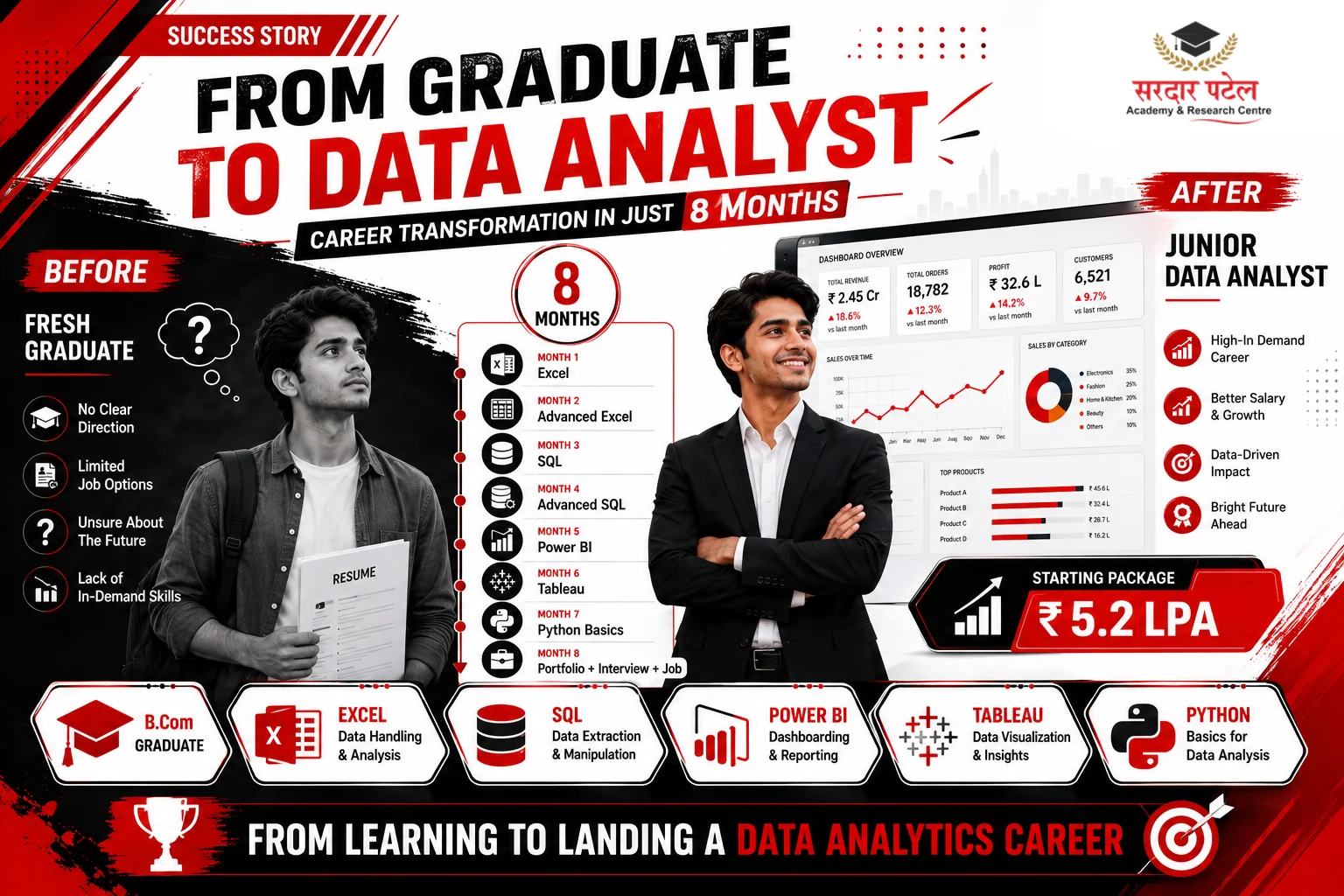
Krishn enrolled in the Data Analyst Course at Sardar Patel Academy & Research Centre (SPARC), training for 8 months. The program's practical, project-based approach — hands-on assignments, real-world datasets, and continuous mentor support — stood out from purely theoretical classroom learning.
He credits two people specifically: Satish Sir, for breaking down difficult technical concepts into simple, practical explanations, and Vanita Ma'am (Centre Head), for consistent motivation and support throughout the course.
Like most beginners, he hit a real learning curve early on — programming logic, SQL syntax, and Python felt unfamiliar at first. There were sessions where a single query wouldn't run for an hour, or where a Python script threw the same error three times before he found the fix. He didn't expect instant mastery; he practised regularly, revised concepts, and asked questions whenever he got stuck. That consistency, more than raw aptitude, is what carried him through.
What made the difference, in his own account, wasn't any single breakthrough moment — it was the accumulation of small ones. A query that finally returned the right result. A dataset that made sense after the third pass. A concept from week two that suddenly clicked while working on a week-six assignment. Each of those small wins built the confidence to take on the next, harder problem, which is exactly how the course was structured to work.
By the end of the course, he had hands-on experience with:
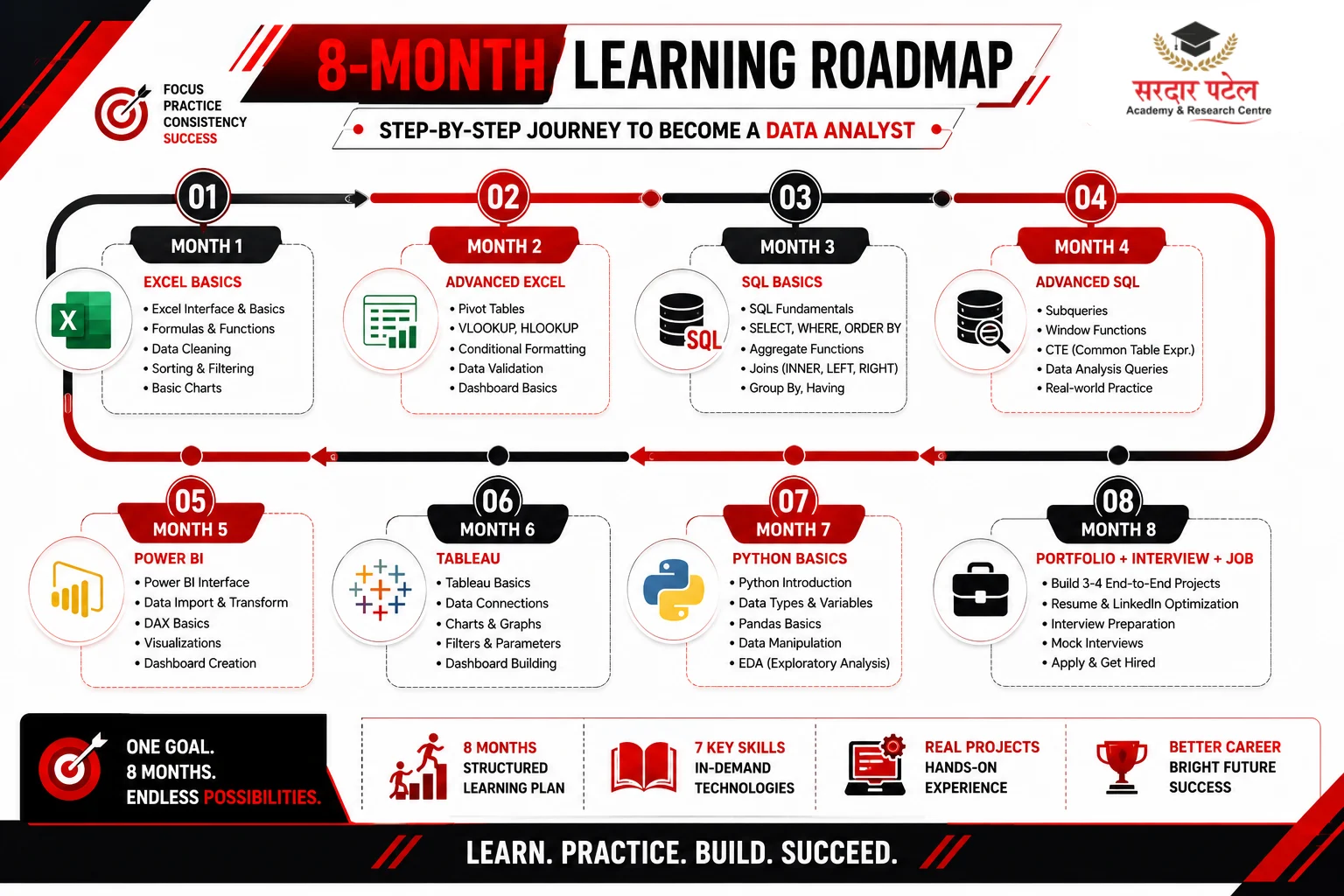
- Python — data cleaning, manipulation, and exploratory analysis
- SQL — retrieving, filtering, joining, and aggregating data to generate reports
- Machine learning fundamentals — predictive analytics, classification, regression, and model evaluation, enough to understand how analytics and AI intersect
- Analytical thinking — asking the right questions, spotting meaningful trends, and presenting findings clearly to support business decisions
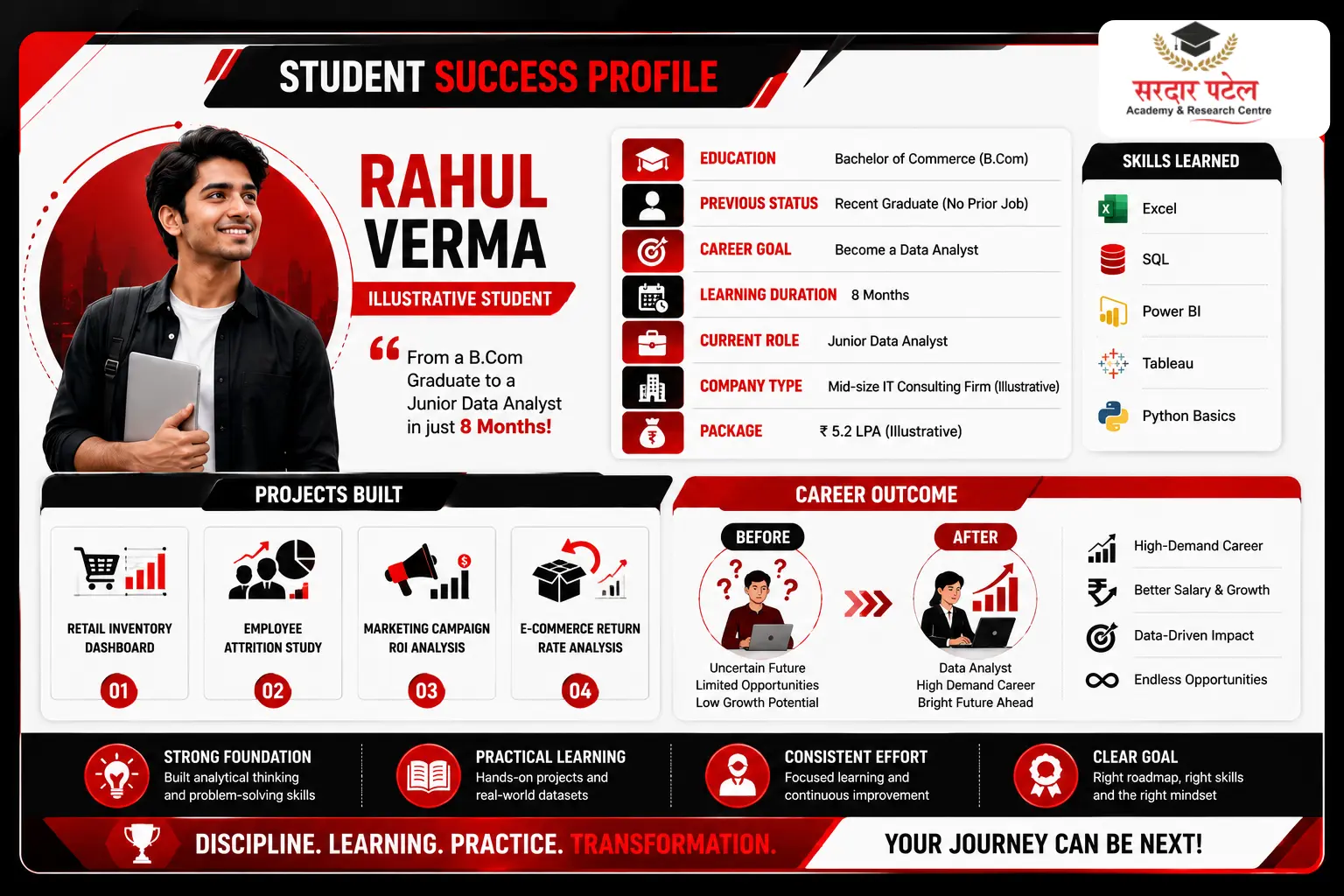
One project stood out as his strongest portfolio piece: an HR attrition dashboard that identified the top three drivers of employee churn by department.
Landing the Role
After completing his training, Krishn secured his first role as a [Job Title] at [Company Name]. In this role, he collects and organises business data, writes SQL queries, uses Python for analysis, identifies trends, and prepares reports that support stakeholder decisions.
It's a milestone that captures what many career-switchers hope for: turning a few months of focused learning into real, applied work.
In His Own Words
"Completing the Data Analyst course at Sardar Patel Academy & Centre was a great experience for me. The learning environment here is very supportive and professional. Satish Sir explains the concepts in a very simple and practical way, making even complex topics easy to understand. Vanita Ma'am (Centre Head) always guides and motivates students and is ready to support in every situation. I would definitely recommend this institute to anyone who wants to learn Data Analytics or any skill-based course."
— Krishn Raj (quoted verbatim; institute name as given in the original testimonial)
Krishn's experience is one of several learner journeys featured in more experiences shared by SPARC's Data Analytics learners.
Lessons for Aspiring Data Analysts
Krishn's journey offers a few practical takeaways for anyone considering the same path:
Your degree isn't the deciding factor.
Commerce, Arts, Science, or Engineering — what matters more is willingness to learn and apply skills practically. Recruiters screening for analyst roles are typically looking at a candidate's SQL and Python fluency and their ability to talk through a project, not the name of their undergraduate program.
Get the fundamentals right first.
SQL, Python, statistics, and data interpretation form the base everything else builds on. Rushing to dashboards or machine learning before these are solid tends to create gaps that show up later, in interviews or on the job.
Practice consistently, not intensely in bursts.
Small, regular effort — solving datasets, writing queries, working through real problems — compounds over time. A study pattern of 45 focused minutes daily generally outperforms an occasional weekend cram session.
Work on real problems, not just exercises.
Employers respond to demonstrated projects, not just completed coursework. A single well-documented project you can explain end-to-end carries more weight in an interview than a long list of finished modules.
Keep learning after the course ends.
Tools and methods in analytics change fast; staying current is part of the job. Reading industry blogs, revisiting older projects with new techniques, and following changes in tools like Power BI and Python libraries help keep skills from going stale. Keeping up with what is changing in Data Analytics this year can also help aspiring analysts understand where the industry is heading.
Conclusion
Career transformation doesn't happen by chance — it happens through informed decisions, consistent effort, and the willingness to step outside your comfort zone. Krishn Raj's journey from a Commerce graduate to a Data Analyst shows what practical training, mentorship, and persistence can achieve.
Ready to write your own success story? Explore the Data Analyst Course at SPARC or get in touch with our team to find the right starting point for you.
FAQs
No. Krishn's story shows that a Commerce background works fine — what matters is building practical skills in SQL, Python, and data interpretation, along with strong analytical thinking.
It varies by individual pace and prior exposure, but with structured, project-based training like SPARC's Data Analyst Course, consistent learners can build job-ready skills within a few months.
Some coding is expected — primarily SQL and Python for data cleaning, analysis, and reporting — but you don't need a Computer Science background to learn it well.
SQL, Python, data visualization, statistical thinking, and the ability to turn raw data into clear, actionable insights for business decisions.
That's a common starting point, not a disqualifying one. Structured, beginner-friendly programs are built to take learners from zero to job-ready in stages — starting with fundamentals like Excel and basic SQL before moving into Python and more advanced analysis.
Yes — if you're a SPARC learner or alum with a story to tell, reach out to us here and we may feature you in an upcoming success story.