+91 9312966129
 sparc.enquiry01@gmail.com



Tally + GST + TDS: The Best Skill Combination for Accounting Jobs?
Are Tally GST TDS skills for accounting jobs the best mix for freshers? See what each skill does, where gaps remain and how to learn them in order
Table of Contents
- Why Tally GST TDS Skills for Accounting Jobs Keep Appearing in Vacancies
- What each skill does in a real office
- How the three connect in a single month
- Tally: The Daily Foundation
- GST: The Compliance Layer
- TDS: The Skill Freshers Often Postpone
- Are Tally GST TDS Skills for Accounting Jobs Enough on Their Own?
- A Six-Step Order for Learning Tally, GST and TDS
- Questions to expect in interviews
- Mistakes That Slow Beginners Down
- Where Tally, GST and TDS Skills Can Take You
- Conclusion
Browse executive vacancies in accounts, and a pattern appears. Different cities, different industries, different pay bands, yet the requirements line keeps naming the same three things: Tally, GST and TDS.
The repetition makes sense. A company’s accounts desk does three jobs every month without exception. It records transactions, reports tax on sales and purchases, and deducts tax from certain payments before depositing it with the government. Each of those jobs lines up with one of the three skills.
This guide asks whether Tally GST TDS skills for accounting jobs really are the strongest starting package for a fresher in India. You will see what each skill involves in practice, where the combination falls short, and how to learn it in a sensible order. It is written for commerce and arts students, career switchers, and anyone weighing a Tally GST TDS course against other options.
Why Tally GST TDS Skills for Accounting Jobs Keep Appearing in Vacancies
A government-run job portal in Tamil Nadu offers a useful example. A job opening for an Accounts Executive in Tiruppur highlights the importance of understanding Tally, GST compliance, TDS procedures, and core accounting practices. Tally Prime is preferred, and a fresher with Tally skills is acceptable. The duties include invoices, bank reconciliation, GST calculations and returns, and TDS deductions and returns.
One listing is not a statistic, and not every employer phrases vacancies this way. What it shows is the reasoning behind the bundle. A small or mid-sized business rarely hires separate specialists for bookkeeping, indirect tax and withholding tax. It wants one junior person who can cover all three at a basic level. That is why Tally GST TDS skills for accounting jobs tend to be asked for together rather than as separate qualifications.
What each skill does in a real office
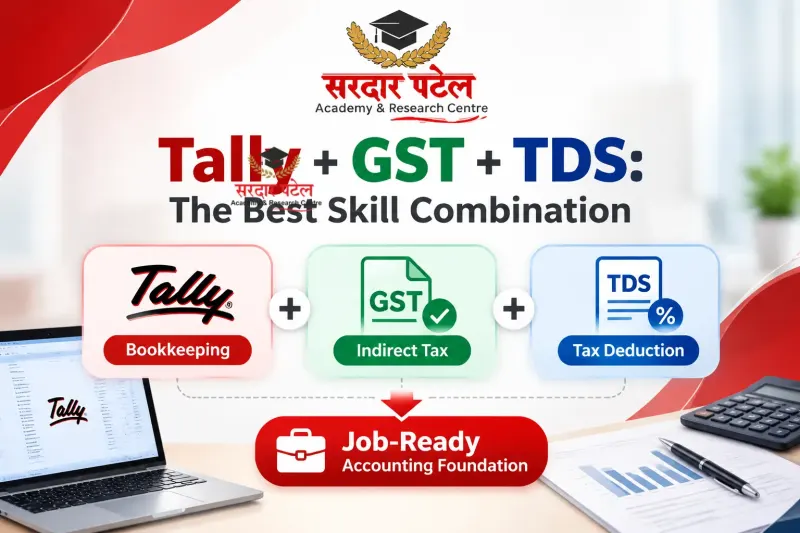
Taken together, Tally GST TDS skills for accounting jobs cover record-keeping, indirect tax and withholding tax. The table shows how the work is divided.
| Skill |
Typical daily work |
What it tells an employer |
| Tally |
Vouchers, ledgers, bank reconciliation, stock entries, financial reports |
You can keep the books running without hand-holding |
| GST |
Tax invoices, input tax credit, monthly or quarterly returns |
You understand how sales and purchases create a tax liability |
| TDS |
Deducting tax on salary and vendor payments, deposits, quarterly statements |
You can handle a deadline-driven compliance task |
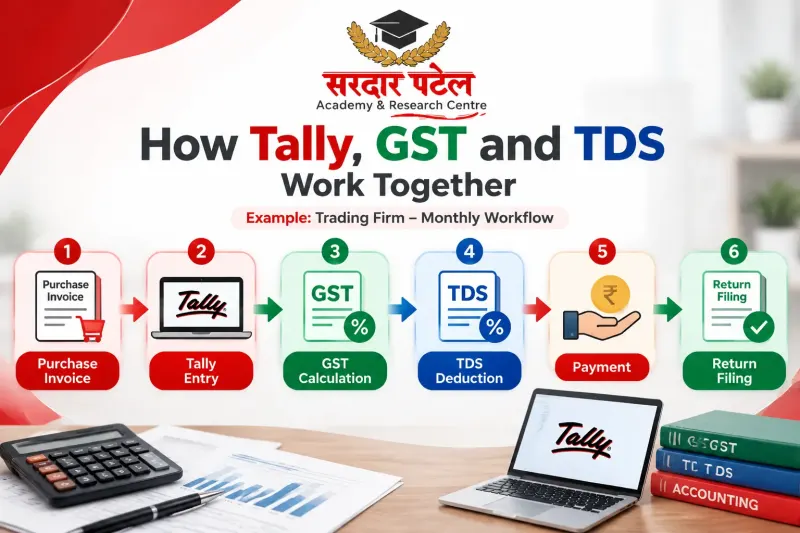
How the three connect in a single month
Picture a small trading firm. Early in the month, the accountant records a supplier’s invoice in Tally, splitting out the GST so the input credit is visible. Mid-month, the firm pays godown rent and a consultant’s fee. The accountant deducts TDS where the law requires it, books the amount as a liability, and deposits it. At month-end, the sales and purchase data feeds the GST return. At quarter-end, the deductions are reported in a TDS statement.
Notice how one wrong entry in the first step can distort everything after it. That chain is the real argument for learning the three skills together instead of in isolation.
Tally: The Daily Foundation
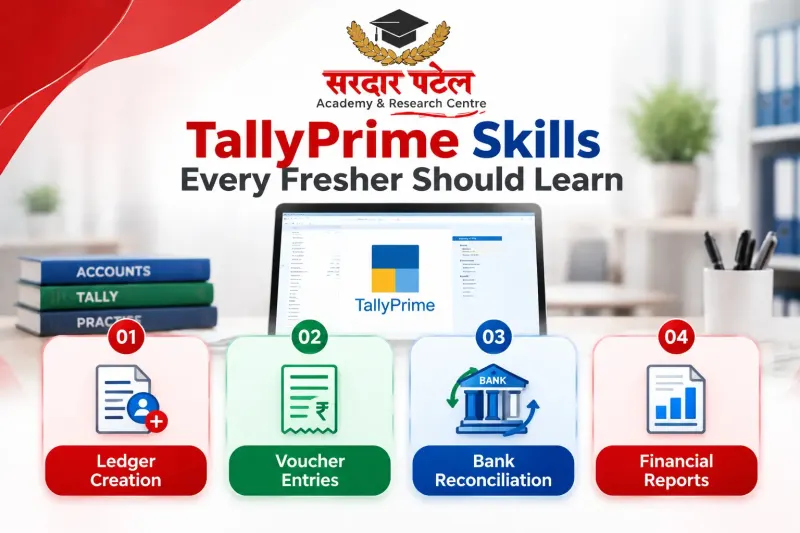
TallyPrime is where most transaction-level work happens. Tally’s own GST software page describes GST invoicing, e-invoice and e-way bill generation, auto-filled GSTR-1 and GSTR-3B data, and reconciliation of returns against the books. For a fresher, the useful skills are more basic than those features sound:
- Creating ledgers under the right groups
- Passing sales, purchase, payment, receipt and journal vouchers correctly
- Reconciling the bank statement with the books
- Reading the trial balance, profit and loss account and balance sheet
If you want a checklist, this breakdown of Tally Prime skills every fresher should learn before applying for jobs is a good place to start, and how to become a Tally accountant explains how the role develops over time.
One caution. Software fluency is not accounting knowledge. If debit and credit are unclear, Tally will faithfully record your mistakes. Expect an interviewer to care more about whether you can explain a journal entry than whether you know every shortcut key. This is the first reason Tally GST TDS skills for accounting jobs work only when basic bookkeeping sits underneath them.
GST: The Compliance Layer
Goods and Services Tax turns every invoice into a reportable event. A regular taxpayer files GSTR-1 for outward supplies and GSTR-3B as the summary return. The GST portal’s user guide for creating and submitting GSTR-3B explains that the form is where liability for a tax period is declared and discharged, and that a filed GSTR-3B cannot be amended. A careless return, in other words, cannot be quietly fixed afterwards.
What a fresher should be comfortable with:
- Reading a tax invoice and spotting the GSTIN, HSN or SAC code and the tax split;
- Knowing when CGST and SGST apply, and when IGST applies instead
- Claiming input tax credit only on eligible purchases
- Matching purchase records with the auto-generated GSTR-2B before filing
- Checking the due date on the returns dashboard rather than trusting memory
Rules and dates are revised from time to time, so verify on the portal, not on a blog post, including this one. The role itself is covered in how to become a GST accountant, which looks at skills and career openings in more detail.
This is the layer where Tally GST TDS skills for accounting jobs start to look different from plain bookkeeping, because mistakes now come with deadlines and late fees attached.
TDS: The Skill Freshers Often Postpone
TDS usually gets pushed to later because it feels like tax law rather than accounting. Yet it touches ordinary work constantly: salaries, rent, professional fees, contractor payments.
The Income Tax Department’s TDS return filing page states that Form 24Q covers TDS on salary and Form 26Q covers payments to residents other than salary. Quarterly due dates fall on 31 July, 31 October, 31 January and 31 May of the next year. The page also notes that late filing can bring a fee under section 234E and a possible penalty under section 271H.
One more thing to watch. The department’s own document on Form No. 140 lists it as the earlier Form No. 26Q, which appears to reflect the numbering under the new Income-tax Act. Colleagues may still say “26Q” in conversation, so learn both names and confirm current form numbers and dates on the official site.
Core TDS tasks worth practising:
- Collecting and checking the PAN of the person being paid
- Recording the deduction as a liability in Tally
- Depositing it on time and keeping the challan details
- Preparing the data for the quarterly statement
- Understanding what the deductee’s certificate is used for
Do not mix up the two kinds of TDS. Income-tax TDS is what Forms 24Q and 26Q report. GST TDS is a separate deduction under section 51 of the CGST Act. It applies only to specified deductors such as government departments, and it is reported in GSTR-7. Tally GST TDS skills for accounting jobs include knowing which one a task refers to.
TCS (tax collected at source) works in the opposite direction: the seller collects tax from the buyer and reports it through its own quarterly statement.
Worked example (illustrative figures, GST ignored for simplicity). Here is the TDS part of Tally GST TDS skills for accounting jobs in one entry. A firm books a consultant’s fee of ₹50,000 and assumes a TDS rate of 10% for illustration. Confirm the applicable rate and threshold before using any figure in real books.
| Account |
Debit (₹) |
Credit (₹) |
| Professional fees |
50,000 |
- |
| TDS payable |
- |
5,000 |
| Consultant (party ledger) |
- |
45,000 |
The firm pays the consultant ₹45,000, deposits ₹5,000 with the government, and includes the deduction in the quarterly statement.
The career side is mapped out in how to become a TDS and TCS executive. In everyday terms, TDS is the third leg of Tally GST TDS skills for accounting jobs, and the one that can lift a data-entry profile toward a compliance role.
Are Tally GST TDS Skills for Accounting Jobs Enough on Their Own?
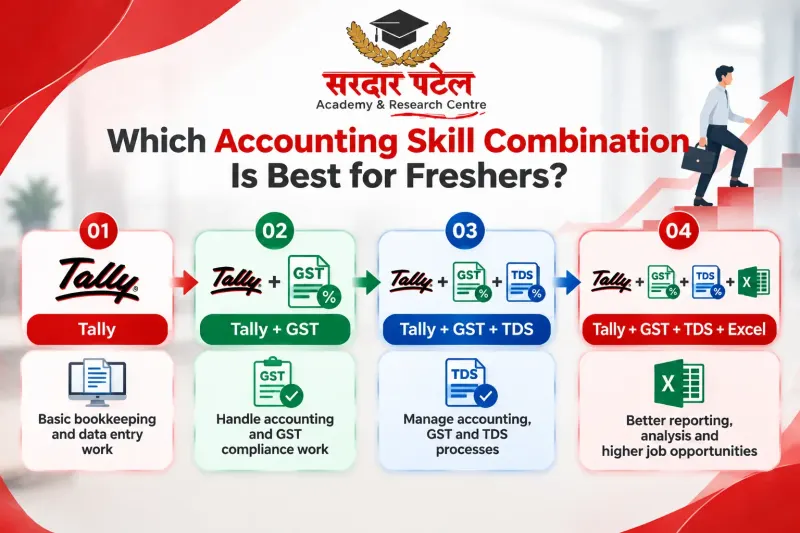
They are an excellent core, not a complete toolkit. Here is how common skill combinations compare for entry-level work:
| Skill set |
Works well for |
Usual gap |
| Tally only |
Basic voucher entry |
No tax compliance exposure |
| Tally + GST |
Billing, sales and purchase accounting |
Weak on salary and vendor deductions |
| Tally + GST + TDS |
General accounts executive and compliance-support roles |
Needs spreadsheet and reporting ability |
| Tally + GST + TDS + Excel + communication |
Broader accounts and MIS-type roles |
Takes longer to build |
Excel is the piece most beginners leave out, and it often appears next to Tally in vacancies. The Tiruppur listing above, for instance, also asks for strong Excel skills. Excel matters for MIS reporting too, where summaries of sales, expenses and receivables go to management. Beyond tools, employers care about accuracy, deadline discipline and the ability to explain a figure to a non-accountant. The article on accounting skills employers look for in freshers goes deeper on that side.
So is it the best accounting skill combination? For business-side accounts roles at entry level, it is one of the most practical. For audit-focused or professional-qualification routes, accounting standards and auditing knowledge will matter more. The honest answer depends on where you want to be in three years.
If the full combination is your target, a structured Tally GST TDS course can shorten the practice curve. You can see the course details before deciding which accounting skill combination suits your goal.
A Six-Step Order for Learning Tally, GST and TDS
Students from the arts stream sometimes assume accounting is closed to them. Accounting career options after 12th arts lays out the routes, and the order below works for most beginners.
- Learn double-entry basics first. Journal entries, ledgers, trial balance. Everything else rests on this.
- Practise TallyPrime on a dummy company. Create masters, pass vouchers, reconcile a bank statement.
- Add GST. Work through tax invoices, input credit, and how return data is prepared.
- Add TDS. Practise deductions on salary and vendor payments, deposit entries and quarterly statement data.
- Run a full mock month. Enter a month of transactions, then produce the GST and TDS data from them.
- Prepare to explain, not just click. Be ready to walk an interviewer through one transaction from invoice to return.
Some learners do this alone with practice files. Others prefer guided training with feedback, which is where a structured Tally GST TDS course helps. Sardar Patel Academy & Research Centre lists a financial accounting programme aimed at job preparation, and you can learn Tally GST & TDS through its course page, where the syllabus, duration and fees should be checked before you decide.
Questions to expect in interviews
Interviewers testing Tally GST TDS skills for accounting jobs often start with practical questions like these:
- How do you record a purchase with GST in Tally?
- What is the difference between GSTR-1 and GSTR-3B?
- When is TDS deducted, and when must it be deposited?
- How do you reconcile a bank statement with the books?
- What would you do if GST portal data does not match your purchase register?
Mistakes That Slow Beginners Down
Most problems in building Tally GST TDS skills for accounting jobs come from a handful of habits.
- Learning software without principles. Shortcuts cannot rescue a wrong debit.
- Leaving TDS for the last week before interviews. It needs hands-on repetition.
- Trusting remembered due dates and rates. Always check the official source.
- Practising only on clean data. Real books have mismatches, so practise finding them.
- Writing a vague resume. When listing Tally GST TDS skills for accounting jobs, “Knows Tally” says little. “Recorded a full month of sales, purchases and TDS entries in TallyPrime” says a lot, provided it is true.
Where Tally, GST and TDS Skills Can Take You
Vacancies that ask for Tally GST TDS skills for accounting jobs commonly use titles such as accounts executive, accounts assistant, Tally operator, GST assistant and TDS executive. With experience, people often move toward senior accountant, compliance or MIS-oriented work. Titles and responsibilities vary by employer, so read each listing for the actual duties.
Conclusion
The trio keeps showing up because it mirrors the real month of an accounts desk: book it, tax it, report it. That makes Tally GST TDS skills for accounting jobs a sound foundation for freshers. Treat it as the core of job-ready accounting skills, provided it rests on accounting basics and is supported by Excel and clear communication.
Start in order, practise on realistic data, verify every rule on official portals, and be able to explain your work. If you want structured guidance, the Advanced Diploma in Financial Accounting at Sardar Patel Academy & Research Centre is one option to explore, alongside any other you are comparing.
FAQs
They are the practical ability to record transactions in Tally, handle GST invoicing and returns data, and manage tax deducted at source along with its deposits and quarterly statements.
It can make you far more employable, but no course guarantees a job. Practice, accounting fundamentals, Excel and interview preparation also count.
Start with basic accounting and Tally, then add GST, then TDS. Each builds on entries and data created in the previous step.
Yes. Begin with double-entry bookkeeping and build upward. Many beginners from non-commerce backgrounds start the same way.
That depends on your starting point and daily practice. If you join a course, its own page should state the duration.
It is strongly advisable. Reports, reconciliations and data checks often move between Tally and spreadsheets.
No. Software applies what you enter. If the treatment is wrong, the output is wrong, so Tally GST TDS skills for accounting jobs always include understanding why a figure appears.