+91 9312966129
 sparc.enquiry01@gmail.com



Student Employability Whitepaper: Skills Companies Want
Read this digital marketing employability report to see which skills companies screen for in freshers, plus a 90-day plan. Get the free PDF from SPARC.

Table of Contents
- Why an Employability Lens Matters More Than a Course Lens
- How Hiring Managers Screen Marketing Candidates
- The Four Layers of Marketing Job Skills
- Layer 1: Channel Fundamentals
- Layer 2: Measurement and Analysis
- Layer 3: Execution Habits
- Layer 4: Business Sense
- What Students List vs. What Employers Test
- Role-Wise Skill Expectations for Entry-Level Marketing Jobs
- SEO Executive
- Performance Marketing Executive (Paid Ads)
- Content and Social Media Executive
- Marketing Analyst or Reporting Associate
- Email and CRM Associate
- The Delhi NCR Context: Why Location Shapes the Skills Conversation
- Illustrative Example: Two Candidates, One Opening
- A 90-Day Plan to Build Employability Proof
- Days 1–30: Build the base
- Days 31–60: Create visible work
- Common Mistakes That Hurt Employability
- Facts, Opinions, and What We Can't Claim
- Conclusion: Turn Skills Into Proof
A student finishes a digital marketing course, updates their CV, applies to 30 openings, and hears back from 2. The usual conclusion is "the market is tough." More often the real issue is simpler: the skills on the CV and the skills on the hiring manager's checklist don't quite match.
This digital marketing employability report looks at that gap. It explains which skills employers screen for, which ones they only assume, and how a student in Delhi NCR can build proof of ability before the first interview. It is written for students, fresh graduates, and early-career professionals who want a clear picture, not a pep talk.
Quick definition: An employability report in digital marketing is a structured look at the skills, tools, and behaviours that make a candidate hireable in marketing roles, based on what employers screen for rather than what courses advertise.
| Free employability PDF for marketing learners in Delhi NCR [Download the free toolkit (PDF)] ← Questions? Call +91 93129-66129 or visit the contact page. |
Why an Employability Lens Matters More Than a Course Lens
Most students ask, "Which course should I take?" Employers ask a different question: "Can this person do useful work in their first month?"
Those two questions lead to different preparation. A course gives you knowledge. Employability is what you can show: a campaign you ran, a report you built, a problem you diagnosed. A certificate says you attended. A portfolio says you can work.
That difference explains why two students from the same batch can have very different outcomes. One has a folder of live work. The other has the same syllabus knowledge and nothing to point at.
How Hiring Managers Screen Marketing Candidates
Understanding the screening process makes it easier to prioritise the skills list. In our view, many small and mid-sized marketing teams typically follow a version of this sequence:

- CV scan (usually brief). They look for tools, projects, and any measurable results
- Portfolio or profile check. A LinkedIn page, a blog, a test account, a campaign screenshot.
- Practical task. A small assignment: audit a page, draft ad copy, outline a content plan.
- Conversation. Here they test thinking, not memory. "Why did you pick that keyword?" matters more than "Define SEO."
Notice where the filtering tends to happen. In our view, many rejections occur at steps one and two, before anyone talks to you. That is why the visible evidence on your CV and profile carries so much weight.
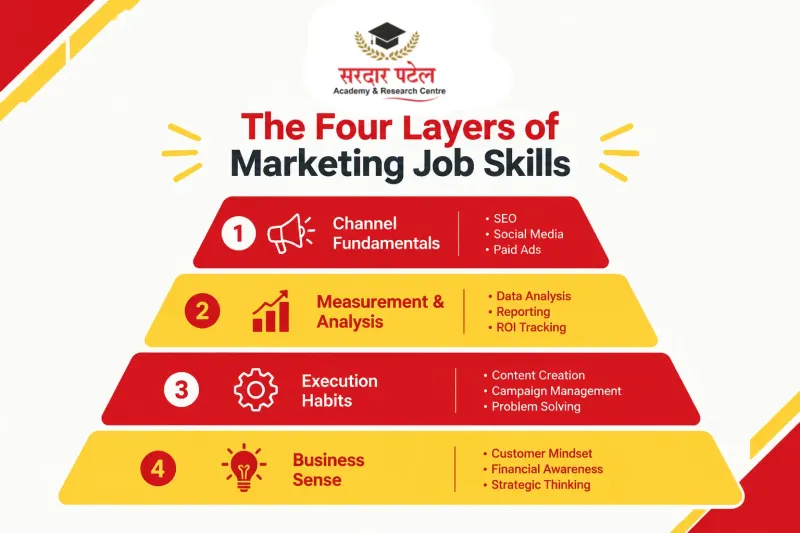
The Four Layers of Marketing Job Skills
A useful way to read any marketing job skills report India publishes is to sort skills into layers. Each layer answers a different employer worry.
Layer 1: Channel Fundamentals
This is the layer courses cover best. It includes:
- Search engine optimisation (on-page, off-page, technical basics) [keyword research tutorial]
- Google Ads and Meta Ads setup and basic optimisation [DM tools article]
- Email marketing and basic automation
- Social media planning and community handling
- Content writing for web and ads
- Using AI tools for research and first drafts, and checking the output for accuracy, tone, and brand fit before it goes anywhere
Employers expect this layer. It gets you into the room but rarely wins the job on its own.
Layer 2: Measurement and Analysis
This layer separates people who run activities from people who understand results. Employers look for comfort with:
- Google Analytics and Search Console
- Reading a campaign dashboard without panic
- Basic spreadsheet skills: sorting, filtering, pivot tables, simple formulas
- Connecting a metric to a decision ("clicks are up but leads are flat, so what changed?")
A fresher who can explain one chart clearly often impresses more than one who lists ten tools..
Layer 3: Execution Habits
These are the behaviours nobody puts in a syllabus:
- Meeting deadlines on small tasks
- Writing clear, short status updates
- Asking a specific question instead of a vague one
- Taking feedback and revising quickly
- Documenting what you did so someone else can repeat it
In our view, hiring managers in small teams often prefer to train a reliable beginner rather than manage a talented but unpredictable one.
Layer 4: Business Sense
In our view, this is the rarest layer in freshers and among the most valued. It means understanding:
- Who the customer is and why they buy
- What a lead is worth to a business
- How marketing connects to sales
- Why a budget has limits
You don't need an MBA for this. You need the habit of asking, "What is this campaign supposed to achieve for the business?"
What Students List vs. What Employers Test
Here is where many CVs go wrong. The table below compares common CV claims with what a hiring manager tends to check.
| Students commonly list |
Employers commonly test |
What closes the gap |
| "Knowledge of SEO" |
Can you audit a page and suggest three fixes? |
A published audit of a real or practice website |
| "Google Ads certified" (e.g. Google Skillshop) |
Can you structure a campaign and explain the budget split? |
A small live campaign with a documented result |
| "Social media marketing" |
Can you plan a month of content for a specific business? |
A content calendar tied to an audience and goal |
| "Content writing" |
Can you write a brief and edit your own draft? |
Two or three published articles with clear targets |
| "Data analysis" |
Can you read a report and recommend an action? |
A one-page analysis of any public or practice dataset |
| "Good communication" |
Can you explain the result to a non-marketer? |
A short written summary or screen-recorded walkthrough |
The pattern is consistent. Claims describe what you studied. Tests check what you can do.
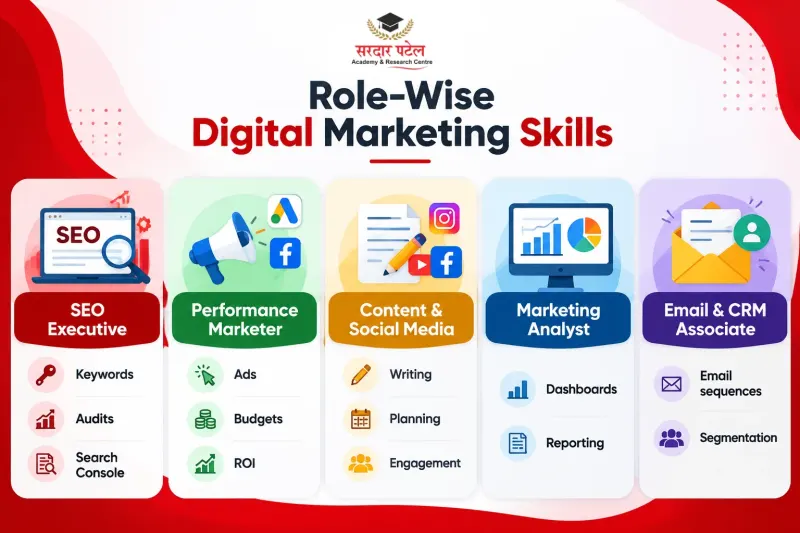
Role-Wise Skill Expectations for Entry-Level Marketing Jobs
Different roles weigh the four layers differently. This breakdown helps you decide where to focus.
SEO Executive
- Weighted toward: Layers 1 and 2
- Core proof: A keyword research sheet, an on-page audit, a Search Console walkthrough
- Often tested with: "Look at this page. What would you change first, and why?"
If this path interests you, the guide on the future of SEO jobs in India is a useful companion read.
Performance Marketing Executive (Paid Ads)
- Weighted toward: Layers 2 and 4
- Core proof: A campaign structure document, a spend-versus-result summary
- Often tested with: "You have a fixed budget and two audiences. How do you split it?"
Content and Social Media Executive
- Weighted toward: Layers 1 and 3
- Core proof: Published writing, a content calendar, engagement notes
- Often tested with: A short writing task against a brief
Marketing Analyst or Reporting Associate
- Weighted toward: Layer 2
- Core proof: A dashboard or a one-page insight summary
- Often tested with: "Here is a traffic drop. Walk me through how you'd investigate."
Email and CRM Associate
- Weighted toward: Layers 1 and 3
- Core proof: A sample email sequence and a list-segmentation idea
- Often tested with: "Draft a welcome email for a new subscriber."
The Delhi NCR Context: Why Location Shapes the Skills Conversation
Delhi NCR has a dense mix of employers: agencies, startups, e-commerce and education companies, small manufacturers, and traders who are only now moving online. That mix creates a particular pattern for freshers.
- Agencies often hire for volume and speed. They value quick learners who can handle several accounts.
- Startups value people who can wear multiple hats and don't wait for instructions.
- Small and family-run businesses need practical marketers who can explain results in plain language, often in a Hindi-English mix.
- Education and service companies look for lead-generation skills and local audience understanding.
For students based around GTB Nagar, Kamla Nagar, Mukherjee Nagar, and the North Campus belt, the practical advantage is access. Many students here are within reach of campuses, coaching hubs, and local businesses that can serve as real practice projects. A small local shop that needs a Google Business Profile cleaned up is a better learning ground than any sample worksheet.
Bilingual communication is a quiet strength in this market. A candidate who can write polished English copy and also speak comfortably with a Hindi-speaking business owner has an edge that rarely appears in a skills list.
Illustrative Example: Two Candidates, One Opening
Consider two freshers applying for the same SEO executive role at a mid-sized Delhi company.
Candidate A lists SEO, Google Ads, social media, and Canva on the CV. The summary says "hardworking and eager to learn." No links.
Candidate B lists fewer tools but adds three lines:
- Audited a local coaching website and shared a five-point fix list
- Wrote two blog posts targeting specific search queries, with a rank-tracking note
- Set up and reviewed a small Google Ads test for a friend's business, with a one-page summary
Candidate B gets the call, even though the tool list is shorter. The hiring manager can picture B doing the job. That picture is what employability means.
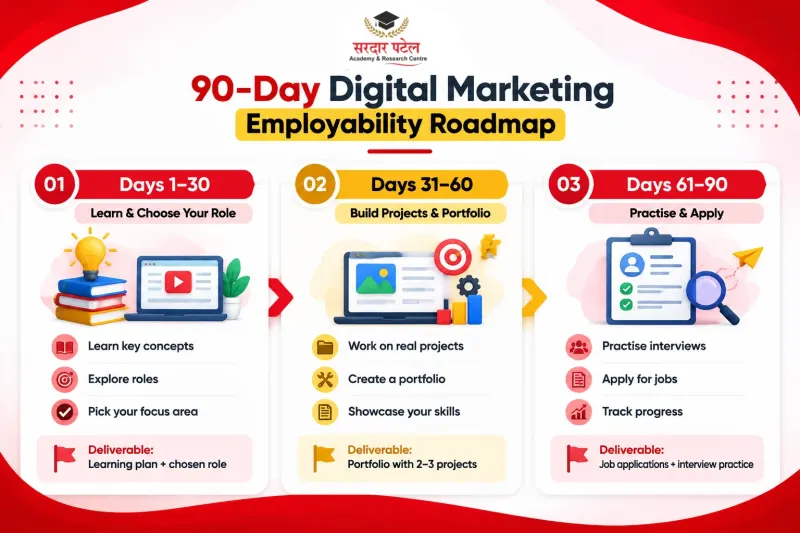
A 90-Day Plan to Build Employability Proof
You don't need a year. Three focused months can change what your profile shows.
Days 1–30: Build the base
- Pick one role path, not five.
- Revise the Layer 1 fundamentals for that role.
- Set up Google Analytics and Search Console on any practice site or blog.
- Start a simple work log: what you did, what you learned, what changed.
Days 31–60: Create visible work
- Choose one real or practice business and run an audit or small campaign.
- Prepare a two-minute explanation of each project: goal, action, result, lesson.
- Apply selectively to roles that match your path.
- After every interview, write down the questions you stumbled on and fix them.
If your timeline is unclear, how long a digital marketing course takes is worth understanding before you plan these 90 days around training.
Common Mistakes That Hurt Employability
- Tool collecting. Listing fifteen tools you touched once looks weaker than three you used well.
- Certificates without work. Credentials help, but they rarely replace evidence.
- Vague CV lines. "Managed social media" tells a recruiter nothing. "Planned 12 posts for a local café and tracked reach weekly" tells them plenty.
- Ignoring analytics. Many freshers avoid data because it feels intimidating. In our view, it is also where hiring managers often see a shortage.
- Applying everywhere. Scattered applications signal that you haven't decided what you want.
- Skipping the follow-up. A short, polite note after an interview or task submission is rare enough to be noticed.
- Choosing a training institute without questions. Before you commit, it helps to know the questions to ask before admission to a digital marketing institute.
Facts, Opinions, and What We Can't Claim
A trustworthy report separates what is known from what is judgment.
- Fact-based: Many marketing roles are tested through practical tasks and portfolios. Analytics, SEO, and paid-ads skills appear across many entry-level job descriptions. You can verify this by reading current listings yourself.
- Opinion-based: The four-layer model in this report is a way of organising skills. It is a working framework, not an industry standard.
- Not claimed: This report does not state placement rates, salary levels or hiring percentages, because none of them could be independently verified.
Conclusion: Turn Skills Into Proof
The central point of this digital marketing employability report is simple. Employers hire evidence, not intention. Channel knowledge opens the door, measurement skill builds trust, good habits keep you employed, and business sense makes you valuable.
For students in Delhi NCR, the next step doesn't have to be dramatic. Pick one role path, build one real project, and learn to explain it clearly. Repeat that for ninety days, and your profile will look very different.
If you'd like structured guidance, you can explore the digital marketing course at Sardar Patel Academy or get in touch with the team to talk through your goals.
| Free employability PDF for marketing learners in Delhi NCR [Download the free toolkit (PDF)] ← Questions? Call +91 93129-66129 or visit the contact page. |
FAQs
It is a document that explains which skills, tools, and habits make a candidate hireable in marketing roles. Instead of listing course topics, it focuses on what employers screen for: practical ability, measurement skills, reliability, and business understanding.
Many employers look for one strong channel skill (SEO, paid ads, or content), basic analytics comfort, clear writing, and dependable work habits. Business understanding is rarer and highly valued. Exact priorities vary by company size and role, so check live job descriptions.
A certificate helps with credibility but rarely decides the outcome alone. Hiring managers usually want proof you can apply the knowledge: a project, an audit, a campaign summary, or published work. Pairing a certificate with visible practice gives you the stronger profile.
Pick a local shop, a friend's business, or your own blog. Run an audit, write a content plan, or test a small ad. Document what you did, what happened, and what you learned. Even small, honest projects show real thinking.
You don't need advanced analytics, but you should be comfortable with Google Analytics, Search Console, and spreadsheets. Being able to read a report and recommend an action is one of the most useful entry-level skills, and one many freshers skip.
It depends on your starting point, your chosen role, and how much practical work you do. Course duration and job-readiness are not the same thing. Structured training plus consistent hands-on practice usually moves faster than study alone.
Sardar Patel Academy & Research Centre (SPARC) offers a free employability PDF for marketing learners in Delhi NCR. You can request it through the contact page or by calling +91 93129-66129.