+91 9312966129
 sparc.enquiry01@gmail.com


Tally Prime Skills Every Fresher Should Learn Before Applying for Jobs
Learn the top Tally Prime skills for freshers, including GST, voucher entry, inventory, bank reconciliation, and Excel to prepare for accounting jobs.

Table of Contents
- Why Employers Look for Tally Skills in Freshers
- Tally Prime Skills for Freshers: The Quick List
- The 10 Skills in Detail
- 1. Creating a Company and Basic Setup
- 2. Ledgers and Groups
- 3. Voucher Entry
- 4. GST in Tally Prime
- 5. Inventory and Stock Items
- 6. Bank Reconciliation
- 7. Reading Reports
- 8. Basics of TDS
- 9. Shortcuts and Speed
- 10. Backup, Security and Excel Export
- What Interviewers May Ask: A Quick Table
- Skills Beyond Tally That Make You Hireable
- Common Mistakes Freshers Make
- A Simple 30-Day Plan to Build Tally Prime Skills for Freshers
- How to Show Your Tally Skills on a Resume
- Why Practical Training Matters (Especially in GTB Nagar)
- Conclusion
You finish your course, add “Tally Prime” to your resume, and get called for an interview. Then the interviewer says, “Show me how you would record a purchase with GST.” Many freshers go blank at this point. They know the software exists, but they have never done the work on their own.
That gap is what this guide is about. The right Tally Prime skills for freshers are not complicated, but they need hands-on practice. Below, you will find the exact skills employers usually check, simple examples, a 30-day practice plan, and tips to show your skills on your resume
Why Employers Look for Tally Skills in Freshers
Many small- and mid-sized businesses in India still use Tally to maintain their books. Shops, traders, distributors, CA offices, and small factories often depend on it for billing, GST, and reports.
When a company hires a fresher, they do not expect an expert. They expect someone who can sit at the computer and start working with little training. If you want to understand the complete career journey, read our guide on how to become a Tally accountant, including the skills to learn, entry-level jobs, and career growth.
That is why Tally skills for jobs are judged by what you can do, not by the certificate you hold.
In simple words: an employer wants to know whether you can enter data correctly, understand what you are entering, and get a correct report at the end.
Tally Prime Skills for Freshers: The Quick List
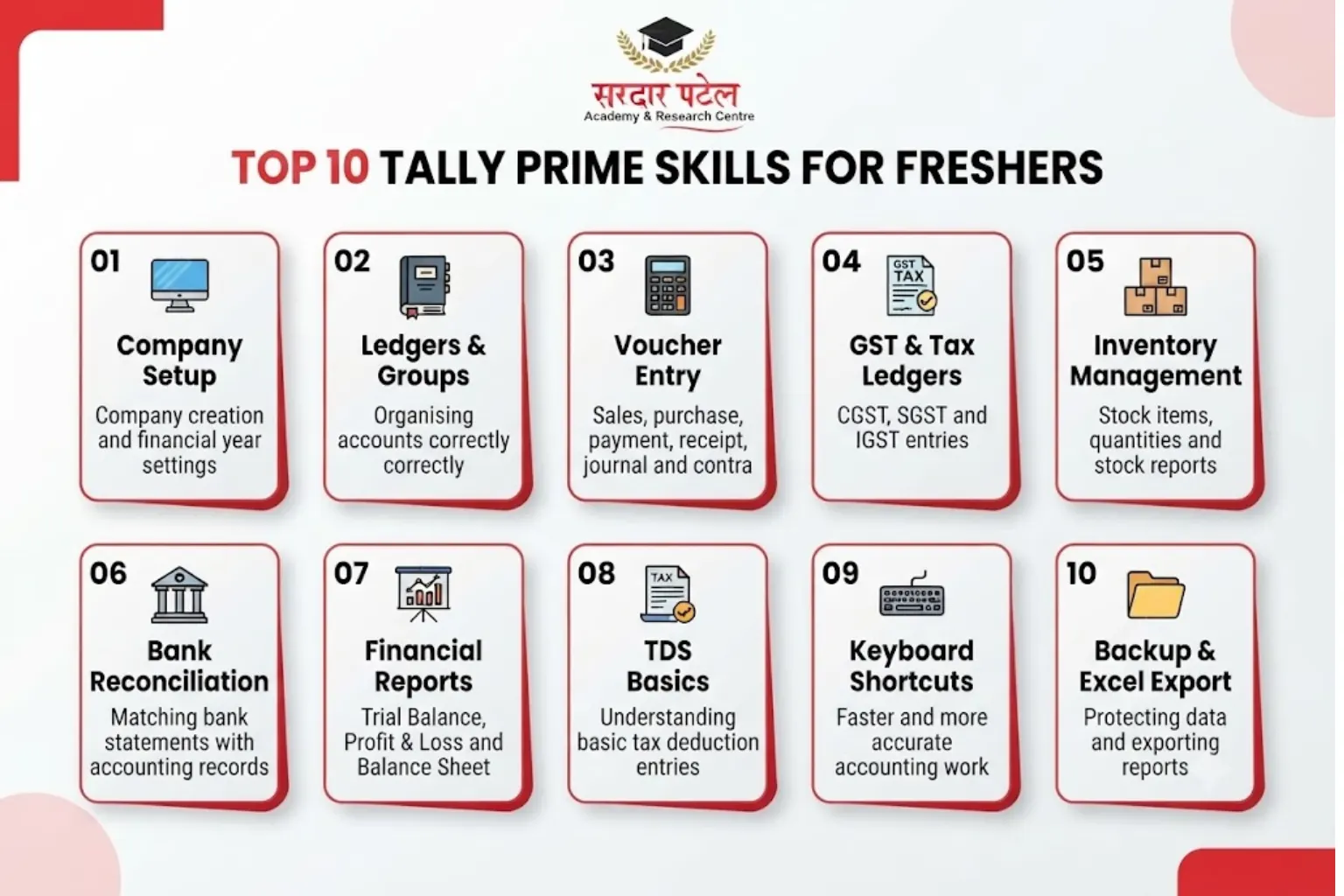
If you want the short answer first, here are the ten skills to build before you apply:
- Creating a company and setting up basic features
- Understanding ledgers and groups
- Voucher entry (sales, purchase, payment, receipt, journal, contra)
- GST entry and tax ledgers
- Inventory and stock items
- Bank reconciliation
- Reading key reports (trial balance, P&L, balance sheet)
- Basics of TDSKey
- board shortcuts and speed
- Data backup, security, and exporting to Excel
Now let's look at each one properly.
The 10 Skills in Detail
1. Creating a Company and Basic Setup
Everything starts here. You should know how to create a company, set the financial year, and turn on features like GST and inventory.
A small mistake at this stage, such as a wrong financial year start date, can affect every report later. Employers often check this first because it shows if you understand the basics.
2. Ledgers and Groups
This is the heart of accounting in Tally. A ledger is an account, like "Cash", "ABC Traders", or "Office Rent". A group is the bucket that decides where that ledger appears in reports.
Example: If you create “Electricity Expense” under the wrong group, your Profit & Loss account will show a wrong picture. Knowing which ledger goes under which group is one of the most important tally accountant skills.
3. Voucher Entry
Vouchers are how you record daily transactions. A fresher should be comfortable with at least these:
- Sales voucher: when you sell goods or services
- Purchase voucher: when you buy
- Payment voucher: when money goes out
- Receipt voucher: when money comes inJ
- ournal voucher: for adjustments, like accruals
- Contra voucher: for cash deposits or bank-to-bank transfers
Do not just learn the button. Learn the reason. For example, if a customer pays you by cheque, which voucher do you use, and which two ledgers are affected? If you can explain this in one line, you are already ahead of many applicants.
4. GST in Tally Prime
This is where many freshers lose marks. You should know how to create GST ledgers (CGST, SGST, IGST), how to record a sale within the state and outside the state, and how to handle purchase entries with input tax credit. Practise how to record purchase entries under GST in TallyPrime to understand tax ledgers and input tax credit.
You should also be able to open GST reports in Tally and understand what they show. Depending on your version and company setup, features like e-invoicing and e-way bill may also be available. For more information on outward-supply reporting, refer to the official GSTR-1 guide on the GST Portal.
Practical example: a trader in Delhi sells goods to a customer in Delhi and another in Jaipur. The first sale uses CGST and SGST, while the second uses IGST. If you can explain why, you understand GST entry, not just data entry.
5. Inventory and Stock Items
Many jobs involve billing for products. So you should know how to create stock items, units of measure, and stock groups, and record purchases and sales with quantity and rate.
Also practise looking at the stock summary. A common interview question is, "How will you check the closing stock?"
6. Bank Reconciliation
Your books say one thing, and the bank statement says another. Bank reconciliation helps you find the reason, such as a cheque not yet cleared or a bank charge you forgot to record.
Tally Prime has a reconciliation feature, but you still need to understand the logic behind it. Practice with a sample bank statement and match entries one by one. Follow the official guide to set up bank reconciliation in TallyPrime and practise matching transactions with a sample bank statement.
7. Reading Reports
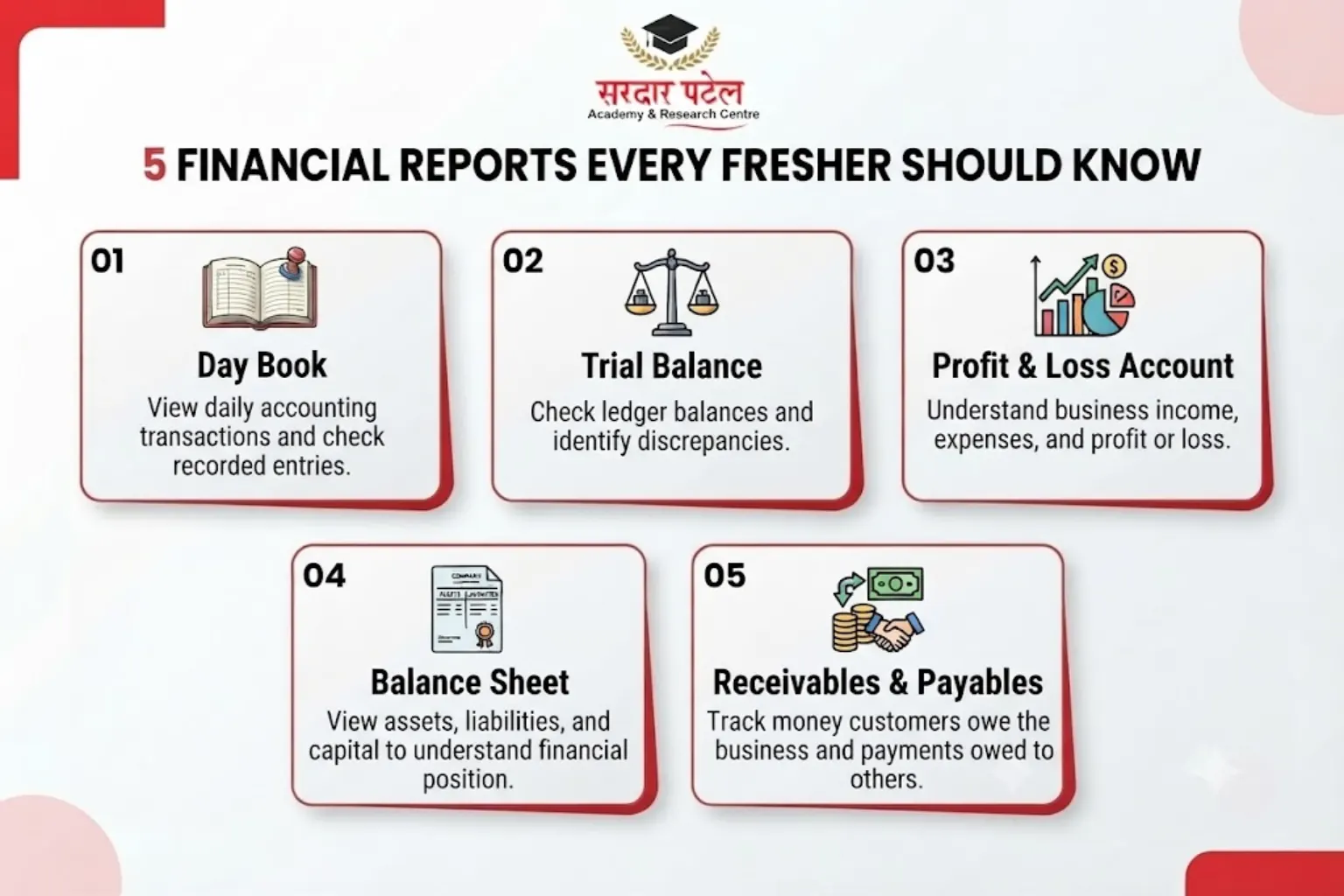
Entering data is only half the job. A good accounts assistant can also read what the data says. You should be comfortable with:
- Day BookTrial Balance
- Profit & Loss Account
- Balance Sheet
- Outstanding receivables and payables
If your trial balance does not tally, can you find out why? That is a real-world skill, and interviewers love to test it.
8. Basics of TDS
You do not need to be a tax expert as a fresher. But knowing what TDS is, how to enable it in Tally, and how to record a simple TDS entry on, say, a professional fee payment is a strong plus. You can learn how to record TDS transactions in TallyPrime by practising common business payments, such as professional fees.
Many freshers skip this topic, so even basic knowledge helps you stand out. To understand why these skills work well together, explore our guide to the Tally, GST, and TDS skill combination for accounting jobs.
9. Shortcuts and Speed
Tally is designed to be used with the keyboard. Knowing a few shortcuts saves a lot of time. For example, vouchers have function key shortcuts (like F5 for Payment, F6 for Receipt, F8 for Sales and F9 for Purchase), and Alt+C lets you create a ledger while you are in the middle of an entry. Shortcuts can vary slightly by version, so confirm them on your own system.
In many office roles, speed with accuracy matters. Practise entering 30 to 40 vouchers in one sitting and track your mistakes.
10. Backup, Security and Excel Export
Accounting data is sensitive. You should know how to take a backup, restore it, and, if needed, set user access. It is also useful to export reports to Excel, because managers often ask for data in a sheet.
A fresher who says, "I take a backup before making big changes," immediately sounds more careful and trustworthy.
What Interviewers May Ask: A Quick Table
| Skill |
A Likely Interview Question |
Practice Task |
| Ledgers and groups |
Under which group does "Rent Paid" go? |
Create 15 ledgers under the correct groups |
| Voucher entry |
Which voucher will you use for a bank deposit? |
Enter 40 mixed vouchers |
| GST |
When do you use IGST? |
Record 5 interstate and 5 local sales |
| Inventory |
How do you check closing stock? |
Create 10 stock items and run reports |
| Bank reconciliation |
Why does bank balance differ from book balance? |
Reconcile one month of entries |
| Reports |
What if the Trial Balance does not match? |
Find an intentional error in sample data |
| TDS |
What is TDS on a professional fee? |
Record one TDS entry |
| Backup |
How do you protect company data? |
Take and restore a backup |
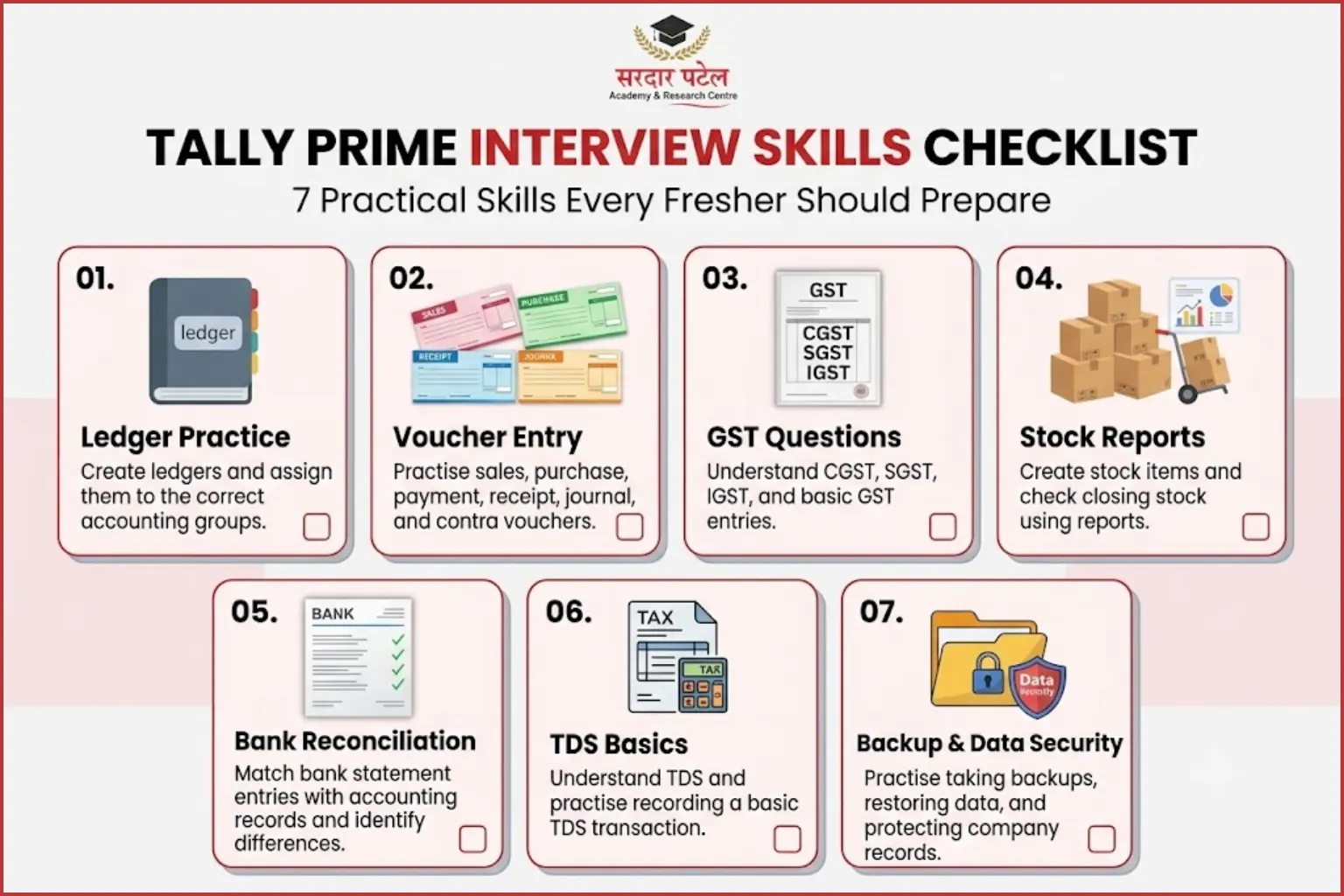
Skills Beyond Tally That Make You Hireable
Software skills alone is not enough. Employers also look for essential accounting skills in freshers, including basic accounting knowledge, Excel proficiency, communication, attention to detail, and confidentiality. Most accounting roles also expect:
- Basic accounting knowledge: debit, credit, assets, liabilities, income, expenses
- Excel basics: sorting, filters, VLOOKUP or XLOOKUP, pivot tables. To understand lookup formulas, read Microsoft's VLOOKUP function guide and practise finding matching data in an Excel table.
- Clear communication: explaining a mismatch politely to a manager or client
- Attention to detail: one wrong digit can change a whole report
- Honesty and confidentiality: you will handle financial information
Think of Tally as your main tool. Accounting knowledge is the engine behind it. If you only know the buttons, you will struggle when something looks unusual.
Common Mistakes Freshers Make
- Learning only from videos without practising on a computer
- Memorising steps without knowing why a ledger is debited or credited
- Ignoring GST because it feels difficult
- Never checking reports after entering data
- Writing "Expert in Tally" on a resume without being able to prove it
Avoid these, and you are already in better shape than a large part of the applicant pool. This is an experience-based observation, not a measured statistic.
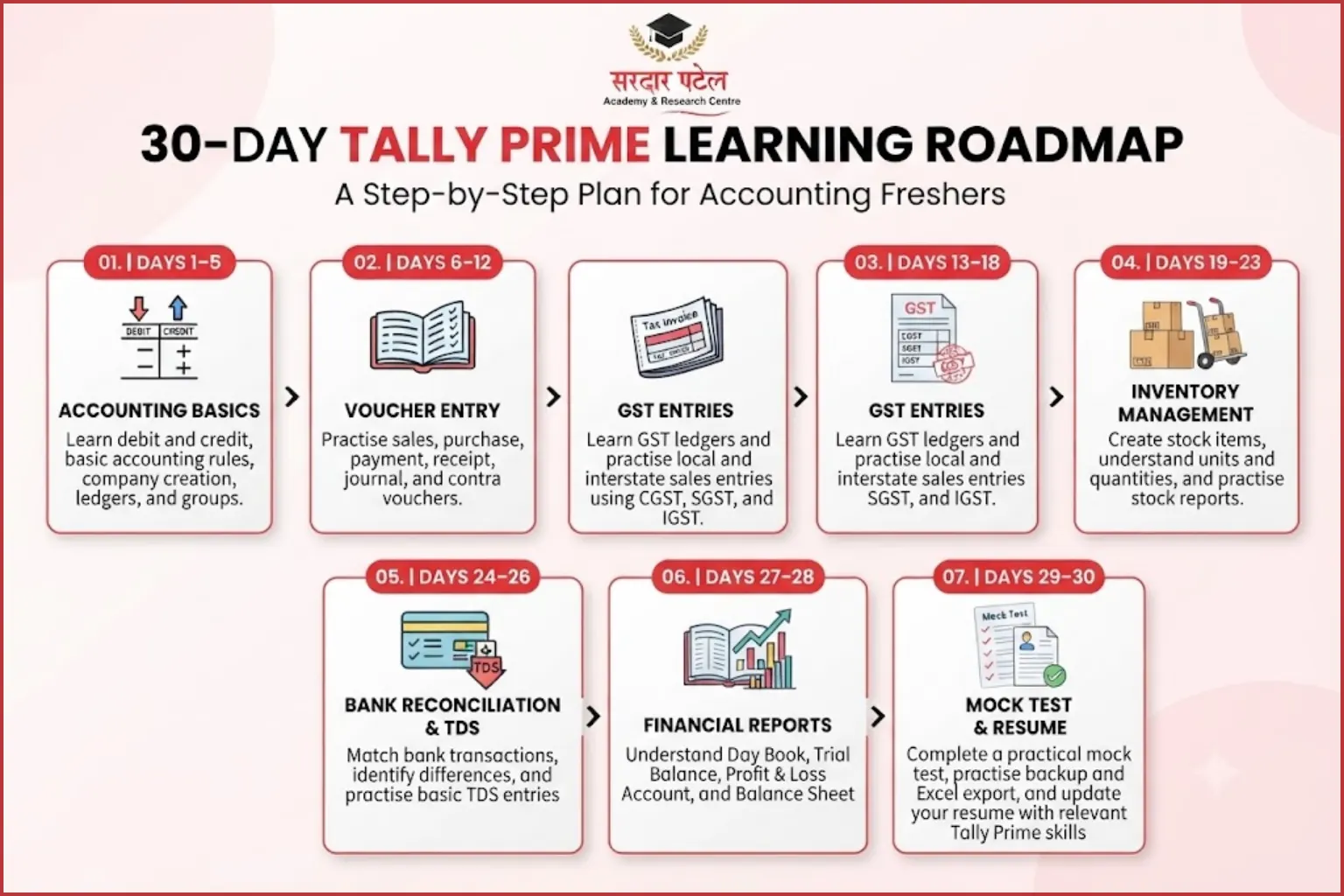
A Simple 30-Day Plan to Build Tally Prime Skills for Freshers
If you are starting now, this plan can help. Adjust it to your pace.
- Days 1 to 5: Learn accounting basics, then create a company, ledgers, and groups.
- Days 6 to 12: Practise all voucher types with a small sample business.
- Days 13 to 18: Add GST entries, both local and interstate.
- Days 19 to 23: Practise inventory, stock reports, and billing.
- Days 24 to 26: Do bank reconciliation and basic TDS entries.
- Days 27 to 28: Study the trial balance, P&L, and balance sheet, and fix mistakes.
- Days 29 to 30: Take a mock test, practise backup and Excel export, and update your resume.
Creating one complete sample company for a whole month of transactions is better than doing ten tiny exercises.
How to Show Your Tally Skills on a Resume
Be specific. Compare these two lines:
Weak: “Knowledge of Tally"
Better: “Tally Prime: voucher entry, GST entries, inventory, bank reconciliation, trial balance, P&L and balance sheet."
You can also add a short practical line, such as "Maintained books of a sample trading company for 3 months, including GST and stock records." Only write what you have really done, because interviewers often test it on the spot.
Still wondering whether Tally alone is enough to get hired? Read our guide on whether Tally is enough to get an accounting job and which additional skills can improve your chances.
Why Practical Training Matters (Especially in GTB Nagar)
Students in and around GTB Nagar have plenty of options for learning accounting software. The difference usually comes from how much hands-on work you get. Reading about Tally is easy. Entering real-looking transactions, making errors, and fixing them is how you actually learn.
When you compare institutes, ask a few simple questions:
- Will I practise on the software every day or only watch a trainer?
- Are GST, inventory, and reports covered with sample business cases?
- Do I get help with interview preparation and resume writing?
- Is the batch size small enough to ask doubts?
At Sardar Patel Academy & Research Centre, the focus is on practical, job-oriented learning, so students work on real-style accounting tasks instead of only theory. Its Tally Prime & Busy course runs for 5 months; fees and batch timings should be confirmed directly with the team.
Conclusion
Employers do not expect a fresher to know everything. They expect proof that you can do the daily work with care. If you build the Tally Prime skills for freshers listed above, practise on a full sample company, and pair them with basic accounting and Excel, your applications will look much stronger.
Start small and stay consistent. A few focused hours each day for a month can change how confident you feel in your next interview.
Ready to move from theory to real practice? Learn financial accounting practically at SPARC and get guidance on building job-ready accounting skills.
FAQs
The most important skills are ledger and group knowledge, voucher entry, GST entries, inventory, bank reconciliation and reading reports. Basic TDS, shortcuts and data backup add extra value.
It depends on your starting point and practice time. A beginner who practises daily can usually learn the core features in about one to two months. Becoming fast and confident takes longer.
It helps a lot. You can start both together, but understanding debit, credit and basic accounting rules will make Tally much easier.
Tally is an important skill, but most employers also want basic accounting, GST and Excel knowledge. Communication and accuracy also matter.
Freshers often apply for roles like accounts assistant, billing executive, data entry operator and junior accountant. Roles and requirements vary by company.
Yes. Most businesses in India deal with GST, so freshers who can record GST entries and read basic GST reports have a clear advantage.
Be ready to do a short live task, like creating a ledger, entering a few vouchers or explaining a Trial Balance. Practising on a complete sample company is the best preparation.