+91 9312966129
 sparc.enquiry01@gmail.com


What is the Course Duration of Digital Marketing?
Wondering about digital marketing course duration? See how many months it takes to learn digital marketing in Delhi, by goal and schedule. Plan your timeline.

Table of Contents
- What Is a Realistic Digital Marketing Course Duration
- How Many Months to Learn Digital Marketing? It Depends on Four Things
- 1. Your starting point
- 2. Daily or weekly time commitment
- 3. Depth of the syllabus
- 4. How much practical work is included
- What You Learn Month by Month
- Short Course vs Long Course: Pros and Cons
- Shorter programs (about 40 hours to a few weeks)
- Longer programs (around 6–7 months)
- Duration by Learner Type
- Common Mistakes When Judging Course Length
- Practical Tips to Finish Faster
- Does a Longer Course Lead to a Better Job?
- Conclusion: Pick the Timeline That Matches Your Goal
You've decided to learn digital marketing, and now one practical question is holding you back: how long will it take? Can you finish alongside college, or while holding down a job? Or does it mean putting life on pause for half a year?
The honest answer is that digital marketing course duration depends on what you want to achieve. In this guide, we break down typical timelines, what each phase covers, and how to choose a schedule that fits your life. If you're a learner in GTB Nagar or anywhere in Delhi NCR, this will help you plan realistically.
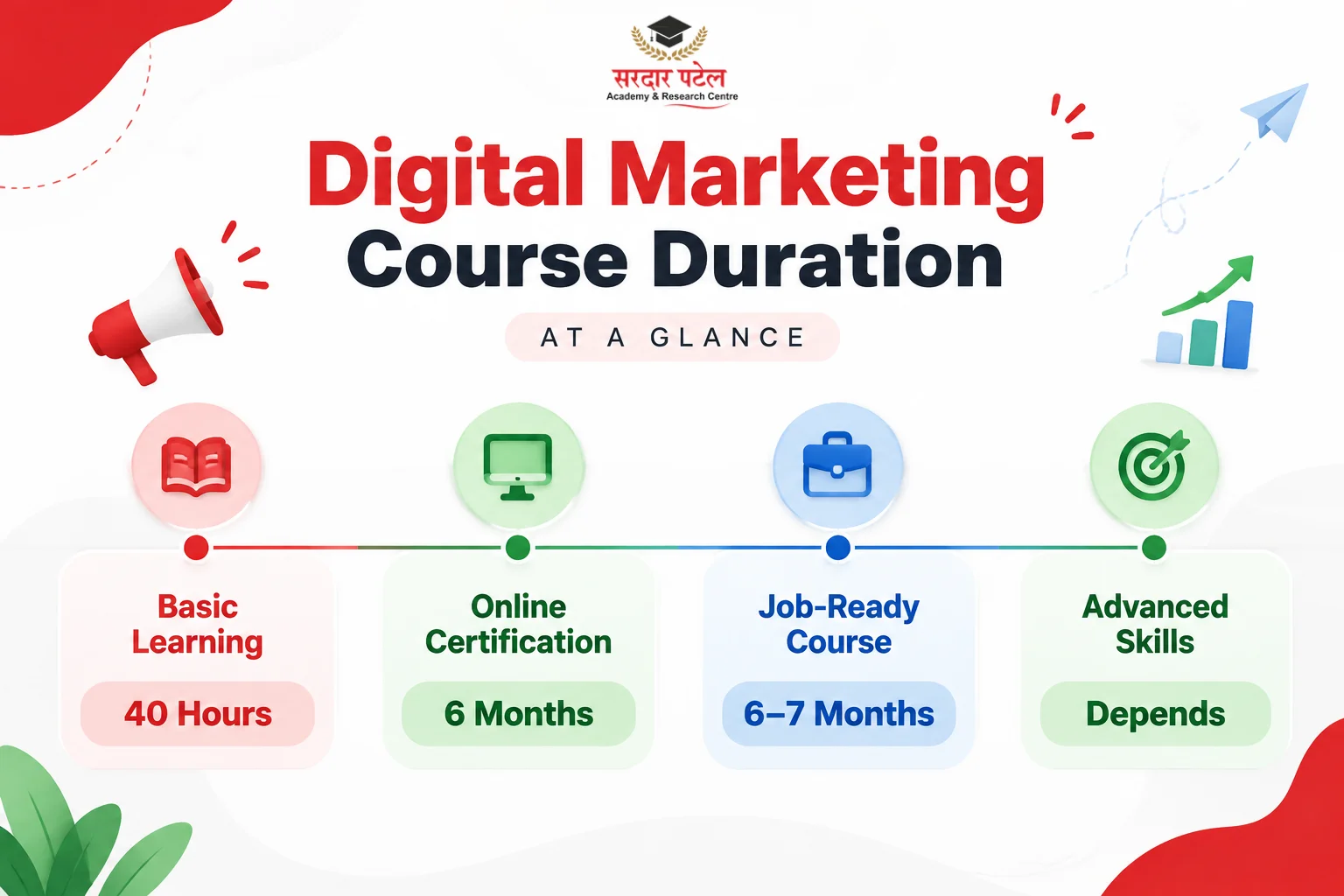
Digital marketing course duration depends on the program. Google's Skillshop fundamentals course takes about 40 hours, Google's professional certificate suggests about 6 months at 10 hours a week, and SPARC's Digital Marketing Course with AI in GTB Nagar runs 6–7 months, including a one-month live internship
What Is a Realistic Digital Marketing Course Duration
Think of the duration as a range, not a fixed number. Institutes design programs around different goals, and the same syllabus can be delivered in a fast-track batch or at a relaxed weekend pace.
Here is a general picture of how timelines look, with a reference for each:
| Learning goal |
Typical timeline |
Reference |
| Basic awareness (what SEO, social media, ads are) |
About 40 hours of study |
Google Skillshop, Fundamentals of Digital Marketing |
| Self-paced online certificate |
About 6 months at 10 hours a week |
Google Digital Marketing & E-commerce Certificate (Coursera) |
| Job-ready foundation across core modules (classroom) |
6–7 months, incl. one-month live internship |
SPARC Digital Marketing Course with AI |
| Advanced or specialised skills (paid ads, analytics, automation) |
Varies by program |
Depends on the modules you choose |
| Sources: Google certificate on Coursera; Search Engine Journal course list for the Skillshop 40-hour figure; SPARC course page. Programs differ, so treat these as reference points. |
How Many Months to Learn Digital Marketing? It Depends on Four Things
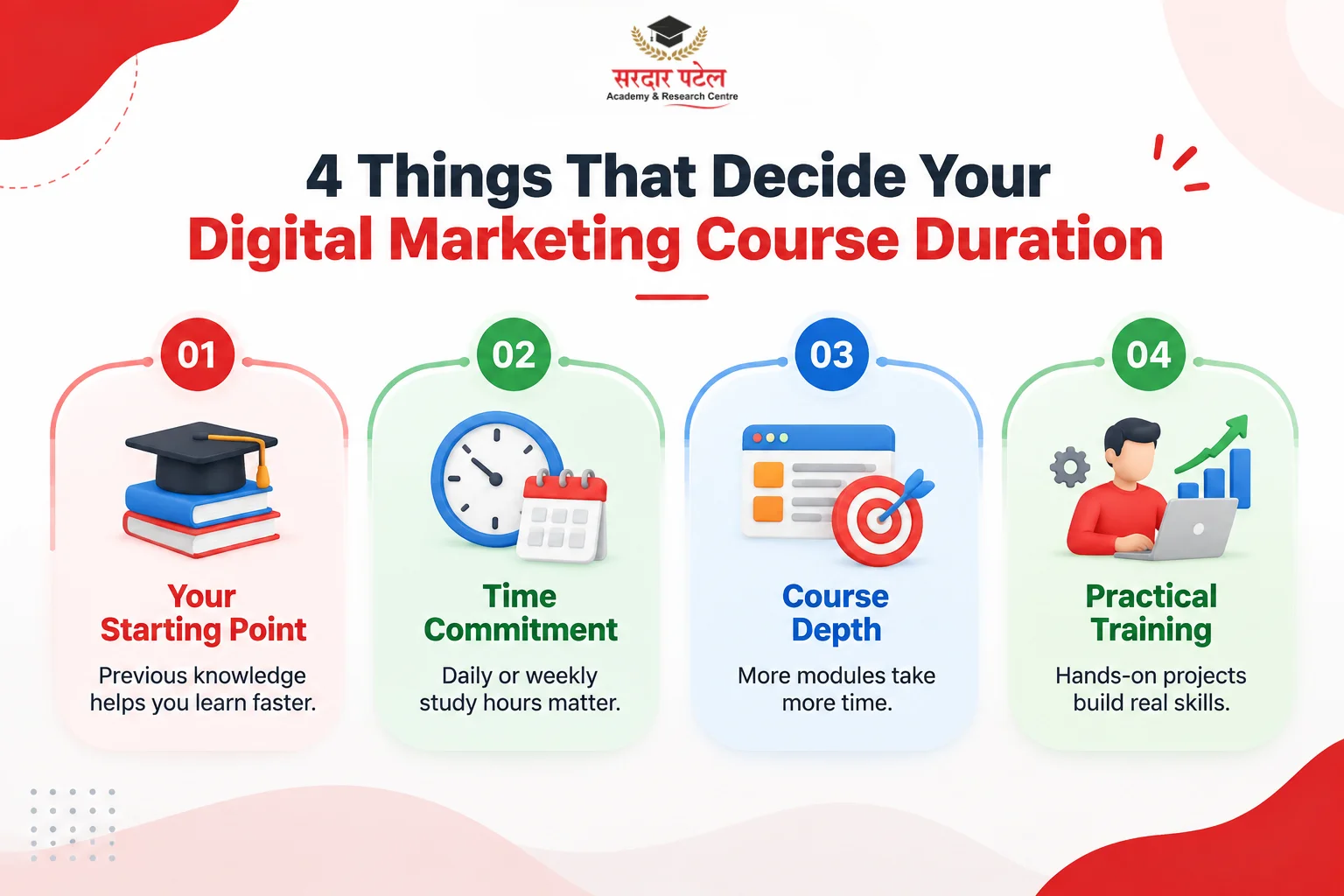
People often ask how many months to learn digital marketing as if there's one correct answer. In practice, four factors decide it.
1. Your starting point
Someone who already runs an Instagram page for a family shop will pick up social media modules faster than a complete newcomer. Prior exposure to writing, design, or basic analytics also shortens the curve.
2. Daily or weekly time commitment
A learner attending classes five days a week, with daily practice, will finish sooner than someone attending only on weekends. Neither is wrong. A working professional in Delhi who commutes from Noida or Gurugram may genuinely need the slower rhythm.
3. Depth of the syllabus
A course covering SEO, social media, Google Ads, email marketing, and analytics takes longer than one covering just social media. More tools means more practice time.
4. How much practical work is included
This is the factor most people overlook. A course that only explains concepts can finish quickly, but you won't feel confident running a real campaign. Time spent on live tasks, such as setting up a Google Business Profile or building a small ad campaign, is where actual skill develops.
What You Learn Month by Month
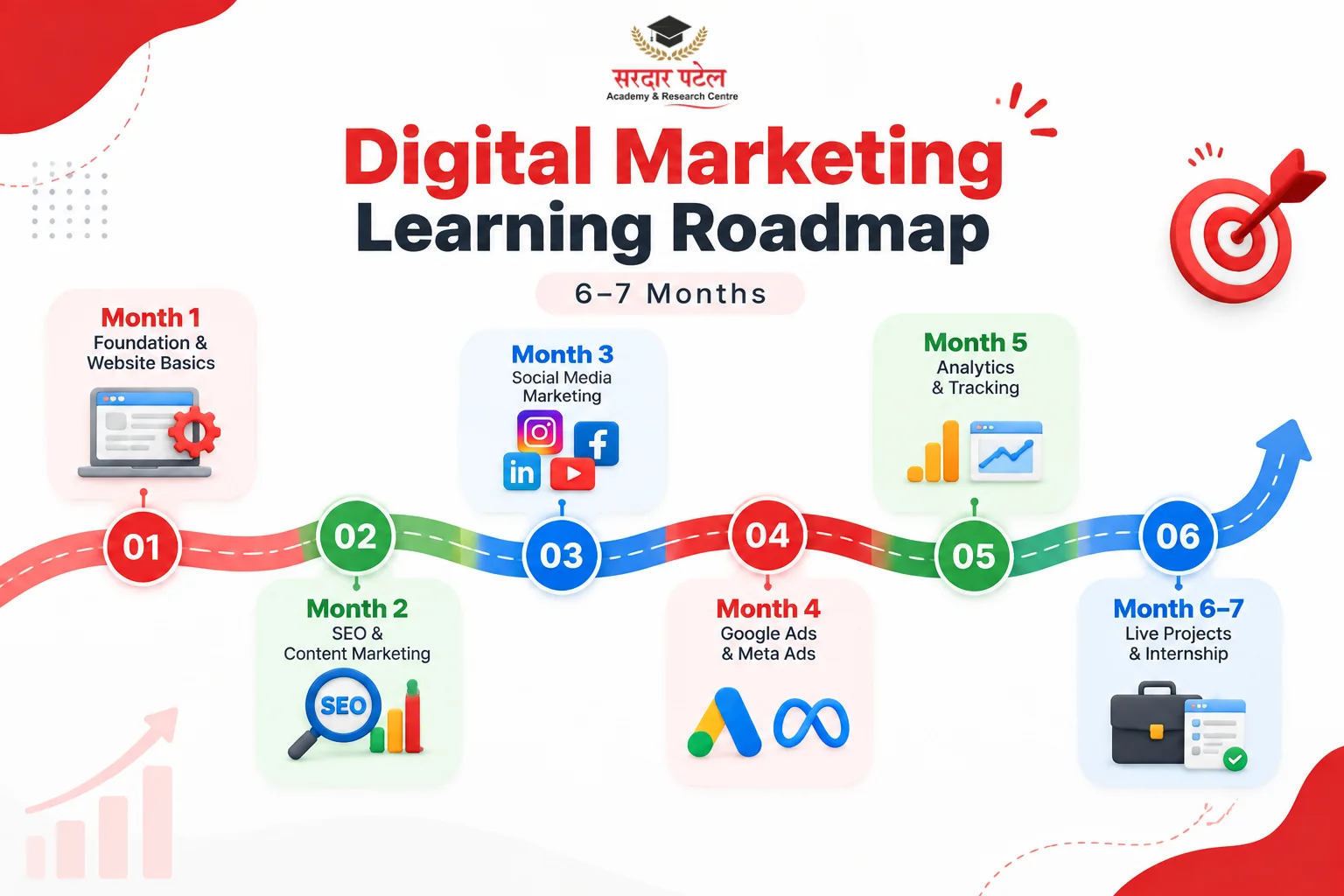
A comprehensive program, such as SPARC's 40+ module course spread over 6–7 months, tends to unfold in phases. The split below is illustrative, not a fixed schedule.
- Foundation phase: How digital marketing works, buyer journeys, website basics, and content fundamentals.
- Traffic phase: SEO (on-page, off-page, technical basics) and social media marketing.
- Paid and conversion phase: Google Ads, Meta Ads, landing pages, and email marketing.
- Measurement phase: Google Analytics, Search Console, and reading performance reports.
- Application phase: A one-month live internship project, portfolio building, and interview preparation.
If you want to see how these modules are actually arranged, the full digital marketing course outline lays out the structure in one place.
Short Course vs Long Course: Pros and Cons
Neither format is automatically better. The right choice depends on what you need from it.
Shorter programs (about 40 hours to a few weeks)
- Pros: Quick, lower commitment, good for understanding the basics.
- Cons: Limited practice, rarely enough for a full-time marketing role.
Longer programs (around 6–7 months)
- Pros: Time for hands-on projects, multiple tools, and mentor feedback.
- Cons: Requires steady commitment, and usually costs more.
- A shorter digital marketing course duration can be a smart pick if you only want to promote your own business. For a career, depth usually beats speed.
Duration by Learner Type
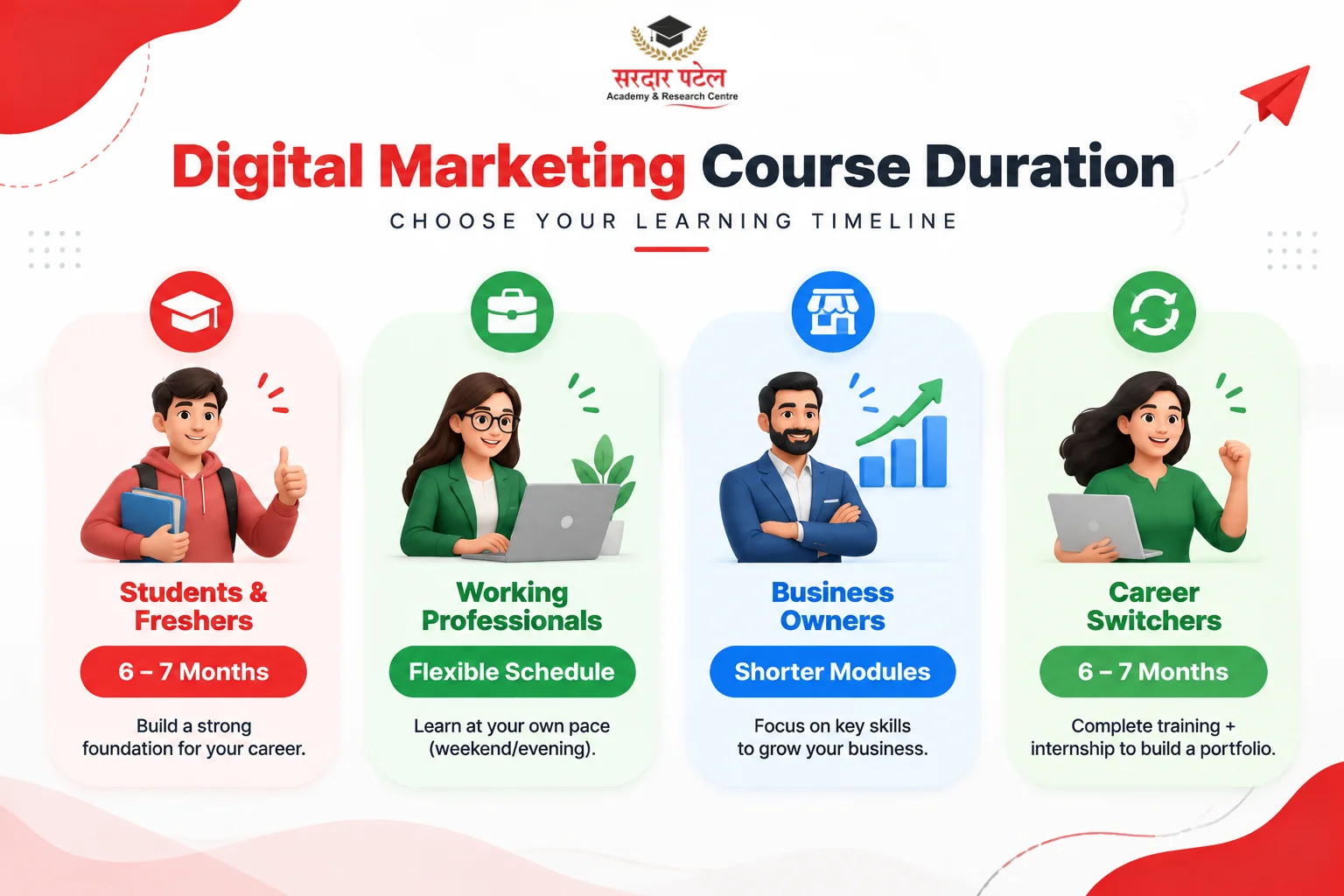
- Students and freshers: A 6–7 month program can work well if you plan it around semester breaks. Evening or weekend batches help fit classes around college.
- Working professionals: Weekend or late-evening batches stretch the total timeline but keep your income steady. Expect the same syllabus to take a little longer.
- Business owners: You probably don't need every module. Focus on SEO, local search, social media, and ads, which can often be learned faster.
- Career switchers: Plan for the full foundation plus a live project, since your portfolio will matter more than your certificate.
Common Mistakes When Judging Course Length
- Choosing the shortest course to save time. Speed means little if you finish without a single real project.
- Ignoring the practice hours. Ask how many hours are hands-on rather than lecture-based.
- Expecting a job right after the last class. Skill-building and job-hunting are two separate phases. Understanding how placement support works at a digital marketing institute helps you set realistic expectations.
- Forgetting about fees. Longer programs usually cost more, so compare the digital marketing course fees in Delhi before you decid
Practical Tips to Finish Faster
- Practise daily, even for 30 minutes, instead of cramming on weekends.
- Build a small project as you learn. A blog, a mock Instagram page, or a local shop's Google listing all count.
- Revise each module before moving to the next one.
- Ask questions early rather than letting doubts pile up.
- Keep a simple notebook of tools and shortcuts you discover.
Does a Longer Course Lead to a Better Job?
Not automatically. Employers in Delhi NCR generally look at what you can demonstrate: a portfolio, a live campaign, a working knowledge of analytics. Duration matters only because it creates room for that practice. If you're weighing job outcomes, this guide on a digital marketing course with placement support explains what to look for beyond the number of months.
Conclusion: Pick the Timeline That Matches Your Goal
To sum up, digital marketing course duration ranges from about 40 hours for the basics to roughly 6–7 months for a full job-ready program like SPARC's. What matters more than the number is how much of that time is spent practising on real tasks.
Your next steps are simple. Decide your goal, check how many hours you can give each week, and compare programs by their practical content, not just their length. If you're in GTB Nagar or nearby parts of Delhi NCR.
Ready to plan your digital marketing career? Explore SPARC’s Digital Marketing Course with AI in GTB Nagar, Delhi, and check the course duration, practical training, and live internship details to find the right learning path for you. Explore the Course.
FAQs
It depends on the program. Google's Skillshop fundamentals course takes about 40 hours, Google's professional certificate is about 6 months at 10 hours a week, and SPARC's Digital Marketing Course with AI runs 6–7 months, including a one-month live internship. Confirm the exact schedule on the course page before enrolling.
At a structured institute like SPARC, a complete beginner should plan for about 6–7 months to cover SEO, social media, ads, and analytics along with a live internship. Self-paced options such as Google's certificate suggest about 6 months at 10 hours a week. Consistent practice matters more than the calendar.
You can learn the basics in a month, such as how platforms work and how to run a simple campaign. Becoming job-ready usually takes longer because real campaigns need practice, feedback, and repetition across several tools.
Yes. Many working professionals choose weekend or evening batches. The overall timeline stretches a little, but the same syllabus can be completed without leaving your job. Block fixed study hours so that practice doesn't slip.
Not necessarily. The syllabus is often similar, but offline batches may offer more face-to-face practice and doubt clearing. Online batches add flexibility. Choose based on your schedule and learning style rather than expecting a big difference in time.
No. A longer program only helps if the extra time goes into live projects and mentoring. A well-structured shorter program can beat a long, theory-heavy one. Check the practical component before judging by length.
It varies. Learners who build a portfolio during the course and keep applying often find the transition smoother. Job timelines depend on the market, your skills, and your effort, so be careful with anyone who promises a fixed outcome.
The most reliable source is the institute itself. You can review the course page for the structure, or speak to the team directly through the contact page to confirm timings that suit you.