+91 9312966129
 sparc.enquiry01@gmail.com


why students prefer practical analytics learning
Discover why students in Delhi NCR are choosing practical analytics learning over theory-only courses. Explore real skills, real projects, real readiness.
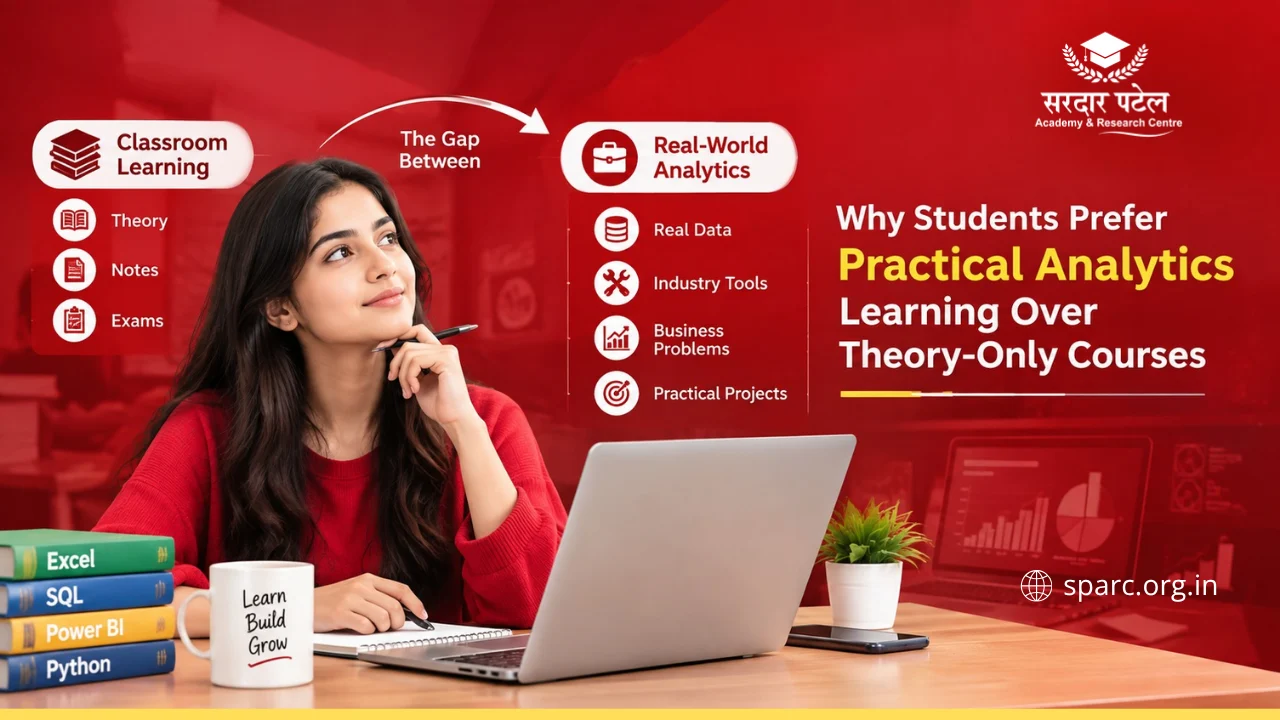
Table of Contents
- What Does "Practical Analytics Learning" Actually Mean?
- Core Elements of a Practical Analytics Program
- Practical vs Theoretical Analytics Training: A Side-by-Side Look
- Why Students Are Actively Choosing Practical Analytics Learning
- It Mirrors What Employers Actually Ask For
- It Builds Real Problem-Solving Instincts
- Portfolio Work Speaks Louder Than Grades
- It Shortens the Confidence Gap
- It Suits Working Professionals Too
- Common Mistakes Students Make When Choosing an Analytics Course
- How to Evaluate If a Course Is Genuinely Practical
- A Quick Note on Delhi NCR's Analytics Learner Base
- Does Practical Training Guarantee a Job?
- Conclusion
Ask any recent graduate who's sat through months of analytics lectures and then walked into their first job, and you'll hear a common complaint: the syllabus didn't match the work. This gap is exactly why practical analytics learning has become the deciding factor for students choosing where to train — especially across Delhi NCR, where the analytics job market moves fast, and employers expect candidates who can actually work with data, not just describe how it should theoretically be handled.
In this article, we'll unpack why practical analytics learning is winning over students, what practical vs. theoretical analytics training actually looks like in practice, and how to evaluate a course before you commit your time and money to it.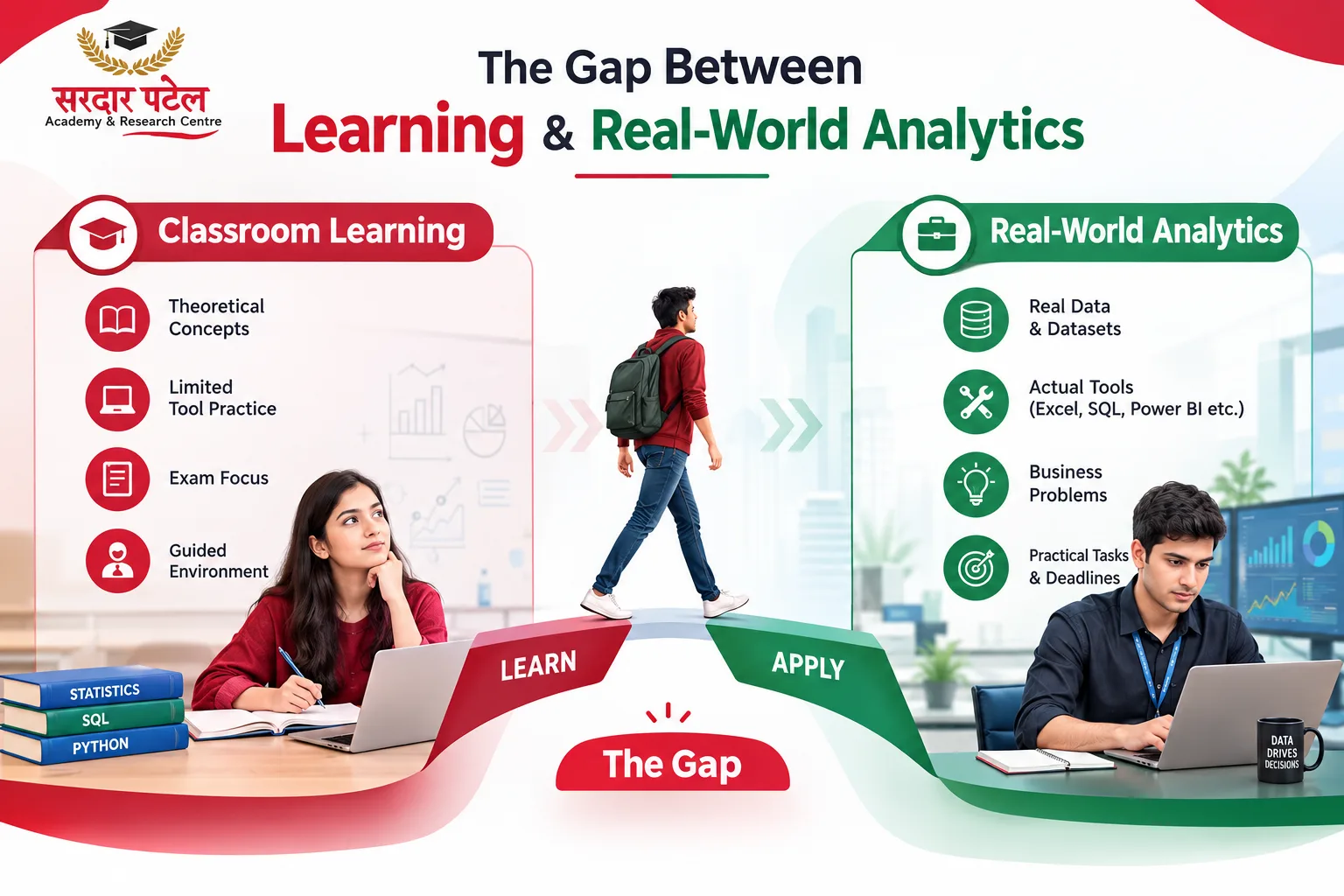
What Does "Practical Analytics Learning" Actually Mean?
Practical analytics learning is a training approach built around real datasets, real business problems, and real tools — rather than slides, formulas, and theory recited from a textbook. To understand the foundation behind this approach, it helps to first understand the basics of data analytics.
Instead of memorizing what a pivot table is, you build one from messy sales data. Instead of reading about regression, you run one on an actual dataset and explain what the output means to a non-technical stakeholder. That distinction — doing the work versus reading about the work — is the entire idea behind practical analytics learning.
Core Elements of a Practical Analytics Program
A genuinely practical program usually includes:
- Live datasets instead of cleaned, textbook-ready sample files
- Tool-based training in Excel, SQL, Power BI, Python, or Tableau — the analytics tools students should learn for practical work. For example, Microsoft describes Power BI as a business analytics platform used to connect, visualize, analyze, and share data.
- Case studies drawn from real business functions like sales, marketing, or operations
- Capstone projects that mirror what an entry-level analyst is asked to do
- Feedback loops, where mentors review your actual output, not just your exam answers
Practical vs Theoretical Analytics Training: A Side-by-Side Look
Students often ask what the real difference is once you strip away the marketing language. Here's a straightforward comparison.
| Aspect |
Theoretical Training |
Practical Analytics Learning |
| Learning method |
Lectures, textbooks, formulas |
Live projects, real datasets, tools |
| Assessment |
Written exams |
Project-based evaluation |
| Focus |
Concepts and definitions |
Application and problem-solving |
| Tool exposure |
Limited or simulated |
Hands-on with industry-standard tools |
| Job readiness |
Requires additional upskilling |
Closer alignment with workplace tasks |
| Confidence at interviews |
Often theory-heavy answers |
Able to walk through actual project work |
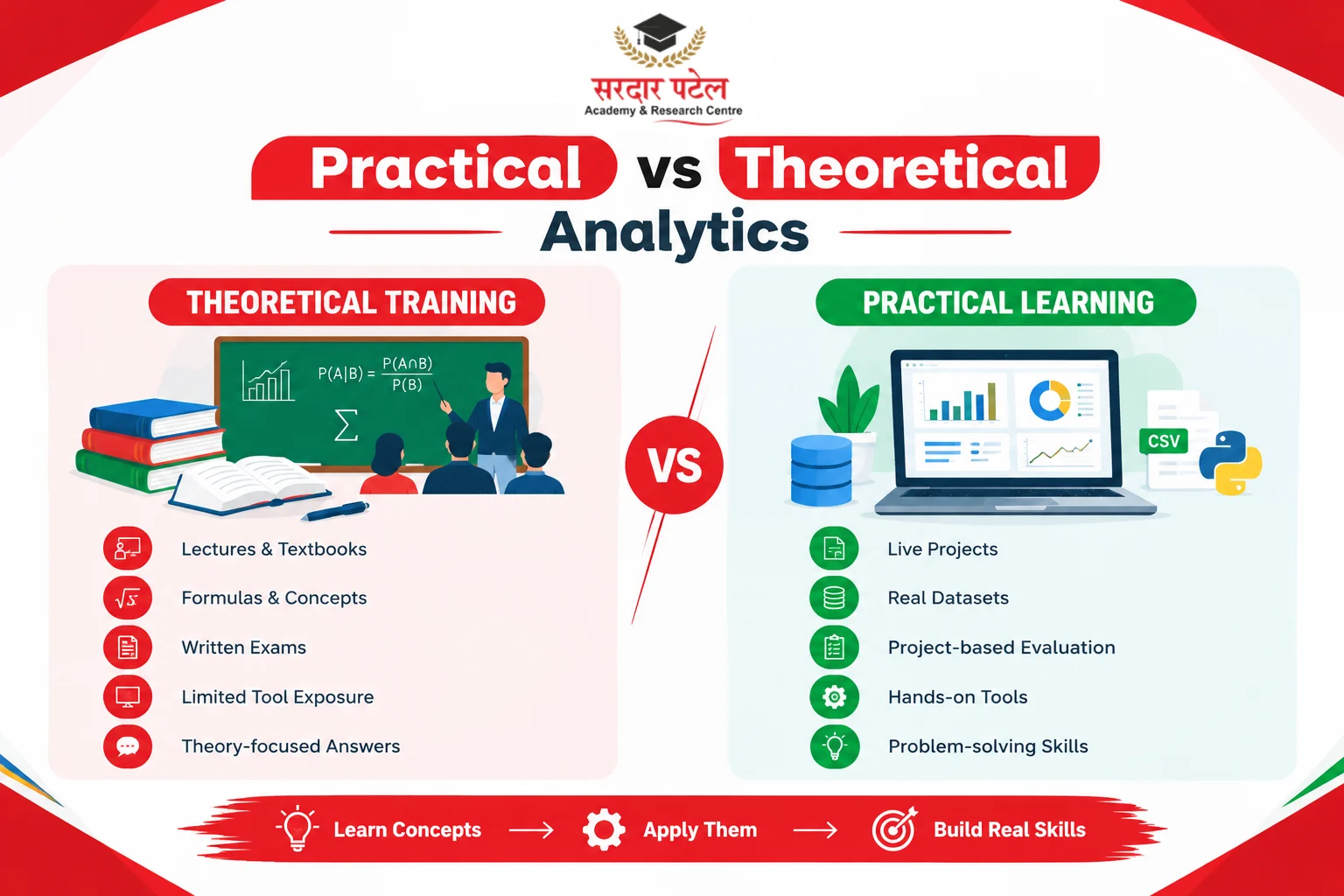
This isn't to say theory is useless — understanding statistical concepts matters. But when practical vs. theoretical analytics training is compared directly, students consistently report feeling more prepared after the former, because they've already made the mistakes a real project throws at you, in a classroom setting where a mentor can correct course.
Why Students Are Actively Choosing Practical Analytics Learning
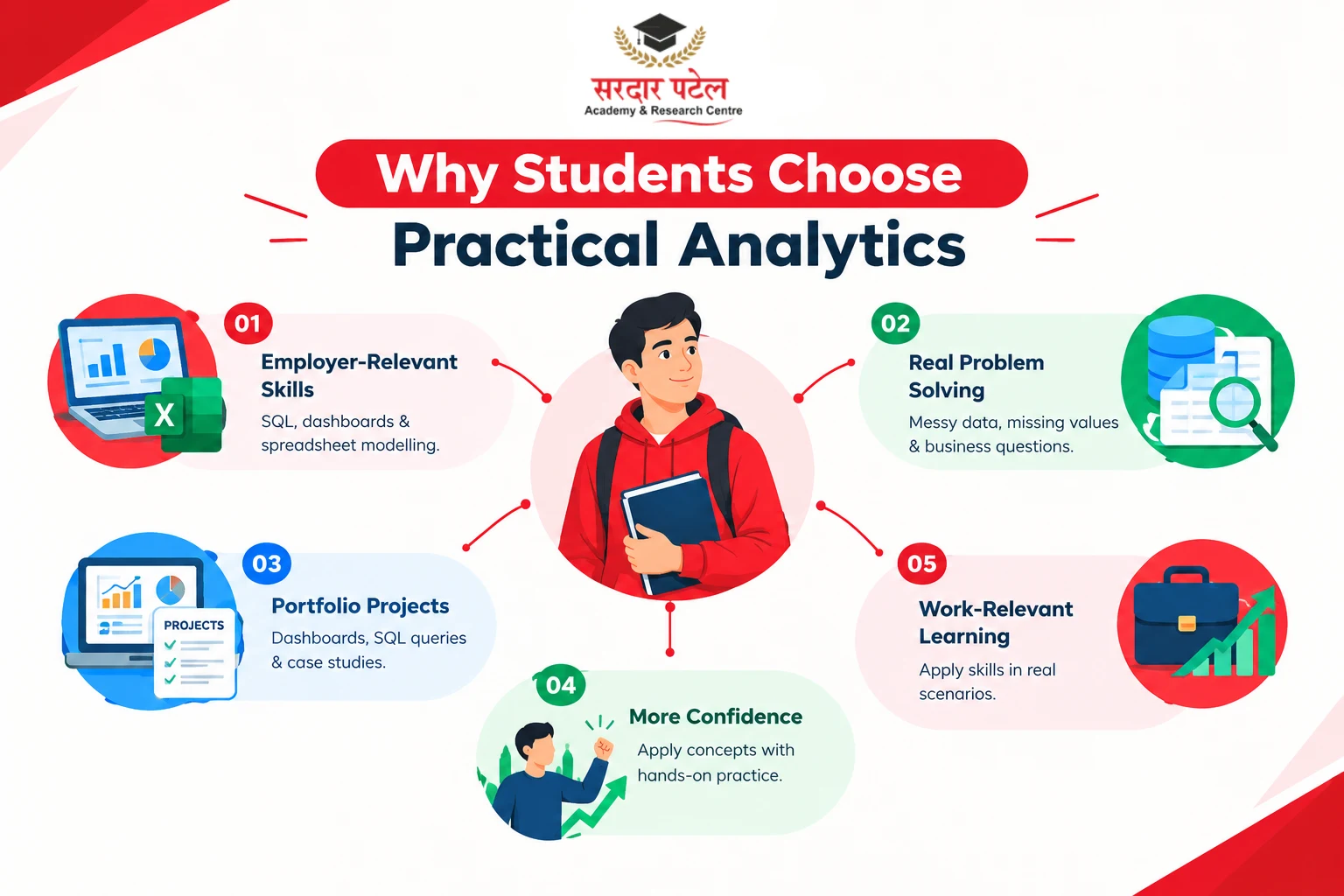
It Mirrors What Employers Actually Ask For
Most entry-level analytics job descriptions in Delhi NCR ask for comfort with SQL queries, dashboard tools, or spreadsheet modelling — not the ability to derive a statistical formula from scratch. Students can also explore analytics skills and career opportunities to understand how these skills connect with different roles.
Practical analytics learning trains directly for this expectation, which is why students who've been through project-heavy programs tend to describe interviews as less intimidating.
It Builds Real Problem-Solving Instincts
Theoretical courses teach you the "correct" answer to a clean problem. Real data is rarely clean. A practical analytics learning environment forces students to deal with missing values, inconsistent formatting, and ambiguous business questions — the exact situations they'll face on the job. Tools such as pandas also provide practical ways to work with missing data and structured datasets during Python-based analysis.
Portfolio Work Speaks Louder Than Grades
When two candidates apply for the same analyst role, a portfolio of dashboards, SQL queries, or a completed case study often carries more weight in a hiring conversation than a mark sheet. Practical analytics learning naturally produces this kind of tangible proof of skill. Dashboards are commonly used to turn analyzed data into visual information that helps organizations understand performance and support decision-making.
It Shortens the Confidence Gap
A common pattern among students who've only studied theory is hesitation — they know the concept but freeze when asked to apply it under pressure. Practical training closes that gap simply through repetition on real tasks.
It Suits Working Professionals Too
For working professionals in Delhi NCR looking to pivot into analytics, time is limited. A structured path for learning analytics lets them apply new skills to work-relevant scenarios immediately, rather than spending months on theory before seeing any usable output.
Common Mistakes Students Make When Choosing an Analytics Course
Before enrolling anywhere, it's worth watching out for a few recurring mistakes:
- Assuming "hands-on" claims are automatically true. Ask what tools are used and whether you'll work with real or simulated data.
- Overlooking mentor availability. Practical learning only works well when there's someone reviewing your project output and correcting errors. This is a good point to check directly — our interview with analytics faculty covers how mentors structure project feedback session by session.
- Ignoring the capstone project quality. A weak or generic final project won't hold up well in interviews.
- Choosing based on course length alone. A longer course isn't automatically more practical — check the actual project-to-lecture ratio.
- Not asking about the tools used in local job postings. Delhi NCR's analytics roles vary by industry (fintech, retail, consulting), so tool relevance matters. If you're comparing options locally, our guide to data analytics certification courses in Delhi is a useful starting point.
How to Evaluate If a Course Is Genuinely Practical
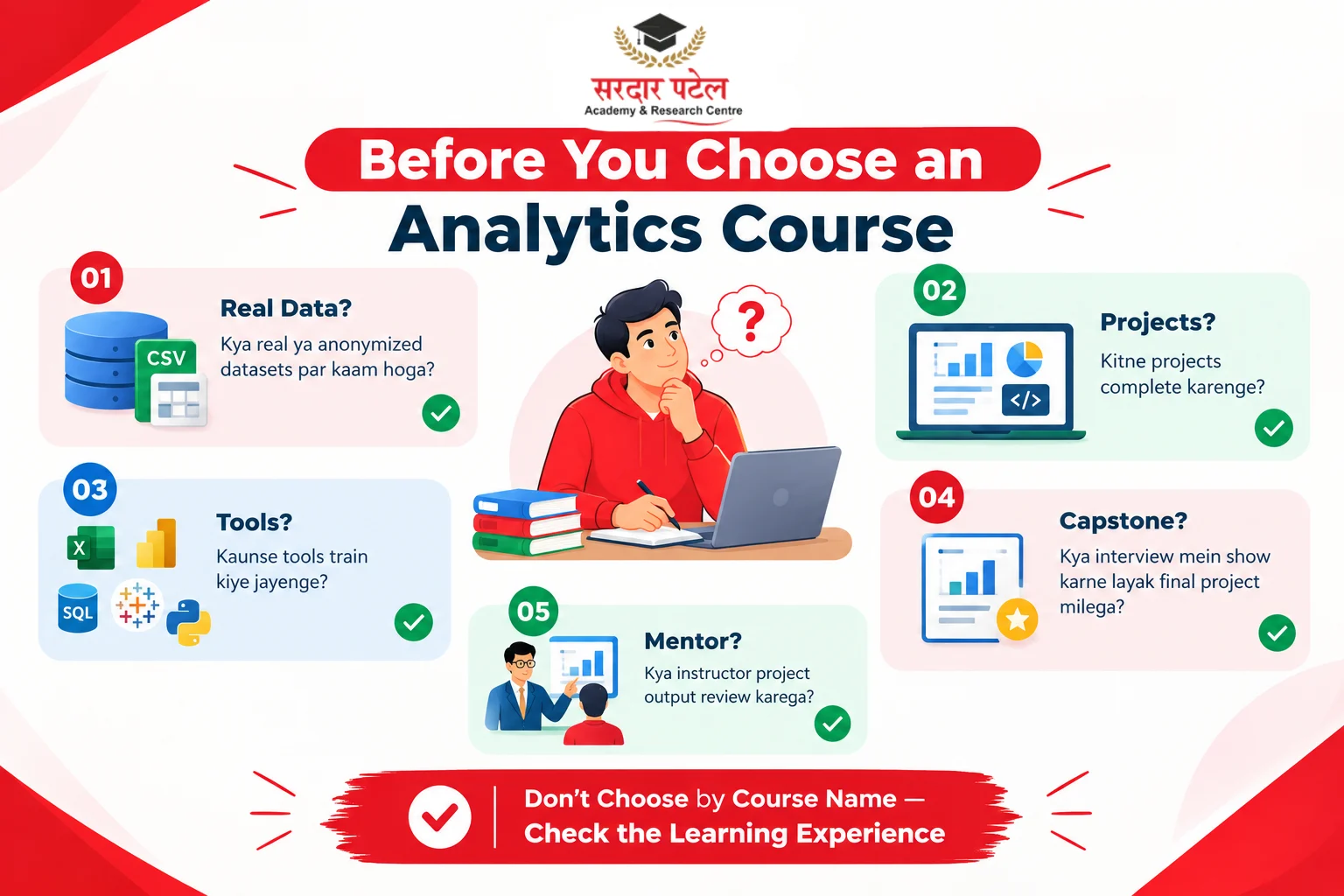
Before signing up for any analytics course, ask these direct questions:
- Will I work on real or anonymized real-world datasets, or only sample files?
- How many projects will I complete, and are they reviewed individually?
- What tools will I be trained on, and are they currently in demand in the local job market?
- Is there a capstone project I can show in interviews?
- Do instructors have practical industry experience, not just academic backgrounds?
If a program can answer these clearly, it's likely offering genuine practical analytics learning rather than repackaged theory with a new name.
A Quick Note on Delhi NCR's Analytics Learner Base
Delhi NCR has a fairly diverse pool of analytics learners — recent graduates, career-switchers from non-technical backgrounds, and working professionals trying to move into data roles. The broader analytics field includes roles such as data analyst, data scientist, and data architect, with different responsibilities and technical requirements. For learners comparing their options, understanding analytics course eligibility and career paths can also help them choose a suitable starting point.
Because the region hosts a wide mix of industries, from IT services to retail to consulting, a practical analytics learning approach tends to serve this variety better than a single theory-heavy curriculum, since it can be adapted to different starting points and goals.
Does Practical Training Guarantee a Job?
No responsible institute should claim that any course — practical or otherwise — guarantees placement. Practical analytics learning improves job readiness and portfolio strength, but hiring also depends on the market, your effort during interviews, and how well you communicate your project work. For a transparent, non-promotional answer on this, see our page on whether placement is guaranteed after an analytics course.
Conclusion
The shift toward practical analytics learning isn't a trend — it's a response to what employers actually need and what students have found genuinely builds confidence. Practical vs theoretical analytics training isn't about dismissing concepts entirely; it's about learning those concepts through real application, so the knowledge sticks and translates into workplace skill.
If you're evaluating your options in Delhi NCR, ask hard questions about project quality, mentor involvement, and tool relevance before committing to any program. To see what a project-driven analytics curriculum looks like in practice, explore Practical Modules with Sardar Patel Academy & Research Centre and get a clearer sense of how hands-on training is structured from day one.
FAQs
It's a training method centered on real datasets, tools, and business case studies, where students build and apply skills instead of only studying theory.
It depends on your goal. For job readiness, most students find practical analytics learning more directly useful, though a basic grounding in theory still helps you understand why a method works.
No. Most beginner-friendly practical programs start with foundational tools like Excel and SQL before moving to more advanced tools.
Excel, SQL, Power BI, Tableau, and Python are among the most commonly taught, depending on the course level and target job roles.
This varies by prior background and course intensity, so it's best to ask a specific program for its structure and project timeline rather than relying on a general estimate.
Yes. Many working professionals prefer practical analytics learning because it lets them apply new skills to real scenarios quickly, without lengthy theoretical detours.
Ask about dataset authenticity, project count, mentor feedback structure, and whether a capstone project is included.
No course can honestly guarantee placement. What it can offer is stronger job readiness through real project experience — placement still depends on the market and the candidate's own effort.