+91 9312966129
 sparc.enquiry01@gmail.com



Data Analytics Certification Courses in Delhi Guide
Compare data analytics certification courses in Delhi for 2026 — skills, tools, fees, placements, and how to choose the right one. Learn more with SPARC.
Table of Contents
- What Is a Data Analytics Certification Course?
- The Delhi-NCR Analytics Job Market in 2026
- Who Should Take This Course
- Students —
- Graduates from non-technical backgrounds
- Working professionals
- Career switchers
- Skills You'll Actually Need
- Tools Covered in Training
- Key Factors to Check Before Joining an Analytics Course
- Certification vs Practical Skills
- Career Paths and Real Salary Data
- Salary progression (India-wide, 2026 industry data):
- How to Prepare Beyond the Certificate
- Why Consider SPARC for Data Analytics Training?
- Conclusion
If you've searched for a data analytics certification course in Delhi, you've probably noticed every institute claims the "best curriculum," the "most placements," and the "most in-demand tools." That noise makes it genuinely hard to tell which course will actually get you job-ready — and which one will just add another certificate to a drawer.
This guide cuts through that. It covers what a real analytics course should teach, what the current Delhi-NCR job market actually pays and hires for, how to evaluate a program before paying for it, and what SPARC specifically offers if you're considering it.
What Is a Data Analytics Certification Course?
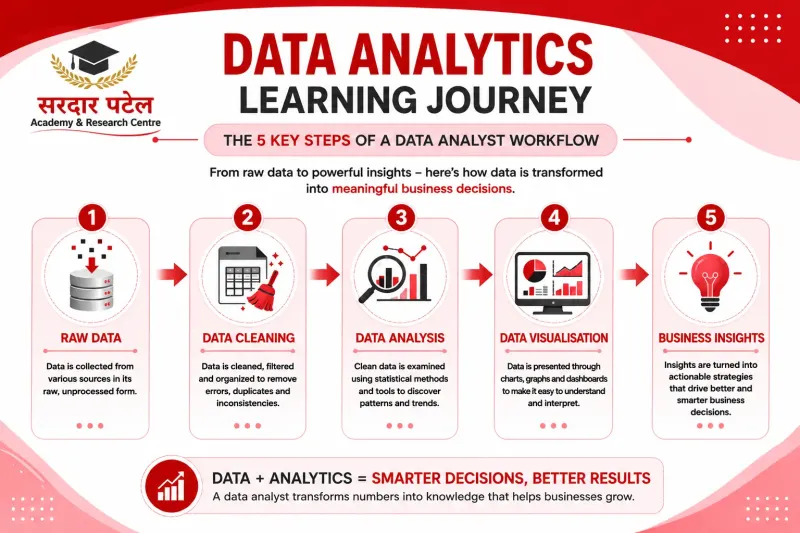
A data analytics certification course is structured training that teaches you to collect, clean, analyse, visualise, and report on data to support business decisions. Understanding data analyst responsibilities can also help beginners see how these skills are applied in real-world roles.
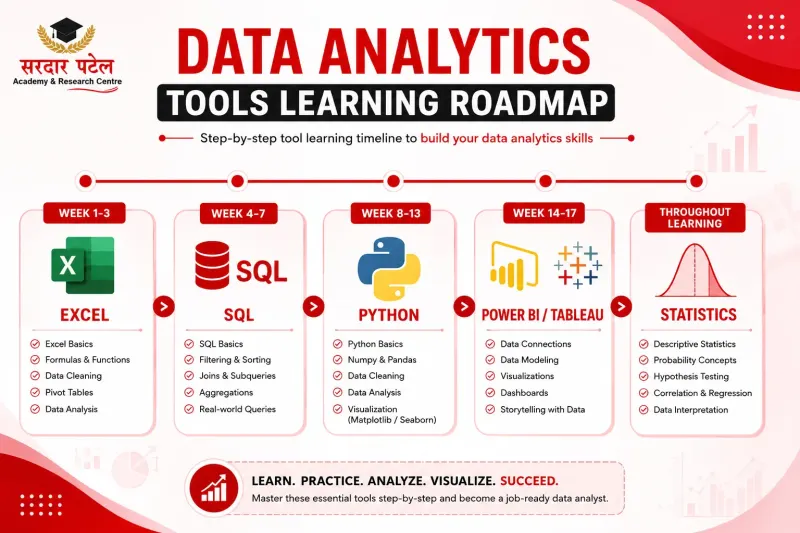
Training typically starts with Excel and statistics fundamentals, then moves into SQL for querying databases, Python (Pandas/NumPy) for data manipulation, and Power BI or Tableau for dashboards and visual storytelling.
The certificate itself only confirms attendance and assessment completion. What actually gets you hired is whether you can open a messy dataset, clean it, query it, build a dashboard, and explain your findings out loud in an interview — unprompted, without your notes.
The Delhi-NCR Analytics Job Market in 2026
Before choosing a course, it helps to know what you're training for. A few figures worth knowing, based on current industry salary data:
- National average data analyst salary in India (2026): roughly ₹6.5–7 LPA across all experience levels, with wide variation by city, skills, and company type.
- Freshers: typically start between ₹3.5–6 LPA; strong SQL + Python + BI portfolios at product companies can start higher.
- Delhi-NCR specifically: Gurgaon and Noida rank among the highest-paying locations in India for data analysts, both ahead of the national average, largely due to the concentration of consulting, fintech, and product companies in the region.
- Skill premium: analysts who combine SQL with Python and a BI tool (Power BI/Tableau) tend to earn a meaningfully higher premium than those relying on Excel and SQL alone.
The takeaway: Delhi-NCR is one of the stronger regional markets for this career, but the pay gap between an Excel-only analyst and a SQL+Python+BI analyst is real and widens with experience. That's the gap a good course should close.
Who Should Take This Course
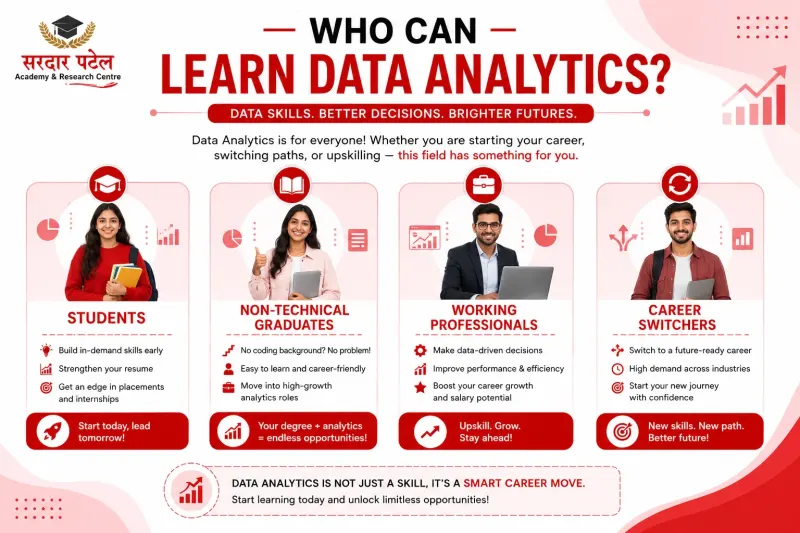
Students —
Can use practical assignments to build a portfolio before internships or entry-level applications.
Graduates from non-technical backgrounds
(commerce, humanities, management) — Analytics is one of the more accessible technical career switches; you don't need a computer science degree, but expect a steeper learning curve on SQL and Python if you've never coded.
Working professionals
(ops, finance, marketing, sales) — Often already work with spreadsheets and reports; adding SQL, Python, and BI tools can shift you into a formal analytics role or strengthen your current one.
Career switchers
Benefit most from a structured, sequenced curriculum rather than self-teaching multiple tools in a random order.
If you're unsure whether this field matches your background and goals, read our guide to data analytics course eligibility and career opportunities.
Choose a batch that matches your actual starting level — not the one with the longest tool list on the brochure.
Skills You'll Actually Need
- Excel — formulas, pivot tables, lookups, basic dashboards. Still the fastest way to explore small datasets.
- SQL — filtering, joins, GROUP BY, aggregate functions, subqueries. This is non-negotiable; almost every analyst job posting lists it.
- Statistics — distributions, correlation, variance, hypothesis basics. You don't need to be a statistician, but you need to reason about "is this difference real or noise?" Understanding confidence intervals can also help analysts interpret how reliable an estimated result is.
- Python (Pandas, NumPy) — data cleaning, automation, and analysis at a scale Excel can't handle.
- Data Visualisation — choosing the right chart, avoiding misleading axes, building dashboards a non-technical stakeholder can read in 10 seconds.
- Business Framing — the skill most courses skip. Knowing why sales dropped matters more than just calculating that they dropped.
Tools Covered in Training
To understand the role of different analytics platforms in more detail, explore our guide to data analytics tools you must know. Don't judge a course by how many tools are listed — judge it by how many hours of hands-on practice each tool actually gets. Five tools taught superficially is worse than three tools you can genuinely use unsupervised.
Key Factors to Check Before Joining an Analytics Course
- Read the full syllabus, not just the course title — ask for a module-by-module PDF.
- Ask for real project examples from past batches — not just "you'll build a project," but which datasets, which tools, and can you see a sample?
- Verify the certificate — who issues it, is it recognised by employers in your target industry, and what are the completion requirements?
- Check trainer access — how are doubts resolved, is there 1:1 feedback on assignments, or is it a recorded-video-only model?
- Confirm the format — weekday/weekend batches, online/offline/hybrid, and whether timings work with your job or college schedule.
- Compare total cost, not just tuition — ask separately about material, tool licenses, assessment fees, and certification fees. For a more detailed look at tuition, additional charges, and what you should check before paying, read our guide Data Analytics Course Fees in Delhi Explained.
- Ask exactly what "placement assistance" includes — resume reviews, mock interviews, referrals to hiring partners, or just a WhatsApp group of job postings. These are very different things.
If placement support is an important factor in your decision, you can also explore our guide to the Best Data Analytics Course in Delhi with Placement and compare what different programs offer.
Certification vs Practical Skills
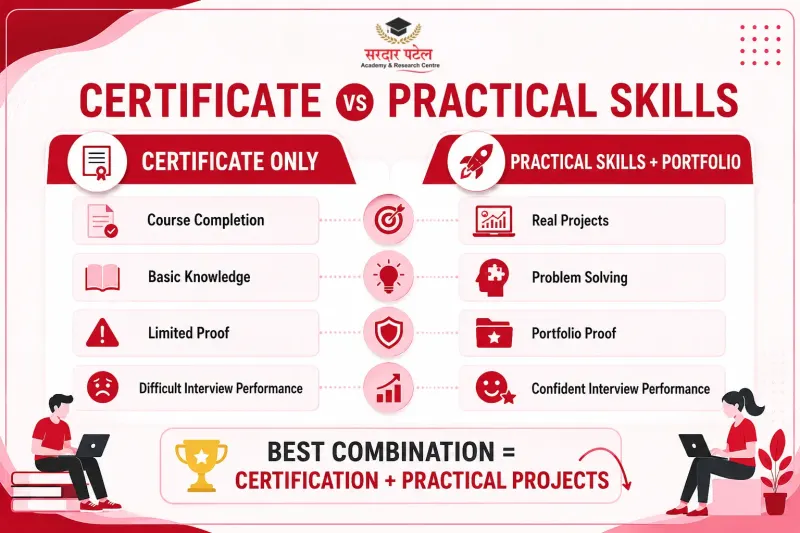
Picture two candidates for the same entry-level analytics role.
Candidate A has three certificates but freezes when asked to write a live SQL query. Candidate B has one relevant certification, and confidently walks through a dashboard they built, explains how they handled missing data, and defends their chart choices.
Hiring managers consistently favour Candidate B. This is why a good course should end with you holding both — a certificate and a small portfolio of projects you can talk through in detail, unscripted. A structured analytics framework can help learners understand how analytics projects move from identifying a business question to creating measurable value.
To understand what hands-on learning should actually look like, read our guide, What is Practical Data Analytics Training? Before choosing a course
Career Paths and Real Salary Data
Typical entry points after certification:
- Junior Data Analyst
- Data Analyst
- Reporting Analyst
- Business Intelligence (BI) Executive
- MIS Analyst
- Junior Business Analyst
A data analyst role typically involves preparing, analysing, visualising, and communicating data to support organisational decisions. For a broader overview of data analytics career scope, skills and salaries, explore our detailed career guide.
Salary progression (India-wide, 2026 industry data):
(Ranges are directional industry averages from Indeed, Glassdoor, and PayScale — actual offers vary by city, company type, and skill depth. Product companies and MNCs generally pay above these bands; service companies typically sit at or below them.
As you gain experience, specialisation (BI, product analytics, marketing analytics, financial analytics) tends to pay more than staying a generalist.
How to Prepare Beyond the Certificate
- Practise on messy, real-world-style datasets — not just clean textbook data.
- Build 2–3 portfolio projects you can explain end-to-end: problem, data source, method, finding, limitation. You should also learn how to present these projects effectively on your analytics resume and LinkedIn profile.
- Practise explaining technical work in plain language — most interviews test communication as much as technical skill.
- Keep learning after the course. Tools and employer expectations shift yearly; treat the certificate as a starting point, not a finish line.
For a structured approach to building your skills, follow our data analytics learning guide.
Why Consider SPARC for Data Analytics Training?
SPARC (Sardar Patel Academy & Research Centre) offers practical Data Analytics training designed to help learners develop skills relevant to today’s Delhi-NCR job market. The course covers essential tools such as Excel, SQL, Python, Power BI, and Tableau, along with opportunities to apply these concepts through practical business-oriented projects.
Before selecting any training institute, including SPARC, take time to compare the syllabus, explore available project work, and read student feedback. This can give you a clearer understanding of the teaching methodology and help you decide whether the course aligns with your learning needs and career objectives.
Conclusion
Choosing the right Data Analytics Certification Course in Delhi is about more than just getting a certificate. Focus on practical skills like Excel, SQL, Python, Statistics, and Power BI/Tableau, along with real-world projects and portfolio building.
Before joining, compare the syllabus, projects, trainer support, fees, and placement assistance. With the right training and consistent practice, you can build job-ready skills and create strong career opportunities in data analytics.
FAQs
It's structured training — typically Excel, SQL, Python, statistics, and a BI tool like Power BI or Tableau — that teaches you to turn raw data into decisions a business can act on, usually validated through a final assessment or project.
Yes. Most learners start with zero coding background. Excel and statistics fundamentals come first, SQL next, then Python and visualisation tools. The learning curve is steeper if you've never worked with formulas or logical conditions before, but it's a well-trodden path.
SQL first — it appears in nearly every analyst job listing. Then either Python or a BI tool depending on whether you want a more technical (Python) or more business-facing (Power BI/Tableau) role.
No. Recruiters increasingly ask candidates to walk through a live project or complete a take-home SQL/Excel task. A certificate gets you shortlisted; a portfolio and clear communication get you hired.
Yes, if the course offers weekend or evening batches with recorded backup sessions. Confirm this explicitly before enrolling, since not every institute offers true flexibility despite advertising it.
Full syllabus, sample projects, trainer access model, batch timings, complete cost (not just tuition), and the specific scope of "placement assistance" — ask them to define it in writing.
Training is the actual skill-building process. Certification is the formal, employer-visible proof that you completed it. A good program is strong on both — training that's rigorous enough that the certificate means something.