+91 9312966129
 sparc.enquiry01@gmail.com


Why Students Prefer Practical Learning Digital Marketing Over Theory
Discover why students choose practical learning digital marketing over theory-heavy courses. Compare approaches and see what makes training job-ready.

Table of Contents
- What Does "Practical Learning" Actually Mean in Digital Marketing?
- Why Are Students Moving Away from Theory-Heavy Courses?
- 1. The Job Market Wants Doers, Not Just Definers
- 2. Digital Marketing Platforms Change Faster Than Textbooks Can
- 3. Confidence Comes from Doing, Not Reading
- 4. It's Easier to Build a Portfolio from Practical Work
- Practical vs Theoretical Digital Marketing Institute: A Side-by-Side Comparison
- Common Mistakes Students Make When Choosing a Course
- How to Evaluate If a Course Is Genuinely Practical
- Where Practical Learning Fits for Different Learners
- Final Thoughts
If you've spent even a week researching digital marketing courses in Delhi NCR, you've probably noticed a pattern in student reviews: almost everyone talks about "hands-on training" and almost no one praises a course for its lecture slides. That's not a coincidence.
Practical learning digital marketing has become the deciding factor for students choosing between institutes, and for good reason. Digital marketing isn't a subject you can master by memorizing definitions — it's a skill you build by running campaigns, breaking things, and fixing them.
In this article, we'll look at why students in Delhi NCR are actively choosing practical, project-based training over theory-heavy classroom courses, what the real differences are between the two approaches, and how to evaluate whether a course actually delivers on its "practical training" promise before you enroll.
What Does "Practical Learning" Actually Mean in Digital Marketing?
Practical learning means acquiring a skill by doing the actual work — not just reading about it or listening to someone explain it.
In a digital marketing context, this looks like:
- Setting up and running a real Google Ads campaign with an actual budget
- Writing and publishing SEO content for a live website
- Building and testing email sequences in an actual ESP (email service provider)
- Analyzing real traffic data in Google Analytics and Search Console
- Managing a client-style social media calendar from planning to reporting
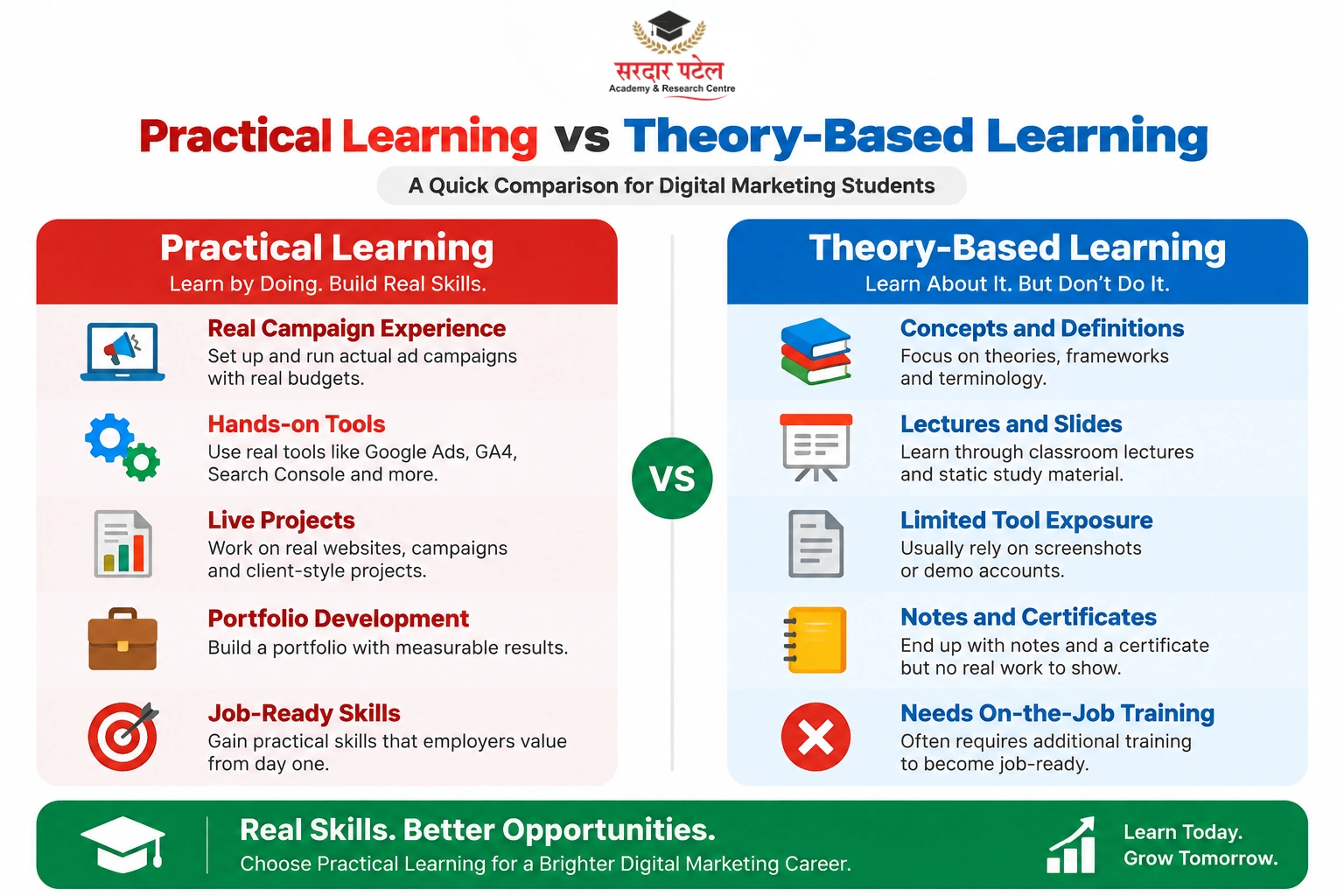
Theoretical learning, by contrast, focuses on concepts, frameworks, and terminology — understanding what a keyword is, what the marketing funnel looks like, or how an algorithm ranks pages, without necessarily doing the work yourself.
Both have value. The problem is when a course is almost entirely theory, and students graduate knowing the vocabulary of digital marketing without knowing how to execute it.
Why Are Students Moving Away from Theory-Heavy Courses?
1. The Job Market Wants Doers, Not Just Definers
Delhi NCR's digital marketing job market — from agencies in Nehru Place to in-house teams in Noida and Gurugram — is largely built around output. Employers want to know if a candidate can actually set up a campaign, write copy that converts, or read a Google Analytics report, not just define these terms in an interview.
A student who can only explain concepts theoretically often struggles in the first few weeks of a job, simply because the tools, dashboards, and real-world quirks of platforms like Google Ads or Meta Ads Manager look nothing like a textbook diagram.
2. Digital Marketing Platforms Change Faster Than Textbooks Can
Google updates its algorithm regularly, ad platforms redesign their interfaces, and new features roll out constantly. A theory-based course built around static material can quickly go out of date.
Practical, project-based learning solves this because students are working inside the live platforms, which naturally exposes them to current interfaces, current best practices, and current limitations — not a screenshot from two years ago.
3. Confidence Comes from Doing, Not Reading
There's a specific kind of confidence that only comes from having actually done something before — launched a campaign, fixed a broken tracking pixel, or recovered a page that dropped in rankings. Students who've only studied these situations tend to freeze up when they meet them for real.
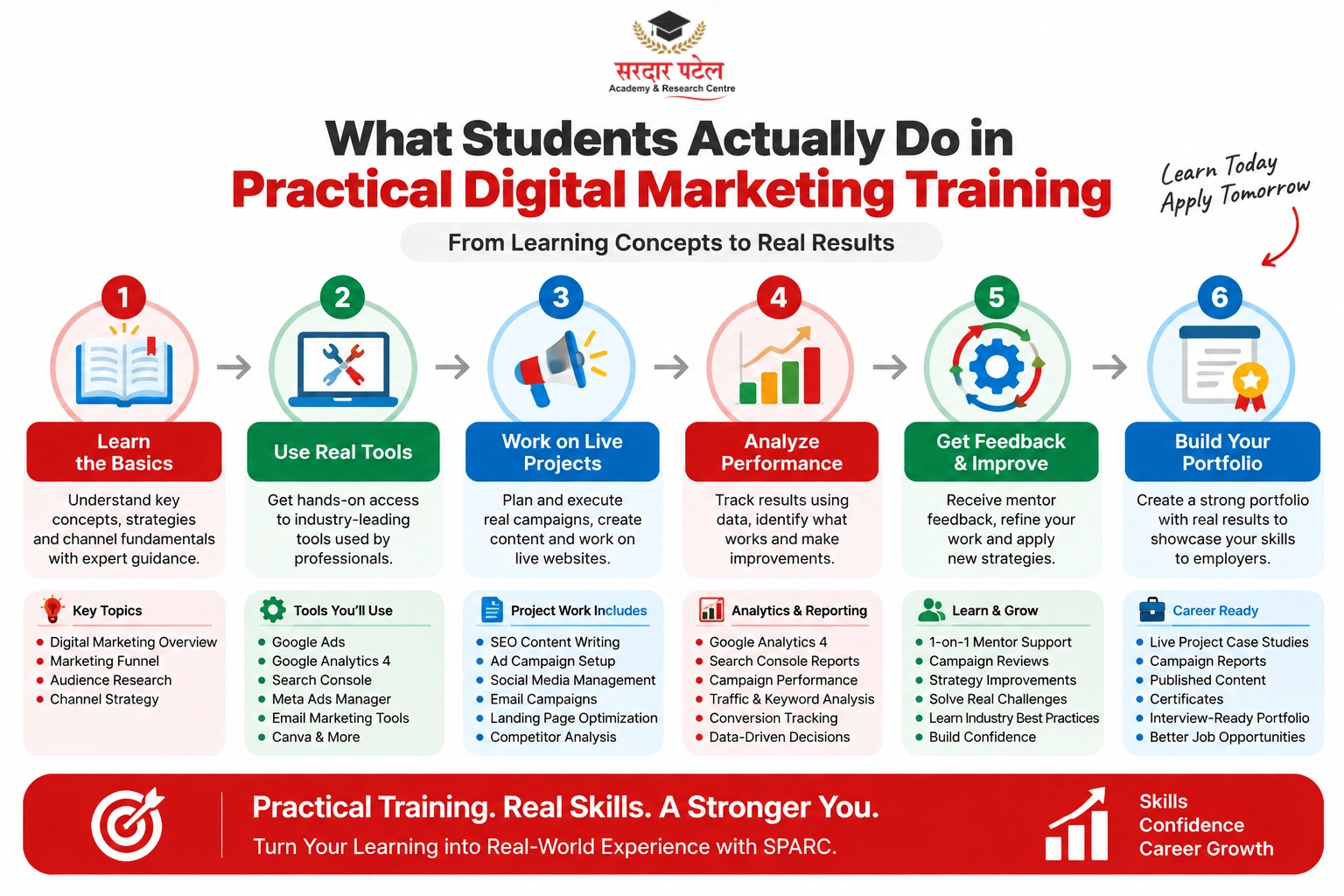
This is one of the most commonly cited reasons students give for preferring hands-on programs: they want to make their mistakes during training, when a mentor is available to guide them, not during their first week on the job.
4. It's Easier to Build a Portfolio from Practical Work
Recruiters increasingly ask to see real work — a live campaign report, a ranked blog post, an email sequence with open and click data. A student who has spent their course writing notes has nothing to show. A student who has spent their course executing real projects walks into interviews with proof.
Practical vs Theoretical Digital Marketing Institute: A Side-by-Side Comparison
|
Factor | Theory-Heavy Institute |
Practical-Focused Institute |
| Core teaching method |
Lectures, slides, textbook modules |
Live projects, real tools, guided execution |
| Tools used |
Screenshots or demo accounts |
Actual Google Ads, GA4, Search Console, ESPs |
| Assessment style |
Written tests, MCQs |
Campaign results, live blog rankings, project reviews |
| Job readiness |
Requires additional on-the-job training |
Closer to day-one job readiness |
| Portfolio at course end |
Notes and certificates only |
Real campaigns, published content, case studies |
| Adaptability to platform updates |
Slower — depends on updated material |
Faster — students learn on current platforms |
| Best suited for |
Purely academic interest |
Students, freshers, and professionals aiming for job roles |
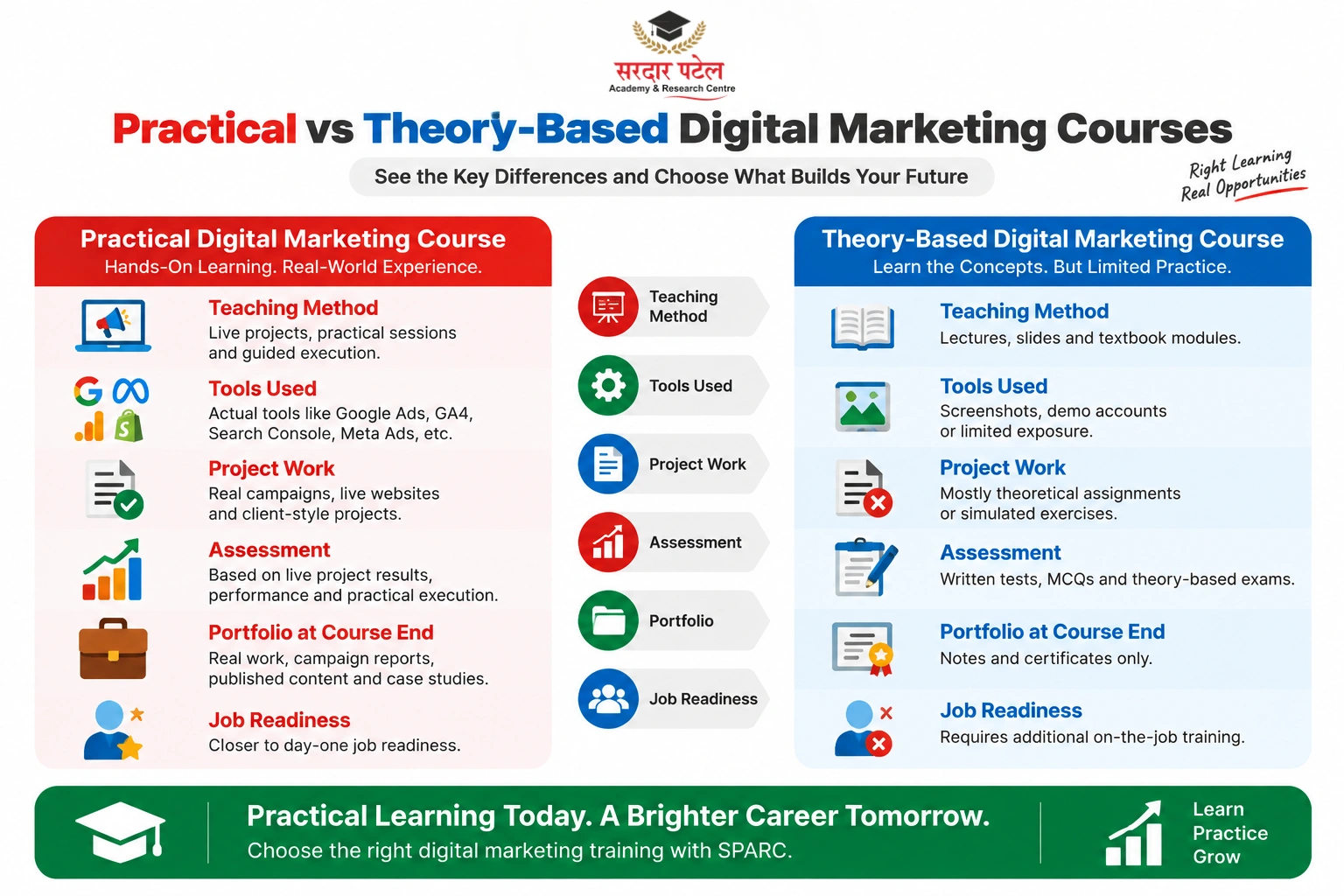
This comparison isn't meant to say theory has no place — a solid conceptual foundation matters. The difference is in the ratio. A practical vs theoretical digital marketing institute comparison usually comes down to how much class time is spent executing real work versus passively absorbing content.
Common Mistakes Students Make When Choosing a Course
- Assuming "live projects" mentioned in marketing material actually happen. Ask specifically how many hands-on projects are included and on what platforms.
- Ignoring who reviews the practical work. Practical training without feedback from an experienced mentor doesn't build real skill — it just builds unreviewed habits.
- Choosing based on syllabus length rather than syllabus depth. A longer list of "modules covered" doesn't mean deeper hands-on exposure.
- Not asking to see sample student work. A genuinely practical institute should be able to show real, published examples — blog posts that rank, ad accounts with reporting, and similar proof.
- Overlooking internship or placement support tied to practical work. Practical training that connects directly to internships (see how one SPARC student used live project work to land an SEO internship) tends to translate into real job outcomes faster.
How to Evaluate If a Course Is Genuinely Practical
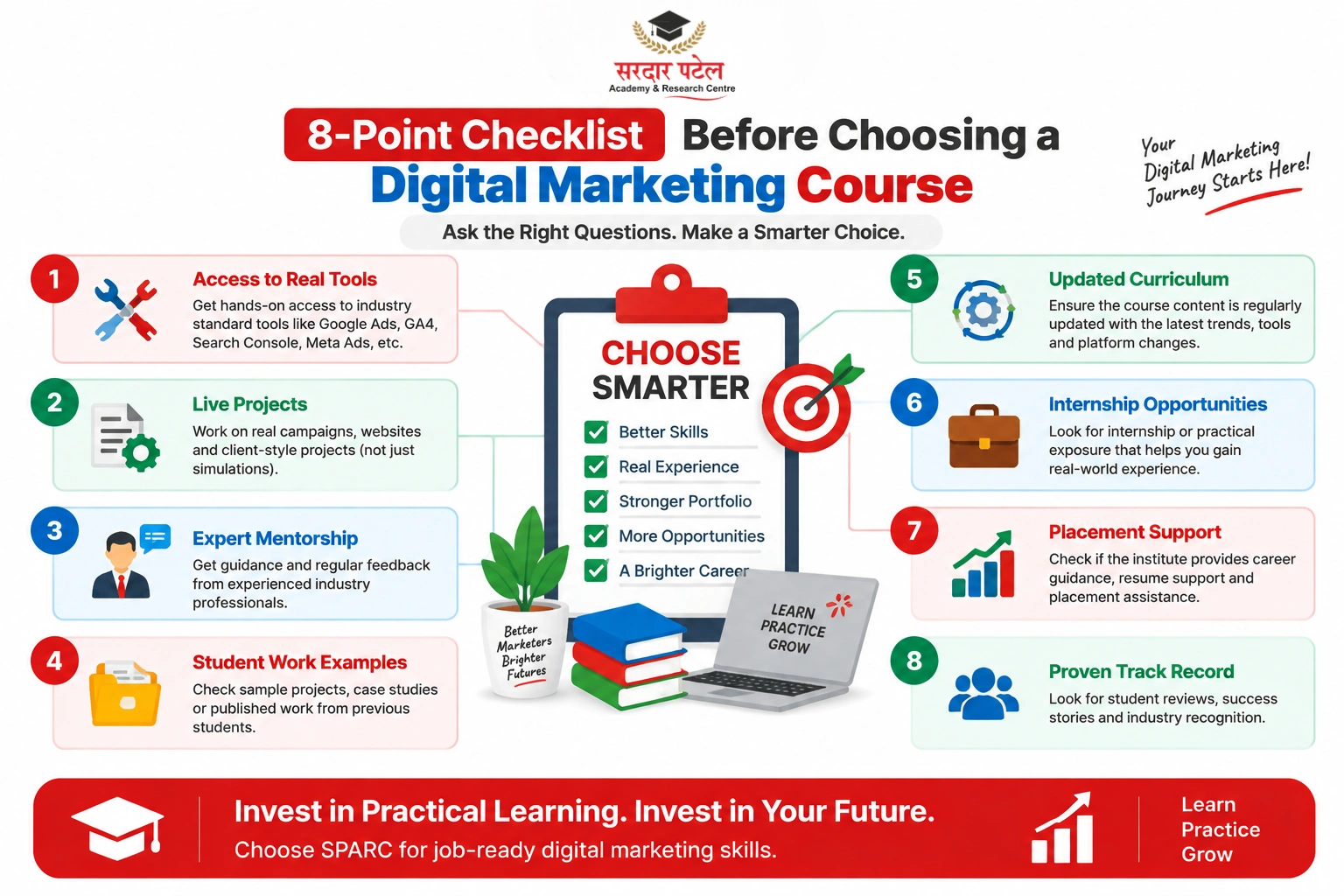
Before enrolling anywhere, it helps to ask a few direct questions:
- Will I get direct access to tools like Google Ads, Meta Ads Manager, and Google Analytics, or only demo/sandbox accounts?
- How many real, deployable projects will I complete — not just simulate?Who reviews my work, and how often?
- Can I see a real student's completed project or a case study of a student's website ranking results?
- Is there a structured path from practical training to an internship or job application?
If an institute can answer these clearly and show evidence, that's usually a strong signal of a genuinely practical program rather than one using the word "practical" as a marketing term.
Where Practical Learning Fits for Different Learners
- Beginners and students benefit most from practical learning because it builds intuition early — instead of memorizing what a "bounce rate" is, they see it change in real time as they adjust a landing page.
- Working professionals switching into digital marketing often need practical training even more urgently, since employers evaluating a career switcher want to see applied skill, not just course completion.
- Business owners learning digital marketing to manage their own marketing (or supervise a team) get more direct value from running an actual campaign for their own business than from theoretical modules that don't map to their situation.
Final Thoughts
The shift toward practical learning digital marketing isn't a passing trend — it reflects what the job market in Delhi NCR (and beyond) actually rewards: people who can execute, not just explain. Theory still has a role, but it works best as a foundation for real, hands-on work, not as a substitute for it.
If you're comparing institutes, don't just ask what topics are "covered" — ask what you'll actually build, run, and be able to show at the end of the course.
At Sardar Patel Academy & Research Centre (SPARC), our digital marketing course is structured around live projects and real tools rather than classroom theory alone. If you'd like to see how the practical modules are structured, explore the course page, or get in touch with our team with your specific questions.
FAQs
No. Understanding core concepts — like how search engines rank pages or how the marketing funnel works — helps make sense of why a practical technique works. The issue is relying on theory alone without applying it.
There's no fixed industry number, but most job-ready programs lean heavily toward hands-on work — often the majority of class time — with theory used to introduce concepts before applying them.
It's possible but harder. Most recruiters in Delhi NCR now ask for a portfolio, live project experience, or a practical test during interviews, so theory alone often isn't enough on its own.
At minimum, look for hands-on access to Google Ads, Google Analytics (GA4), Google Search Console, an email marketing platform, and social media scheduling/reporting tools.
Not necessarily. Course duration depends more on curriculum design than on the theory-to-practice ratio — a well-structured practical course can cover the same timeline as a theory-heavy one.
SEO in particular rewards practical learning because ranking results depend on real websites, real competition, and real algorithm behavior — something no simulated exercise can fully replicate.
Not inherently. Pricing depends on the institute, duration, and included tools rather than the teaching method itself — it's worth comparing what's included rather than assuming practical training costs more.
Many do, but assessments are often based on project outcomes — like a campaign's performance or a piece of ranked content — rather than purely written tests.