+91 9312966129
 sparc.enquiry01@gmail.com


Data Analytics After 12th: Can 12th Pass Students Learn Analytics?
Learn data analytics after 12th, explore the best courses, degree options, skills, career scope, and a step-by-step roadmap for beginners.
Table of Contents
- What Data Analytics Actually Means
- Can You Really Start Data Analytics After 12th?
- Does Your Stream Matter?
- Do You Need a Degree First?
- Which Degree Pairs Well with Analytics?
- What Analytics Courses After 12th Usually Teach
- A Step-by-Step Roadmap
- A Weekend Practice Project
- How to Choose the Right Course
- Where Sardar Patel Academy Fits In
- Common Mistakes to Avoid
- Career Scope: What You Can Realistically Expect
- Conclusion
Class 12 is over, and the usual advice kicks in: choose a degree, finish it, then think about skills. There is a quieter option that many students overlook. You can start learning data analytics after 12th, alongside college instead of waiting until after it.
So, can a Class 12 student really learn analytics? Yes. The field rewards people who handle numbers patiently and can explain what they find, and no board result or stream decides that. Data analytics after 12th is realistic as long as you begin with the basics and build in order. Below you will find what to learn, which degrees pair well, a practical roadmap and the mistakes that slow beginners down.
What Data Analytics Actually Means
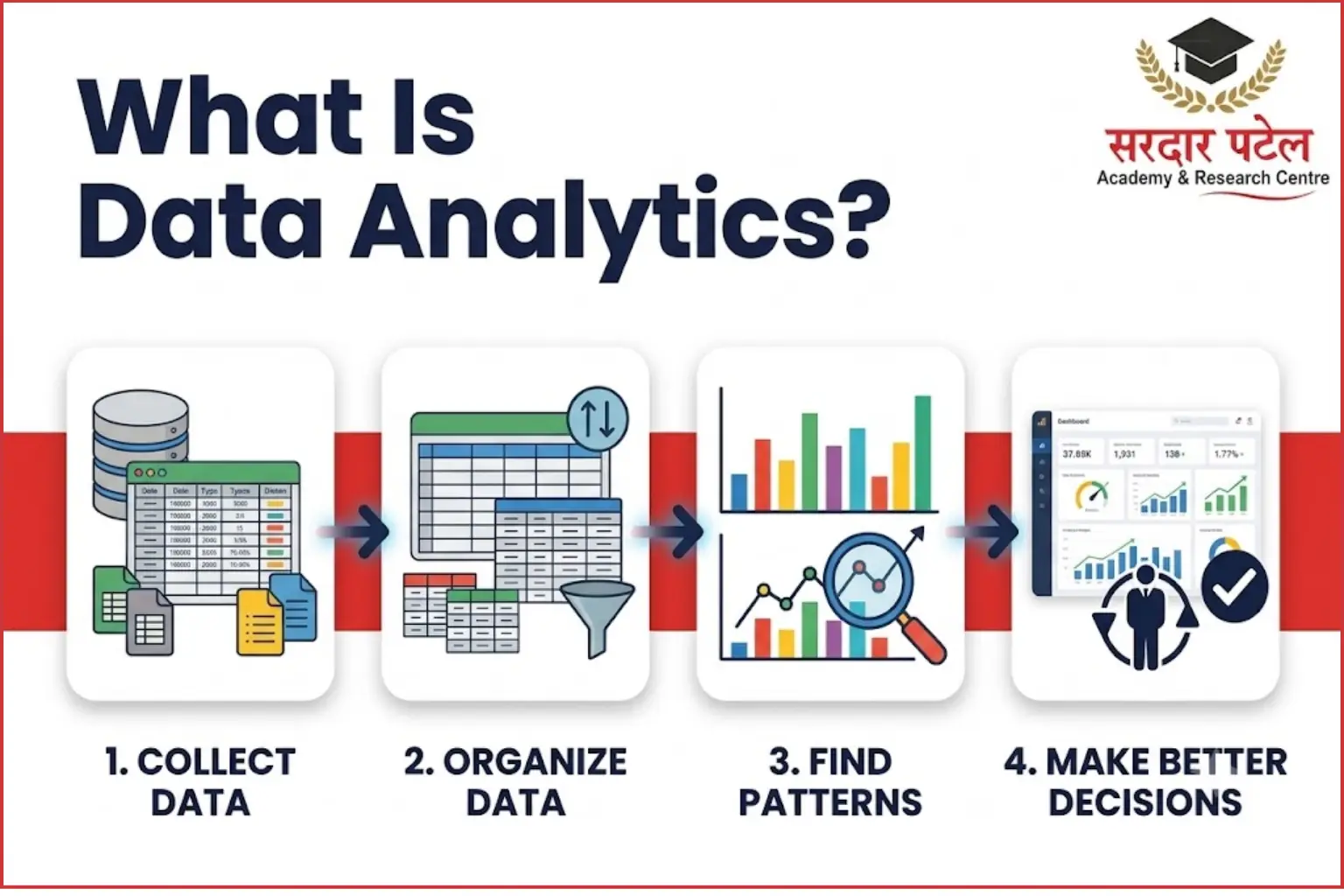
Data analytics is the practice of collecting data, organising it and studying it to answer a real question.
Picture a college canteen. The manager notices that samosas sell out by eleven while sandwiches pile up. She checks a week of sales, trims the sandwich order and makes more samosas. That is analytics in miniature: data, a pattern, a decision.
Businesses follow a similar approach, but across broader operations and larger datasets. They track which products sell, which ads bring customers and where users drop off. If you want the full background first, this beginner guide to what data analytics is walks through the basics.
Can You Really Start Data Analytics After 12th?
Yes, with realistic expectations. Starting data analytics after 12th will not make you a senior analyst at eighteen. What it gives you is time: time to get comfortable with messy data, to practise tools and to make beginner mistakes while the stakes are low.
Does Your Stream Matter?
Not really. Every stream has a natural strength, and none of them is a requirement. Commerce students already understand how sales and costs behave, which gives numbers context. Science students may feel at home with the maths. Anyone who writes clearly has an edge when it is time to explain findings. If you come from commerce, this guide on whether commerce students can learn data analytics goes into specifics.
The maths you need at the start is school-level: percentages, averages, ratios and reading graphs.
Do You Need a Degree First?
Not to start learning. Some beginner programmes say plainly that no degree or experience is required. Google's Data Analytics Professional Certificate is one of them, and it begins with spreadsheets, SQL and visualisation tools.
Jobs are a different matter, because some employers do ask for graduation. So treat skills and degree as a pair. That pairing is where data analytics after 12th pays off: you reach graduation with practice behind you instead of starting from zero.
Which Degree Pairs Well with Analytics?
You do not need a "data" degree, but your choice shapes your strengths.
| Degree route |
What it adds |
Check before applying |
| B.Com / BBA |
Business, accounting and sales context |
Whether electives include statistics or IT |
| BCA / BSc Computer Science |
Programming and database foundations |
Maths requirements in Class 12 |
| BSc Statistics / Mathematics |
A strong statistics base |
Entry eligibility at each college |
| BA Economics |
Experience with economic data and trends |
Whether it includes quantitative methods |
| BSc Data Science / Analytics |
Direct focus on the field |
Eligibility, which can include Class 12 maths |
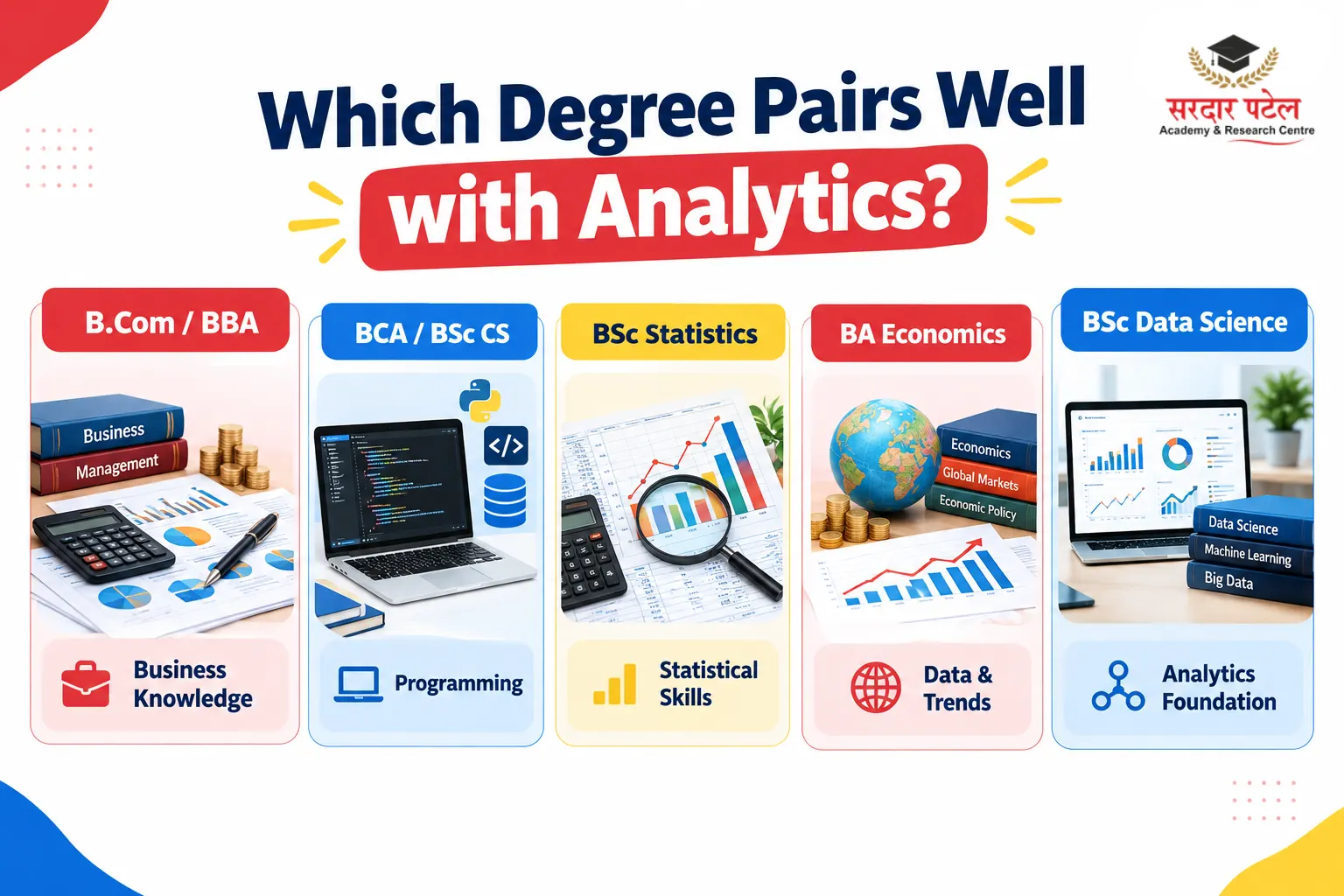
Eligibility differs from college to college, so confirm it on each admission page. Whichever route you take, data analytics after 12th can run alongside it.
What Analytics Courses After 12th Usually Teach
A well-built beginner programme works in layers. Most analytics courses after 12th cover some version of this:
- Spreadsheets (Excel or Google Sheets): sorting, filtering, formulas and pivot tables
- SQL: pulling the right rows from a database
- Statistics basics: mean, median, correlation and samplingPython: cleaning and analysing data with code
- Visualisation tools: Power BI or Tableau for dashboards
- Projects: a report or dashboard you can show others
Tools differ between institutes, so always read the syllabus. If you prefer guided, classroom-style learning in the capital, this data analytics course in Delhi shows what a structured programme can look like.
A Step-by-Step Roadmap
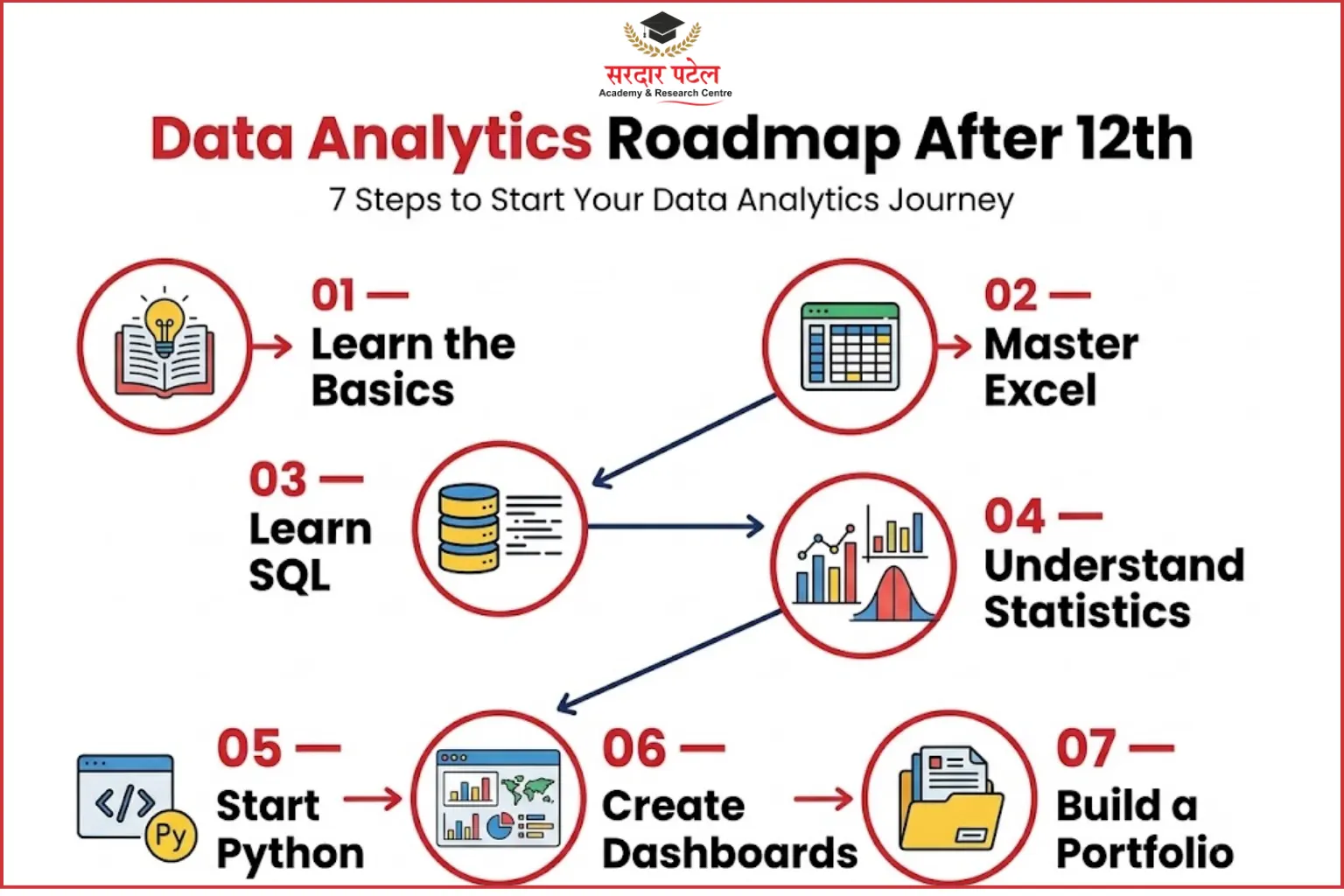
Most people find data analytics after 12th overwhelming only when they try everything at once. Take it in order:
- Learn the vocabulary. Understand terms like dataset, metric, dashboard and insight.
- Master spreadsheets. Spend real time here, because many analyst tasks still happen in them.
- Add SQL. Practise writing queries on sample databases.
- Study basic statistics. You need the logic, not advanced theory.
- Pick up Python and one visualisation tool. One of each is enough at first.
- Free option: IIT Roorkee's Data Analytics with Python course on NPTEL states it is. free to enrol. Check the current batch dates before planning around it
- Build two or three projects. Use public datasets on topics you enjoy.
- Show your work. Put the projects on a simple portfolio or LinkedIn profile.
A Weekend Practice Project
Not sure what a "project" looks like? Try this one.
- Pick a small dataset. Your own monthly spending works, and so does a public cricket dataset.
- Clean it. Fix spelling differences, remove duplicates, and fill obvious gaps.
- Ask one question. For example, which month cost the most and why?
- Show the answer. Make one chart and write a three-sentence summary a friend could understand.
Analysts use a similar process in their daily work by examining data, asking relevant questions, creating visual reports, and sharing meaningful insights.
How to Choose the Right Course
Not every programme suits a beginner. Before paying, check:
- Does the syllabus start from spreadsheets instead of assuming coding knowledge?
- Are there hands-on projects, not just video lectures?
- Are the trainers working or experienced professionals?
- Does the schedule fit around college or exams?
- What do past learners say? Reading data analytics institute reviews in Delhi helps you compare options fairly.
When comparing analytics courses after 12th, ask for a demo class. A course meant for data analytics after 12th should be comfortable with learners who have never written a line of code.
Where Sardar Patel Academy Fits In
If you are weighing data analytics after 12th in Delhi and want structured guidance, Sardar Patel Academy & Research Centre is one place to compare. Its Data Analytics Course with AI runs for eight months, moving from basic to advanced level, so Class 12 students can start from the basics. Here is what the course covers:
- Tools: Advanced Excel, SQL, Python, Power BI, Tableau, and AI tools
- Projects: 40+ projects, using practical assignments, live projects, and real-world datasets
- Eligibility: Class 12 students can join, and there is no strict educational requirement
- Location: Kingsway Camp, near GTB Nagar Metro Station (Gate No. 4), Delhi
Judge it the way you would judge any institute: read the syllabus, ask how projects are handled, and check whether batch timings suit your college schedule.
Common Mistakes to Avoid
- Jumping to machine learning. Without spreadsheets, SQL and statistics, advanced topics will not stick.
- Collecting certificates without projects. A finished project shows more than another certificate does.
- Skipping statistics. Tools produce numbers; statistics helps you judge whether to trust them.
- Expecting an instant job. No course can promise one.
- Ignoring your studies. Treat data analytics after 12th as a skill that grows beside your degree.
Career Scope: What You Can Realistically Expect
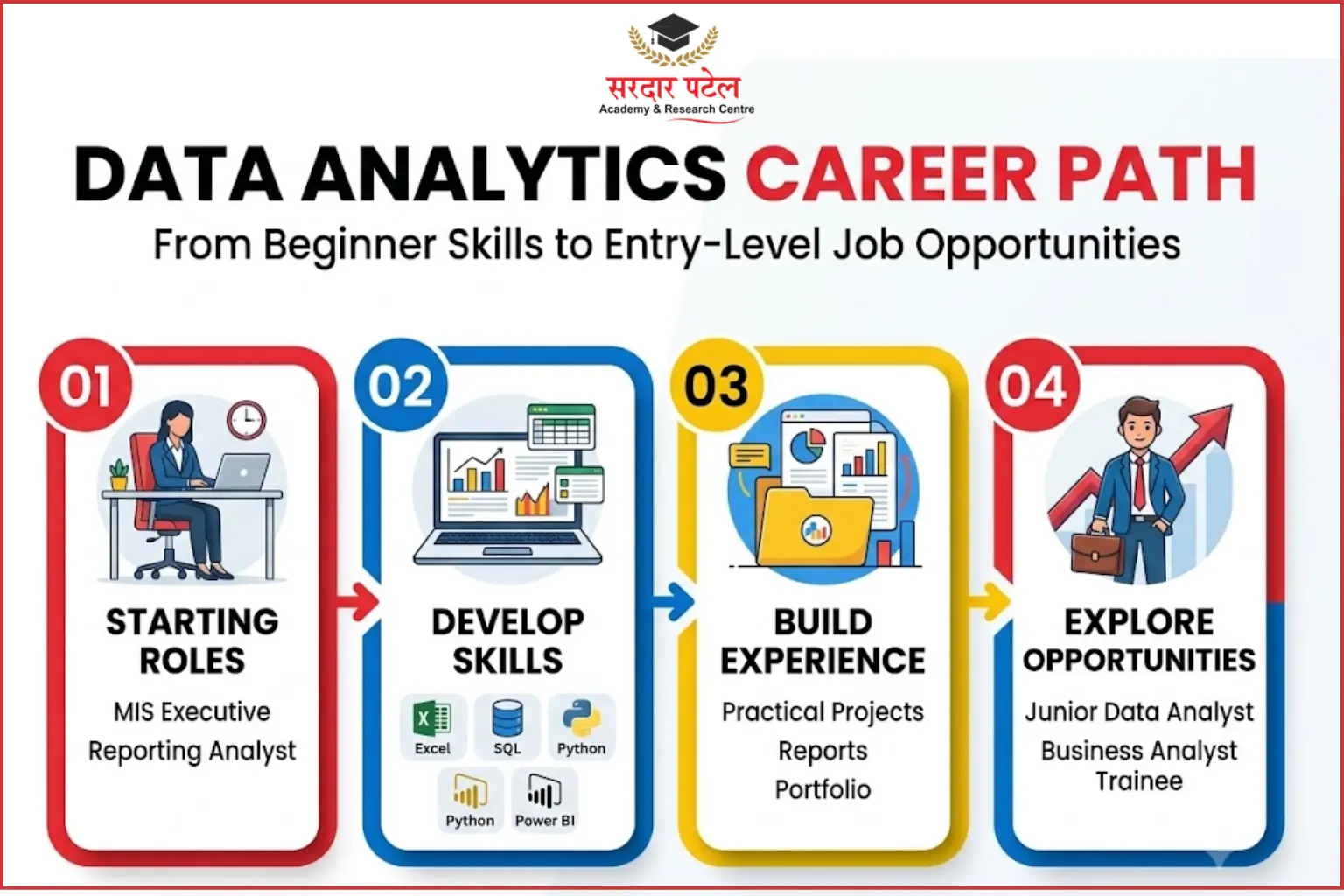
Analytics skills are used in marketing, finance, operations, e-commerce and many other fields. Entry-level roles can include MIS executive, reporting analyst, junior data analyst and business analyst trainee, though titles and requirements vary by employer.
The real benefit of starting early is time. By graduation you could have a portfolio and a few years of practice instead of a blank résumé. Starting data analytics after 12th gives you room to experiment and refine your skills before a recruiter asks for results.
Conclusion
Class 12 gives you a rare stretch of time: no job pressure yet, and room to try something new. Spend part of it on spreadsheets, SQL, and one small project, and by graduation you will have something concrete to show. That is the real case for data analytics after 12th.
If you would like guided practice, explore Sardar Patel Academy's data analytics course and see whether it fits your plan. You can also call +91 93129 66129 or +91 93129 77129.
FAQs
Yes. Beginner programmes start with spreadsheets and basic maths, so a Class 12 student can follow along with regular practice.
Only school-level maths at the start. Statistics is introduced gradually, and you pick it up as you go.
No stream is required. Science, commerce, and arts students can all begin, and each brings a different strength.
It depends on your pace and the course. One well-known beginner certificate estimates about six months at ten hours a week, while Sardar Patel Academy's Data Analytics Course with AI runs for eight months. Other classroom courses can be shorter or longer, so check the schedule.
No. Spreadsheets and SQL usually come first, and Python is typically introduced afterwards.
Choose whichever you will actually finish. Online learning is flexible, while a classroom adds structure and someone to ask. Many learners start free online and move to a guided course later.
Entry-level roles such as MIS executive or junior analyst are common starting points, but requirements differ by employer, and nobody can promise a timeline. Skills, projects, and often a degree all count.