+91 9312966129
 sparc.enquiry01@gmail.com



Future of SEO Jobs in India
Discover the future of SEO jobs in India, explore new career paths, learn essential skills and understand how AI may reshape SEO opportunities by 2030.

Predictions about the end of SEO keep circulating as AI continues to transform how people discover information online. Chatbots will answer everything, the argument goes, so nobody will need to rank a web page again. Is SEO really dying? Yet job boards keep listing SEO openings, agencies keep hiring analysts, and Google keeps publishing guidance on how sites get found. So which story holds up?
This report looks at the future of SEO jobs in India using public data from the World Economic Forum, IAMAI, Naukri and Google. It separates what the evidence supports from what is only a reasoned expectation, and it ends with a practical route into search careers. The short answer for students, career switchers and working marketers: SEO is changing shape, not disappearing.
Why the SEO Job Market in India Looks Strong
Jobs follow audiences and budgets, and both are still moving online in India.
A Search Audience That Is Still Expanding
The IAMAI–Kantar Internet in India Report 2025, as reported by Tele.net, puts active internet users at 958 million in 2025, up about 8% from the previous year. Rural India accounts for around 548 million of them and is growing nearly four times faster than urban India. About 588 million people (61% of users) watch short-form video. The previous edition, the 2024 report, found that 98% of its 886 million users accessed content in Indic languages.
Each new user searches, compares prices and reads reviews, often in Hindi, Tamil, Marathi or Bengali. A business that wants those customers needs someone who understands how people phrase questions and how pages earn visibility. About 38% of the population, roughly 579 million people, is still outside the active user base, so the audience has not peaked.
What Employers Are Signalling
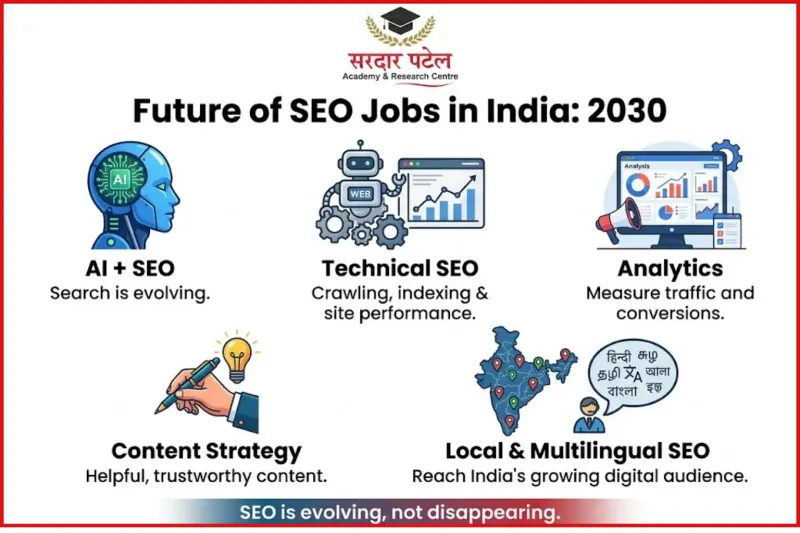
The WEF Future of Jobs Report 2025 found that Indian companies expect to adopt skills-based hiring more readily than the global average: 30% plan to drop degree requirements, against 19% worldwide. For a fresher without a prestigious degree, a portfolio of pages that rank can carry more weight than a certificate.
Naukri JobSpeak reported white-collar hiring up 2% year on year in September 2026, with the index at 3,053 against 3,002 a year earlier, as Staffing Industry Analysts reported. That followed a 14% jump in August, which Naukri's CEO said was boosted by festive-season timing. His summary of September: a steady but more selective market, where AI/ML roles rose 20% while hiring for 0–3 years' experience grew only 1%. For freshers, that is a useful reality check. These figures cover all white-collar roles, not SEO alone, and Naukri's lists of companies hiring for digital marketing do not separate SEO from paid ads or social media. Read honestly, the data shows wide demand for visibility skills without providing a specific number of SEO jobs.
How AI Search Is Changing SEO Work
What Google Has Actually Said
Google Search Central's page on AI features and your website makes three points. First, specific optimisation is not required for AI Overviews or AI Mode, and the usual SEO fundamentals remain worthwhile. For a webpage to be considered a reference in Google's AI search results, it generally needs to be indexed and qualify to appear in regular search listings. Third, both features may run several related searches across subtopics, a process Google calls query fan-out.
In plain terms, AI answers are assembled from web pages, and someone still has to make those pages crawlable, accurate and useful. Traffic from these features also appears in Search Console's standard Web report, so measurement skills stay relevant.
What Are GEO and AEO?
You will see two new acronyms. AEO (Answer Engine Optimisation) means structuring content so search engines and assistants can pull a direct answer from it. GEO (Generative Engine Optimisation) means improving the chances that AI-generated responses cite your brand or page. Both are extensions of classic SEO, relying on clear structure, trustworthy content and technical accessibility, not a separate discipline with separate rules.
Tasks That Shrink and Tasks That Grow
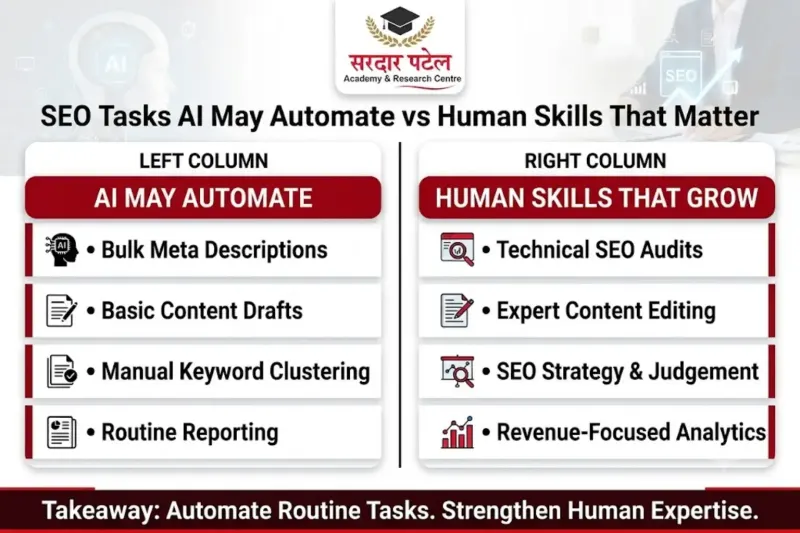
The table below is our own assessment, not a published forecast.
| Work area |
Likely direction |
Reason |
| Bulk meta descriptions and basic copy drafts |
Shrinks |
AI tools draft these quickly |
| Manual keyword list building |
Shrinks |
Clustering is increasingly automated |
| Technical audits, crawling and indexing fixes |
Grows |
AI answers can only cite pages that search engines can reach |
| Topic strategy backed by real expertise |
Grows |
Generic content is easy to produce, so original insight stands out |
| Reporting that links traffic to revenue |
Grows |
Businesses want proof, not rankings alone |
| Regional-language and local SEO |
Grows |
Usage in Indic languages is already the norm |
Picture a shoe retailer in Jaipur. An AI summary may answer a question about running shoes, but its facts come from product pages, reviews and business listings. The retailer who keeps those assets current is the one who gets cited, and the person maintaining them is doing SEO.
SEO Roles Likely to Matter by 2030
Job titles vary between employers, so treat this as a guide to types of work rather than a fixed list.
| Role |
Core work |
Skills worth building |
| SEO Executive or Analyst |
Audits, on-page fixes, reporting |
Keyword research, Search Console, GA4 basics |
| Technical SEO Specialist |
Crawling, indexing, site speed, structured data |
HTML, Core Web Vitals, log file reading |
| Content and SEO Strategist |
Topic planning, briefs, quality control |
Editing, subject knowledge, SERP analysis |
| Local and Multilingual SEO Specialist |
Business profiles, regional queries |
Language fluency, citation management |
| E-commerce SEO Manager |
Category structure, product pages |
Merchandising sense, analytics |
| AI Search Analyst (emerging) |
Tracking brand mentions in AI answers |
Research design, testing, data handling |
The last row is the least settled. Companies are still working out how to measure visibility inside AI answers, so expect the title and duties to shift. Live listings already show the direction: a Gurugram Team Lead, GEO (SEO & AI Search) role at Cvent, listed on Naukri in July 2026, asks for knowledge of how LLMs retrieve and cite content. A Bengaluru SEO, AEO and GEO specialist role at Grant Thornton INDUS covers AI Overviews and LLMs. Titles differ (GEO, AEO, AI search), but both still list classic skills such as technical SEO, Search Console and GA4. These listings come from job aggregators, so check the original posting before relying on any detail.
A Typical Career Ladder
Most people start as an SEO Executive or Analyst, move to Senior Executive or Specialist within a few years, then to SEO Manager, and eventually to Head of SEO or Head of Organic Growth. A technical or content specialisation often opens a faster route than staying a generalist.
The SEO Career Outlook: Skills That Hold Their Value
The outlook depends on your skill mix. Tool operation alone is the easiest part to automate. Judgement is harder, so ask which of your tasks a tool cannot do.
Technical Foundations
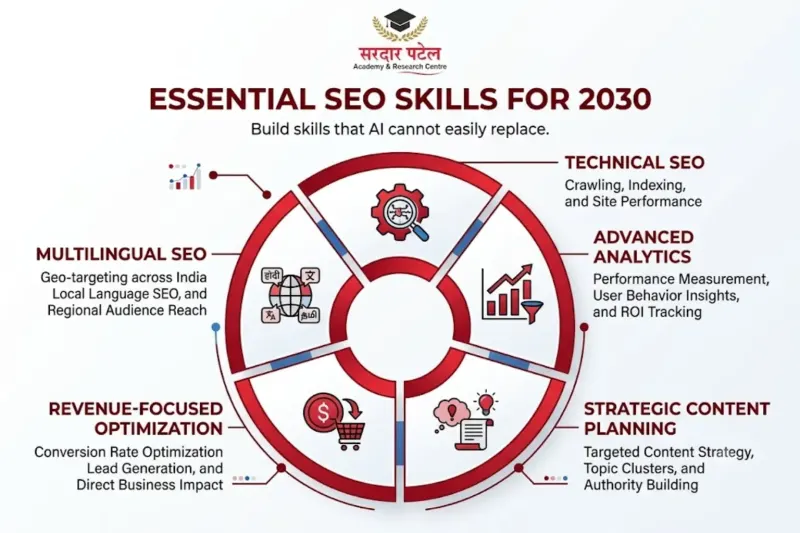
Understanding how a crawler finds a page, how it decides what to index, and why a slow template hurts visibility will stay useful no matter what the interface looks like. Beginners can build a strong foundation by learning technical SEO basics explained through crawling, indexing, site structure and page performance before moving on to advanced website audits.
Data and Measurement
Search Console and GA4 show what people searched for, which pages earned clicks and where visitors left. A professional who can explain those patterns to a business owner is far more valuable than one who only exports reports.
Content Judgement
Google's quality guidance emphasises experience, expertise and trust. That favours people who can brief a subject expert, verify claims and cut padding. Editing is an SEO skill.
Language and Platform Reach
People now look things up on video and social platforms as well as in a search box, so follow social media trends alongside algorithm updates. Regional-language fluency is a real advantage, given how many users browse in Indic languages. Search visibility now extends beyond traditional search engines, making it useful for SEO professionals to understand social media trends in 2026 and how audiences discover brands across different platforms.
Domain Knowledge
SEO for a bank, an insurance comparison site or accounting software is easier to do well when you understand the subject. Specialist knowledge brings credibility that a generalist may struggle to match.
The Tool Stack to Know
Start with free tools: Google Search Console, GA4 and Google Keyword Planner. Then learn a crawler such as Screaming Frog and a suite such as Ahrefs or Semrush. Tools change; the principles behind them do not.
SEO Job Demand Through 2030
No credible public source offers a precise vacancy forecast. What follows is a reasoned outlook built from the evidence above, so read it as direction, not prediction.
| Segment |
Why demand may persist |
Caution |
| Agencies |
Many small firms outsource search work |
Pressure on pricing as tools improve |
| In-house brand teams |
Organic traffic lowers paid-ad dependence |
Roles may merge with content or analytics |
| E-commerce and marketplaces |
Large catalogues need structure and upkeep |
Heavy competition for the same keywords |
| Banking, finance and insurance |
Trust-sensitive content needs expert handling |
Compliance reviews slow publishing |
| Education and healthcare |
Local and informational searches are constant |
Accuracy standards are high |
| Freelance and small business consulting |
Local firms need basic visibility |
Income can be uneven |
By city, Naukri's September 2026 data (as reported by The Hans India) shows Hyderabad leading metro hiring growth at 9%, Pune stable, and Delhi-NCR and Mumbai each down 6% year on year, with emerging cities largely flat. That is one month of all white-collar hiring, not SEO alone, so treat it as a hint. GEO and AI-search listings we found were based in Gurugram, Bengaluru and Pune. For a real picture, count live SEO listings in your own city on Naukri or LinkedIn and note the date.
Overall, this looks less like one big job market and more like several smaller ones, each rewarding a different blend of skills.
SEO Salary in India: How to Check Real Numbers
"SEO salary in India" is one of the most searched questions on this topic, but published pay figures differ widely between sources, so this report does not quote a single band. Pay varies with city, employer type, specialisation and whether you work in-house, at an agency or freelance. Technical and analytics-heavy roles generally command more than entry-level execution work.
To get a reliable number, search your target role on Naukri, LinkedIn and Indeed and compare at least 20 listings from your city. The table below shows how far public figures spread. These are third-party estimates and one posted listing, not an official benchmark, and the lower rows come from salary blogs rather than payroll data.
| Source |
Figure |
What it covers |
| Fueler, 23 Aug 2026 |
₹2.5–5 lakh a year |
Entry-level digital marketing roles, including SEO Executive |
| Hyring salary model 2026 |
₹3.9 lakh a year (median) |
SEO Executive, modelled estimate |
| Networkers Home 2026 |
₹3–8 lakh a year; ₹8–14 lakh at 5+ years |
SEO Executive, then senior or technical SEO (a training provider's blog) |
| Kochar Infotech listing, Sep 2026 |
₹8–10 lakh a year |
AEO/SEO/GEO Specialist, Gurugram, 3–5 years |
SEO vs PPC vs Social Media
| - |
SEO |
PPC (paid ads) |
Social media |
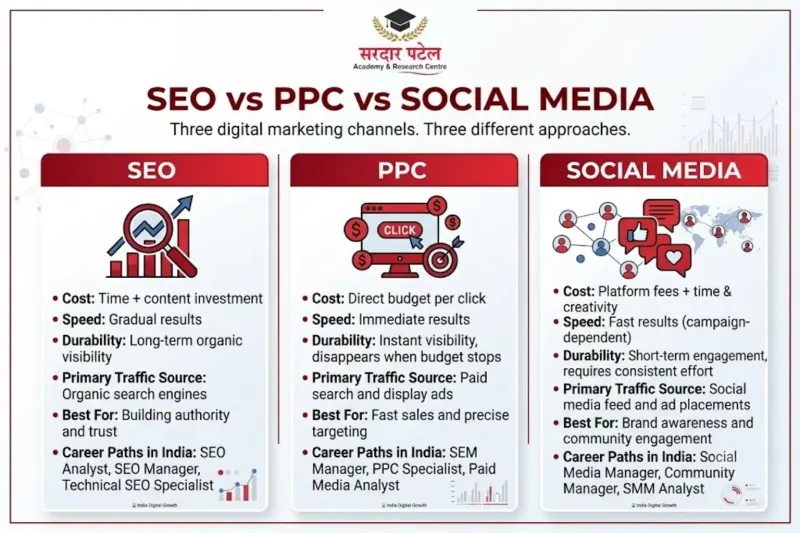
| Cost model |
Time and content investment |
Pay per click or impression |
Content plus optional ads |
| Speed of results |
Slower, compounding |
Immediate |
Varies |
| Durability |
Lasts after effort stops |
Stops when spend stops |
Depends on consistency |
| Core skills |
Technical, content, analytics |
Bidding, copy, analytics |
Creative, community, trends |
Many marketing teams combine all three, so learning the basics of each makes you more employable.
Risks and Common Mistakes
Optimism should not become complacency.
- Learning tools instead of principles. Software changes every year, while crawling, relevance and user intent change slowly.
- Chasing shortcuts. Mass-produced pages and low-quality link schemes are exactly what automation and spam filters target.
- Ignoring measurement. If you cannot show what changed after your work, an employer will struggle to justify your role.
- Having no portfolio. Hiring managers want evidence of results, even from a personal project.
- Expecting a fixed salary band. Check live listings for your city and specialisation.
Entry-level competition is also real. The market is promising, but it rewards people who can show practical ability rather than those who only list keywords on a resume.
A Step-by-Step Path Into SEO
- Test your fit. Before choosing SEO as a career, consider whether digital marketing is hard for beginners and how much time you can dedicate to learning its fundamentals and practising new skills.
- Learn the fundamentals. Study crawling, indexing and ranking using Google's own documentation as your main text.
- Build a practice site. Choose a niche you know, publish around ten useful pages and watch them in the Search Console.
- Pick one specialisation. Technical SEO, local SEO, content strategy or e-commerce each lead to different roles.
- Document your results. Write a short case study covering the starting point, your changes and what moved.
- Apply and keep learning. Search updates arrive constantly, so treat learning as part of the job.
A 6 to 12 Month Roadmap
- Months 1 to 2: fundamentals, Search Console and GA4 basics.
- Months 3 to 5: build and publish your practice site; learn a crawler and one keyword tool.
- Months 6 to 8: choose a specialisation, run audits on small local sites, collect your first case study.
- Months 9 to 12: apply for roles or freelance work, with two or three documented results.
Want a guided route? Start the SEO Career Path with Sardar Patel Academy & Research Centre and shorten the trial-and-error phase.
Conclusion
The evidence points one way. India's online audience is still growing, employers want digital and analytical skills, and Google continues to say sound SEO practice matters for its newest search features. SEO work will not look like it did five years ago, but it is far from empty. Routine tasks shrink; technical, analytical, local and strategic work grows.
If you are ready to act, start small: learn the fundamentals, build something real and measure it. When you want a clear structure to follow, start an SEO Career Path and turn this research into a plan.
FAQs
It can be, particularly for people who combine technical, analytical and writing skills. Demand for online visibility is broad, though public data does not give a clean SEO-only vacancy count. Success depends on building demonstrable results.
AI will automate routine tasks such as drafting basic copy and clustering keywords. Google says SEO fundamentals still apply to its AI features, so roles involving technical quality, strategy and measurement should remain relevant.
Freshers face competition, but skills-based hiring is more common among Indian employers than the global average, according to WEF data. A visible portfolio and one clear specialisation improve your chances considerably.
Technical SEO, analytics, content judgement, regional-language reach and comfort with AI tools are the strongest candidates. Domain knowledge in a field such as finance or healthcare adds further separation.
Not necessarily. Many employers weigh proven ability heavily, and WEF data shows a notable share of Indian companies planning to relax degree requirements. A degree can still help in some corporate settings.