+91 9312966129
 sparc.enquiry01@gmail.com


Future of Business Intelligence Careers
Explore the business intelligence career future, BI jobs in India, key skills, industry trends, and a practical roadmap to build a successful BI career.

Table of Contents
- What a BI Career Involves Today
- A day in the life of a retail BI analyst
- Is Business Intelligence a Good Career Going Forward?
- Why demand does not disappear
- What is being automated
- Trends Shaping the Business Intelligence Career Future
- The Future of BI Jobs in India
- What this means for Delhi NCR
- Skills That Keep You Employable: Business Intelligence Career Future
- Step-by-Step Roadmap to Build a BI Career
- Common Mistakes to Avoid
- Where a BI Career Can Lead
- Conclusion
Ask ten analytics professionals whether BI is still a safe career, and you will hear ten different answers. Some say AI will swallow dashboard work whole. Others point out that every company still runs on reports, and nobody trusts a number without checking it first.
Both camps have a point. This guide looks at the business intelligence career future in practical terms: what is changing inside the job, which skills are gaining value, how the future of BI jobs in India is likely to unfold, and what you can start doing this month. There are no inflated salary promises here, only a clear reading of the direction. For a broader perspective on analytics career opportunities, see whether data analytics remains a strong career path in 2026.
What a BI Career Involves Today
Business intelligence is the work of turning scattered company data into information people can act on. A BI professional pulls data from sales systems, CRMs, finance tools, and spreadsheets, cleans and structures it, and presents it through dashboards and reports that managers use to decide things. For a neutral definition, the overview of business intelligence on Wikipedia covers the basics.
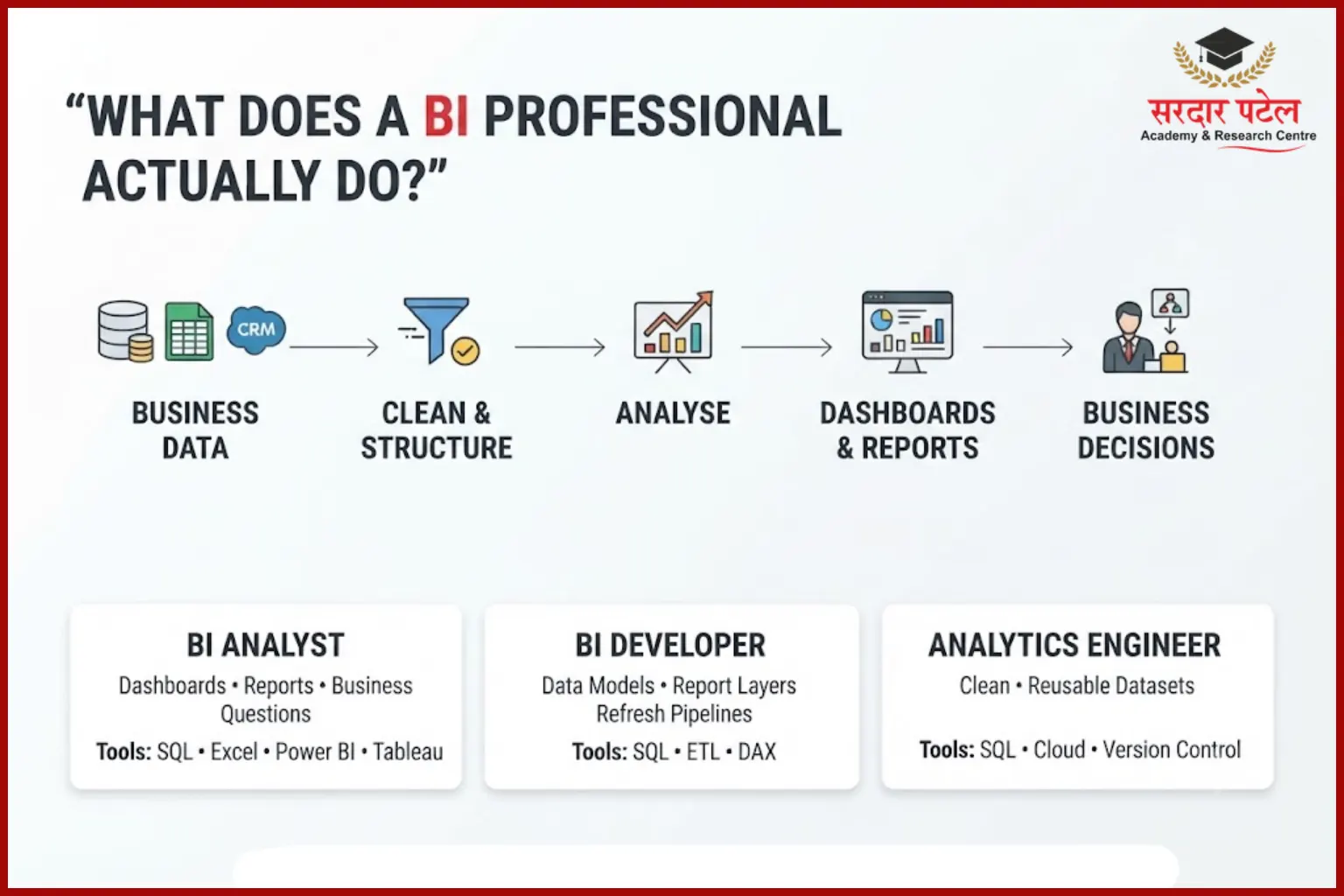
Job titles change from company to company. Here is how the common roles differ:
| Role |
Main focus |
Typical tools |
| BI Analyst |
Dashboards, reports, answering business questions |
SQL, Excel, Power BI, Tableau |
| BI Developer |
Data models, report layers, refresh pipelines |
SQL, ETL tools, DAX |
| Analytics Engineer |
Clean, reusable datasets for other teams |
SQL, cloud warehouses, version control |
In smaller teams, one person often covers two or three of these roles.
A day in the life of a retail BI analyst
Picture an analyst at a retail chain. A regional manager asks why sales dipped in one city last week. The analyst checks that the data refreshed properly, splits sales by store and category, and spots stock-outs in one category. By afternoon, a short note with one chart reaches the manager, suggesting a review of replenishment. The real work was checking data, finding the cause, and recommending an action. The chart was the smallest part.
Is Business Intelligence a Good Career Going Forward?
Yes, with one condition: you need to grow beyond chart-making. That is the honest summary of the business intelligence career future.
Why demand does not disappear
Companies will always need to track revenue, costs, stock, customers and delivery performance. Someone has to make sure those numbers match across departments. That need is tied to how businesses operate, not to one software product, so the business intelligence career future rests on firmer ground than any single tool trend.
What is being automated
Routine work is getting easier to hand off. Drag-and-drop dashboards, basic queries and first-draft reports can be produced faster than before, and AI assistants inside BI tools can suggest visuals or write simple formulas. If your only value is "I can build a bar chart in Power BI", you will feel pressure.
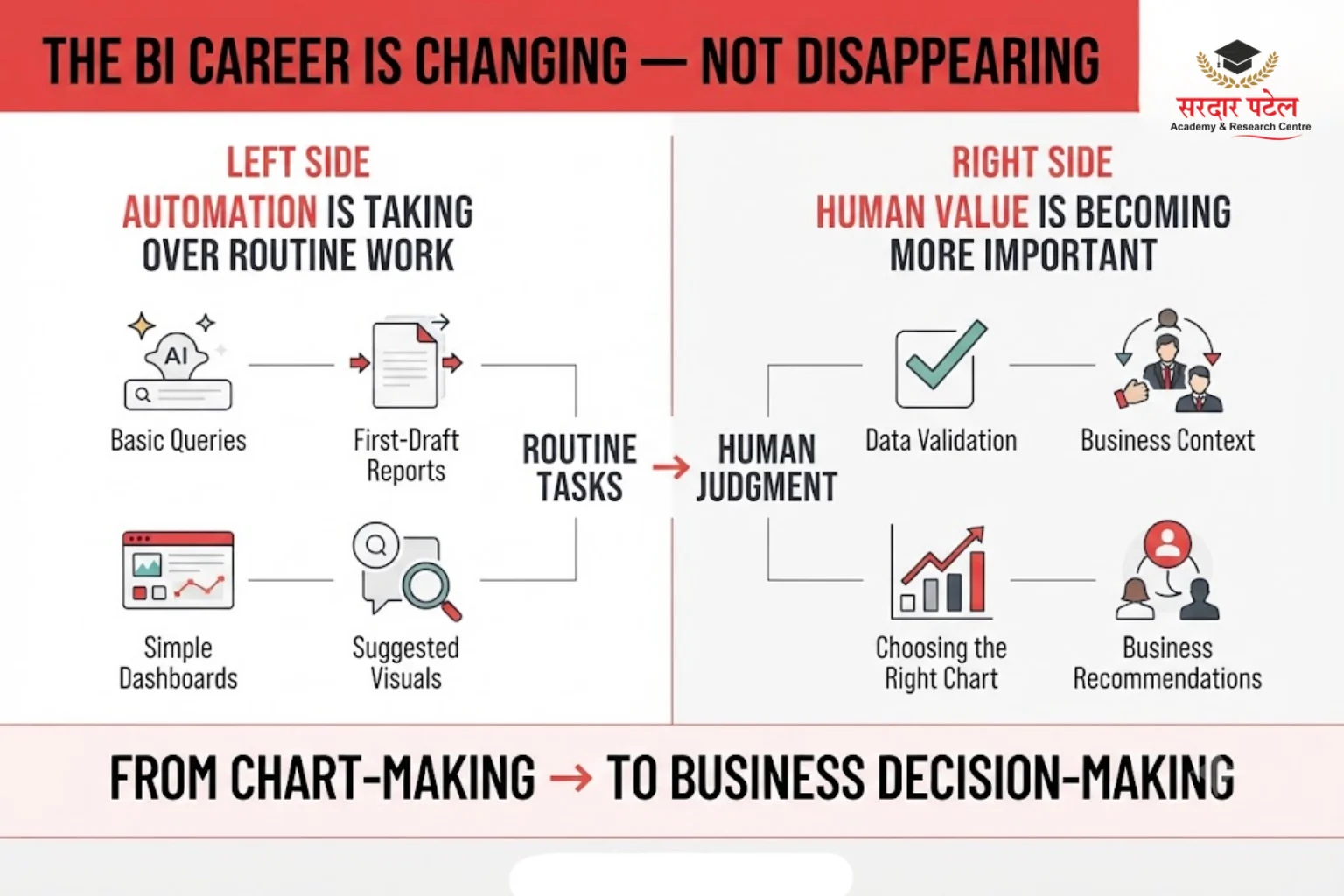 The business intelligence career future belongs to people who can decide which chart matters, check whether the data behind it is right, and explain what the business should do next. This shift is also part of the wider impact AI is having on analytics work and the way professionals use data tools.
Trends Shaping the Business Intelligence Career Future
- Self-service analytics. Business teams increasingly build their own simple reports. BI professionals shift toward creating trusted datasets and templates that others can use safely.
- AI-assisted analysis. Natural-language queries and automated summaries are becoming standard features. They speed up the first draft, but a human still has to validate results and catch answers that sound plausible but are wrong.
- Cloud data platforms. More organisations store data in cloud warehouses. Knowing how data is stored, modelled and refreshed is becoming as valuable as knowing how to visualise it.
- Data governance. Terms like "active customer" or "net revenue" must mean the same thing everywhere. People who maintain consistent KPI definitions become hard to replace.
Taken together, these trends push the business intelligence career future toward judgment and away from button-clicking. As BI workflows continue to evolve, knowing which analytics tools are useful for different tasks can help professionals build a more practical skill set.
The Future of BI Jobs in India
India's businesses give BI professionals plenty to work with. Banking, retail, e-commerce, healthcare, logistics and manufacturing all generate large volumes of operational data, and many organisations still struggle to use it well. That gap is where BI work sits.
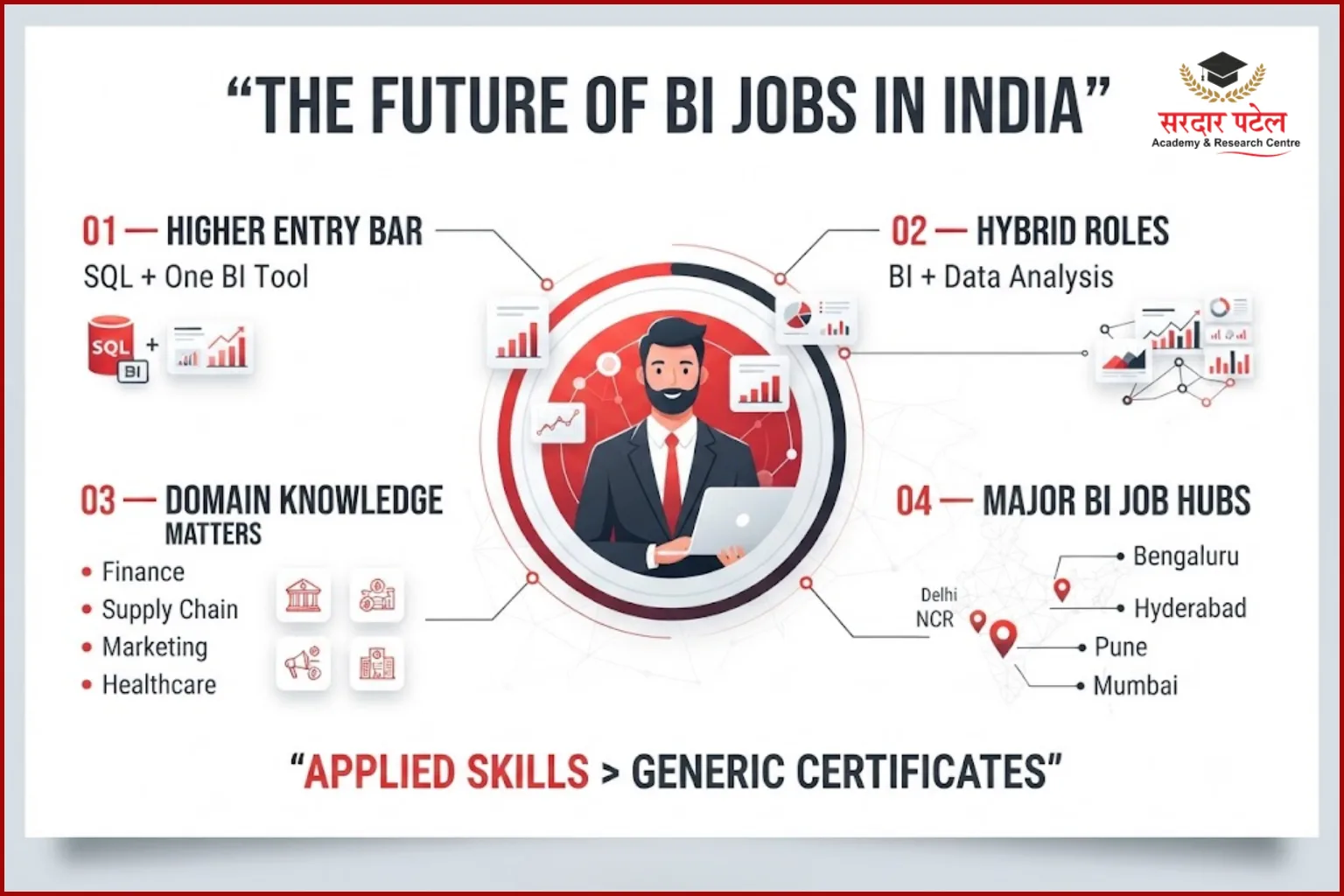
Here is what the future of BI jobs in India looks like, based on how the field is moving:
- Higher entry bar. SQL plus one BI tool is becoming the baseline, not a bonus.
- Hybrid roles. Data analyst jobs increasingly include BI duties, and BI roles often include light analysis.Domain knowledge matters.
- Understanding finance, supply chain, marketing or healthcare metrics makes you more useful than tool skills alone.
- Metro hubs stay important. Delhi NCR, Bengaluru, Hyderabad, Pune and Mumbai are where many analytics teams are based.
None of this makes the path easy. Competition for generic entry-level roles is real, and the business intelligence career future in India favours candidates who can show applied work, not just certificates.
What this means for Delhi NCR
If you are in Delhi, Noida or Gurugram, you are close to a wide mix of employers: e-commerce, banking and fintech, consulting, and corporate reporting teams. That variety helps the business intelligence career future look more concrete, because you can pick a sector and learn its metrics instead of staying generic. For a closer look at local hiring, see this piece on Delhi companies hiring more data analysts.
Skills That Keep You Employable: Business Intelligence Career Future
These are the skills that hold their value as the business intelligence career future unfolds. For a broader look at the skills and career scope across analytics roles, explore this guide to building a stronger analytics career foundation.
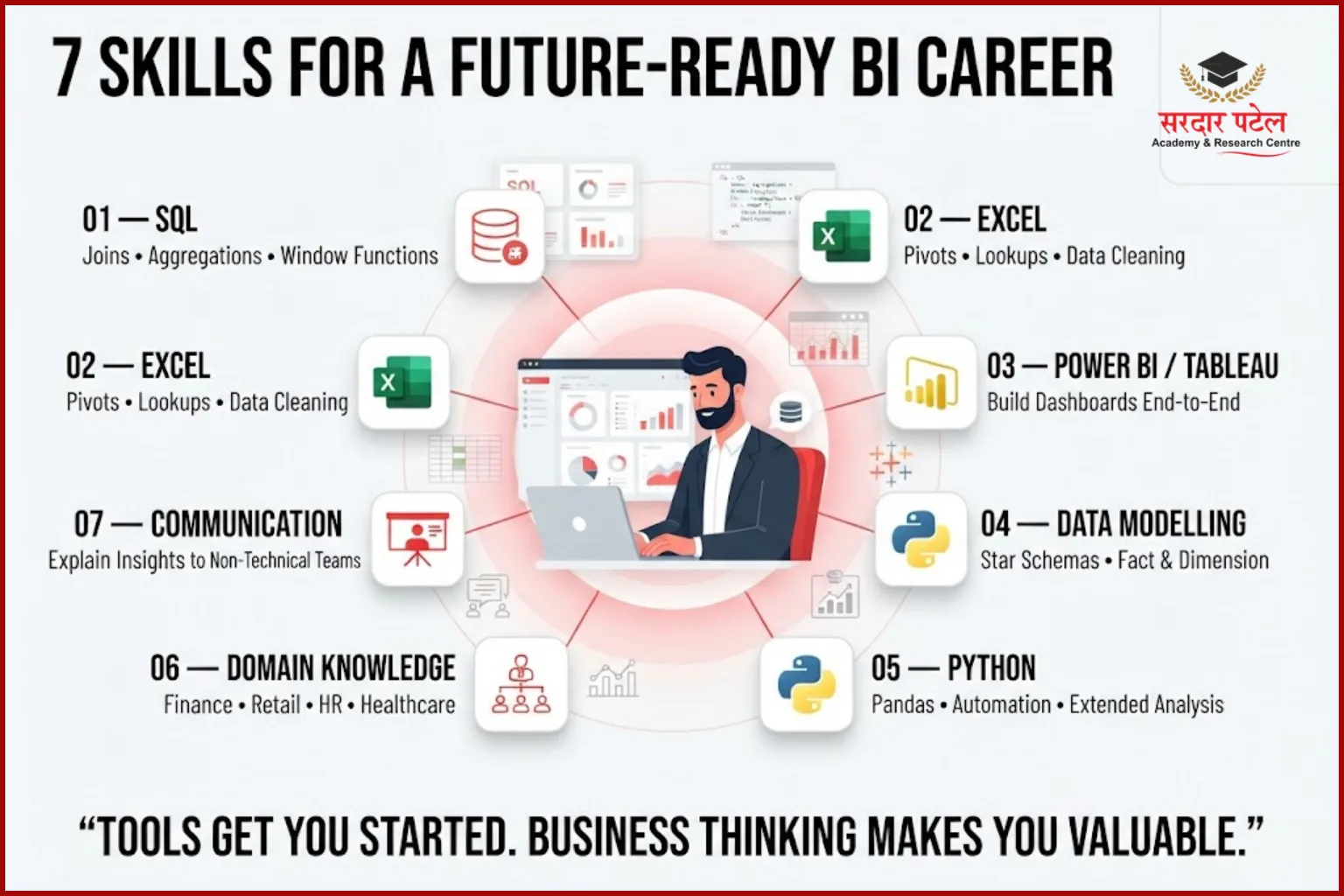
| Skill |
Why it matters |
How to build it |
| SQL |
Most BI roles need direct data access |
Practise joins, aggregations, window functions |
| Excel |
Still the everyday language of business teams |
Pivot tables, lookups, data cleaning |
| One BI tool (Power BI or Tableau) |
Turns analysis into something others can use |
Build dashboards end to end |
| Data modelling |
Keeps reports fast, accurate, and reusable |
Learn star schemas, fact and dimension tables |
| Python basics |
Automates cleaning and extends analysis |
Start with pandas |
| Domain knowledge |
Helps you ask better questions |
Pick one sector and study its metrics |
| Communication |
Gets insights acted on |
Present findings to a non-technical person |
Data modelling deserves extra attention. A good grounding in how a data warehouse is structured helps you build reports that stay accurate as data grows.
Here is why that matters. Imagine a dashboard showing more orders than the finance team's figure. A common cause is a join that duplicates rows, so one order is counted twice. The chart looks perfect, and the number is wrong. Someone who understands data modelling finds this quickly; someone who only knows drag-and-drop may never notice.
Not sure whether to learn Python now or later? This breakdown of SQL vs Python for analytics careers explains where each fits. For most BI roles, SQL comes first.
Step-by-Step Roadmap to Build a BI Career
Here is a practical route into the business intelligence career future, built on skills rather than tool certificates.
- Learn SQL properly. Aim for comfort with joins, subqueries, and aggregations on real, messy tables.
- Pick one BI tool and go deep. Power BI and Tableau both work. The Power BI overview from Microsoft is a sensible starting point.
- Understand data modelling. Learn why a dashboard slows down or shows wrong totals.
- Build projects that look like real work. Choose a messy dataset, define three business questions, build the dashboard, and write a short note on what you would recommend. Need ideas? Browse these data analytics project ideas for students.
- Choose a domain. Retail, finance, HR, or healthcare: pick one and learn its common KPIs.
- Get structured guidance. Self-study works, but feedback, deadlines, and mentors speed things up. Programmes like those at SPARC are one way to get that structure.
- Apply with evidence. Build your resume around business problems you solved, not a list of tools.
Common Mistakes to Avoid
People who misread the business intelligence career future usually fall into one of two traps: panic or complacency. These specific mistakes feed both.
- Collecting tools instead of depth. Knowing five tools shallowly is weaker than knowing one well.
- Building dashboards without a question. Start with the decision, then design the visual.
- Skipping SQL. Relying only on drag-and-drop limits what you can do.
- Copying tutorial projects. Recruiters notice identical portfolios.
- Ignoring data quality. A beautiful dashboard on wrong data is worse than none.
- Treating AI as a threat or a shortcut. Use it as an assistant, and verify what it produces.
Where a BI Career Can Lead
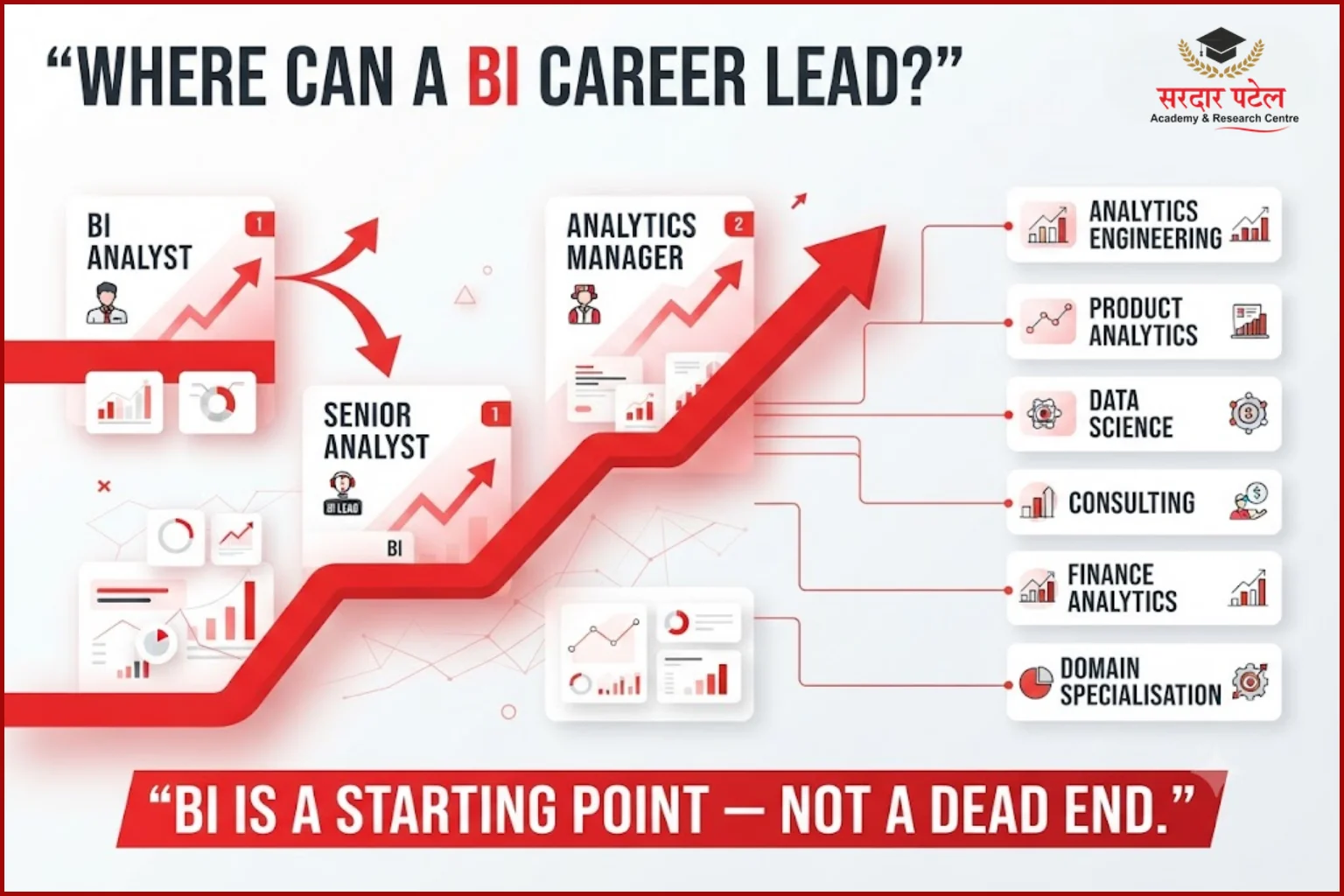
BI is a strong starting point, not a dead end. A typical vertical path runs from BI analyst to senior analyst, then BI lead, then analytics manager. Sideways moves are just as common: analytics engineering, product analytics, data science, consulting, or a domain specialism such as finance analytics.
That flexibility is a quiet strength of the business intelligence career future. If you lean toward the management side, a business analytics course can add the strategy and decision-making layer.
Conclusion
The business intelligence career future is not about whether dashboards survive. It is about whether you can turn data into decisions people trust. Tools will keep changing. SQL, data modelling, domain understanding, and clear communication will keep earning their place.
If you are ready to act, start with one dataset and one real business question this week. When you want structured, project-based guidance, explore the data analytics course and build your BI career step by step.
FAQs
Yes, for people who combine SQL, a BI tool, business understanding, and communication. The business intelligence career future is promising for those who go beyond building charts.
AI is reshaping the business intelligence career future, but it cannot own business context, data trust, or recommendations. Roles will change more than they disappear.
Expect higher entry expectations, more hybrid analyst roles, and strong demand for domain knowledge. Freshers who show real projects stand out from those who only list courses.
SQL, Excel, and one BI tool. Add data modelling and Python basics once those feel comfortable.
BI focuses on reporting, monitoring and decision support, while data science leans toward modelling and prediction. Many professionals start in BI and move across later.